Rank tracking used to mean one thing: where does your page appear in Google’s results. In 2026, it means two things. Google still handles the majority of search traffic, but ChatGPT, Perplexity, and Google AI Overviews now answer millions of queries that used to land on your site directly — without ever showing your URL.
The best rank tracker depends on which problem you’re solving. Optimizing for Google positions requires keyword-level accuracy, local tracking, and SERP feature monitoring. Appearing in AI search answers requires prompt-based tracking, citation analysis, and share of voice across AI platforms. Many teams now need both — and no single tool handles both well.
This guide covers 15 tools that handle one or both, with honest assessments of what each does well and where it falls short.
The 15 best rank tracking tools
| Tool | Type | Starting Price | Best For | Free Trial |
|---|---|---|---|---|
| Semrush | SEO | $139.95/mo | Full SEO suite | 7 days |
| Ahrefs | SEO + AI | $129/mo | SEO + Brand Radar for AI | No |
| SE Ranking | SEO | $65/mo | Agencies, white-label reporting | 14 days |
| Nightwatch | SEO | $39/mo | Most accurate local/global tracking | Yes |
| AccuRanker | SEO | $129/mo | Enterprise keyword volumes | Yes |
| Mangools | SEO | $49/mo | Budget SEO suite | 10 days |
| SE PowerSuite | SEO | Free–$29.10/mo | Desktop-based, free tier | Free tier |
| Wincher | SEO | $49/mo | Clean, affordable keyword tracking | 14 days |
| Google Search Console | SEO | Free | First-party Google data | N/A |
| Airefs | AI Search | $24/mo | AEO tracking for startups and SMBs | 7 days |
| Peec AI | AI Search | $89/mo | Enterprise AI visibility, 115+ languages | 14 days |
| Profound | AI Search | $99/mo | Enterprise AEO with content generation | Yes |
| Promptwatch | AI Search | $99/mo | 10-platform AI tracking | 7 days |
| Cognizo | AI Search | $89/mo | AEO monitoring + content creation | No |
| Otterly AI | AI Search | $19/mo | Budget AEO entry point | Yes |
SEO rank tracking tools
SEO rank trackers measure keyword positions in Google and sometimes Bing. They’re well-established with years of data behind them. The main differentiators are accuracy, scale, local tracking depth, and whether rank tracking is a standalone product or part of a broader SEO suite.
1. Semrush: Best full-suite SEO rank tracker
Semrush has 4.5/5 on G2 from 2,620+ reviews and tracks positions across a database of 25 billion keywords in 190 countries. Rank tracking is one part of a much larger toolset covering backlinks, site audits, content optimization, and paid search intelligence.
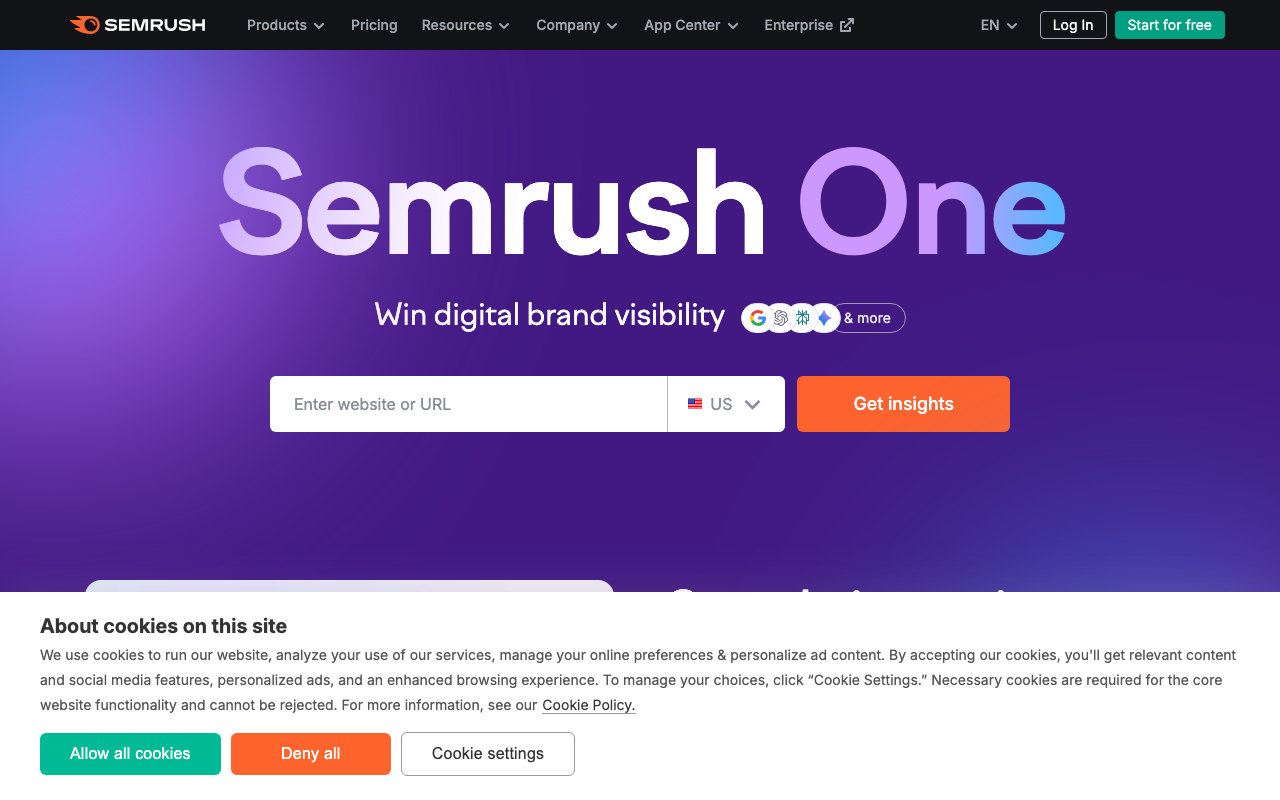
The downside is cost and keyword limits. The Pro plan ($139.95/mo) covers 5 projects and 500 keywords — which agencies exhaust quickly. Guru ($249.95/mo) adds historical data and content marketing tools.
Key features:
- Position tracking in 190 countries with local and mobile data
- Competitor keyword gap analysis
- Site audit, backlink analysis, and content tools in one platform
- SERP feature tracking (Featured Snippets, Local Packs, Knowledge Panels)
- Keyword cannibalization detection
Pricing: $139.95–$499.95/mo, 7-day free trial
Pros:
- Most comprehensive SEO suite in the market
- 25B+ keyword database with accurate local and mobile tracking
- Strong competitor analysis and backlink data alongside rank tracking
Cons:
- Higher entry price than standalone rank trackers
- Keyword limits require upgrading for agency-scale work
- AI visibility tracking is minimal compared to dedicated AEO tools
2. Ahrefs: Best SEO tracker with an AI visibility layer
Ahrefs combines traditional keyword rank tracking — with one of the strongest backlink databases in the industry — with Brand Radar, a dedicated AI visibility module covering ChatGPT, Perplexity, Gemini, and Copilot.
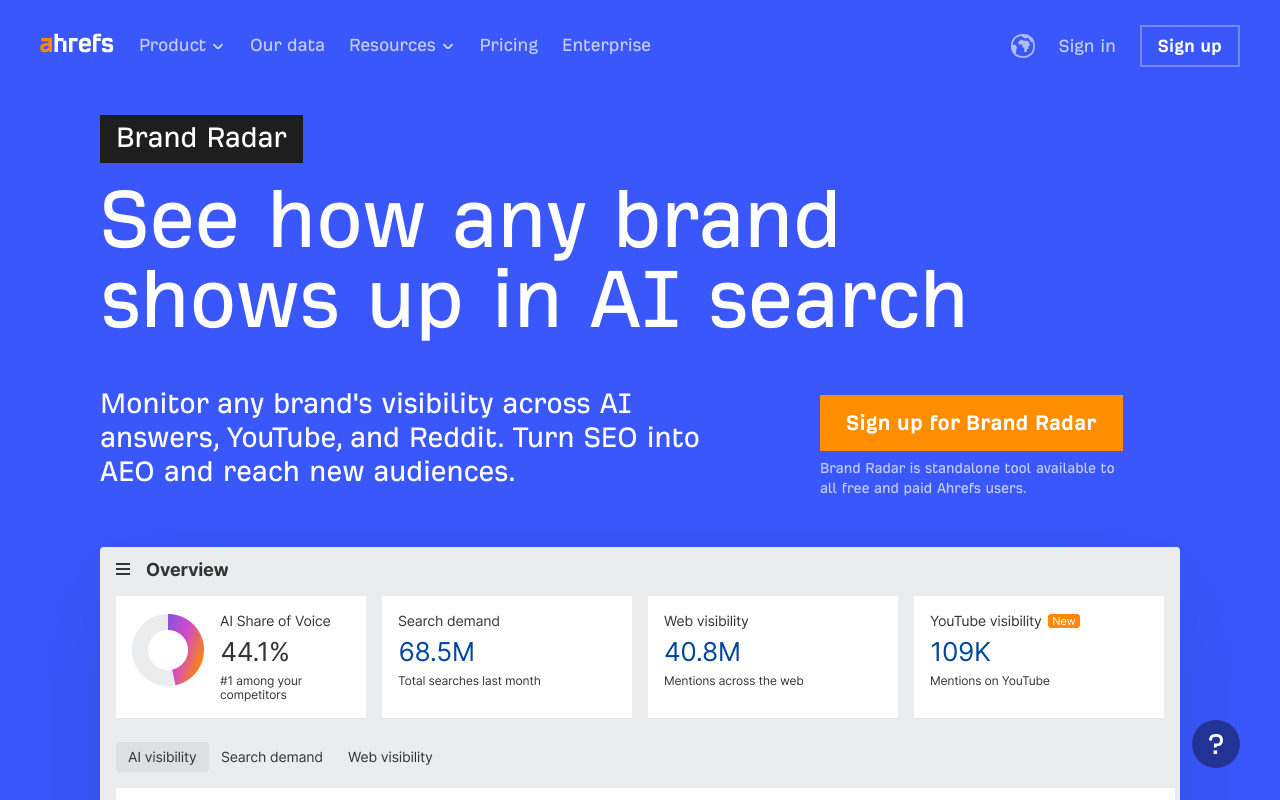
Brand Radar uses 253M+ monthly prompts derived from real search behavior. That’s the largest prompt dataset in the category. The accuracy concerns are documented though: independent testing in early 2026 found one reviewer reporting 3 ChatGPT mentions via Ahrefs vs 123 when checked manually — a 97% gap.
The pricing structure is layered. Brand Radar requires an Ahrefs base plan (from $129/mo) plus EUR 179/mo per AI index, or EUR 654/mo for all 6 indexes. Full AI coverage costs ~EUR 773/mo minimum.
Key features:
- Keyword rank tracking in Google, Bing, and YouTube
- 253M+ monthly prompt database for AI visibility tracking
- Cited domains and pages — which sources AI cites when mentioning your brand
- Industry segmentation for multi-product companies
- Full integration with Ahrefs Site Explorer and Keywords Explorer
Pricing: $129/mo (Ahrefs base) + EUR 179–654/mo for Brand Radar
Pros:
- Only tool combining SEO keyword tracking with AI visibility in one platform
- Largest AI prompt database in the category
- Strong historical data and backlink integration
Cons:
- EUR 773/mo minimum for full AI coverage
- Documented accuracy issues with AI tracking (97% undercounting in one independent test)
- Keyword-based AI tracking is poorly matched to how people interact with conversational AI
3. SE Ranking: Best SEO rank tracker for agencies
SE Ranking covers rank tracking across Google, Bing, Yahoo, and YouTube, with local and mobile tracking, competitor analysis, and white-label reporting. The $65/mo Essential plan includes 750 keywords — better keyword volume than Semrush’s 500-keyword Pro plan at more than twice the price.
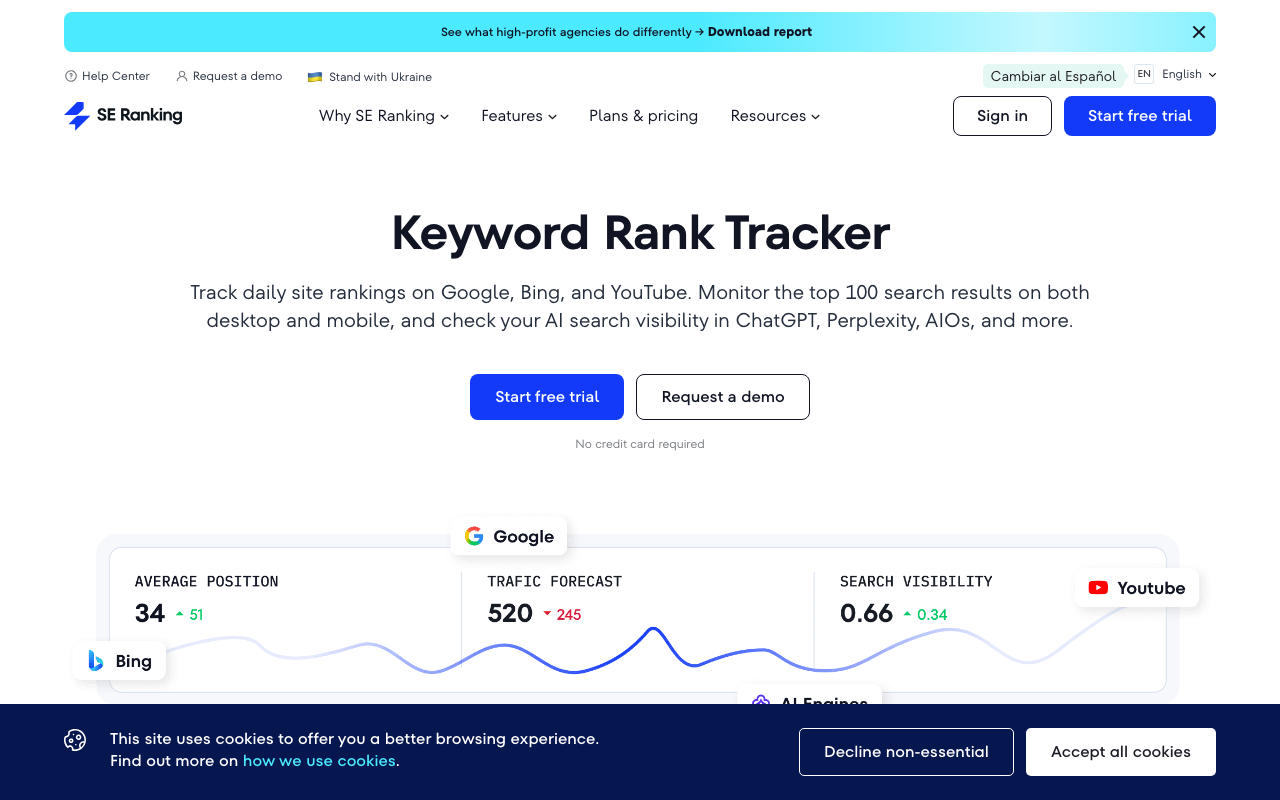
It’s built with agency workflows in mind: white-label dashboards, bulk client management, and configurable reporting on daily, weekly, or monthly schedules.
Key features:
- Rank tracking across Google, Bing, Yahoo, and YouTube
- Local and mobile position tracking
- White-label dashboards and client management
- Competitor keyword and visibility tracking
- On-page SEO checker and backlink monitoring
Pricing: $65–$259/mo, 14-day free trial
Pros:
- Better keyword-per-dollar value than Semrush
- White-label reporting and bulk client management built in
- Strong local and mobile tracking
Cons:
- Backlink database is smaller than Ahrefs or Semrush
- No meaningful AI visibility tracking
4. Nightwatch: Best SEO rank tracker for accuracy
Nightwatch holds a 4.9/5 rating on G2 — the highest accuracy rating in this comparison. It tracks Google positions down to city-level granularity, which matters for local businesses or campaigns where geo-specific rankings drive decisions. Google, Uber, and Tripadvisor use it for localized rank tracking.
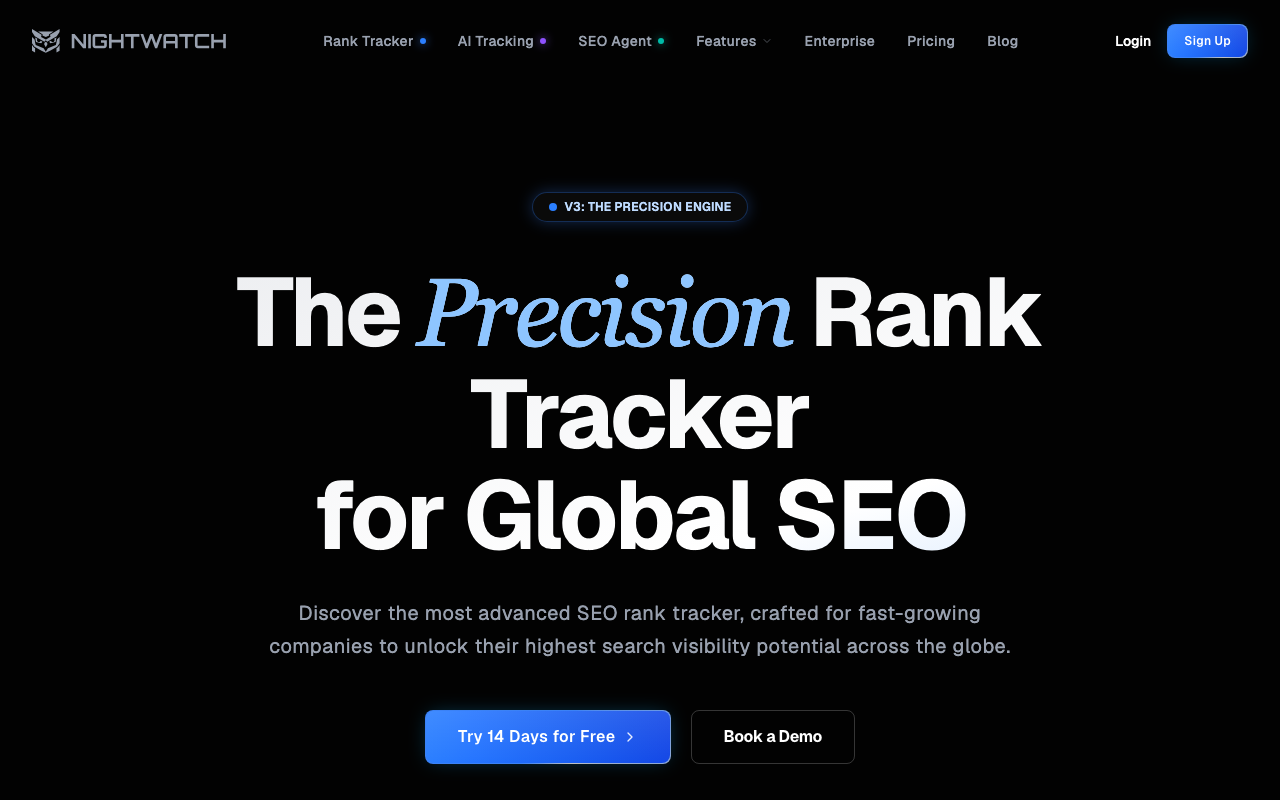
The platform focuses on rank tracking rather than bundling in a broader SEO suite. That focus shows in the data quality.
Key features:
- City-level local rank tracking
- Daily rank updates with on-demand checking
- Competitor tracking and share of voice reporting
- SERP feature monitoring
- API access on higher plans
Pricing: Starting at $39/mo, free trial available
Pros:
- Highest G2 accuracy rating in this comparison (4.9/5)
- City-level local tracking for geo-specific campaigns
- Lower starting price than Semrush or Ahrefs
Cons:
- No backlink analysis, site audit, or broader SEO toolset
- Smaller keyword database than the full-suite options
- No AI visibility tracking
5. AccuRanker: Best SEO rank tracker for enterprise keyword volumes
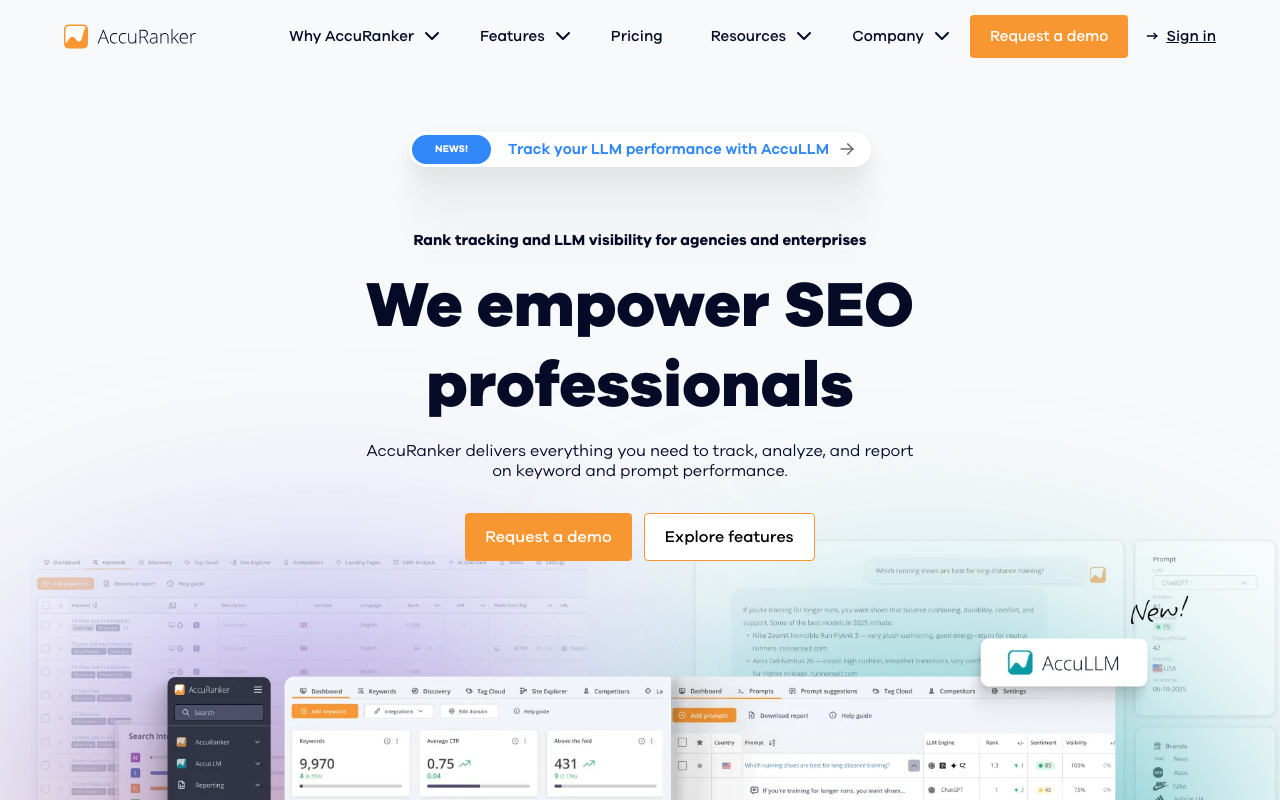
AccuRanker handles 10,000+ keywords per client at enterprise scale. On-demand rank checks process within hours — faster than most competitors’ daily cycles. Integration support is strong: connects to Google Analytics, Google Search Console, and BI tools for custom reporting.
Key features:
- On-demand rank checking — updates within hours, not days
- GA4 and GSC integration for traffic correlation
- Competitor share of voice tracking at scale
- Grump feature: instant rank updates across all tracked keywords
- API access for custom reporting pipelines
Pricing: Starting at $129/mo for 1,000 keywords; enterprise custom
Pros:
- On-demand rank checking for same-day accuracy
- Strong GA4, GSC, and BI tool integrations
- Handles very high keyword volumes without performance issues
Cons:
- More expensive than Nightwatch or SE Ranking for equivalent keyword volume
- Rank tracking only — no backlink analysis or broader SEO toolset
6. Mangools / SERPWatcher: Best budget SEO suite
Mangools is five SEO tools in one subscription: SERPWatcher (rank tracking), KWFinder (keyword research), SERPChecker (SERP analysis), LinkMiner (backlinks), and SiteProfiler (site analysis). The Basic plan at $49/mo gives access to all five.
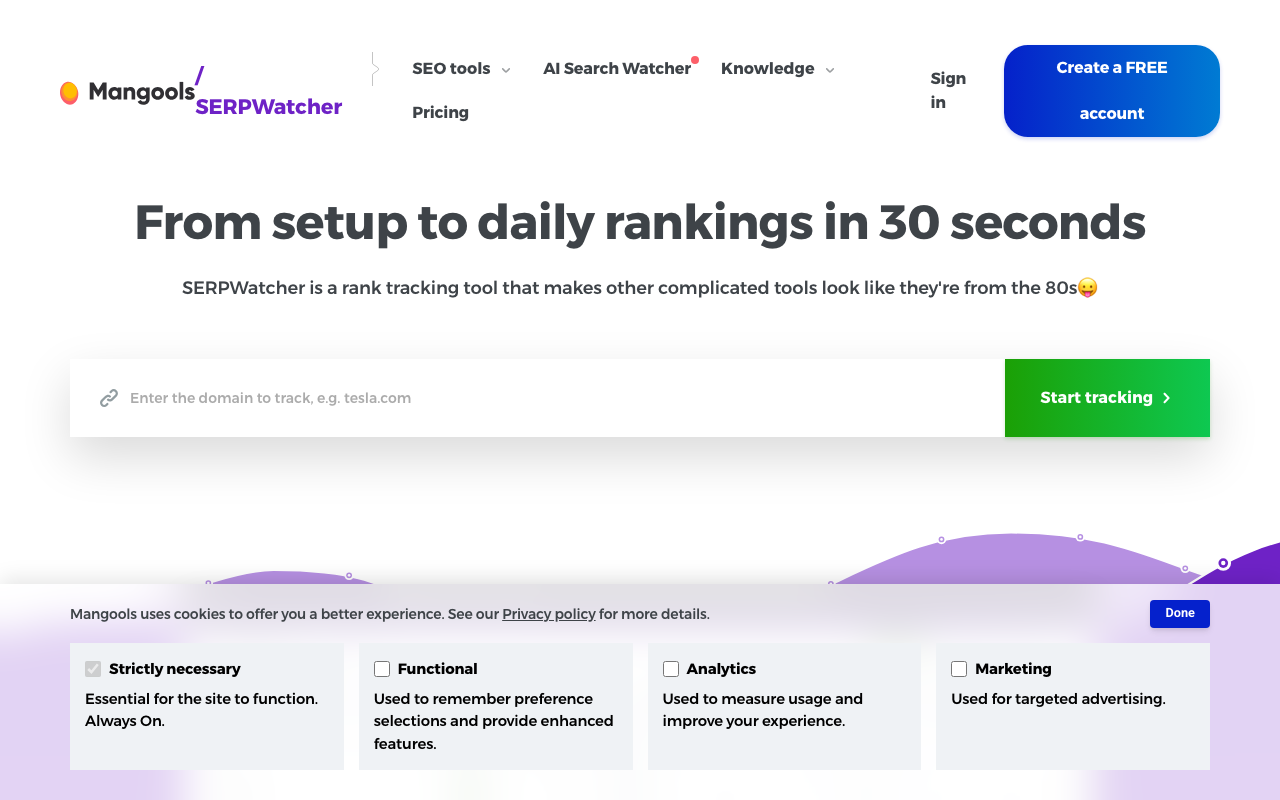
SERPWatcher covers daily rank tracking for up to 200 keywords on the Basic plan. Not built for enterprise scale, but for freelancers and small businesses that want a full SEO toolkit without Semrush prices, the value is clear.
Key features:
- Daily rank tracking with position history
- Dominance Index — a share-of-voice metric unique to SERPWatcher
- Keyword research via KWFinder
- SERP analysis and backlink tools bundled in
- Clean interface accessible to non-specialists
Pricing: $49–$129/mo, 10-day free trial
Pros:
- Five SEO tools for the price of one
- Good value at the $49/mo entry tier
- Accessible interface with a low learning curve
Cons:
- Keyword limits are low for agency-scale work
- Accuracy doesn’t match Nightwatch or AccuRanker
- No AI visibility tracking
7. SE PowerSuite Rank Tracker: Best free-tier SEO rank tracker
SE PowerSuite’s Rank Tracker is desktop software — not cloud-based — which means no per-seat fees and you own the data locally. The free version has no keyword limit, which is genuinely rare. Paid versions ($29.10/mo Professional, $52.50/mo Enterprise) add automated reporting and white-label exports.
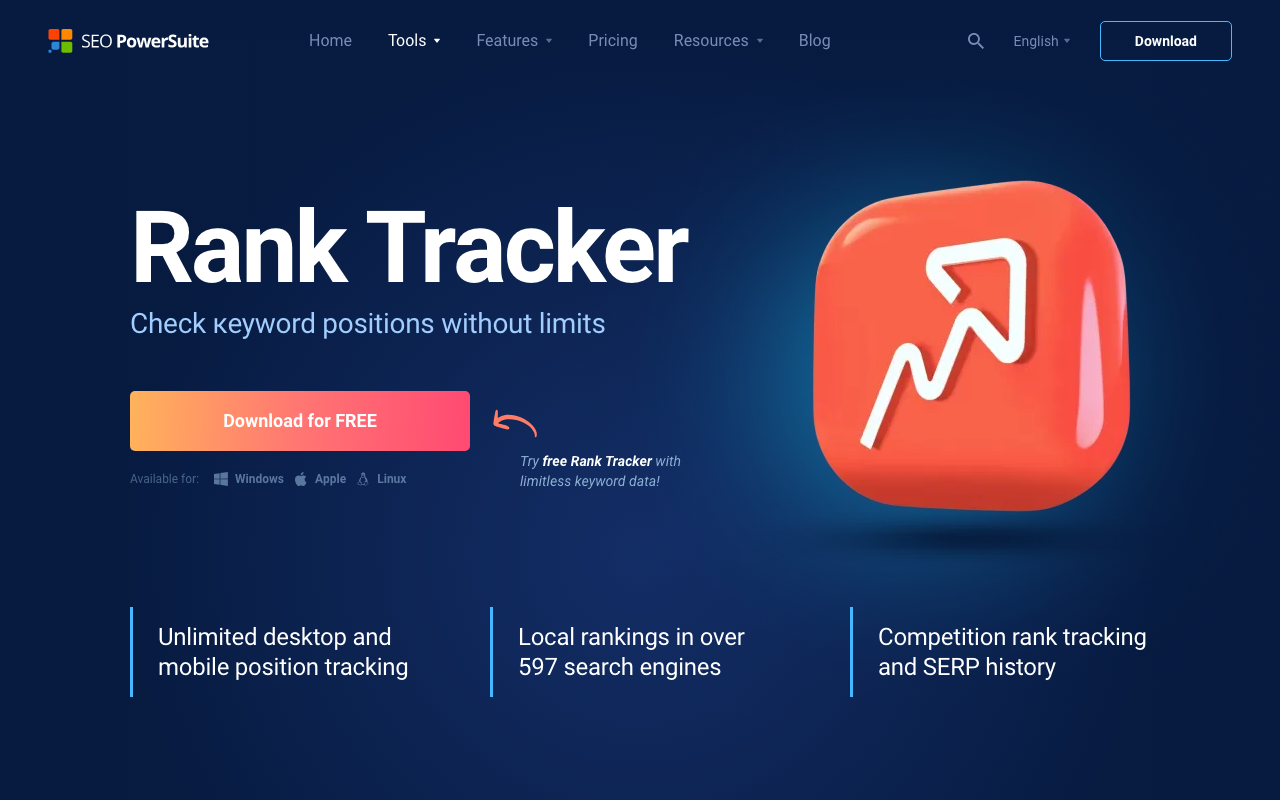
The desktop model limits teams that need cloud access or API integrations. But for solo SEOs with high keyword volumes who don’t want to pay per keyword, the free tier is the strongest option in this comparison.
Key features:
- Unlimited keywords on the free tier
- Tracks rankings across 300+ search engines
- Mobile ranking data and SERP feature detection
- White-label PDF reports on paid plans
- Scheduled automated rank checks
Pricing: Free–$52.50/mo
Pros:
- Unlimited keywords on the free tier
- No subscription required for core tracking
- Mobile ranking and SERP feature tracking included
Cons:
- Desktop-only — no cloud access or mobile app
- Dated interface compared to cloud-based alternatives
- No AI visibility tracking
8. Wincher: Best clean, affordable keyword tracker
Wincher covers Google rank tracking with daily updates, competitor tracking, and on-demand rank checks. At $49/mo, the Starter plan includes 500 keywords, unlimited websites, and Google Search Console integration. It’s consistently cited for having the cleanest interface in this category.
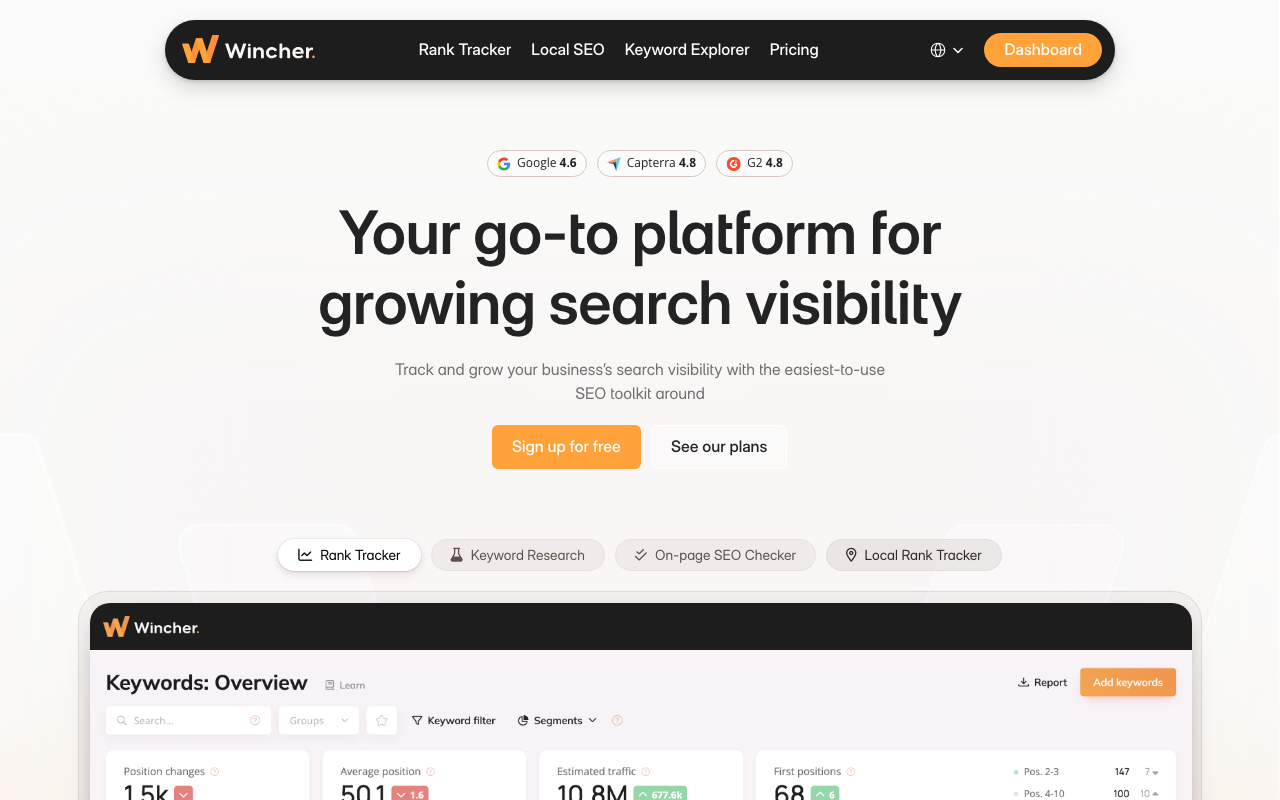
Not built for enterprise scale and doesn’t include backlink analysis or site audits. For startups and SMBs that want straightforward keyword tracking without complexity, it’s one of the better options at this price point.
Key features:
- Daily rank tracking with on-demand checks
- Unlimited websites on all plans
- GSC integration for search performance correlation
- Automated weekly email reports
- Competitor tracking
Pricing: $49–$249/mo, 14-day free trial
Pros:
- Unlimited websites even on the starter plan
- Clean interface with a low learning curve
- GSC integration on all plans
Cons:
- Rank tracking only — no backlink or audit tools
- Local tracking is less granular than Nightwatch
- No AI visibility tracking
9. Google Search Console: Best free rank tracking option
Google Search Console provides the most accurate Google ranking data available because it comes directly from Google. It shows average position, clicks, impressions, and CTR for every query your site appears for, with 16 months of history and no keyword limits.
What it doesn’t do: competitor tracking, rank change alerts, local position tracking, or AI visibility. It’s a data source, not a rank tracking product. But for validating what your paid rank tracker reports, GSC is the ground truth.
Key features:
- First-party Google data — average position, clicks, impressions, CTR
- 16 months of search performance history
- Page-level and query-level filtering
- Index coverage and crawl reports
- Core Web Vitals monitoring
Pricing: Free
Pros:
- First-party data directly from Google — no estimation or sampling
- Free with no keyword limits
- 16 months of historical data
Cons:
- No competitor data
- No automated alerts for ranking changes
- Average position can mask position distribution across pages
- No AI visibility tracking
AI search rank tracking tools
AI search rank trackers measure how often AI platforms cite your brand, which sources they pull from, and how your share of voice compares to competitors. None of them replace SEO rank tracking — they’re measuring a different channel entirely.
10. Airefs: Best AI search rank tracker for startups and SMBs
Airefs tracks your brand’s visibility in AI search — how often ChatGPT, Perplexity, and other AI platforms mention you when users ask questions in your category. The Lite plan starts at $24/mo, making it the most affordable full-featured AEO tracker available.
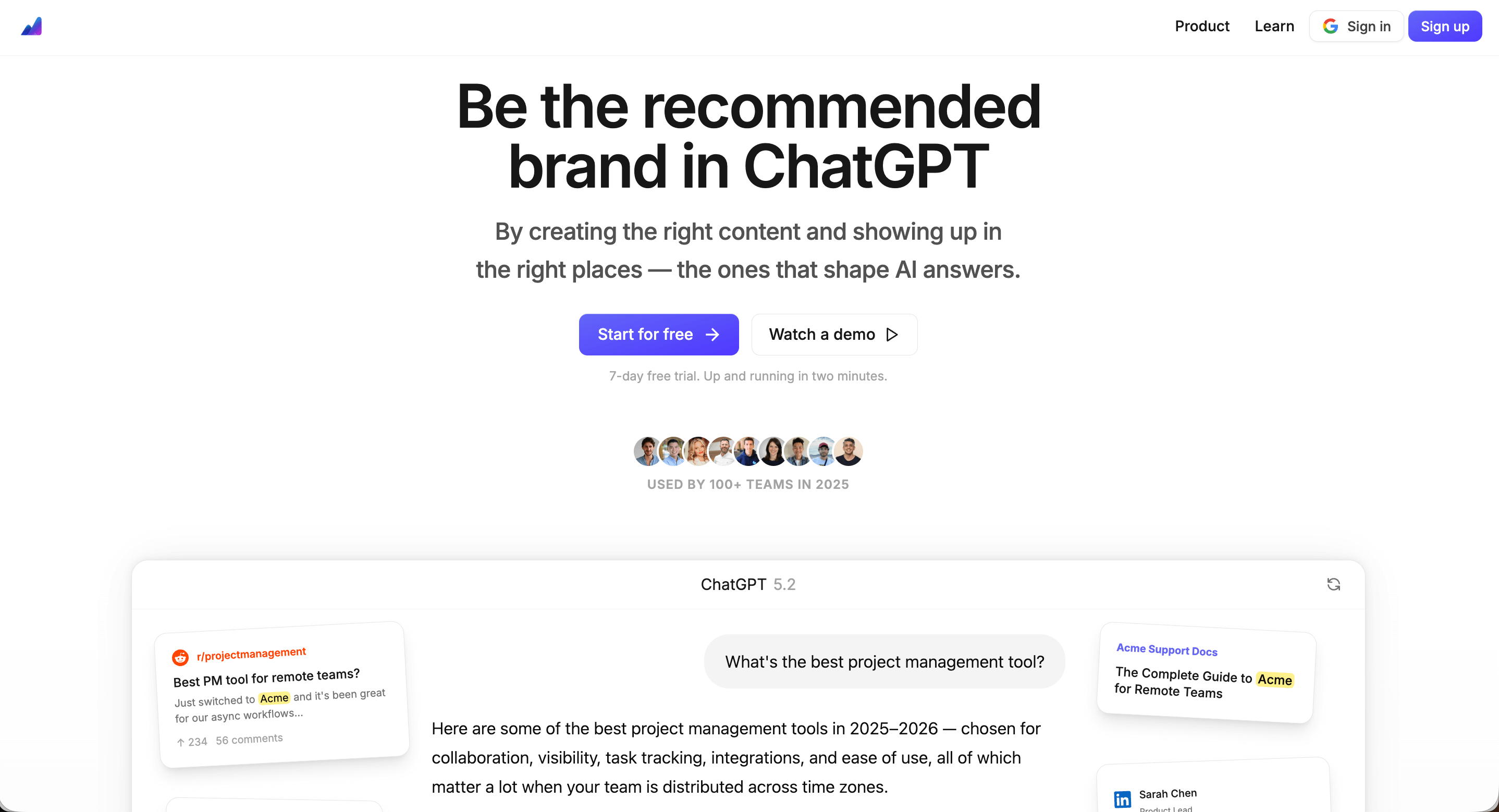
The differentiator is the Reddit layer. Beyond tracking AI citations, Airefs monitors Reddit keyword conversations — the discussions that feed into AI training data and influence which brands AI models recommend over time. Competitors like Profound don’t offer this at any price point. For teams that need more than a dashboard, a done-for-you tier has the team creating content and participating in relevant discussions on your behalf.
Key features:
- ChatGPT-first prompt tracking with Perplexity, Claude, and Gemini available on request
- Competitor citation analysis — which sources competitors rank in that you don’t
- Reddit keyword monitoring, up to 30 keywords depending on plan
- AI Search Analytics tracking real traffic from AI platforms and AI crawler activity
- AEO strategist access on Expert plan and above
- Done-for-you content creation and community participation
Pricing (yearly, 20% discount applied):
- Lite: $24/mo — 1 domain, 3 competitors, 25 prompts, 3 Reddit keywords
- Pro: $49/mo — 3 domains, 5 competitors, 60 prompts, 10 Reddit keywords, 7-day free trial
- Expert: $83/mo — Unlimited domains, 10 competitors, 150 prompts, 30 Reddit keywords, AEO strategist
- Done-for-you: $299/mo+ — Monthly strategy calls, content creation, discussion participation
Pros:
- Lowest cost entry for AEO tracking at $24/mo
- Reddit monitoring has no equivalent in any other AEO tool
- Transparent pricing with a free trial — no sales call required
- Done-for-you tier converts tracking insights into actual content and community work
Cons:
- Doesn’t track traditional Google keyword rankings — AI search only
- Smaller prompt volume data than Profound at equivalent price tiers
- Less brand recognition than Profound or Peec AI
The AI Search audit gave us visibility into how we perform against competitors, LLM sentiment analysis and insights into our ChatGPT traffic.
— Alex C, Brand Director, Hassell
11. Peec AI: Best AI search rank tracker for enterprise accuracy
Peec AI launched in early 2025, hit EUR 650K ARR within four months, and closed a $21M Series A by November. Customers include Wix (5x year-over-year increase in LLM traffic), Merge (5x increase in LLM-driven demo requests), and Glide (blog posts appearing in ChatGPT and Perplexity within 24 hours of publishing).
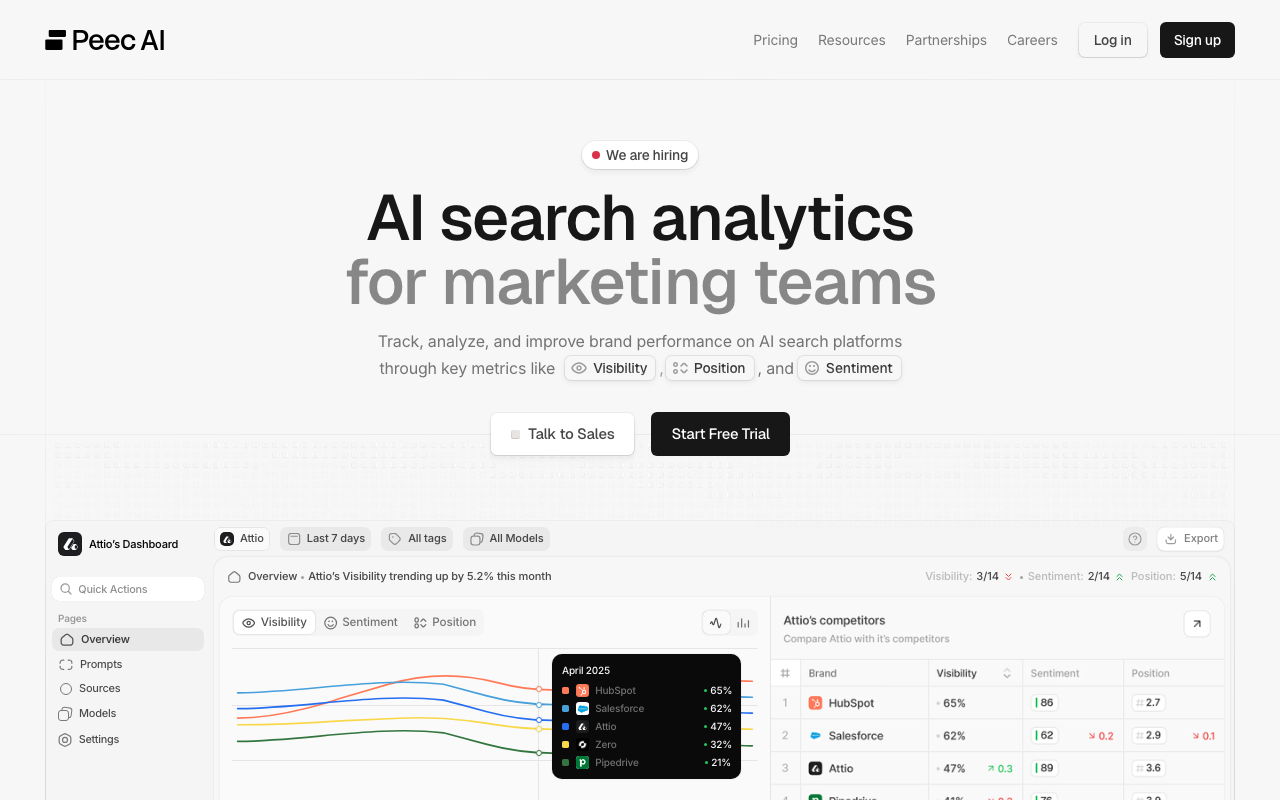
The technical differentiator is UI scraping rather than API calls. Peec simulates actual user interactions, capturing what real users see — not what an API returns, which can differ meaningfully from the live UI response. Peec also supports 115+ languages, making it the strongest option for global brands or non-English markets.
Key features:
- UI scraping for real-world response accuracy
- 115+ language support — broadest in the AEO category
- Visibility percentage across ChatGPT, Perplexity, and AI Overviews
- Competitor benchmarking with regional breakdowns
- Sentiment analysis (positive, neutral, negative)
- Daily tracking on all plans
Pricing:
- Starting at $89/mo with 14-day free trial
- Additional AI platforms (Claude, Gemini, DeepSeek, Grok): EUR 20–30/mo each
- Enterprise: custom pricing
Pros:
- UI scraping produces more accurate results than API-based tracking
- 14-day free trial is longer than most competitors
- $30M+ in funding with enterprise case studies that back up the claims
Cons:
- No content generation — monitoring only
- Add-on pricing for additional AI platforms can significantly increase cost beyond the base price
- No GA4 or GSC integrations
Peec allows us to pinpoint the exact types of content that are surfaced in specific LLMs.
— Crystal Carter, Head of SEO Comms, Wix
12. Profound: Best AI search rank tracker for enterprise teams
Profound raised $58.5M from Sequoia and holds G2 Leader status for the AEO category (Winter 2026). Customers include MongoDB, Ramp, and Figma. It’s the most funded and most enterprise-validated AEO platform available.
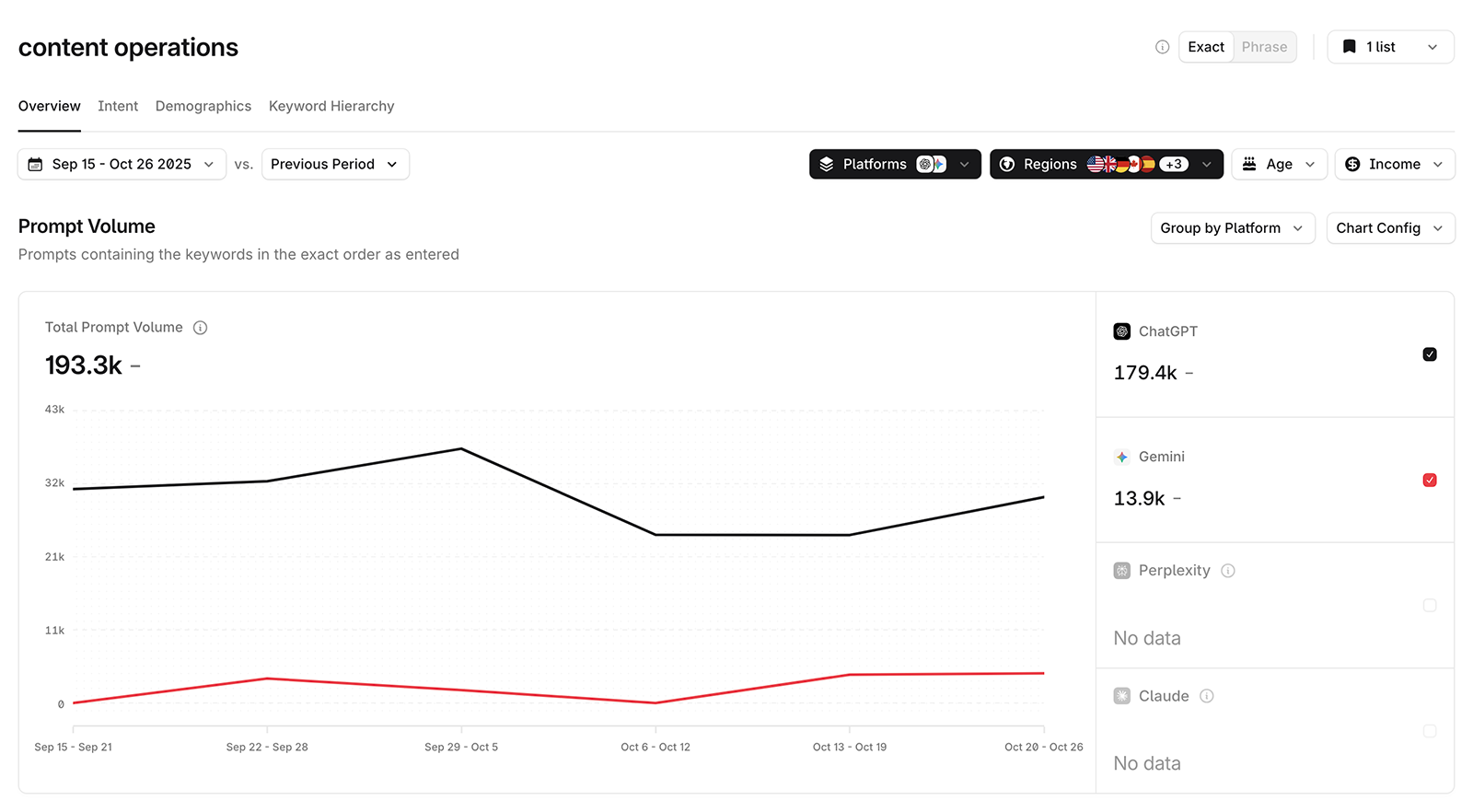
The platform covers 10+ AI platforms with daily proprietary crawler tracking, plus Agents — an AI-powered content generation feature built into the Growth plan. At $399/mo, it’s a complete AEO stack: track, diagnose, and create content. The pricing gap is real though: the Starter plan ($99/mo) is limited to ChatGPT with 50 prompts — less than Airefs Pro at $49/mo.
Key features:
- 10+ AI platform tracking with proprietary daily crawler
- Prompt volume data — search demand behind your category queries
- Agents: AI-powered AEO content generation (Growth plan and above)
- Citation domain and page analysis
- Share of voice benchmarking against competitors
Pricing:
- Starter: $99/mo — ChatGPT only, 50 prompts
- Growth: $399/mo — 10+ platforms, Agents content generation
- Enterprise: Custom
Pros:
- G2 Winter 2026 Leader — strongest market validation in the AEO category
- $58.5M Sequoia backing with a genuine enterprise customer base
- Agents content generation built into the Growth plan
Cons:
- Starter plan is the weakest per-dollar entry in this comparison
- Full functionality requires $399/mo
- No Reddit monitoring at any price point
13. Promptwatch: Best AI search rank tracker for platform breadth
Profound’s Growth plan ($399/mo) is where 10-platform coverage begins. Promptwatch’s Growth plan ($249/mo) covers 10 platforms from day one — including Mistral and Meta AI that Profound doesn’t track.
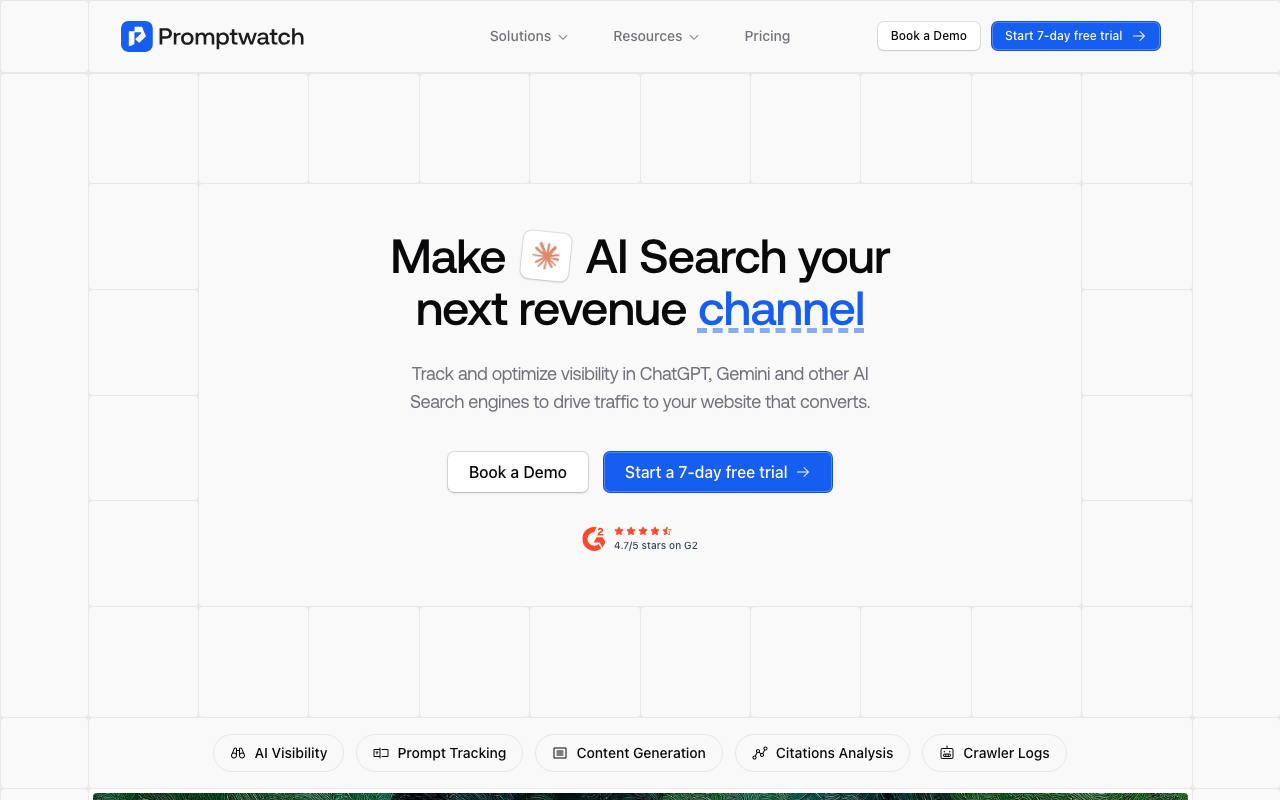
The dataset behind Promptwatch is 1.11 billion citations, clicks, and prompts across 6,900+ brands. That scale provides reliable benchmarking; you’re not interpreting your numbers in isolation.
Key features:
- 10-platform tracking: ChatGPT, Gemini, Claude, Perplexity, Grok, Copilot, DeepSeek, AI Overviews, Mistral, Meta AI
- Reddit and YouTube tracking alongside AI platforms
- Crawler logs — real-time AI bot monitoring for your site
- ChatGPT Shopping data — product recommendation tracking
- Free agency prospecting tools: AI Brand Visibility Report, GEO Glossary
Pricing:
- Starter: $99/mo
- Growth: $249/mo
- Business: $579/mo
- 7-day free trial
Pros:
- 10-platform AEO coverage at $249/mo vs Profound’s $399/mo — $150/mo cheaper for equivalent breadth
- 1.11 billion data points for reliable category benchmarking
- Reddit and YouTube extend monitoring beyond AI answer engines
- Free prospecting tools are useful for agencies
Cons:
- No GA4 or GSC integrations
- Starter plan feature details not publicly disclosed
- Amsterdam-based support may create timezone friction for US teams
14. Cognizo: Best AI search rank tracker for teams combining monitoring and content
Cognizo adds something most AEO tools don’t: bot-to-human attribution. It tracks how AI crawler activity converts to actual human traffic — a meaningful capability for teams building internal ROI cases for AEO investment.
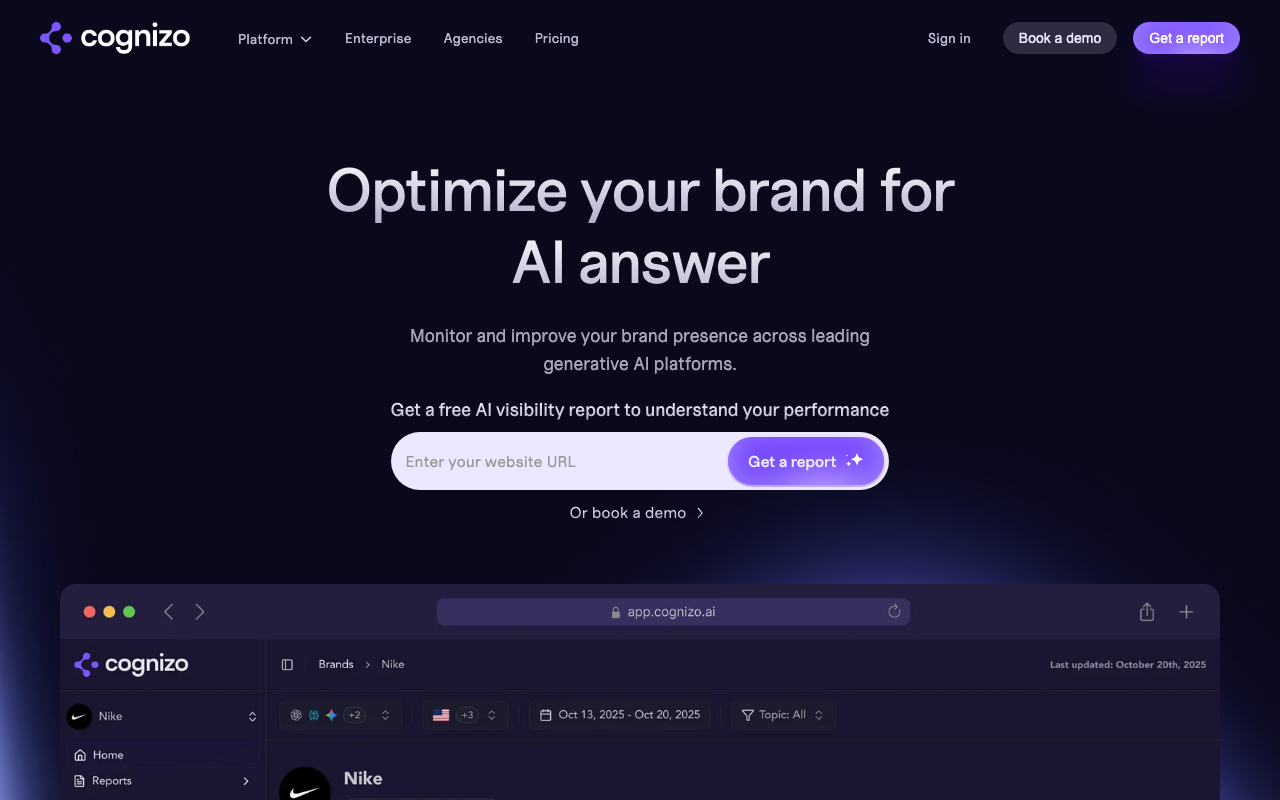
Starting at $89/mo, it combines monitoring, content briefs, technical audits for LLM crawlability, and automated content creation. Profound requires $399/mo for equivalent scope.
Key features:
- AI visibility monitoring across 10 platforms including Meta AI and DeepSeek
- Bot-to-human attribution — unique in the AEO category
- AI-powered content briefs based on citation gap analysis
- Technical audits identifying LLM crawlability barriers
- Automated content creation and revision workflows
- Phone and online support
Pricing: Starting at $89/mo (full plan details require contact)
Pros:
- Monitoring + content briefs + content creation in one workflow
- Bot-to-human attribution makes AEO ROI measurable internally
- Phone support is more accessible than most software-only tools
Cons:
- No named customer case studies or public testimonials
- Full pricing requires a sales conversation
- No G2 presence or third-party category recognition
15. Otterly AI: Best budget entry point for AI search tracking
Otterly AI is the lowest-cost entry into AEO tracking at $19/mo. It covers ChatGPT and Perplexity with brand mention tracking and basic sentiment analysis — enough for teams that want visibility data before committing to a larger platform.
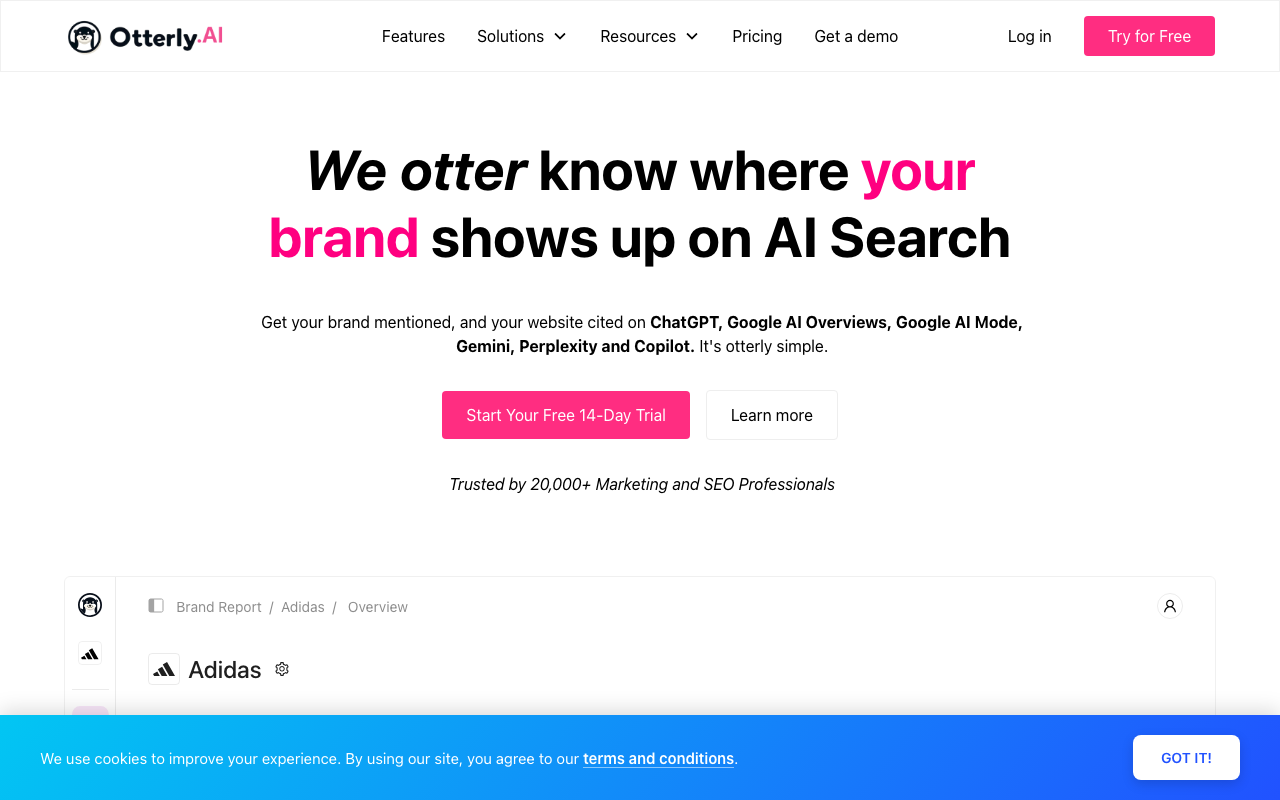
Feature depth is limited compared to Airefs or Peec AI. No Reddit monitoring, no done-for-you option, no competitor citation analysis. But at $19/mo, it’s the cheapest way to confirm whether AI platforms are mentioning your brand.
Pricing: Starting at $19/mo, free trial available
Pros:
- Lowest entry price in this comparison for AI search tracking
- Simple to set up and interpret
- Good starting point before committing to a larger AEO platform
Cons:
- Limited feature depth compared to mid-tier AEO tools
- No Reddit monitoring or competitor citation analysis
- No content creation or strategy support
How to choose the right rank tracking tool
The first question is which channel you’re tracking. SEO rank tracking and AI search visibility tracking require different tools — there’s no meaningful overlap between them.
If you need both, start with your primary revenue channel. For most teams today, that’s still Google. Run a dedicated SEO tracker for keyword positions, then layer in an AEO tool once you have evidence that AI platforms are sending meaningful traffic — whether from signup source data, GSC referral data, or crawler log activity.
For SEO tracking: The main trade-off is breadth vs. precision. Semrush and Ahrefs give you the full SEO toolset in one platform; Nightwatch and AccuRanker give you more accurate rank data as dedicated trackers. SE Ranking is the strongest value for agencies that need white-label reporting. SE PowerSuite is the only meaningful free option.
For AI search tracking: Cost of entry ranges from $19/mo (Otterly AI) to $399/mo (Profound Growth). Airefs is the strongest all-around option under $100/mo, combining prompt tracking, Reddit monitoring, and competitor citation analysis. Peec AI is better for global teams or where UI scraping accuracy is critical. Profound is the right choice for enterprise teams that need content generation built into their AEO workflow.
Frequently asked questions
What’s the difference between SEO rank tracking and AI search rank tracking?
SEO rank tracking measures where your pages appear in Google’s results for specific keywords. AI search rank tracking measures how often AI platforms cite your brand when answering user questions. They’re measuring different channels. A brand ranked #8 on Google for a keyword might be recommended first by ChatGPT on the same query — or completely absent. You need different tools for each.
Can one tool handle both SEO and AI search rank tracking?
Ahrefs comes closest, combining traditional keyword tracking with Brand Radar for AI visibility. The trade-off is cost (EUR 773/mo minimum for full AI coverage) and documented accuracy concerns with the AI layer. Most teams find it more practical to run a dedicated SEO tracker alongside a dedicated AEO tool than to pay for Ahrefs at full AI coverage.
How accurate is AI rank tracking?
Accuracy varies by methodology. UI scraping tools (Peec AI) capture what users actually see — the same response a real user gets. API-based tools query the AI model directly, which can differ from what the live UI returns. Keyword-based AI tracking (Ahrefs Brand Radar) has been found to significantly undercount mentions in independent tests. Prompt-based tools (Airefs, Profound, Promptwatch) are generally more reliable for conversational query tracking.
What’s the best free rank tracking tool?
Google Search Console is the most accurate free SEO option — first-party Google data, no keyword limits, 16 months of history. SE PowerSuite’s Rank Tracker adds a free desktop tier with unlimited keywords for teams that need more than GSC provides. For AI search tracking, there’s no meaningful free tier; most tools offer 7–14 day trials.
How many keywords should I track?
Track keywords that map to actual business goals — queries where a ranking change would affect revenue. Most teams over-track on vanity keywords and under-track on high-intent ones. For a focused campaign, 100–300 keywords is usually sufficient. Agencies managing multiple clients need higher limits; that’s where SE Ranking ($65/mo, 750 keywords) or AccuRanker outperform budget options.
Does AI search rank tracking work the same as keyword rank tracking?
No. In SEO, you track a specific URL’s position for a keyword. In AI search, you track whether your brand appears in AI-generated answers when a relevant prompt is run. Position in AI answers isn’t deterministic the way Google rankings are — the same prompt can return different responses. AEO tools handle this by running prompts repeatedly over time and aggregating the results.
Which rank tracking tool is best for local businesses?
For Google local ranking, Nightwatch (city-level granularity, 4.9/5 G2) and SE Ranking (strong local tracking with white-label reporting) are the strongest options. For AI search local tracking, most AEO tools don’t yet offer city-level data — it’s an emerging capability. Peec AI’s regional breakdowns are the most developed in this category.
Want to start tracking your AI search visibility? Try Airefs free for 7 days and see exactly where your brand stands in ChatGPT and Perplexity.
Related reading: