


If you’ve ever heard SEOs talk about Share of Voice (SoV), they’re talking about a metric inside Ahrefs that measures how visible your website is in organic search for a specific list of keywords you’re tracking.
It’s a simple but powerful idea: for the keywords that matter to your business, what percentage of all the clicks are you winning versus everyone else? Think of it like shelf space at a supermarket, but for Google search.
What Share of Voice Really Means for Your Business
Picture that crowded supermarket aisle again. Every brand wants to be at eye level, right where shoppers are most likely to look. That’s exactly what Share of Voice is for SEO—it tells you how much prime real estate you own when people search for the things you sell. A bigger SoV means more eyeballs, period.
This isn’t just some vanity metric anymore; it’s a gut check on your market authority. It helps you answer the really important questions:
- Are our SEO efforts actually moving the needle and getting us more attention?
- Which competitors are sneaking up on us and stealing traffic?
- How much of the conversation around our core services do we actually own?
Why It’s Getting More Important in an AI World
The Ahrefs Share of Voice metric is becoming even more critical now that AI is baked into search. When tools like Google’s AI Overviews or ChatGPT generate an answer, they pull from sources they see as established, visible, and authoritative.
Having a high SoV is a massive signal that your brand is a key player. It makes it far more likely that you’ll be cited as a source in those AI-generated answers. This isn’t just about ranking anymore; it’s about becoming the default answer.
A strong Share of Voice often acts as a leading indicator of market share. When your online visibility climbs, it’s usually a sign that brand recognition and revenue are about to follow. It draws a straight line from SEO work to business results.
This isn’t just a theory. The data backs it up. In the B2B SaaS world, for instance, companies with an organic SoV over 20% have been found to grow 28% faster than their competitors year-over-year. According to a 2021 study by Gartner, brands that have a higher share of voice than their market share tend to grow, while those with a lower share of voice tend to shrink.
Of course, to measure this accurately, you first need to know who you’re even competing against. Our guide on how to find competitors of a website walks you through that process step-by-step.
How Ahrefs Calculates Your Market Visibility
Think of every keyword you track as a pie representing all the potential clicks up for grabs. Your Share of Voice is simply the size of your slice of that pie.
Ahrefs figures this out by looking at two simple things for each keyword: its monthly search volume and the estimated click-through rate (CTR) for your specific ranking position.
So, if a keyword gets 1,000 searches a month and your #1 spot earns an estimated 30% of clicks, you’re likely capturing around 300 of those visits. Ahrefs does this math for every single keyword you’re tracking, adds it all up, and then shows you what percentage of the total possible traffic you’re winning.
This is how visibility, powered by SEO data, translates directly into market authority.
It’s a straightforward process: your brand uses SEO to build visibility, which ultimately carves out a stronger position in the market.
The Data Behind the Clicks
The real magic behind this metric is Ahrefs’ sophisticated CTR model. Instead of relying on generic averages, Ahrefs crunches massive amounts of real clickstream data. This is crucial because it allows the model to adapt to the messy reality of modern search results.
For instance, the CTR for a #1 ranking isn’t a fixed number. It changes dramatically depending on what else is on the page. In fact, research from Backlinko shows that the #1 organic result on Google gets an average CTR of 27.6%. However, the presence of SERP features can significantly alter this. The model is smart enough to adjust for attention-grabbing SERP features that push organic results down, like:
- Featured snippets that give away the answer.
- Ad carrols that dominate the top of the page.
- “People Also Ask” boxes that hijack a user’s attention.
This context-aware approach gives you a far more realistic picture of the traffic you’re actually getting, not just what you could be getting.
Adding a Dollar Value to Your Visibility
Ahrefs doesn’t just stop at a percentage. It also offers a powerful complementary metric called Share of Traffic Value (SoTV). This feature is a game-changer because it estimates the monetary worth of your organic visibility.
How? It multiplies your estimated traffic for each keyword by what it would cost to buy that same traffic through Google Ads (its CPC value).
SoTV turns an abstract visibility metric into a hard dollar figure. It helps you answer the question, “How much would we have to pay in ads to get the same results our SEO is delivering?”
This makes Ahrefs’ Share of Voice metric a must-have for any business—especially in B2B SaaS—that needs to prove clear ROI. For large-scale analysis, using a top-tier enterprise rank tracking software is key to managing this data effectively.
Finding and Analyzing Your SoV in Ahrefs
Getting your hands on the Ahrefs Share of Voice metric is actually pretty straightforward. It all happens inside their Rank Tracker tool, and this is where that fuzzy idea of “market position” turns into a concrete chart you can actually use.
First things first, you need to get your project set up. Once you have a list of keywords you’re tracking, you’ve got to tell Ahrefs who you’re up against. Just hop into your project’s Rank Tracker and add your main competitors to the list.
With your keywords and competitors plugged in, Ahrefs takes over and does the heavy lifting. It crunches the numbers, calculating the visibility for your site and your competitors across that entire keyword list, then plots it all out over time. According to Ahrefs, you can find this chart right in the Dashboard, Overview, and Competitors Overview reports within Rank Tracker.
How to Interpret the SoV Chart
Once Ahrefs works its magic, you’ll see a trend line for your site and for each competitor you added. This visual tells a powerful story at a glance, showing you who’s gaining ground and who’s slipping in the search results for the keywords that really matter to your business.
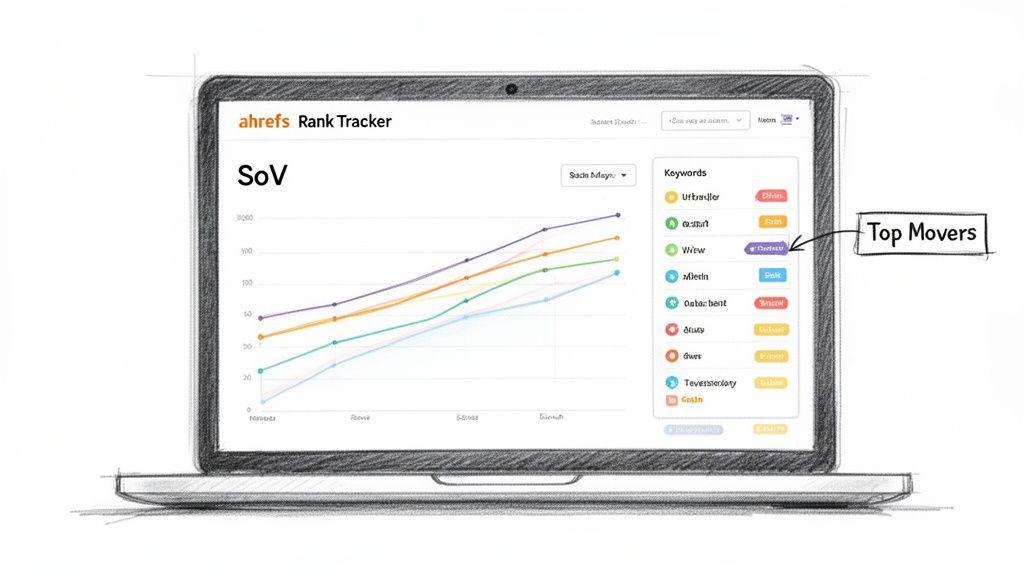
This graph is a perfect example of what you’ll see. You can track how different brands’ visibility ebbs and flows, letting you pinpoint the exact moments one competitor surged ahead while another one faded.
But just looking at the chart isn’t enough. The real insights come when you start asking the right questions:
- Is our new content strategy actually working? If you see your SoV line trending up after a big content push, that’s a fantastic signal that you’re on the right track.
- Who is our biggest threat right now? A competitor with a steeply rising SoV line is making aggressive moves. They deserve a closer look.
- Where are we losing our grip? A dip in your SoV can almost always be traced back to losing top spots for a few high-impact, high-volume keywords.
Analyzing your Share of Voice isn’t a one-and-done task. It’s an ongoing cycle of monitoring, questioning what the data is telling you, and tweaking your strategy. It transforms raw ranking data into a serious competitive intelligence tool.
Ultimately, this data gives you the context you need to make smarter SEO decisions. If you’re looking for ways to present these findings, check out our guide on the best SEO ranking reporting software available. Keeping a regular eye on this stuff helps you stay ahead of the curve and prove the real impact of your SEO work.
Proven Strategies to Increase Your Share of Voice
Growing your Ahrefs Share of Voice isn’t about throwing random tactics at the wall and hoping something sticks. It’s a deliberate, multi-front campaign. To really move the needle, you have to systematically chip away at your competitors’ visibility while building up your own.
Think of it as a combination of smart offense, solid defense, and a long-term plan to become the undeniable authority in your space.
Let’s break down three proven ways to make it happen.
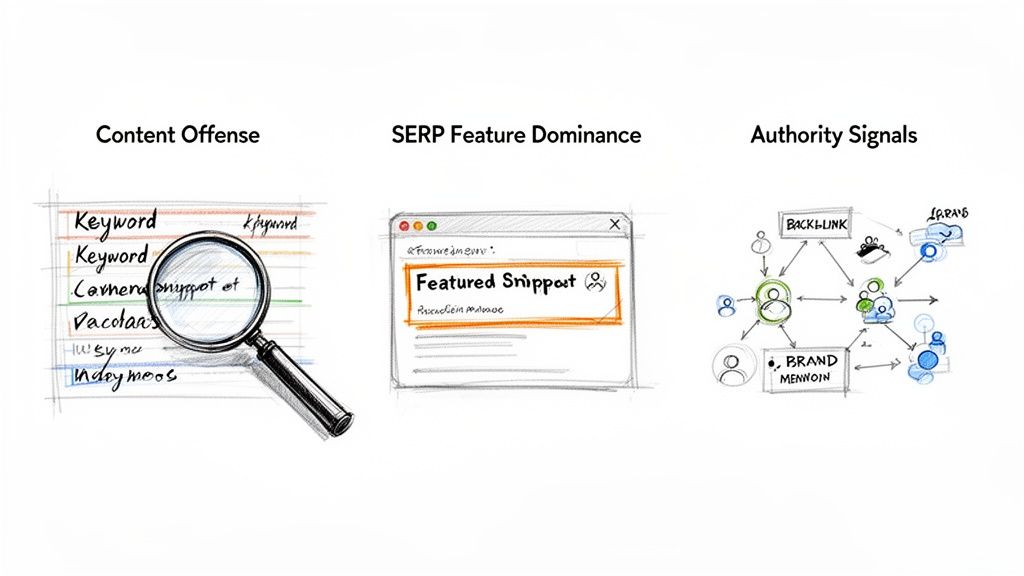
Launch a Strategic Content Offense
The quickest way to gain ground is to go where your competitors are strong and you’re nowhere to be found. This means finding your keyword gaps.
Fire up Ahrefs’ Content Gap tool to see which valuable keywords your competitors are ranking for that you aren’t. Filter that list by search volume, relevance, and difficulty to find the low-hanging fruit and the high-value targets.
Once you have your list, the mission is simple: create content that is demonstrably better than what’s currently ranking. A HubSpot study found that companies that blog 16+ times per month get about 4.5 times more leads than companies that blog 0-4 times monthly. This highlights the direct link between content volume, visibility, and business results. The idea isn’t just to get on the page, but to take over the top spots, which directly carves out a bigger piece of the visibility pie for those keywords.
Dominate High-Visibility SERP Features
The classic “ten blue links” are only part of the search story now. A massive chunk of clicks—and by extension, Share of Voice—is swallowed up by SERP features that sit above the traditional results. Winning these is no longer optional.
Here’s where to focus:
- Featured Snippets: Answer common questions directly and concisely. Use clear headings and structured data to make it incredibly easy for Google to grab your content for “Position 0.”
- People Also Ask (PAA) Boxes: Structure your articles with H2s and H3s that sound like real questions. Then, provide a clear, punchy answer right after the heading.
- Video Carousels: If a keyword has video intent, creating and optimizing a short video can land you in a prime, highly-visual spot on the results page, stealing clicks from all the text-based results.
Nailing these features isn’t just about a rank boost. It lets you leapfrog competitors and command more visual real estate, making your brand impossible to ignore.
Owning SERP features is like securing the best storefronts on a busy street. Even if a competitor has a larger store down the block, your prime location captures the immediate attention and foot traffic, dramatically increasing your perceived market presence.
Build Unshakeable Authority Signals
In the long run, SoV is all about authority. Google rewards brands it trusts, and that trust is built through powerful external signals.
This means earning high-quality backlinks from reputable sites in your industry. Every authoritative link is a vote of confidence, boosting your domain’s overall strength and making it easier to rank for everything else. According to Ahrefs’ own research, over 90% of pages get no organic search traffic from Google, largely because they have no backlinks.
Brand mentions are just as crucial, especially with AI answer engines on the rise. These systems look for consensus among trusted sources. When your brand keeps popping up in articles, forums, and reviews, it tells AI models that you’re a major player. This is absolutely critical for future-proofing your visibility. You can learn more about this by exploring how to rank in Google AI Overviews.
And while we’re mostly talking about search engines, this visibility mindset applies everywhere. On platforms like TikTok, understanding TikTok SEO to analyze and optimize videos for maximum visibility can give you another powerful channel to grow your overall digital footprint.
Choosing where to start can be daunting, so let’s compare these strategies.
SoV Growth Strategy Comparison
| Strategy | Primary Goal | Effort Level | Potential SoV Impact |
|---|---|---|---|
| Content Offense | Fill keyword gaps and displace competitors on key terms. | Medium to High | High |
| SERP Feature Dominance | Capture high-visibility spots like snippets and PAA boxes. | Low to Medium | Medium |
| Authority Building | Increase domain strength and brand trust signals. | High | Very High (Long-term) |
Each approach offers a different balance of effort and reward. A content offense delivers direct, measurable gains, while authority building is a slower burn that pays off massively over time.
Common Mistakes to Avoid When Tracking SoV
Measuring your Ahrefs Share of Voice is only half the battle. If your data is flawed, you’ll end up with a misguided strategy, wasting time and resources on things that don’t move the needle.
One of the most common mistakes is tracking a keyword list that’s either incomplete or just plain wrong for your business. This can paint a dangerously inaccurate picture of your real market position.
Another big one? Failing to separate your branded search traffic from non-branded. A high SoV that comes mostly from people already searching for your brand name can hide serious weaknesses. You might think you’re dominating, but in reality, you’re invisible to new audiences who don’t know you exist yet.
A Passive “Set It and Forget It” Mindset
Treating Share of Voice like a static report is a recipe for getting outmaneuvered. The search landscape is always in flux—competitors are constantly launching new content, and Google is always tweaking its algorithms.
A study on brand visibility found that market share often correlates with Share of Voice, but this relationship is dynamic. A passive approach means you’ll miss the early warning signs of a competitor gaining ground or fail to capitalize on new opportunities as they emerge.
SoV isn’t a one-and-done metric; it demands consistent attention. Checking in regularly lets you spot trends, react to what your competitors are doing, and adjust your strategy before you fall behind.
Viewing SoV in a Silo
Maybe the biggest mistake of all is looking at Share of Voice as just another isolated SEO metric. Its real power comes alive when you connect it to actual business outcomes. A rising SoV should, over time, lead to more qualified leads, more conversions, and more revenue.
If your visibility is growing but your business metrics are flat, that’s a red flag. It’s time to dig deeper:
- Are you ranking for the wrong keywords that attract researchers, not buyers?
- Is your on-page experience dropping the ball and failing to convert the traffic you’re winning?
- Are you even tracking traffic sources correctly? For example, understanding why GA4 under-reports ChatGPT traffic is key to getting the full picture.
By tying your SoV performance back to the metrics that actually matter, you turn it from a simple chart into a powerful tool for driving real business growth.
Beyond Search Rankings: The Future of Share of Voice
While Ahrefs is still the gold standard for measuring your visibility in search, the very definition of “voice” is getting a major update. A top Google ranking is a huge win, but it’s no longer the only game in town. We’re moving into an era where AI-driven search often acts as the final gatekeeper to information.
This is where the idea of AI Share of Voice comes in. Think of it as a new way to measure visibility, tracking how often your brand gets mentioned or recommended inside AI-generated answers from tools like ChatGPT and Google’s AI Overviews.
Nailing your Ahrefs Share of Voice is the perfect first step. AI models lean heavily on established, authoritative sources, so think of your existing SEO authority as the fuel for your future AI visibility.
Why Your Off-Page Strategy Just Became Mission-Critical
Your brand’s presence on trusted, third-party platforms now directly feeds these AI models. Authority on forums like Reddit, mentions in industry publications, and glowing reviews are no longer just “off-page SEO”—they’re the raw data that shapes AI-generated answers.
This makes your off-page game more important than ever for future-proofing your brand. Every single time your brand is discussed in a relevant subreddit or cited in a trade journal, you’re building the signals that AI models look for when deciding who the real experts are.
Expanding Your View of Visibility
Beyond traditional search, your overall market presence is also shaped by your visibility on social video platforms. A strong presence there contributes to the digital footprint that AI models evaluate, reinforcing your brand’s authority across multiple channels. Getting smart by understanding different content platforms like TikTok and YouTube Shorts is a wise move.
Ultimately, the future of Share of Voice is about owning the conversation, wherever it’s happening.
Frequently Asked Questions
What is Ahrefs Share of Voice?
Share of Voice (SoV) in Ahrefs is a competitive analysis metric that measures your website’s visibility in organic search results for a specific set of tracked keywords. It calculates the percentage of all possible organic clicks for those keywords that go to your site versus your competitors.
Is Share of Voice the same as market share?
No, but they are closely related. Share of Voice is a measure of marketing visibility, while market share is a measure of sales. A higher SoV is often a leading indicator of future growth in market share, as increased brand awareness can lead to more customers.
How do I find my competitors for the SoV report?
Ahrefs’ Site Explorer tool has a “Competing Domains” report under the Organic Search section. It shows you which other websites rank for the same keywords as you, giving you a data-driven list of your true online competitors to add to your Rank Tracker project.
What is a good Share of Voice percentage?
There is no single “good” number, as it is highly dependent on your industry and competitive landscape. A common strategic goal is to achieve a Share of Voice that is higher than your actual market share. For example, if you have a 10% market share, aiming for a 15-20% SoV is a strong target for growth.
How long does it take to increase my Ahrefs Share of Voice?
The timeframe depends on your strategy and the competitiveness of your keywords. You might see an impact from optimizing for SERP features in a few weeks. However, more substantial strategies like a major content offense or authority building typically take 3-6 months to show significant results in your SoV report.
Does Share of Voice only matter for Google?
While the Ahrefs tool specifically measures SoV for Google’s organic search, the concept applies to any channel where brands compete for attention. You can analyze your share of voice on social media (e.g., brand mentions), paid advertising (e.g., impression share), and emerging platforms like AI answer engines.
Ready to measure and influence your visibility in the new era of AI search? Airefs is the action platform that turns AI answers into a measurable marketing channel. Track your brand’s presence in ChatGPT, uncover the sources driving AI responses, and get actionable content opportunities to shape the conversation. Start building your AI Share of Voice with Airefs today!