

For years, SEO was a simple game: rank high on a results page, get the click. That’s changing fast. AI Search Engine Optimization (AEO) isn’t about climbing a list of links; it’s about becoming the answer itself.
The goal has shifted from winning a click to getting your brand mentioned directly inside AI-generated responses. This includes models like ChatGPT and Google AI Overviews. Visibility inside that AI-generated text is the new top spot.
Understanding the New Reality of Search
When you use an AI search tool, you get a single, synthesized answer. It pulls information from multiple places to give you exactly what you need. This is the new user experience.
Your brand must stop thinking like a website and start thinking like a trusted source. You need to be the kind of source AI systems rely on to build their answers.
Success is no longer about hitting position one on Google. It’s about how consistently your brand gets recommended when users ask questions that matter to your business. We now measure this as Share of Voice.
How AI-Generated Answers Change Everything
This trend is happening now. Google’s AI Overviews change how people find information. They often answer a query so completely that users never need to click through to a website.
This directly impacts the click-through rates and traffic acquisition models we’ve relied on for decades. For B2B SaaS companies, this is both a huge challenge and an even bigger opportunity.
Imagine being the recommended solution in an AI answer. That single mention can replace multiple touchpoints. It establishes instant authority and trust in a way a blue link never could.
AI Search Engine Optimization isn’t about tricking an algorithm. It’s about providing such clear, authoritative, and well-structured information that AI models choose your content as the most reliable source to build their answers from.
What Modern AI Search Looks Like
Here’s a snapshot of how to track and measure your visibility in this new world.
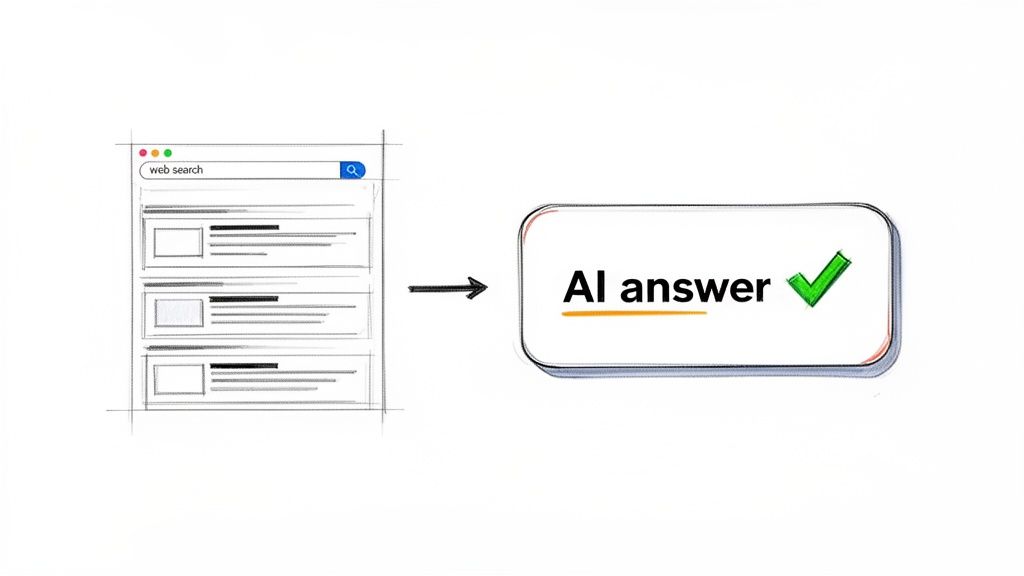
This kind of dashboard doesn’t focus on keyword rankings. Instead, it tracks the metrics that actually matter for AEO: prompts, share of voice, and competitive mentions.
The numbers show this shift is accelerating. AI search traffic has surged 527% year-over-year. Tools like Google AI Overviews now hit over two billion monthly users.
These AI-powered summaries contribute to a reality where roughly 60% of searches result in zero clicks. Your content has to show up inside the answer, or it might as well be invisible.
Traditional SEO vs AI Search Engine Optimization (AEO)
To grasp the change, it helps to see the old and new models side-by-side. The table below breaks down the fundamental shifts in goals, tactics, and what “success” means.
| Metric | Traditional SEO | AI Search Engine Optimization (AEO) |
|---|---|---|
| Primary Goal | Rank #1 on a SERP | Get mentioned in an AI answer |
| Key Metric | Organic Traffic & Clicks | Share of Voice (SoV) & Citations |
| Main Tactic | On-page optimization, backlinking | Creating citable, structured content |
| User Journey | Click to website, then navigate | Get answer, then brand search/direct |
| Focus | Keywords | User Prompts & Intent |
| Content Strategy | Blog posts targeting keywords | Factual, well-sourced knowledge base |
This is a complete rethinking of how we earn visibility online. The old playbook focused on getting people to our site. The new one is about getting our brand’s expertise into the search engine’s brain.
Adapting means learning a new set of rules. You can dive deeper with our complete AI Search Optimization guide.
How AI Answers Reshape the Customer Journey
AI-generated answers create a new layer between your brand and your audience. Users get a single, synthesized response instead of sifting through links. This disrupts the customer journey we’ve spent years optimizing.
Your goal is no longer just to rank for a keyword. The real objective is to influence the narrative inside the AI’s answer. This shift demands a new way of thinking about ai search engine optimization.
For a B2B SaaS company, being the recommended solution in an AI answer is incredibly powerful. A mention like that is a high-trust endorsement. It creates a direct line to new customers.
The New Funnel from Prompt to Purchase
The traditional marketing funnel—awareness, consideration, decision—is being squeezed. An AI answer can take someone from a high-level prompt to a specific brand recommendation in seconds. This accelerated journey means every word in an AI-generated response carries immense weight.
Imagine a user asking, “What’s the best project management tool for a remote team?” The AI often recommends one or two, explaining why they’re the best fit. If your brand is in that explanation, you’ve just bypassed the entire consideration stage.
This new reality changes the role of your content. It must be so clear and authoritative that an AI feels confident using it as a primary source for its recommendations.
How AI Models Select and Prioritize Sources
AI models don’t “think” like humans. They follow a mechanical process of parsing, evaluating, and stitching together information. Understanding the mechanics lets you influence the outcome.
An AI answer is not an opinion; it’s a collage. It’s assembled from the most structured, reputable, and semantically clear pieces of content the model can find. Your job is to create those pieces.
The selection process values certain trust indicators. These signals help the model decide which sources are reliable enough to include in a final answer.
Key factors that influence source selection include:
- Structured Data: Clean headings (H2s, H3s), lists, and tables make your content easy for an AI to parse.
- Semantic Clarity: Precise, unambiguous language helps the model understand your information’s exact meaning.
- Authoritativeness: The model looks at signals like backlinks, brand mentions on reputable sites, and consistent information.
- Freshness: Current, up-to-date content often gets prioritized, especially for fast-changing topics.
When you optimize for these factors, you make your content AI-ready. This is a core part of modern ai search engine optimization. For more on this, read our guide on ChatGPT and advertising opportunities.
The Shift from Clicks to Citations
In the old world, the click was the ultimate prize. Now, a citation within an AI answer can be more valuable. It acts as a direct endorsement from a seemingly neutral third party.
This changes how we measure success. Instead of obsessing over click-through rates (CTR), we must track our “Share of Voice.” This metric tells us how often our brand gets mentioned for key prompts compared to competitors.
Ultimately, this new journey rewards brands that are genuinely helpful. The best strategy is to become the most reliable source of information in your niche. When you do that, AI models will naturally amplify your expertise.
Measuring Your Share of Voice in AI
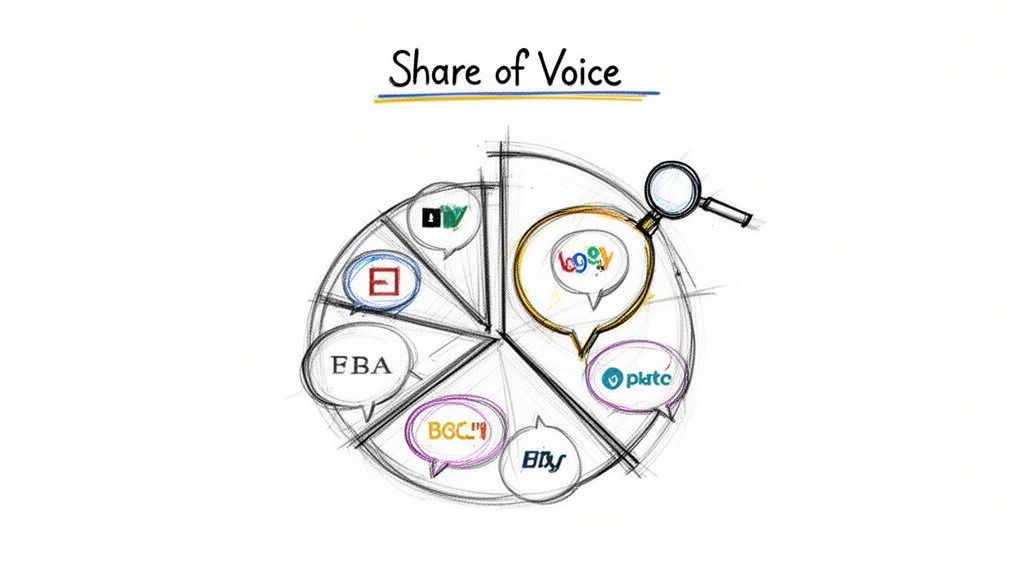
In traditional SEO, we obsessed over rankings and clicks. In AI search engine optimization, the number one metric is Share of Voice (SoV). This measures how often your brand gets mentioned for relevant questions compared to your competitors.
It’s about measuring your authority in the conversations AI is having with your potential customers. A high SoV tells you that AI models see you as a go-to solution. It’s the new benchmark for visibility and influence.
Defining Your Core Prompts
First, you need to know what your audience is asking. These are the full questions and commands people use in tools like ChatGPT and Perplexity. A solid set of prompts should cover the entire buyer’s journey.
Frame your customers’ problems as natural language questions. If you sell project management software, track a range of prompts. These should span from early-stage research to head-to-head comparisons.
Think in terms of these categories:
- Problem-Awareness Prompts: “how to manage tasks for a remote team”
- Solution-Comparison Prompts: “best project management tools for startups”
- Brand-Specific Prompts: “is [competitor] better than [your brand] for agile workflows”
- Feature-Specific Prompts: “which PM tool has the best gantt chart features”
Tracking these prompt types gives you a 360-degree view of where you’re winning. The goal is to build a list of 20-30 essential prompts that represent your market.
Share of Voice answers one simple question: “When a potential customer asks an AI for help, how often does it recommend us?” It’s the ultimate measure of trust and authority in this new world of search.
Tracking and Benchmarking Visibility
Once you have your core prompts, you need a system to track them across different AI models. Manual checking is unreliable and frustrating. Dedicated ai search engine optimization tools are indispensable.
A platform like Airefs automates the entire process. It queries AI models with your prompts, logs every brand mention, and calculates your Share of Voice.
This screenshot from Airefs shows exactly how SoV is visualized. It puts your brand’s mention frequency right alongside your key competitors.
The dashboard shows you how your visibility stacks up against everyone else over time. This constant monitoring lets you benchmark your performance and know exactly where you stand. It turns a fuzzy concept like “AI visibility” into a hard number.
You can dive deeper into how this works in our guide to measuring Ahrefs Share of Voice.
From Measurement to Action
Measuring your SoV is the starting point for your entire strategy. A low Share of Voice for a critical prompt is a massive red flag. It points you straight to your biggest growth opportunities.
By seeing which competitors get mentioned and what sources the AI is citing, you can reverse-engineer their success. The goal is to systematically show up in more answers. This helps you carve out a bigger piece of the conversation for your brand.
Analyzing AI Sources to Guide Your Strategy
To get your content into AI answers, you must first understand what those answers are made of. This leads to the most important activity in AI search engine optimization: analyzing cited sources. These sources are the building blocks for every AI-generated response.
Think of it as detective work for your niche. By dissecting the sources, you see which articles, forum threads, and documentation AI systems already trust. This is the foundation of your entire AEO strategy.
The Anatomy of an AI Answer
An AI answer is a collage, pieced together from different bits of information. For every prompt you care about, AI models pull from a handful of URLs. Your job is to find those URLs and figure out why they were chosen.
This source-level analysis shifts your strategy from guesswork to a data-driven plan. You can see which formats, structures, and platforms are already winning. That insight lets you create content AI models are far more likely to use.
An AI model’s trust isn’t earned through brand recognition alone. It’s earned by consistently providing the clearest, most well-structured, and verifiable information on a topic—often from a mix of your own content and third-party discussions.
Identifying High-Impact Source Types
After analyzing dozens of AI answers, you’ll notice certain types of content pop up repeatedly. While every industry is different, a few common patterns usually emerge.
Recognizing these categories helps you build a more effective, diverse content plan. For a deeper look at how AI systems consume information, check out these web data use cases for SEO and AI pipelines.
Common source categories often include:
- Authoritative Blog Posts: In-depth articles from respected industry blogs.
- Product Documentation: Official help docs with factual, technical details.
- Community Discussions: Reddit and Quora threads where real people discuss problems.
- Third-Party Review Sites: Unbiased comparisons from sites like G2 or Capterra.
How to Conduct a Source-Level Analysis
A manual source analysis is simple but time-consuming. Start by running your top 5-10 core prompts through an AI model like ChatGPT or Perplexity. Log every single source cited in the answers.
Here’s a straightforward process to follow:
- Select a Core Prompt: Pick a high-priority question like “best crm for small business.”
- Generate an Answer: Run the prompt through your target AI model.
- Extract All Sources: Carefully copy every URL cited in the answer or footnotes.
- Categorize Each Source: Classify each URL by type (blog post, forum thread, etc.).
- Analyze the Content: Visit each link and figure out why it was likely chosen.
- Repeat and Find Patterns: Do this for multiple prompts to see which websites and formats show up most often.
After analyzing just a handful of prompts, a clear picture will emerge. You might discover that for comparison prompts, the AI leans heavily on Reddit threads. For technical questions, it might prefer a competitor’s official docs.
This manual work builds a deep understanding of the source landscape. It shows you exactly where the important conversations are happening. For more details, check our research on analyzing 14 million AI search results.
Creating Content and Joining Discussions
After analyzing sources, your strategy has two clear paths: create new content and join existing discussions. You need to do both to build a solid ai search engine optimization program.
Your source analysis shows you which high-authority pages AI models already trust. These are your content opportunities. The game plan is to build something better on your own site—more detailed, better structured, and more thorough.
The other path is to jump directly into the conversations AI models are learning from. See a Reddit or Quora thread cited in an answer? That’s a discussion opportunity. By joining in, you can directly shape future AI responses.
Prioritizing Content Creation Opportunities
Not every content gap is an emergency. Prioritize where you’ll get the most impact. Start by flagging the articles from competitors or third-party sites that get cited most often.
Your goal isn’t just to mimic what’s already out there. You need to create a resource that’s objectively better. That might mean going deeper, offering clearer explanations, or using AI-friendly formatting like tables and lists.
The best AI-optimized content becomes a definitive resource. It doesn’t just answer the first question; it anticipates and answers the next logical questions, making it a one-stop-shop for AI models.
Here are three types of content opportunities to look for:
- The “Consolidator” Post: Write a single, comprehensive article that pulls together information from multiple cited sources.
- The “Data-Driven” Update: Find a popular article with old stats and create a new version with fresh data.
- The “Structured” Alternative: Spot a popular source that’s poorly formatted and create a well-structured version.
By focusing on these high-impact plays, you can strategically replace competitor sources with your own.
Capitalizing on Discussion Opportunities
Discussion opportunities are a more direct—and often faster—way to influence AI answers. Community hubs like Reddit and Quora are goldmines. AI models love the authentic, user-generated opinions they find there.
The trick is to be authentic. Don’t just spam a link to your product. Add real value to the conversation by answering the question thoughtfully. Mention your brand only if it’s a helpful resource.
When trying to quickly find content and discussion opportunities, tools like an AI Post Generator can help you draft initial ideas.
A Framework for Action
To turn analysis into growth, you need a simple framework. For every key prompt, look at the top sources, categorize them, and decide on your move.
| Source Type | Primary Opportunity | Example Action |
|---|---|---|
| Competitor Blog Post | Content Creation | Write a more in-depth guide on the same topic. |
| Reddit Thread | Discussion Participation | Join the thread with a helpful comment. |
| Outdated Industry Report | Content Creation | Publish a new report with current statistics. |
| Quora Question | Discussion Participation | Provide a detailed answer and cite your brand. |
This systematic approach makes sure you’re proactively building your brand’s authority. For B2B SaaS marketers, this mix of creating and participating is the heart of effective ai search engine optimization. To find the right platforms, check our guide on the best AEO tools available today.
Building a Proactive AEO Flywheel
Effective AI search engine optimization is a continuous process. The goal is to build a self-reinforcing flywheel. This shifts you from reacting to AI answers to proactively shaping them.
It starts by listening for relevant keywords and brand mentions in communities like Reddit. This lets you jump into emerging conversations before they become established sources for AI models. Getting in early lets you influence the narrative from the beginning.
This proactive approach creates a powerful feedback loop. As your brand shows up more in trusted discussions, AI models start to recognize you as an authority. This leads to more organic mentions in AI answers.
This simple, repeatable process is what builds the AEO flywheel.
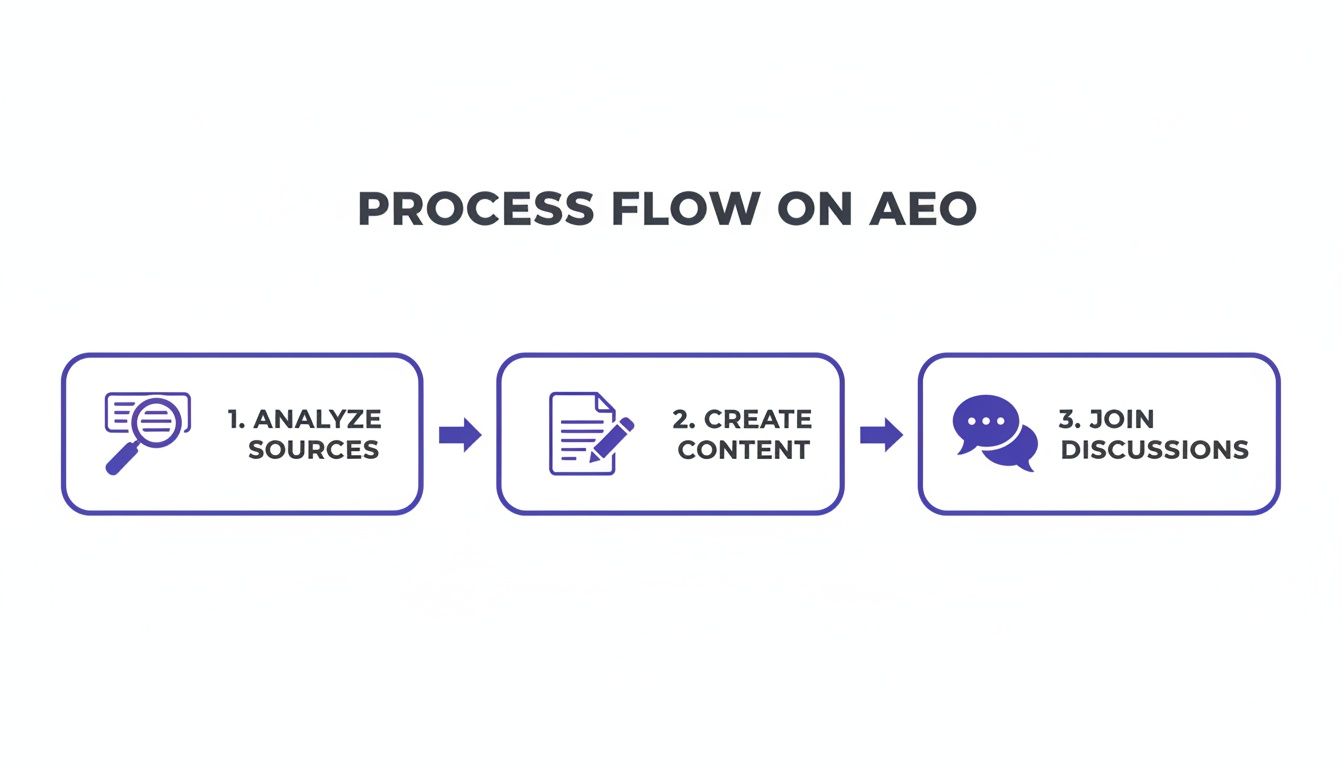
This breaks the flywheel down into three core moves: analyzing trusted sources, creating AI-friendly content, and joining the right discussions.
Monitoring and Engaging in Real-Time
The fuel for your flywheel is real-time monitoring. You need a system that flags new discussions about the problems your product solves. This lets you engage when conversations are most active and influential.
Set up alerts for your brand name, competitor names, and problem-based keywords. For instance, a project management tool could monitor Reddit for “best way to manage team tasks.” When a new thread pops up, that’s your cue.
The most valuable AEO opportunities are often found in fresh, active discussions. By being the first helpful voice in a thread, you not only assist a potential user but also provide a clean, citable source for future AI answers.
Consistency is key. Dedicating a small amount of time each day to monitoring and participating builds incredible momentum. Over time, your brand becomes a familiar, helpful presence.
Turning Monitoring into a Repeatable Workflow
To make this sustainable, you need a clear workflow. A simple, structured approach ensures you never miss an opportunity. It keeps your efforts focused on high-impact activities.
Here’s a practical, three-step workflow:
- Monitor Key Platforms: Use tools to track keywords across sites like Reddit and Quora. Find 3-5 new, relevant conversations each week.
- Engage Authentically: Lead with a genuinely helpful answer. Ditch the marketing copy and focus on solving the user’s problem.
- Track Your Impact: Use a platform like Airefs to see if your participation is influencing AI answers. This connects your engagement directly to changes in your Share of Voice.
This simple loop—monitor, engage, track—is the engine of your AEO flywheel. Each cycle strengthens your brand’s authority. This makes it progressively easier to earn mentions and grow your visibility.
Frequently Asked Questions
What is the real difference between SEO and AEO? SEO aims to get clicks by ranking a webpage on a results page. AEO’s goal is to get your brand mentioned inside an AI-generated answer. Success is measured by Share of Voice, not website traffic.
How can I track my brand’s visibility in AI answers? Manual tracking by typing prompts into ChatGPT is unreliable because answers constantly change. You need a specialized tool like Airefs to monitor prompts, track mentions, and calculate your Share of Voice accurately.
Is AEO just for big companies? No. AI models rely heavily on niche community discussions on platforms like Reddit and Quora. This allows smaller companies to build authority and gain visibility by participating authentically, without needing a large budget.
What kind of content works best for AEO? Clear, well-structured, and factual content works best. Think of data-driven posts, in-depth guides, unbiased comparisons, and detailed technical documentation. Keeping this content fresh and updated also helps maintain visibility.
Ready to stop guessing and start measuring your visibility in AI answers? Airefs gives you the data and tools to see where you stand and find your next growth opportunities. Get started with Airefs today.