

AI-powered answers are the new search results page. Users get information directly from models like ChatGPT, Perplexity, and Google AI Overviews. This changes the goal of SEO from ranking #1 to being the brand cited in AI answers.
This shift creates a new measurement challenge. Traditional rank trackers don’t see inside AI responses. You need a new class of software: AI visibility tools.
These platforms measure and influence your share of voice in this new channel. Gaining visibility across all AI-driven platforms is now a non-negotiable part of modern marketing. This guide reviews the 12 best AI visibility tools to help you choose the right one.
1. Airefs
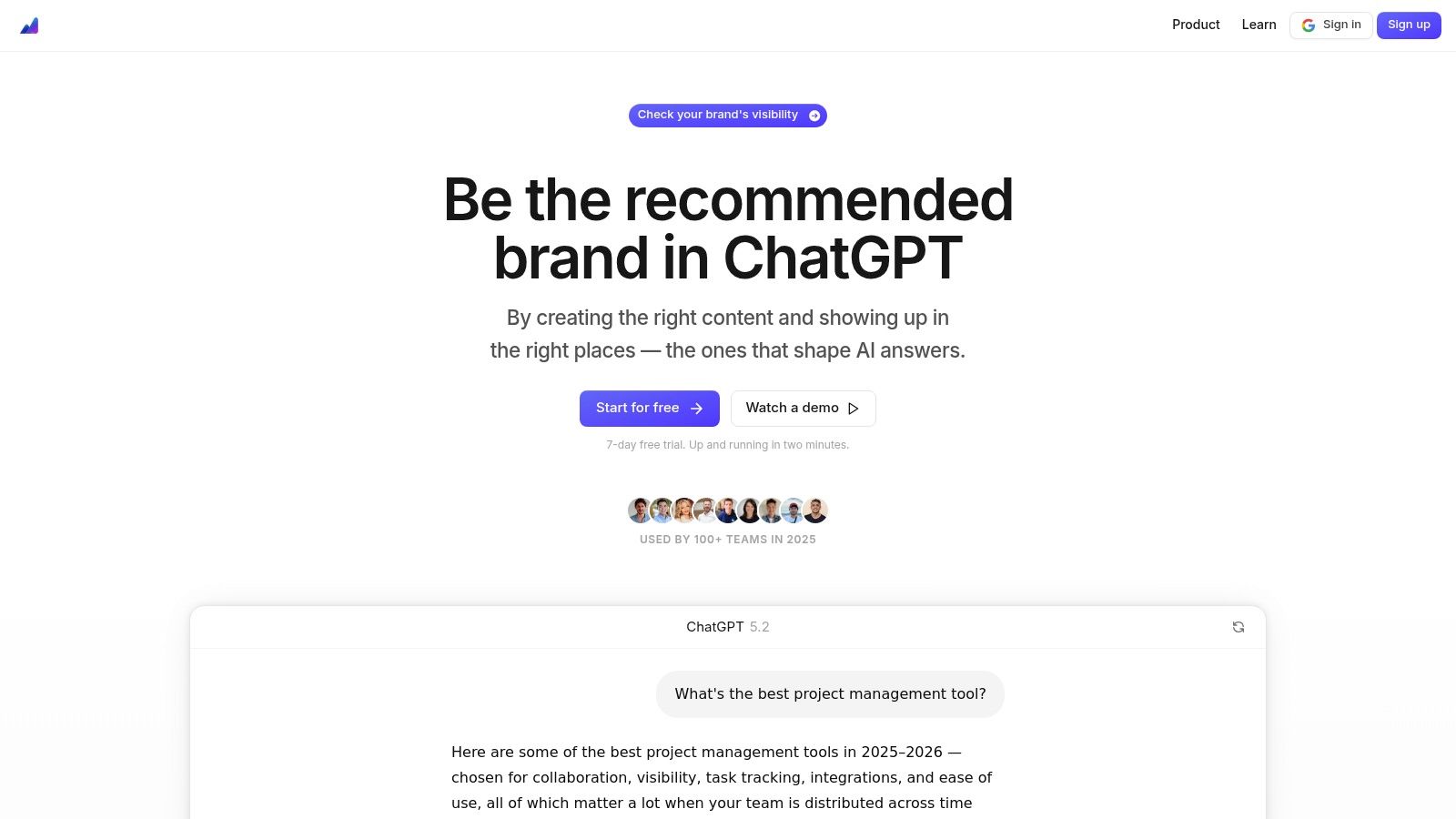
Airefs is the “Google Search Console for AI answers.” It’s a platform for brands to measure and influence their presence in AI-generated search. It moves beyond old SEO metrics to focus on customer prompts and the sources AI models cite.
The platform provides source-level transparency. It reveals the exact articles, reviews, and discussions that shape AI answers. This insight turns strategy from guesswork into a clear action plan.
Marketers can pinpoint which content to create or improve. They can identify conversations to join and tie efforts to business outcomes. This makes it a crucial tool for winning visibility where modern discovery begins.
Why Airefs is a Standout Choice
Airefs connects visibility data directly to execution. The platform tracks your brand’s share of voice against competitors across multiple LLMs. It provides daily data refreshes to keep insights current.
For teams that need help acting on these insights, Airefs offers a Done-for-You service. Its strategists handle content creation and community engagement. This hybrid approach makes it one of the most practical ai visibility tools available.
Core Features & Use Cases
- Source-Level Visibility: See the exact URLs and conversations AI models rely on.
- Share of Voice Tracking: Benchmark your brand’s visibility against competitors for key prompts.
- Multi-LLM & Geo-Targeting: Segment performance by AI models, countries, and languages.
- Actionable Opportunity Finder: The platform flags content gaps and discussion opportunities.
Pricing and Access
Airefs offers transparent pricing with a 7-day free trial.
- Lite: $24/month for tracking 1 domain and 25 prompts.
- Pro: $49/month for 3 domains and 60 prompts with daily data refresh.
- Expert: $83/month for unlimited domains and 150 prompts.
- Done-for-You: Starts at $299/month, bundling the product with strategist execution.
Pros & Cons
| Pros | Cons |
|---|---|
| Unique source-level visibility shows exactly what content to create or influence. | Default tracking is ChatGPT-first; broader LLM coverage may require higher-tier plans. |
| Actionable workflow connects data to DIY or done-for-you execution. | AI search is an evolving channel, so gains can be uneven and require sustained effort. |
| Multi-LLM, multi-country tracking provides a comprehensive view of your global AI footprint. | |
| Affordable, transparent pricing makes it accessible for startups and agencies. |
Website: https://getairefs.com
2. Semrush
Semrush integrates AI Overview (AIO) tracking into its comprehensive SEO suite. It provides a seamless way for existing users to monitor AI-driven search changes. The tool detects which keywords trigger AIOs within existing workflows.
This integration is Semrush’s key differentiator. It contextualizes AIO visibility within the broader SEO landscape. You can track your domain’s presence, discover competitors, and identify content opportunities.
Key Features & Use Cases
- AIO Keyword Detection: Identify keywords in your tracking campaigns that generate Google AI Overviews.
- Integrated Competitive Intelligence: Analyze which competitors are winning AIO placements for your target keywords.
- Workflow Continuity: Fold AIO analysis into established processes like keyword research and rank tracking.
Pricing and Access
Semrush is a subscription service starting at around $129.95/month. Access to more advanced features requires higher-tier plans (Guru, Business).
Pros & Cons
- Pros: Mature, all-in-one platform; integrates AIO data into existing SEO workflows.
- Cons: Can be expensive, especially with add-ons; steep learning curve for new users.
Website: https://www.semrush.com
3. SISTRIX
SISTRIX provides dedicated AI Overview filters and historical SERP data. Its strength is clear, large-scale AIO tracking across many international markets. It’s a familiar environment for professional SEOs to monitor AI search impact.
The platform excels at identifying keywords that trigger AIOs. It also tracks a domain’s visibility within them over time. This historical perspective allows users to analyze trends and correlate AIO presence with traffic changes.
This granular data supports a more nuanced approach to AI-driven content optimization. The platform empowers experienced users with the raw data to build their own AEO strategies.
Key Features & Use Cases
- AIO Keyword Filters: Instantly segment keyword lists to see which queries generate AI Overviews.
- Domain-Level AIO Reporting: Track your overall share of voice within AIOs and benchmark against competitors.
- International SERP Archives: Analyze AIO rollout and behavior across different countries for global campaigns.
Pricing and Access
SISTRIX is a premium tool aimed at professionals and agencies. Plans are modular, and full access requires a significant investment.
Pros & Cons
- Pros: Purpose-built AIO filters are clear and easy to use; excellent international and historical data.
- Cons: Pricing is geared toward enterprise budgets; less direct guidance than specialized AEO tools.
Website: https://www.sistrix.com
4. seoClarity
seoClarity is an enterprise-grade SEO platform for large organizations. It offers deep, granular tracking of Google AI Overviews. It connects AIO visibility to business outcomes by modeling the impact on traffic and CTR.
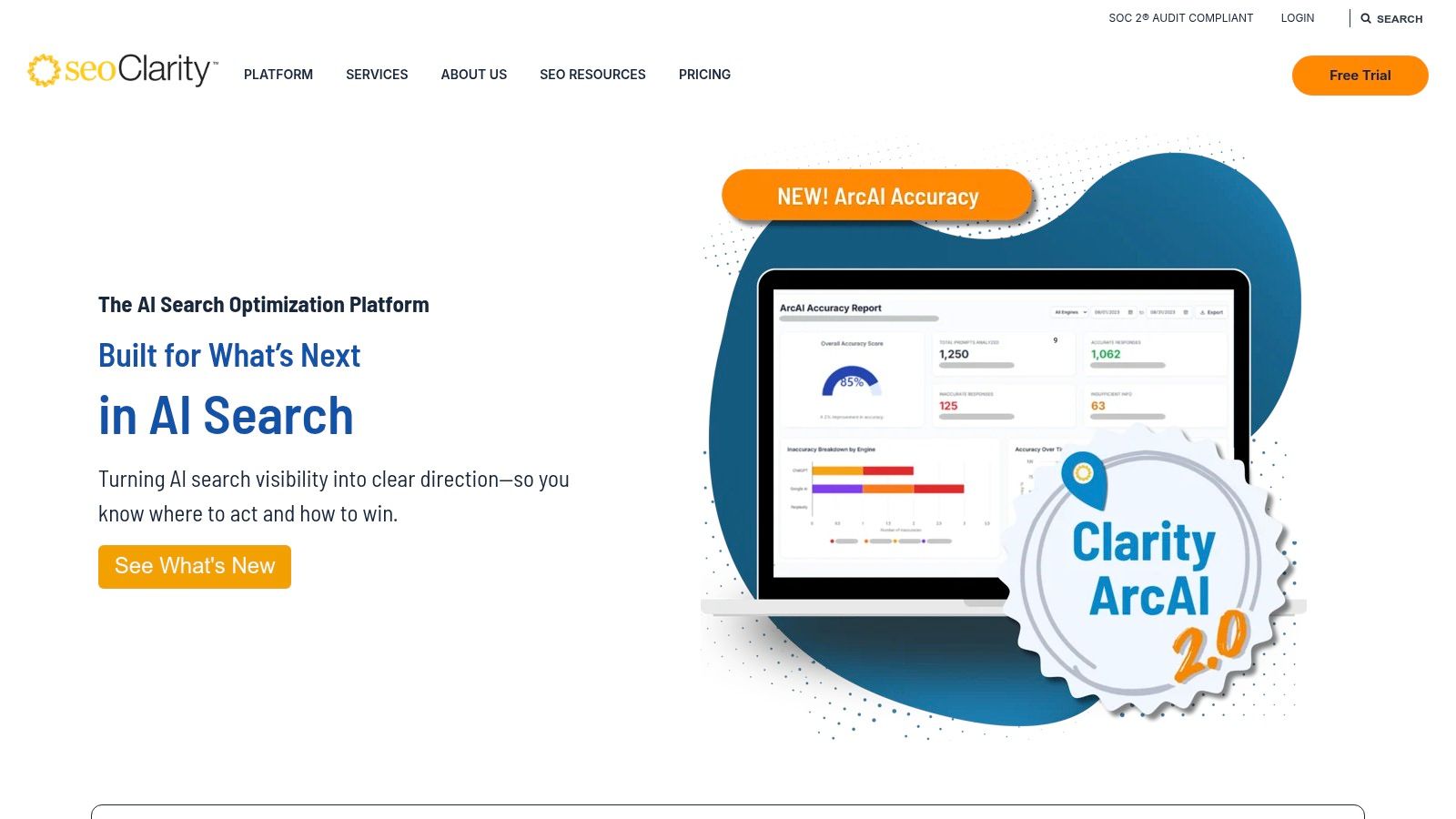
The platform’s differentiator is its keyword-to-URL level analysis. Teams can see which pages are cited and monitor brand mentions. This detail is critical for prioritizing optimization efforts. You can learn more about AI Overviews tracking and platform approaches.
Key Features & Use Cases
- Brand & Citation Monitoring: Track every brand mention and identify which URLs are cited in AI Overviews.
- Trended CTR & Traffic Impact: Use impact modeling to forecast how AIO visibility affects organic traffic.
- Instant AIO Snapshots: Conduct on-demand checks for specific keywords to see the current AIO result.
Pricing and Access
seoClarity is an enterprise solution with custom pricing. Access requires a consultation, as packages are tailored to specific needs.
Pros & Cons
- Pros: Built to handle massive keyword sets; provides deep reporting connecting AIO data to traffic.
- Cons: Enterprise-level pricing is inaccessible for smaller companies; can be overly complex for simple needs.
Website: https://www.seoclarity.net
5. BrightEdge
BrightEdge is a premier enterprise solution among ai visibility tools. It uses powerful Generative Parser technology for deep insights into AIO performance. The platform is designed for large-scale operations.
Its key differentiator is providing historical context and strategic thought leadership. BrightEdge publishes extensive data on AIO market share and industry shifts. This helps teams understand the macro environment and justify investment.
Key Features & Use Cases
- Industry-Level Trend Data: Track AIO visibility trends across entire sectors to benchmark performance.
- Source and Citation Analysis: Deconstruct AI Overviews to see which domains are being cited.
- Historical SERP Timeline: Analyze the evolution of AIOs for your target keywords over time.
Pricing and Access
BrightEdge is an enterprise platform with custom pricing. Access requires a formal sales process and is positioned for large corporations.
Pros & Cons
- Pros: Excellent for enterprise-scale SEO; strong data stories and thought leadership.
- Cons: Requires a significant enterprise budget; platform can be complex for simple needs.
Website: https://www.brightedge.com
6. Similarweb (Rank Tracker / Rank Ranger)
Similarweb’s rank tracker flags AI Overview data within its dashboards. It is ideal for teams who want to monitor AI SERP changes as part of standard reporting. It flags which tracked keywords trigger AIOs, making it easy to spot threats.
The platform embeds AIO insights into familiar rank tracking workflows. It allows you to filter and analyze AIO presence alongside traditional organic rankings. This helps teams understand the holistic impact of AI Overviews.
Key Features & Use Cases
- AIO Presence Flags: Quickly identify which of your tracked keywords display Google AI Overviews.
- Keyword-Level AIO Filtering: Filter keyword lists to analyze terms with and without AIOs.
- Integrated Traffic Intelligence: Connect AIO presence with estimated traffic impacts and competitor benchmarks.
Pricing and Access
Similarweb offers customized enterprise plans. Pricing for its rank tracking suites is typically provided via a sales consultation.
Pros & Cons
- Pros: Integrates AIO data into standard rank reporting; backed by powerful market intelligence.
- Cons: Advanced features may require higher-tier plans; some users note data policy changes over time.
Website: https://www.similarweb.com
7. SEOmonitor
SEOmonitor provides a dedicated and detailed AI Overviews monitor. The platform excels at daily cadence, capturing the complete AI-generated response. It is essential for teams needing granular, day-to-day insights into their AIO presence.
The key differentiator is mapping AIO data directly to existing SEO campaigns. It connects brand mentions back to specific keywords you are tracking. This allows teams to see which terms are driving AI visibility and measure the impact.
Key Features & Use Cases
- Daily AIO Capture: Get daily updates on AIO presence, including full-text capture and cited sources.
- Volume-Weighted Metrics: Analyze AIO visibility using metrics weighted by search volume.
- Integrated Competitor Tracking: See which competitors are being cited in AIOs for your target keywords.
- Mobile and Desktop Coverage: Track AIOs across both device types for a complete picture of visibility.
Pricing and Access
SEOmonitor uses a customized subscription model based on tracked keywords and domains. You must contact their sales team for a quote.
Pros & Cons
- Pros: Daily data provides near real-time insights; integrates directly into existing rank-tracking projects.
- Cons: Country availability can be limited in free trials; UI can feel slow with very large datasets.
Website: https://www.seomonitor.com
8. SE Ranking (SE Visible)
SE Ranking offers an accessible yet powerful option with its “SE Visible” module. It monitors multiple AI engines, including ChatGPT, Perplexity, Gemini, and Google AI Overviews. This makes it a great choice for SMBs seeking comprehensive AI visibility.
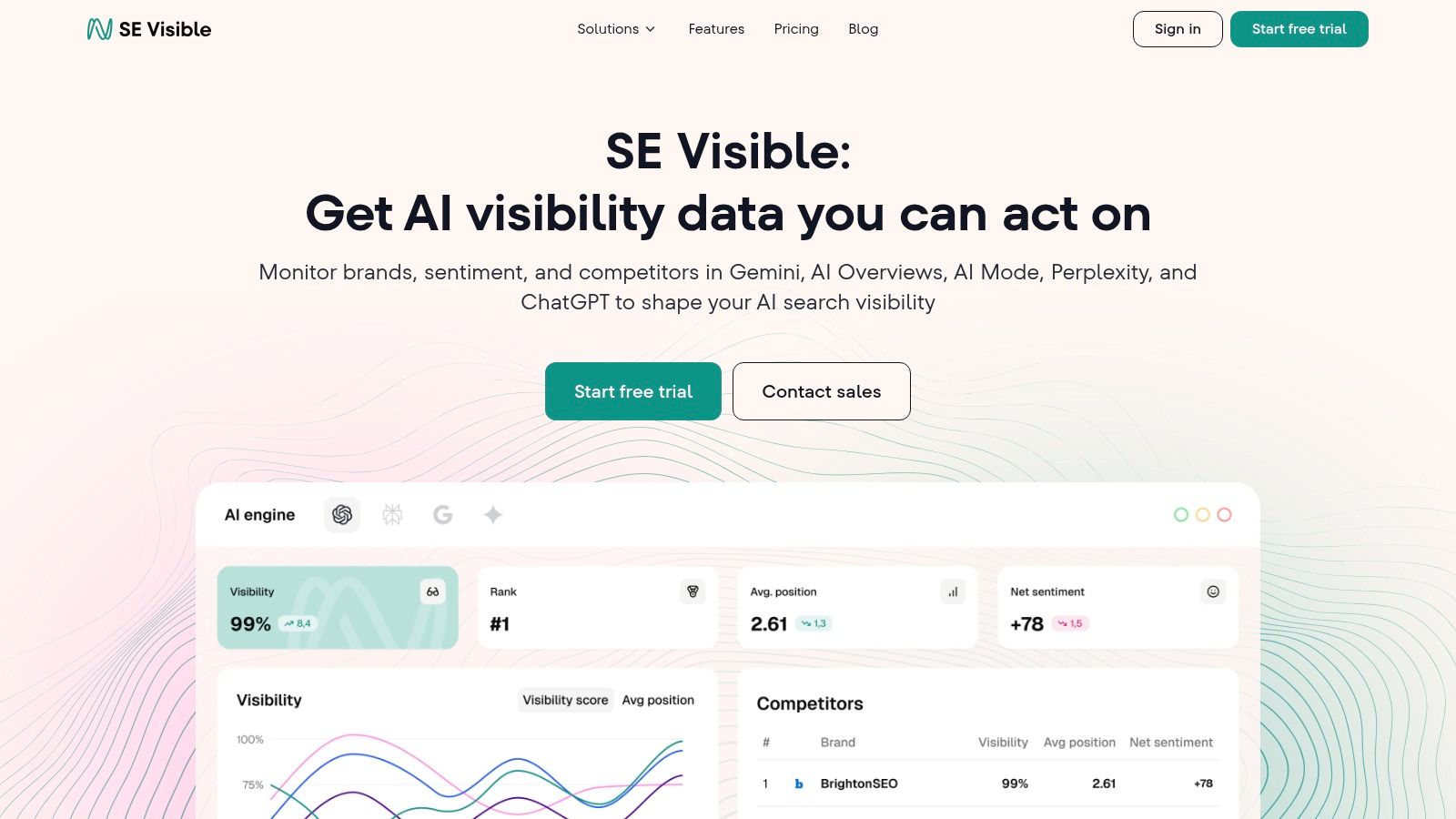
The platform’s key differentiator is its balance of wide coverage and affordability. SE Visible tracks brand mentions using specific prompts. This is useful for businesses needing to understand their global AI footprint on a budget.
Key Features & Use Cases
- Multi-Engine AI Visibility: Track your brand’s presence across ChatGPT, Perplexity, Gemini, and Google AI Overviews.
- Prompt-Based Tracking: Set up specific prompts to monitor how different AI models cite your brand.
- Competitive & Global Research: Analyze competitor mentions and export data for deeper analysis.
Pricing and Access
SE Ranking is known for competitive pricing. SE Visible is an add-on, and the final cost depends on the number of prompts and keywords tracked.
Pros & Cons
- Pros: Lower entry price than many competitors; good breadth of AI engine coverage for the cost.
- Cons: As a newer module, analytics may not match top-tier suites; costs can escalate with add-ons.
Website: https://visible.seranking.com
9. AccuRanker
AccuRanker focuses on exceptionally fast and accurate rank tracking, now with AI Overview data. It’s built for teams who need near-real-time SERP updates. The platform shows not just if an AIO is present, but which domains are featured.
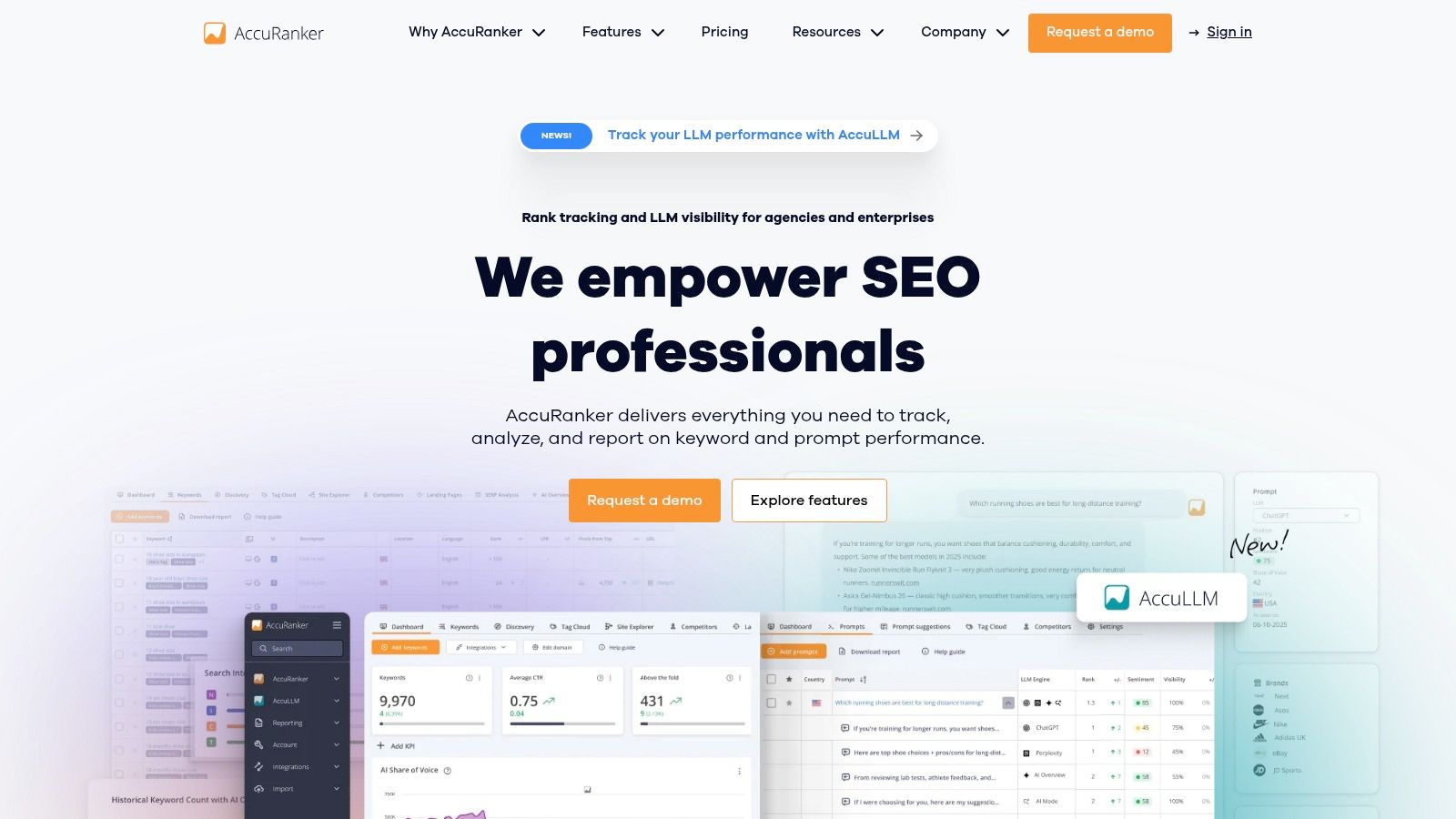
The primary differentiator is its dedicated ‘AI Overview’ dashboard. This feature visualizes historical AIO presence against your domain’s appearances. You can quickly see the top domains winning AIO placements and view AIO text.
Key Features & Use Cases
- Historical vs. Owned AIO Presence: Track total AIOs versus how many times your domain was featured.
- Top AIO URLs and Domains: Instantly see which competitors are dominating AI Overviews.
- Daily Updates & On-Demand Refresh: Get keyword rankings and AIO data updated every 24 hours.
Pricing and Access
AccuRanker uses a tiered subscription model based on keywords tracked. Plans start around $129/month for 1,000 keywords.
Pros & Cons
- Pros: Extremely fast and reliable rank tracking; clear, intuitive widgets for AIO analysis.
- Cons: AIO tracking is primarily Google-centric; advanced features require more expensive plans.
Website: https://www.accuranker.com
10. Nozzle
Nozzle offers a flexible, data-centric approach for enterprise teams. It treats AI Overviews as an integrated segment across all its dashboards. This allows SEOs to slice, dice, and export AIO data into their BI stacks.
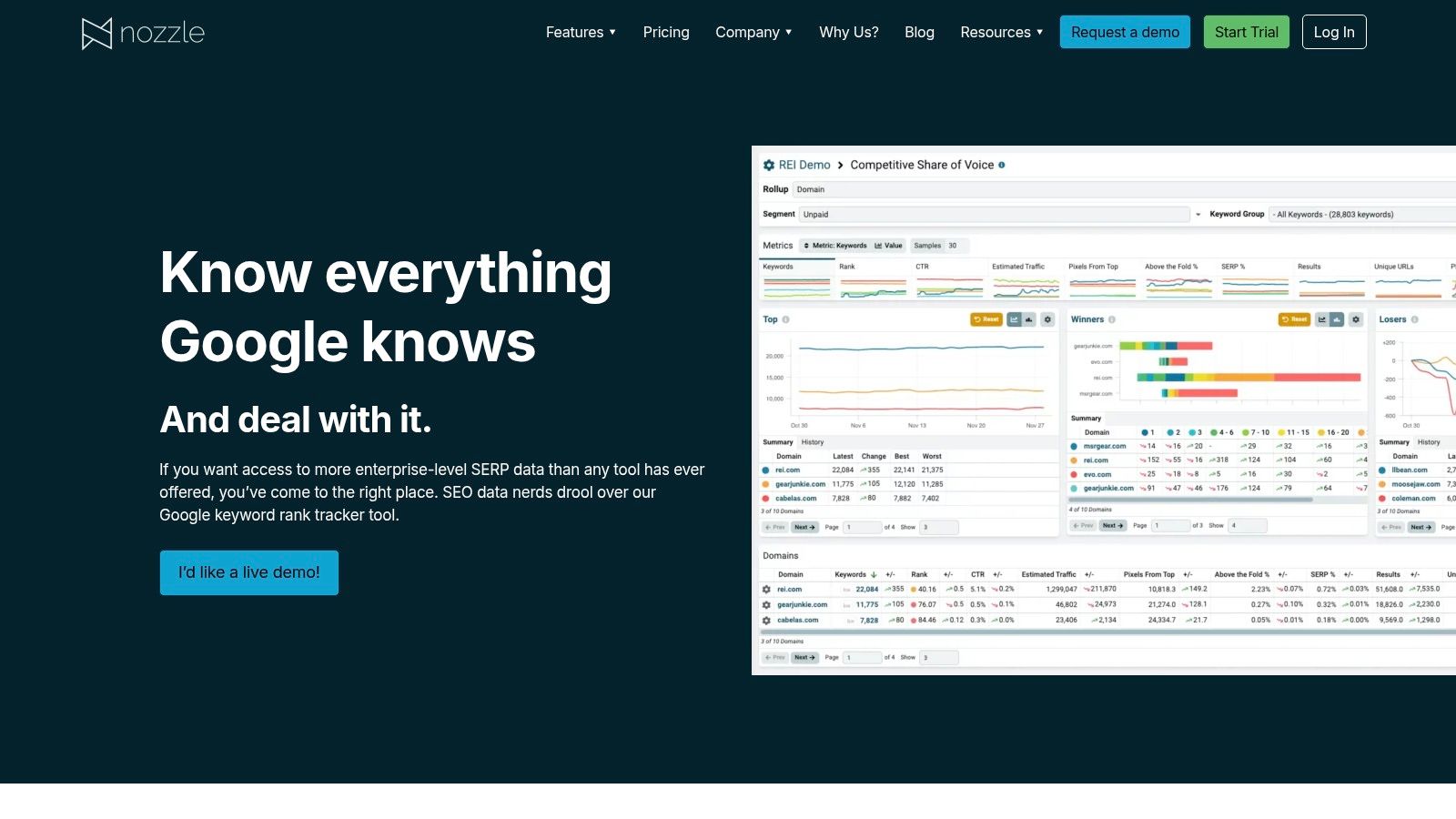
The platform’s strength is its raw data accessibility and powerful export capabilities. Instead of pre-canned reports, Nozzle empowers teams to build custom analytics. This is ideal for organizations that need to correlate AIO performance with broader business metrics.
Key Features & Use Cases
- AIO as a SERP Segment: Analyze AIO visibility within existing Share of Voice and performance dashboards.
- SERP Replays and Screenshots: Capture and review historical SERPs, including AIOs, for analysis.
- BI-Friendly Data Exports: Pipe raw SERP and AIO data directly into BigQuery or Looker.
Pricing and Access
Nozzle uses a usage-based pricing model. For enterprise needs, pricing is typically discussed directly with their sales team.
Pros & Cons
- Pros: Highly flexible, analysis-first approach; powerful data export options for BI integration.
- Cons: Requires significant time to configure; best for teams with strong data analysis capabilities.
Website: https://nozzle.io
11. thruuu
thruuu integrates AI Overview (AIO) monitoring with content creation workflows. It appeals to content teams needing an affordable tool to build content for AIO placements. It provides AIO snapshots and shows which brands and sources are cited.
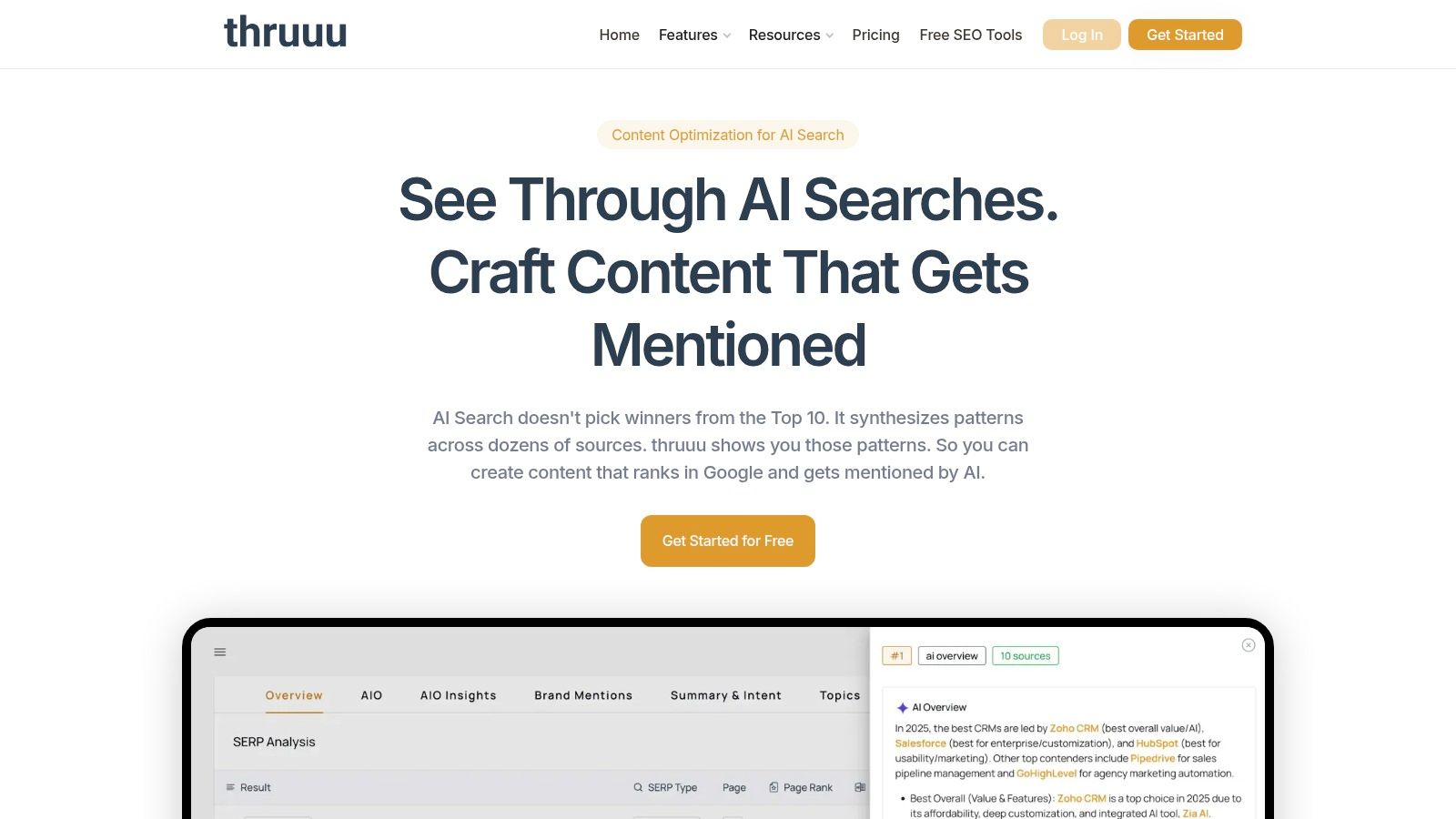
The platform connects AI visibility data directly to the content briefing process. It helps you act on insights immediately. You can analyze cited sources and then use the platform’s tools to structure a new article.
Key Features & Use Cases
- AIO Monitoring & Source Analysis: Track brand mentions and identify the specific domains cited in AI Overviews.
- AIO vs. Organic Comparison: Directly compare AIO results with traditional organic listings.
- Integrated Content Tools: Move from AIO analysis to using the SERP Analyzer and Content Briefs.
Pricing and Access
thruuu offers accessible pricing, with plans starting around $19/month. Access to AIO monitoring requires higher-tier plans but remains cost-effective.
Pros & Cons
- Pros: Affordable entry point; strong connection between AIO analysis and content creation workflows.
- Cons: The best AIO monitoring features are on higher-tier plans; fewer enterprise connectors.
Website: https://thruuu.com
12. Conductor
Conductor is an enterprise-grade solution with a sophisticated ‘AI Search Performance’ report. It tracks brand mentions and citations across ChatGPT, Perplexity, Gemini, and Google AIO. This provides a comprehensive view of a brand’s presence in the AI search ecosystem.
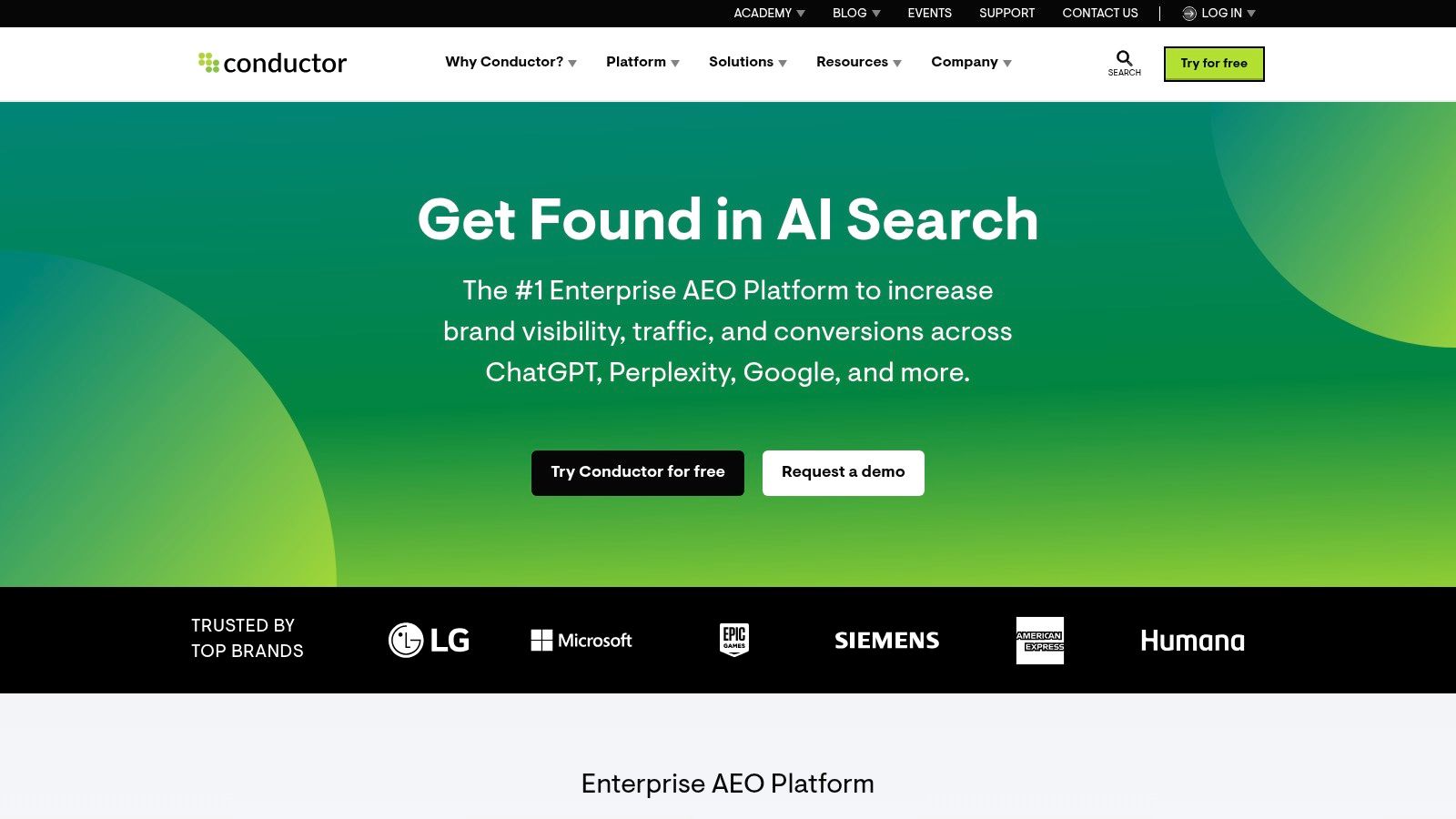
The platform’s key differentiator is its dual tracking capability. It caters to cross-functional teams from SEO and content to PR. Conductor captures full AI responses for detailed analysis of context and market share.
Key Features & Use Cases
- Multi-Engine AI Tracking: Monitor your brand’s visibility, sentiment, and citations across multiple AI engines.
- Deep AI Response Analysis: Capture and analyze full AI-generated answers to understand context.
- Cross-Functional Reporting: Create unified reports on topic and prompt performance for multiple stakeholders.
Pricing and Access
Conductor is an enterprise platform with custom pricing. Access typically involves a consultation and is positioned for larger organizations.
Pros & Cons
- Pros: Broad multi-engine coverage beyond Google AIO; designed for enterprise collaboration.
- Cons: Enterprise-level pricing; prompt and topic limits may require plan upgrades.
Website: https://www.conductor.com
Top 12 AI Visibility Tools — Feature Comparison
| Product | Core features | Source & actionability | Best for / Target audience | Price & positioning |
|---|---|---|---|---|
| Airefs (Recommended) | Prompt-based LLM monitoring, capture of AI answers, citation & source tracking, alerts, DFY execution | Deep source-level visibility + content & discussion opportunities; clear DIY or done‑for‑you workflows | B2B SaaS, in‑house marketers, agencies, founders aiming to own AI answers | Lite $24/mo · Pro $49 · Expert $83 · DFY from $299/mo; “Google Search Console for AI answers” (startup-friendly) |
| Semrush | All‑in‑one SEO + AIO keyword detection and content workflows | Adds AIO context to keyword strategy; less granular source citation than Airefs | Teams already in Semrush wanting AIO insights in existing SEO workflows | Mature SEO suite; pricing rises with add‑ons and seats |
| SISTRIX | AIO keyword filters, SERP archives, country trend monitoring | AIO indicators and citation details with strong SERP history | International SEO teams needing large‑scale AIO tracking | Professional/enterprise focus; pricing skewed toward larger teams |
| seoClarity | Brand/domain AIO visibility, cited links, trend deltas, snapshots | Deep reporting tying AIO to traffic & competitors; instant snapshots | Large sites and enterprise SEO teams needing keyword→URL impact | Enterprise pricing; sales cycle required |
| BrightEdge | Generative Parser, AIO detection, industry trend reporting | Source & citation analysis integrated into content workflows | Enterprise content teams and SEO orgs | Enterprise budget and onboarding |
| Similarweb / Rank Ranger | Rank tracking with AIO flags; SERP & traffic intelligence | Integrates AIO presence into rank and traffic reports | Teams blending rank/traffic analysis with AIO signals | Part of Similarweb ecosystem; tiered pricing |
| SEOmonitor | Daily AIO capture (full answers), brand mentions, export/API | Daily cadence mapped to rank projects; mobile + desktop coverage | Agencies and teams wanting daily AIO monitoring tied to projects | Varies by plan; some trial country limits |
| SE Ranking (SE Visible) | Multi‑engine AI monitoring (ChatGPT, Perplexity, Gemini, Google AI), prompt tracking | Multi‑engine visibility and brand dashboards at competitive price | SMBs and agencies needing multi‑engine coverage on a budget | Competitively priced; newer module with add‑ons possible |
| AccuRanker | Fast rank tracking, AIO overview page, top AIO URLs and history | Quick SOV widgets and per‑keyword AIO text; Google‑centric | Teams needing fast, frequent rank updates with AIO context | 24‑hour updates; higher tiers for advanced exports/scale |
| Nozzle | AIO as dashboard segment, SERP replays/screenshots, BI exports | Analysis‑first with BigQuery/Looker/Sheets exports for pipelines | Data‑driven teams integrating AIO into analytics stacks | Enterprise pricing; typically sales‑led |
| thruuu | AIO snapshots & monitoring, content briefs, clustering | Maps AIO sources to content workflows; affordable entry | Content teams and agencies focused on briefs & optimization | Accessible pricing; top AIO features on higher plans |
| Conductor | Full AI response capture, mention & sentiment analysis, prompt/topic management | Multi‑engine capture and cross‑functional AEO reporting | Enterprise AEO/SEO, content and comms teams | Enterprise platform with onboarding and plan limits |
How to Choose the Right AI Visibility Tool
The market for AI visibility tools has matured rapidly. The key takeaway is that visibility isn’t just about being mentioned. It’s about understanding the context, sources, and sentiment driving AI-generated answers.
Your journey begins with defining your goals. A proactive strategy involves influencing the sources AI models learn from. This requires a tool that can deconstruct AI responses and reveal the underlying content.
Defining Your Core Needs
Start by answering a few foundational questions. Are you focused on brand protection, competitive intelligence, or new content opportunities? Your answer will guide your evaluation.
- Brand Monitoring: Tools like Semrush, SISTRIX, or SE Ranking offer robust, accessible solutions for tracking brand mentions and sentiment.
- Competitive Share of Voice (SOV): For a deeper understanding of your market position, you’ll need platforms like seoClarity and BrightEdge.
- Source-Level Influence: To start influencing, you need to know why an AI says what it does. A tool like Airefs traces answers back to their sources, giving you a content roadmap.
Matching a Tool to Your Team and Budget
Your team’s operational reality is as important as your strategic goals. A complex enterprise tool is useless if your team lacks the bandwidth to use it.
For Enterprise Teams: Large organizations benefit from comprehensive platforms like seoClarity, BrightEdge, or Conductor. They offer deep data integration and justify their higher price for complex campaigns.
For Startups and SMBs: Smaller teams should look for tools with a blend of functionality and value. SE Ranking and SEOmonitor provide excellent AI features without the enterprise cost. For source analysis, Airefs delivers actionable insights without overwhelming a lean team.
For Agencies: Agencies need scalable, efficient tools with clear reporting. Similarweb and SE Ranking are strong contenders with multi-project management and API access.
From Data to Action: The Final Deciding Factor
The best AI visibility tool closes the loop between data and action. It’s not enough to know you were mentioned; you need to know what to do next. Ask if the tool provides a clear path from insight to implementation.
Take advantage of free trials. Test each platform with your own brand and a core industry topic. This hands-on experience is the only way to find which tool aligns with your workflow. For more context, explore various AI competitive analysis tools in 2026.
Ready to stop just tracking mentions and start influencing them? Airefs is the only tool designed to show you the why behind AI answers, tracing them back to the exact sources you can influence. See which articles, discussions, and reviews are shaping AI’s perception of your market and get a clear roadmap to improve your AI visibility.
Start Your Free Airefs Trial Today
FAQ About AI Visibility Tools
What is AI visibility?
AI visibility is your brand’s presence in the answers generated by AI search engines like Google AI Overview, ChatGPT, and Perplexity. It measures how often your brand, products, or content are cited as a source or mentioned in AI responses. The goal is to become a trusted, authoritative source for these AI models.
How do AI visibility tools work?
These tools monitor various AI platforms by submitting specific prompts or keywords at scale. They capture the AI-generated responses, analyze the text, and identify which brands, websites, or URLs are cited as sources. This data is then aggregated into dashboards showing metrics like Share of Voice, source mentions, and sentiment.
Why is traditional rank tracking not enough for AI search?
Traditional rank trackers measure your URL’s position on a standard search engine results page (SERP). They cannot “see” inside the AI-generated answer boxes, which often synthesize information from multiple sources without requiring a user to click a link. AI visibility tools are designed specifically to analyze the content of these AI answers.
Can I really influence what an AI says?
Yes. AI models learn from a vast corpus of public web data, including articles, forums, reviews, and documentation. By creating high-quality, authoritative content on the topics your customers care about and engaging in relevant online discussions, you can influence the information ecosystem that AI models use. Tools that identify these sources give you a direct roadmap for influence.