Traditional SEO focused on one thing: ranking on Google’s blue links. In 2026, that’s no longer enough. ChatGPT, Perplexity, and Google AI Overviews now answer millions of buying queries directly — recommending products, comparing vendors, and naming brands without users ever clicking a search result. The brands getting cited in those answers are winning customers before a competitor’s website even loads.
AI SEO tools are the platforms built for this shift. They track your brand in AI-generated answers, identify which sources AI models cite, monitor competitor mentions across LLMs, and tell you exactly what to do to show up more. The best ones also bridge the gap between traditional SEO and AI search — because ranking in Google AI Overviews and ranking in organic results are increasingly the same work.
This guide covers the 12 best AI SEO tools in 2026 — platforms that track AI visibility across ChatGPT, Google AI Overviews, Perplexity, and more, with pricing from $24/mo to enterprise custom.
What are the best AI SEO tools in 2026?
The top 12 AI SEO tools are Airefs, Semrush AI Toolkit, Ahrefs Brand Radar, SE Visible, SEOmonitor, Morningscore, Profound, Peec AI, Otterly AI, AthenaHQ, Scrunch AI, and Writesonic GEO.
Top AI SEO tools — Comparison table
| Tool | Best for | AI Platforms | Starting price |
|---|---|---|---|
| Airefs | AEO + SEO combined; ChatGPT-first tracking with Reddit monitoring | ChatGPT (default), others on request | $24/mo |
| Semrush AI Toolkit | Existing Semrush users adding AI visibility | ChatGPT, Google AI Overviews, AI Mode, Perplexity, Gemini | $99/mo |
| Ahrefs Brand Radar | Largest prompt database; Ahrefs users | ChatGPT, Perplexity, Gemini, Copilot, AI Overviews, AI Mode | EUR 773/mo (add-on) |
| SE Visible | Multi-brand agencies; unlimited seats | ChatGPT, Perplexity, Gemini, AI Overviews, AI Mode | $189/mo |
| SEOmonitor | SEO agencies unifying Google + AI tracking | ChatGPT, Gemini, Perplexity, AI Overviews | EUR 99/mo |
| Morningscore | SMBs wanting SEO + AI in one gamified platform | ChatGPT, AI Overviews | $49/mo |
| Profound | Enterprise AEO with content generation | ChatGPT, Perplexity, Claude, Gemini, Grok, 10+ | $99/mo |
| Peec AI | Funded startup; strong case studies | ChatGPT, Perplexity, AI Overviews (+ others €20-30/mo) | $89/mo |
| Otterly AI | Affordable AEO with Gartner recognition | ChatGPT, AI Overviews, AI Mode, Perplexity, Gemini, Copilot | $29/mo |
| AthenaHQ | YC-backed; exceptional case studies | ChatGPT, Perplexity, Google AI Overviews, AI Mode, Gemini, Claude, Copilot, Grok | $95/mo (annual) |
| Scrunch AI | Enterprise AI experience platform | ChatGPT, Perplexity, Google AIO, Copilot (+ 5 on Enterprise) | $250/mo |
| Writesonic GEO | Content production + AI visibility combined | ChatGPT, Claude, Gemini, Perplexity, 10+ | $199/mo |
1. Airefs
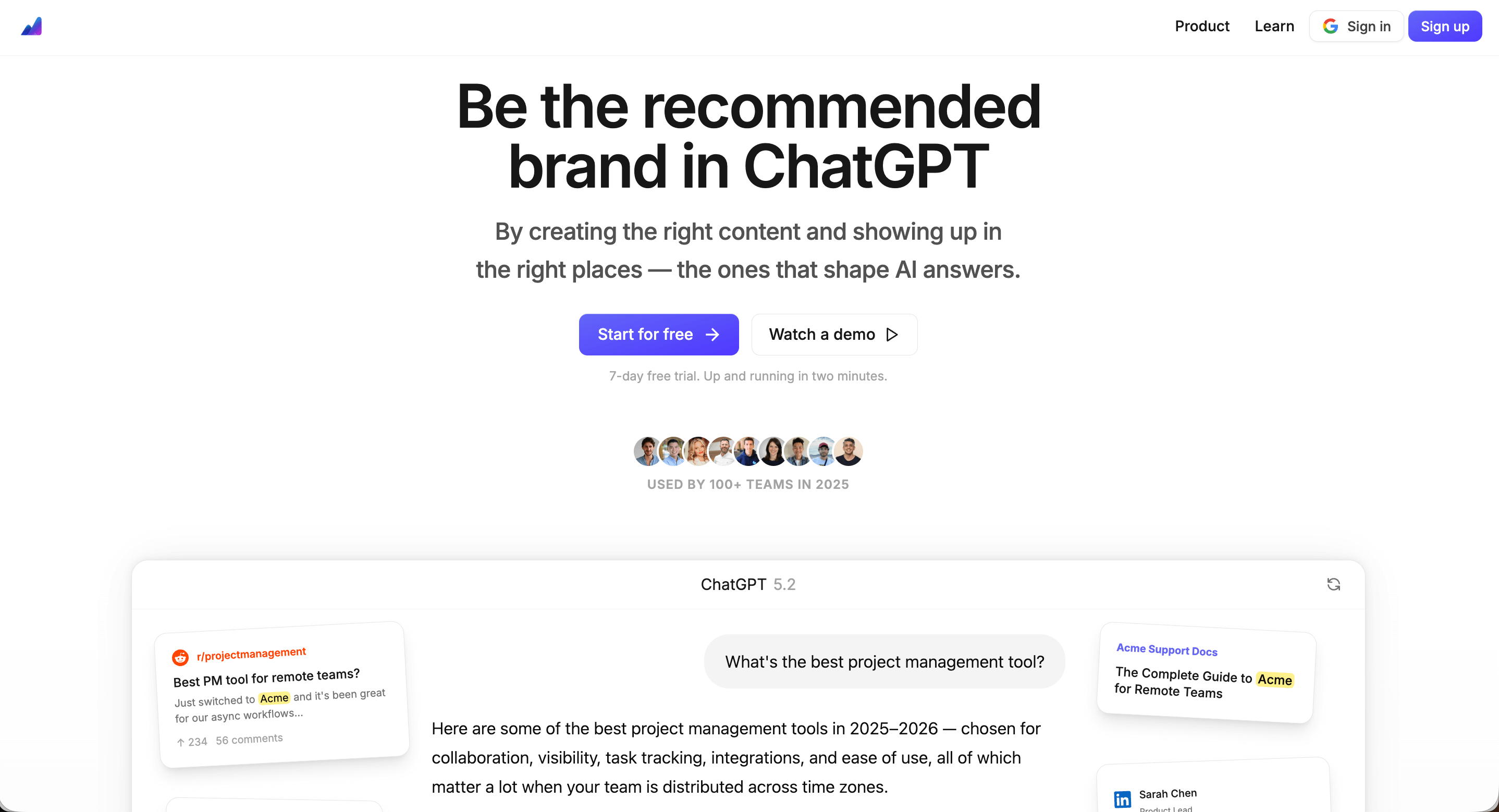
Airefs is the AI SEO tool built on a simple premise: most AI answers pull from a small, predictable set of sources — and if you know what those sources are, you can influence them. Rather than giving you a visibility score and leaving you to figure out the rest, Airefs shows you the exact articles, Reddit threads, and forums that ChatGPT cites for the queries that matter to your business, then tells you which ones to create, update, or join.
It’s one of the few platforms that combines prompt tracking with AI crawler analytics in a single dashboard, bridging traditional SEO and AI search. Your AI crawler data tells you how often GPTBot and other AI crawlers visit your site; your prompt tracking tells you whether those visits translate into mentions. That closed loop makes Airefs uniquely useful for teams that need to improve their AI visibility without guessing.
Key features:
- Prompt tracking — Runs your defined queries on ChatGPT (by default) and records whether your brand, competitors, or specific URLs appear in the answer
- Source-level discovery — Identifies the exact articles, forums, and Reddit threads that AI models pull from when answering questions in your category
- AI crawler analytics — Tracks real visits from GPTBot, PerplexityBot, ClaudeBot, and other AI crawlers; shows which pages get used and how often
- Reddit monitoring — Alerts you to new discussions in your niche before they become established AI sources; plan-dependent keyword tracking
- AEO + SEO combined — Shows content opportunities that improve both AI mentions and traditional Google rankings, including blog content, forum participation, and link-building
- Done-for-you option — Agency package includes an AEO strategist, content creation, and human participation in relevant discussions
Pricing:
| Plan | Price | Prompts | Domains |
|---|---|---|---|
| Lite | $24/mo | 25 (ChatGPT by default) | 1 |
| Pro | $49/mo | 60 (ChatGPT, others on request) | 3 |
| Expert | $83/mo | 150 (ChatGPT by default) | Unlimited |
| Done-for-you | $299/mo+ | Included | Unlimited |
All plans include a 7-day free trial on Pro.
Pros:
- Lowest starting price among full-featured AI SEO platforms ($24/mo)
- Source-level citation data shows exactly what to create or engage with — not just scores
- Combines prompt tracking with AI crawler analytics for a complete picture
- Reddit monitoring catches new conversation opportunities before competitors do
- Done-for-you package handles execution, not just strategy
Cons:
- Prompt tracking defaults to ChatGPT (other LLMs on request, not built-in for all plans)
- Smaller brand recognition than Semrush or Ahrefs
Customers: 100+ teams across startups, SMBs, and agencies.
“Airefs gives us clear visibility into how our brand shows up across LLMs. This is something we simply couldn’t easily track before.” — Anthony L, Head of Marketing, LegalVision
Website: getairefs.com
2. Semrush AI Toolkit
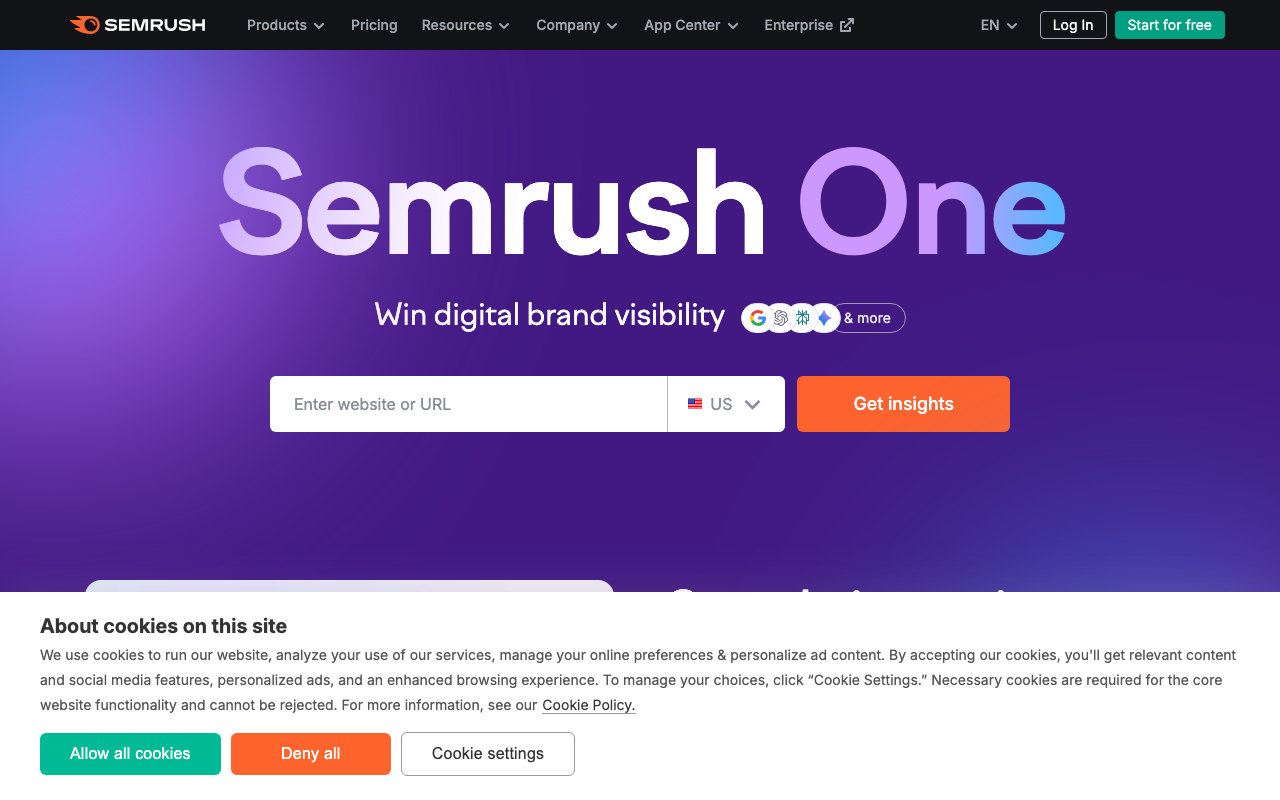
Semrush is the most recognized name in SEO ranking and reporting software, and its AI Visibility Toolkit extends that brand equity into AI search. For teams already paying for Semrush, it’s the most logical first step into AI SEO — the data lives in a platform you already know, and AI visibility sits alongside keyword tracking, site audits, and backlink analysis.
The toolkit measures your AI Visibility Score: how often your brand appears in AI-generated answers compared to up to nine competitors. It runs prompts across ChatGPT, Google AI Overviews, AI Mode, Perplexity, and Gemini, surfacing where you’re visible, where you’re absent, and which keywords represent the best opportunity to close the gap.
Key features:
- AI Visibility Score — Brand impression percentage across AI responses, benchmarked against up to 9 competitors
- Prompt tracking — 25 custom prompts included in the standalone toolkit ($99/mo), more on Semrush One plans
- Keyword opportunity discovery — Identifies prompts where competitors appear but you don’t
- AI SEO audit — Crawlability analysis across devices and LLMs to catch technical barriers
- Integrated SEO suite — Rank tracking, backlink analysis, site audits, and keyword research in one platform
Pricing:
| Plan | Price | Prompts | Domains |
|---|---|---|---|
| AI Visibility Toolkit (standalone) | $99/mo | 25 | 1 |
| Additional 50 prompts | +$60/mo | — | — |
| Semrush One Starter | $199/mo | 50 | 5 |
| Semrush One Pro+ | $299/mo | 100 | 15 |
Annual billing saves 17%. No free trial for the AI toolkit (demo reports available).
Pros:
- Combines traditional SEO and AI visibility in one trusted platform
- Large existing user base means strong community, integrations, and support
- Strong testimonials with quantified results (one agency attributes 40% of new leads to AI visibility)
Cons:
- Expensive to scale ($99/mo per domain; +$99/mo per additional user; +$60/mo per 50 prompts)
- No free trial for the AI toolkit
- Keyword-based tracking approach is less aligned with natural language AI queries
Customers: 10M+ Semrush users; AI toolkit adopted by Coalition Technologies, Sure Oak, Chargeblast.
“The AI visibility score that’s provided by Semrush is a piece of how we’re reporting that.” — Jordan Brannon, President, Coalition Technologies
Website: semrush.com
3. Ahrefs Brand Radar
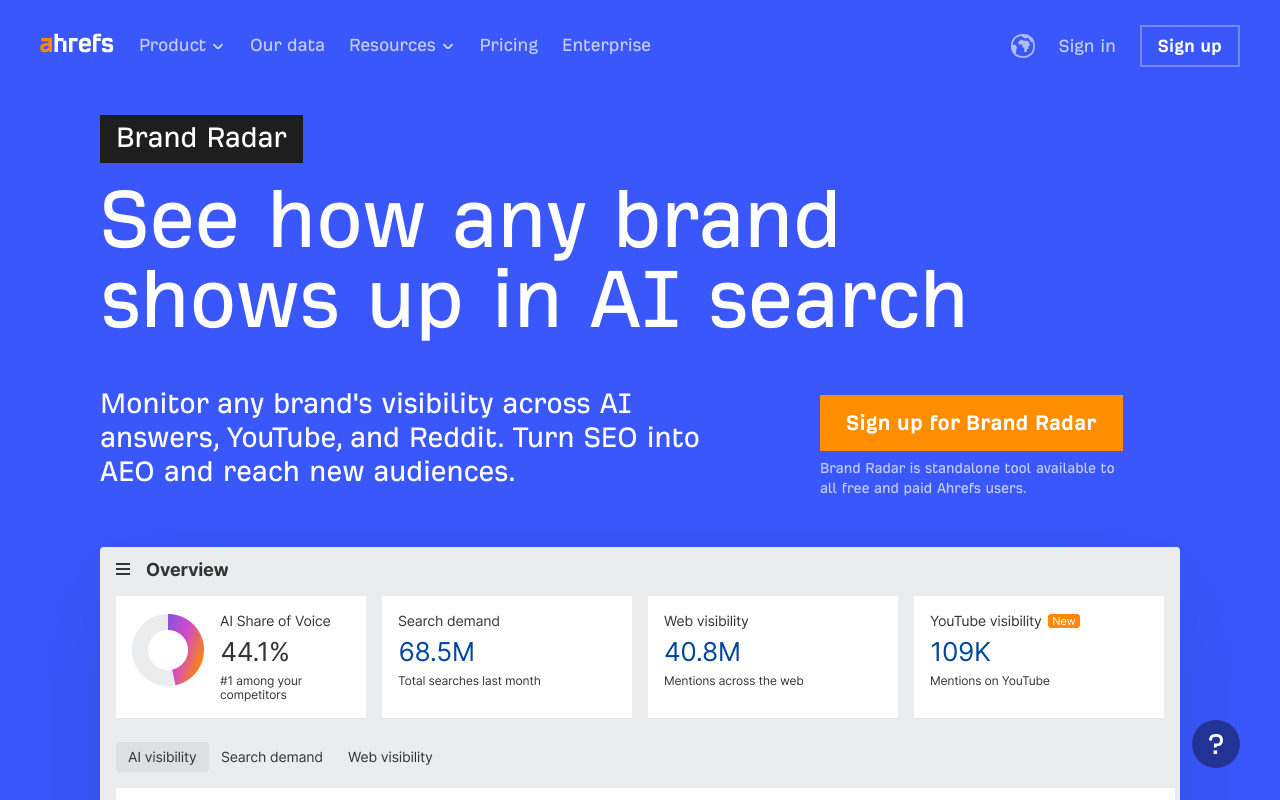
Ahrefs built its reputation on the largest backlink index in SEO, and Brand Radar extends that data-driven approach to AI search. With 253M+ monthly prompts tracked — drawn from real search data rather than synthetic queries — it has the largest prompt database of any platform reviewed here. For teams already on Ahrefs, the integration with Site Explorer, Keywords Explorer, and Site Audit means AI visibility data lives alongside the SEO metrics you already act on.
The share of voice methodology shows your brand impression percentage across AI responses, how it trends over time, and which competitors are gaining ground. Industry segmentation lets you separate, say, a technology company’s fitness product visibility from its software visibility — a level of granularity most dedicated AEO tools don’t offer.
Key features:
- AI Share of Voice — Brand impression percentage across AI responses with competitor benchmarking
- Cited domains & pages — Identify top sources cited when AI answers mention your brand
- 253M+ monthly prompts — Search-backed (not synthetic), giving real-world signal on what users actually ask
- Custom prompt tracking — Schedule daily, weekly, or monthly tracking for specific queries
- Industry segmentation — Filter visibility by vertical to separate distinct business lines
- Historical data — Access historical AI visibility trends (rare among newer competitors)
- Full Ahrefs integration — Site Explorer, Keywords Explorer, Site Audit, Rank Tracker
Pricing:
| Plan | Monthly | Annual |
|---|---|---|
| Ahrefs Lite (base required) | EUR 119/mo | EUR 1,190/yr |
| Single AI index (per platform) | +EUR 179/mo | +EUR 1,790/yr |
| All indexes bundle (6 platforms) | +EUR 654/mo | +EUR 6,540/yr |
| Custom queries | EUR 1.87/unit | EUR 1.87/unit |
Minimum cost: ~EUR 773/mo (Lite + all 6 indexes).
Pros:
- Largest prompt database (253M+ monthly, search-backed not synthetic)
- Historical data gives a baseline that newer tools lack
- Full integration with established Ahrefs SEO platform
Cons:
- Most expensive option by far (EUR 773/mo minimum)
- Significant accuracy issues: independent testing found 3 ChatGPT mentions reported vs 123 actual (97% undercounting)
- No sentiment analysis or quality scoring despite premium pricing
- Keyword-based tracking is misaligned with natural language AI queries
“Incredibly ambitious and powerful research tool, boasting the largest prompt database available. However, its eye-watering price, questionable accuracy in key areas, and agency-unfriendly model make it a niche solution.” — EWR Digital, Feb 2026
Website: ahrefs.com/brand-radar
4. SE Visible (by SE Ranking)
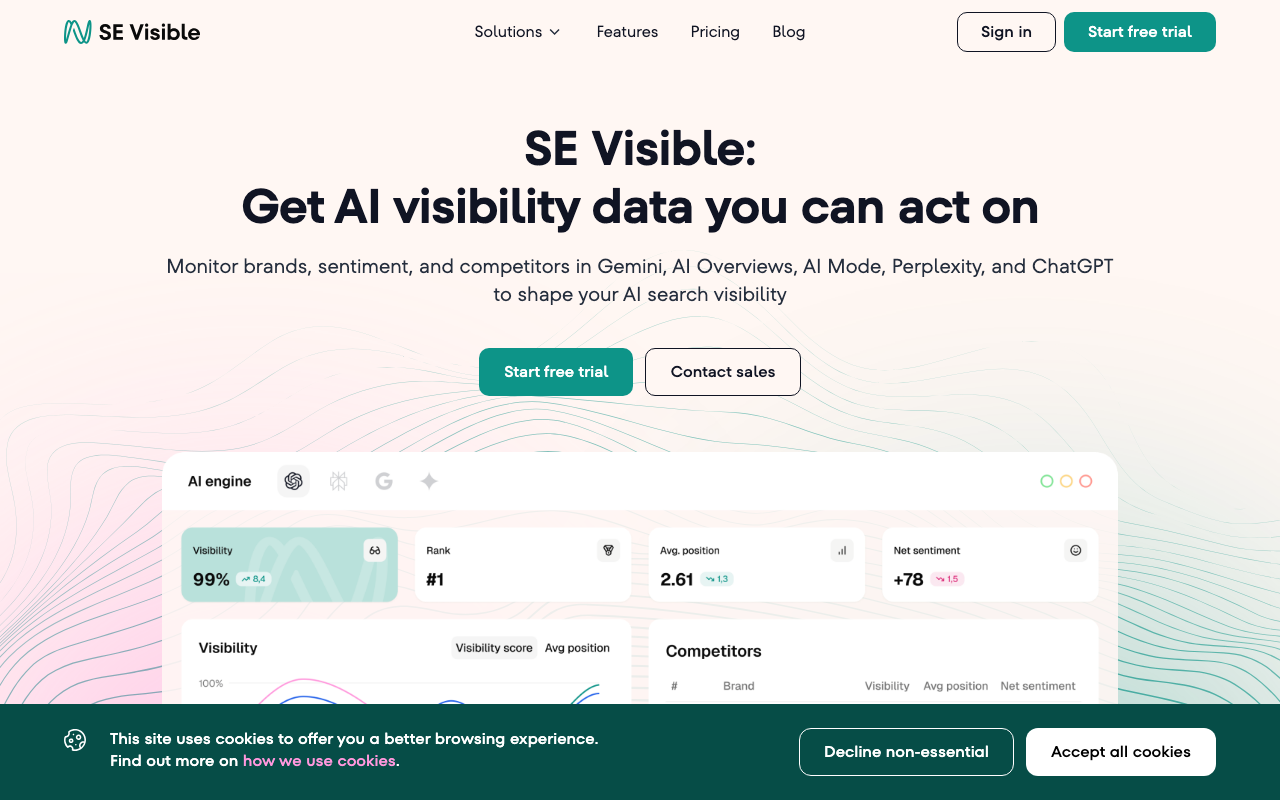
SE Ranking has been building SEO tools for over a decade. SE Visible is their purpose-built AI visibility platform, designed with the operational maturity their parent company is known for: multi-brand management, unlimited seats, multi-country support, and weekly automated reports out of the box.
It’s a strong fit for agencies managing multiple clients across different markets. While newer dedicated AEO platforms are still figuring out multi-region support, SE Visible launched with 7 countries and 5 languages built in — a meaningful advantage for international teams. At $189/mo for 450 prompts across 5 brands with unlimited user seats, it’s also one of the better values at the mid-tier price point.
Key features:
- Brand mention tracking — Across ChatGPT, Perplexity, Gemini, AI Overviews, AI Mode
- Sentiment analysis — Tracks whether AI mentions your brand positively, negatively, or neutrally
- Competitor benchmarking — Side-by-side AI visibility comparison across tracked brands
- Source/citation tracking — Identifies which URLs AI models cite when mentioning your brand
- Multi-brand management — 5 brands on Core, 10 on Plus, 15 on Max
- Unlimited user seats — No per-seat pricing on any plan
- Multi-country/language — 7 countries (US, UK, Canada, France, Germany, Netherlands, Spain), 5 languages
- Weekly performance updates — Automated reports included on all plans
Pricing:
| Plan | Monthly | Annual (~20% off) | Prompts | Brands |
|---|---|---|---|---|
| Core | $189/mo | ~$151/mo | 450 | 5 |
| Plus | $355/mo | ~$284/mo | 1,000 | 10 |
| Max | $519/mo | ~$415/mo | 1,500 | 15 |
10-day free trial on all plans.
Pros:
- Unlimited user seats on all plans (great for agencies)
- Multi-country and multi-language from day one
- Backed by SE Ranking’s 10+ years of SEO expertise and infrastructure
Cons:
- Product is relatively new (late 2025) — no testimonials yet
- Only 5 AI platforms (missing Claude, Grok, DeepSeek, Meta AI)
- “Coming soon” features suggest the product is still maturing
- Weekly updates vs daily from some competitors
Website: visible.seranking.com
5. SEOmonitor
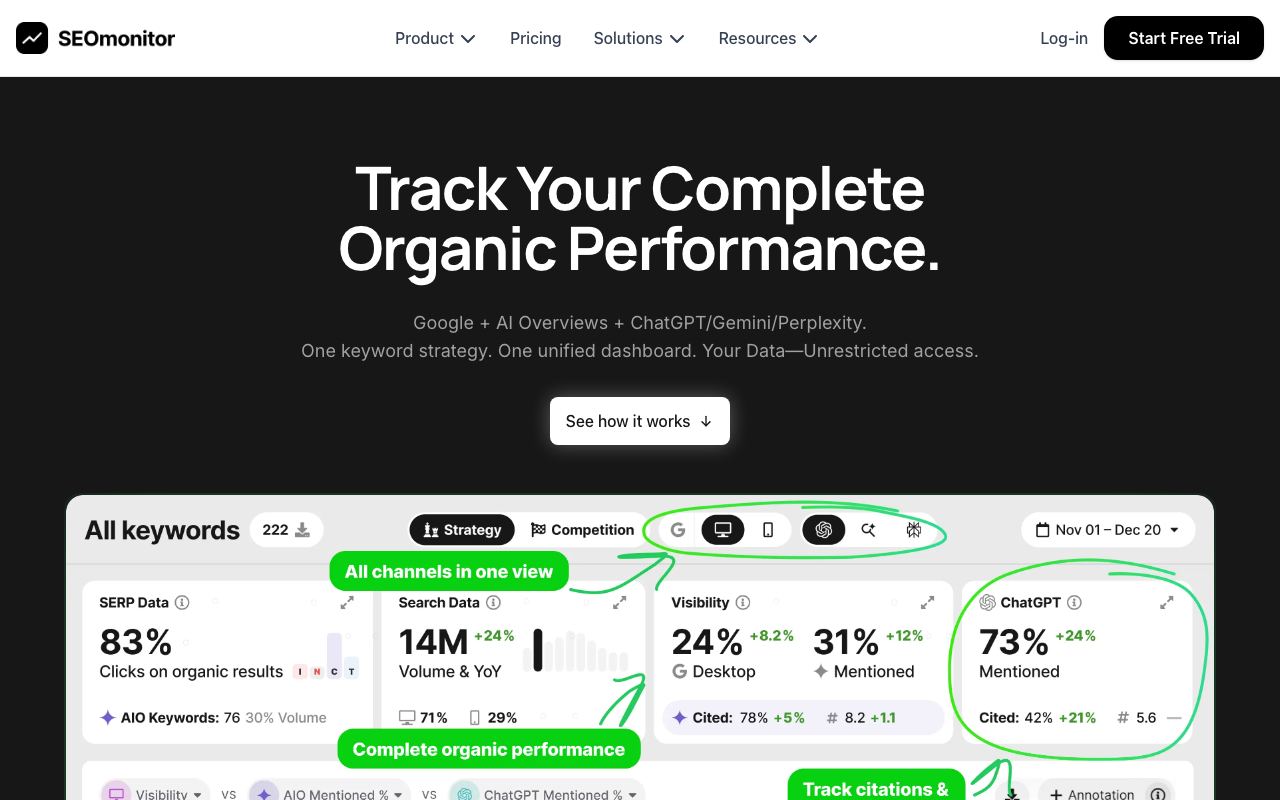
SEOmonitor is one of the most compelling tools on this list for SEO agencies: it unifies Google rank tracking, AI Overview monitoring, and ChatGPT/Gemini/Perplexity visibility into a single dashboard — with a pricing model that charges per keyword tracked, not per seat. Unlimited users is standard. That makes it exceptional for agencies billing hourly or managing large teams where per-seat costs add up.
Its Autonomous Content Writer goes from topic discovery all the way to CMS publishing and performance tracking. SEOmonitor’s published stats are striking: 80% of articles written using its workflow rank within 30 days, and 52% get cited in AI Overviews. For agencies focused on both traditional search marketing intelligence and AI visibility, it’s one of the few tools that handles both without compromise.
Key features:
- Unified dashboard — Google rankings + AI Overviews + ChatGPT/Gemini/Perplexity in one view
- AI Overview tracking — Mentions and citations tracking in Google’s AI answers
- AI Search tracking — Weekly visibility across ChatGPT, Gemini, Perplexity
- Autonomous Content Writer — Topic discovery → draft → CMS publishing → performance tracking
- SEO forecasting — Seasonality, YoY trends, CTR curves, AI Overview impact modeling
- Keyword research — Auto-clustering, intent detection, irrelevant keyword filtering
- Full API access (API 3.0) and Agency Dashboard
Pricing:
| Plan | Price | Notes |
|---|---|---|
| Starter | EUR 99/mo | Pay-per-keyword model |
| Pro | EUR 299/mo | Advanced features |
| Writer add-on | EUR 25/mo | Autonomous Content Writer |
Unlimited users on all plans. 14-day free trial, no credit card. PITCH phase (setting up campaigns) is free; WIN phase (activating campaigns) triggers payment.
Pros:
- Pay-per-keyword model with unlimited users — unusually agency-friendly
- Autonomous Content Writer with full publishing pipeline (unique at this price)
- Impressive published results: 80% articles rank in 30 days, 52% cited in AI Overviews
Cons:
- Weekly AI Search updates vs daily from dedicated AEO tools
- EUR pricing may be less attractive for US customers
- PITCH/WIN phase structure adds complexity to onboarding
Customers: Vodafone, Publicis, Performics, Marks & Spencer, Gymshark, Omio, Miro, TUI, Brainlabs, Wavemaker. G2 rating: 4.7/5.
“10x team productivity. The AI Content Writer alone saves us 100+ hours monthly.” — Radu Marcusu, CEO, Upswing
Website: seomonitor.com
6. Morningscore
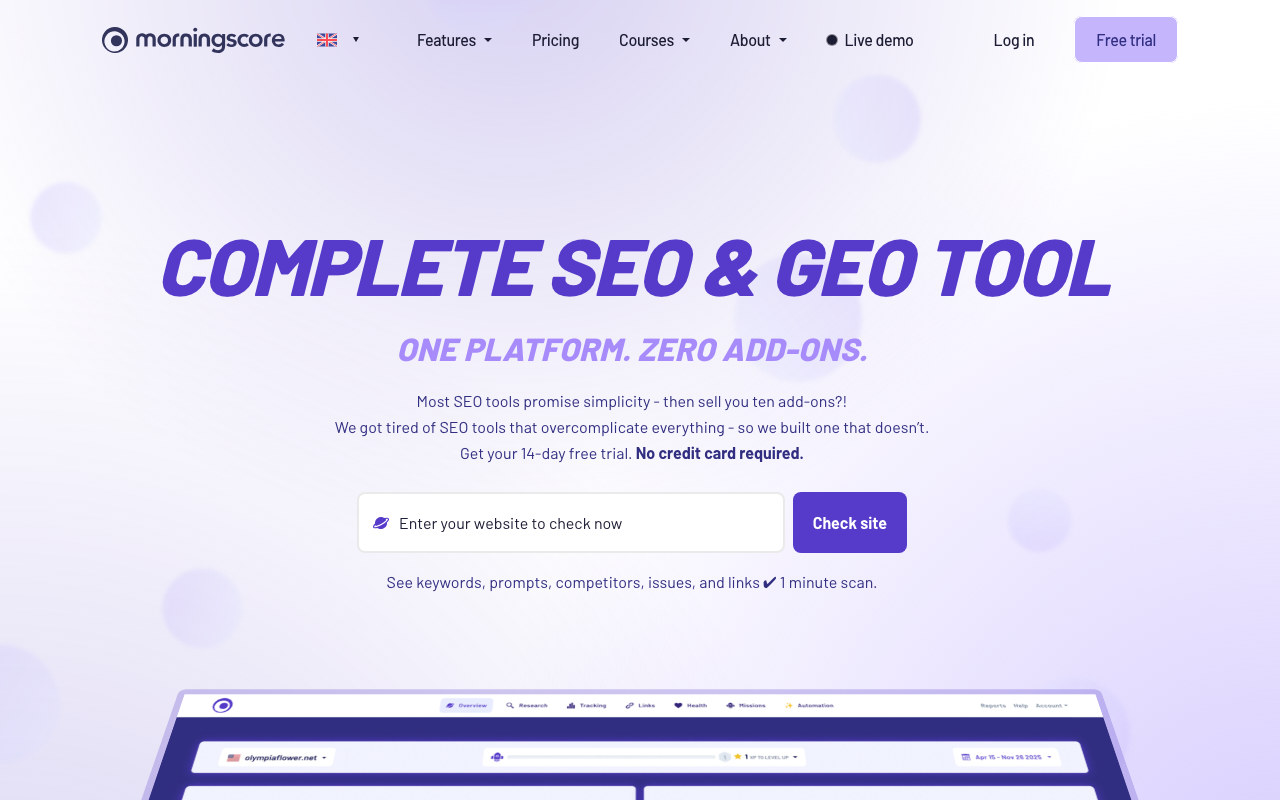
Morningscore is a full SEO platform — keywords, backlinks, site health, and now AI visibility — built for SMBs who want one tool rather than a stack. Founded in 2018, it serves around 3,700 customers and has earned strong ratings across Trustpilot (4.7/5), Google Reviews (4.9/5), and G2 (4.5/5). Its AI tracking sits inside a familiar SEO workflow, so teams don’t have to learn an entirely new tool to start monitoring ChatGPT and AI Overviews.
What makes Morningscore distinctive is its gamified progress system — teams earn XP as they complete optimization tasks — and its transparency: it shows the actual AI response text as proof of brand mentions, not just a number. At $49/mo for the Business plan with 100 tracked prompts, it’s one of the most affordable entries into combined SEO + AI tracking.
Key features:
- ChatGPT rank tracker — Tracks brand mentions in ChatGPT responses
- AI Overviews tracker — Monitors citation and appearance in Google AI Overviews
- Full SEO platform — Keywords (rank tracker, research, competitor analysis), Links (backlink checker, link building), Health (SEO audit, broken links, site speed)
- AI Content Writer — Integrated content creation tool
- Shows actual AI response text — Transparency on how brand appears, not just a score
- WordPress plugin (RANK AI) and Shopify app
- Gamified XP system — Progress tracking to keep teams motivated and accountable
Pricing:
| Plan | Price | Keywords | Prompts | AI Credits |
|---|---|---|---|---|
| Lite | $49/mo | 100 | 10 | 50 |
| Business | $69/mo | 500 | 100 | 500 |
| Pro | $129/mo | 2,000 | 500 | 2,500 |
| Premium | $259/mo | 5,000 | 2,000 | 10,000 |
14-day free trial, no credit card required.
Pros:
- Affordable combined SEO + AI tracking from $49/mo
- Full SEO platform means one subscription instead of two tools
- Shows actual AI response text (rare transparency)
- WordPress and Shopify integrations
Cons:
- AI tracking is an add-on to a SEO platform, not the core focus
- Limited prompt counts even on higher plans (10 prompts on Lite)
- Tracking limited to ChatGPT and AI Overviews (misses Perplexity, Claude, Gemini)
Customers: ~3,700 customers. Based in Odense, Denmark.
“70 percent of our revenue comes from organic traffic now. If it wasn’t for Morningscore, we wouldn’t have grown to have our own production facilities.” — Celia Kirkegaard Nielsen, Co-owner, Cloud Celebration
Website: morningscore.io
7. Profound
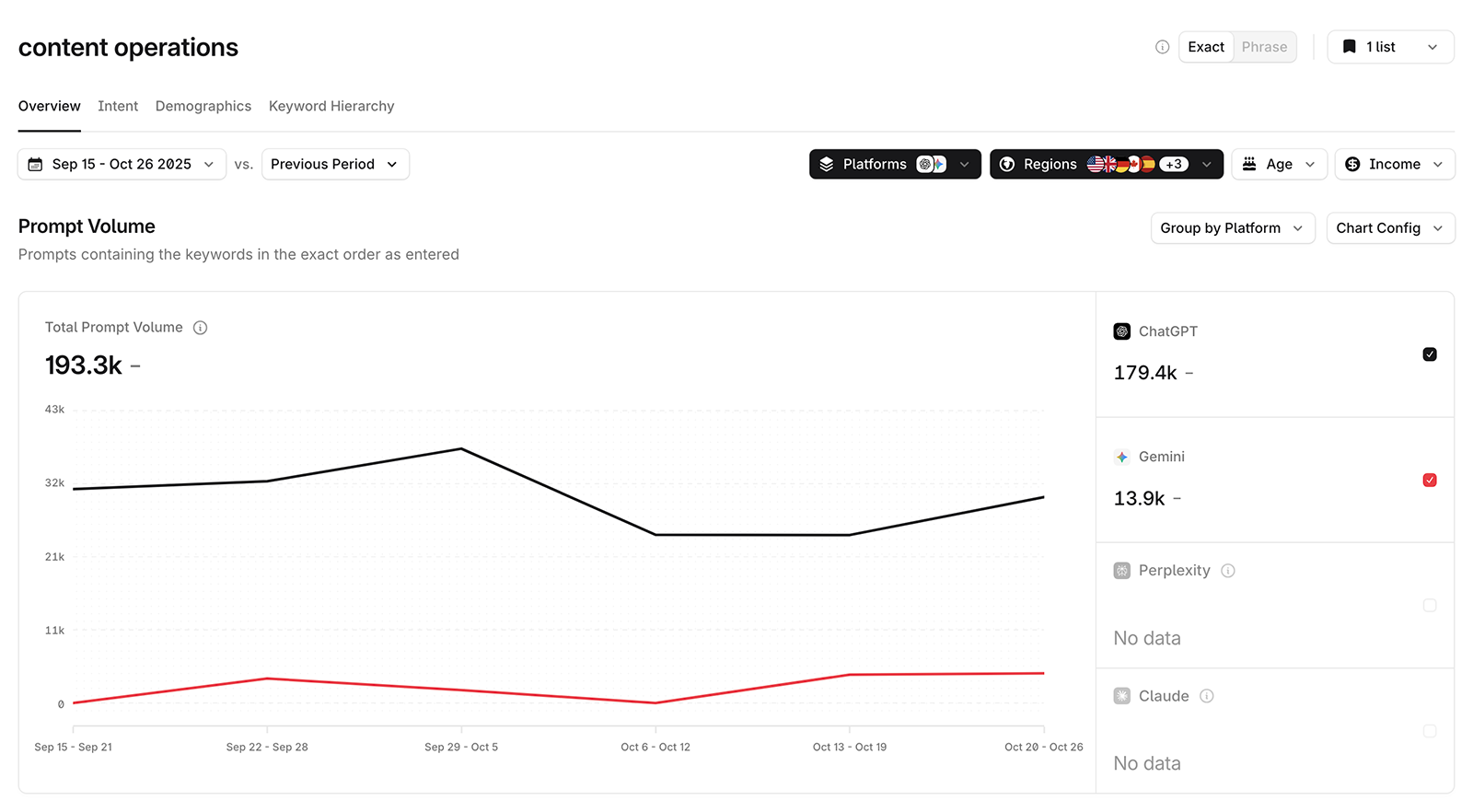
Profound is the most-funded AEO platform in the market — $58.5M total across seed, Series A (Kleiner Perkins + NVIDIA), and Series B (Sequoia) — and it shows in the depth of its feature set. It tracks across 10+ AI models including ChatGPT Shopping, DeepSeek, and Grok, generates AI-optimized content at scale, and provides prompt volume data showing how many people are searching for related queries across AI platforms.
For enterprise teams that need AI search data combined with content production and competitive intelligence, Profound is the most comprehensive single platform. Its G2 Winter 2026 AEO Leader status and customer list (MongoDB, Ramp, Figma, Zapier, DocuSign) reflect genuine enterprise adoption, not just marketing claims. Ramp’s case study — 7x AI visibility increase and becoming the 5th most visible fintech brand globally — is one of the most cited results in the AEO category.
Key features:
- Answer Engine Insights — Brand mention tracking, AI response analysis, citation discovery across 10+ platforms
- Agent Analytics — AI crawler visibility, traffic attribution, content performance
- Prompt Volumes — AI search volume data, trend discovery, performance benchmarking
- ChatGPT Shopping — Shopping visibility, shopping triggers, product analysis
- Content Agents — AI-optimized content creation at scale (listicles, how-tos, comparisons) with human-in-the-loop review
Pricing:
| Plan | Price | Prompts | Platforms |
|---|---|---|---|
| Starter | $99/mo | 50 | ChatGPT only |
| Growth | $399/mo | 100 | ChatGPT, Perplexity, Google AI Overviews |
| Enterprise | Custom | Custom | All 10+ AI models |
| Agency Growth | $99/mo | 10 pitch workspaces | — |
Annual billing discount available. API access is Enterprise-only.
Pros:
- Most comprehensive platform coverage (10+ AI models)
- Massive funding ($58.5M) and proven enterprise results (7x visibility increases)
- Prompt volume data shows AI search demand (rare feature)
- G2 Leader in AEO category
Cons:
- Starter plan limited to ChatGPT only with just 50 prompts
- Growth plan ($399/mo) is a significant jump from Starter
- Enterprise pricing is opaque
Customers: MongoDB, Indeed, Mercury, Docusign, Zapier, Ramp, Figma, Zocdoc, G2, US Bank, Clay, Mejuri.
“Ramp boosted AI visibility 7x and became the 5th most visible fintech brand globally within weeks.” — Profound case study
Website: tryprofound.com
8. Peec AI
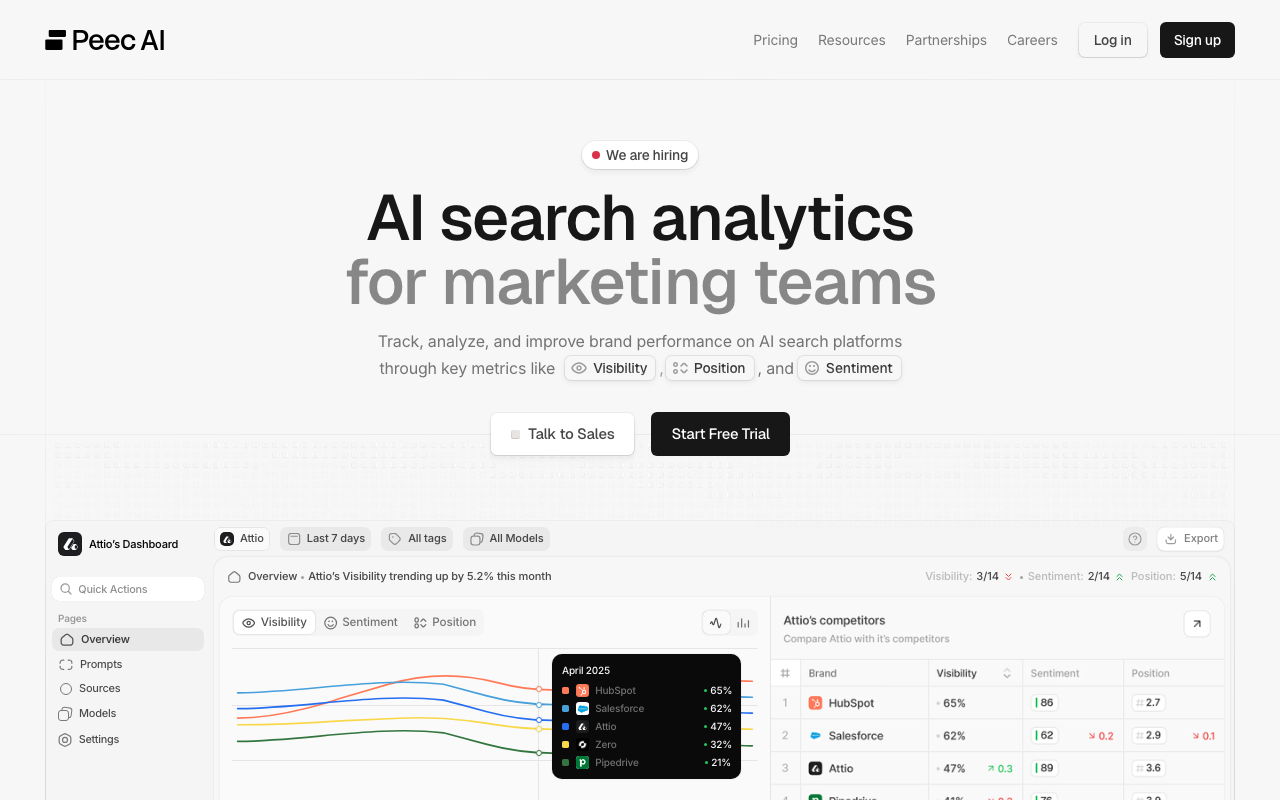
Peec AI is one of the fastest-growing AEO platforms in the market — EUR 650K ARR within 4 months of launch, $30M+ in total funding, and a $100M+ valuation before its first birthday. Founded in Berlin in early 2025, it focuses on accuracy: rather than calling AI APIs, Peec uses UI scraping technology that simulates how real users interact with ChatGPT, Perplexity, and AI Overviews. That means the data reflects what users actually see, not what the API returns.
Its case studies with Wix (5x YoY increase in LLM traffic), Glide (blog posts ranking in ChatGPT within 24 hours), and Merge (5x increase in LLM-driven demo requests) are among the strongest in the category. Peec has 115+ language support and strong regional breakdown capabilities, making it particularly useful for international brands.
Key features:
- Brand visibility monitoring — Percentage-based metrics across tracked AI platforms
- Competitor benchmarking — Regional breakdowns showing where you appear vs competitors by market
- Sentiment analysis — Tracks whether AI answers present your brand positively or negatively
- Source & citation tracking — Identifies which URLs AI models reference
- Actionable recommendations — Specific suggestions to improve visibility in each platform
- UI scraping technology — Simulates real user interactions rather than API calls for more accurate data
Pricing: Starting at $89/mo. 14-day free trial. All plans include daily tracking of ChatGPT, Perplexity, and AI Overviews. Additional platforms (Claude, Gemini, DeepSeek, Grok) are available at EUR 20-30/mo each.
Pros:
- Impressive enterprise customers (Wix, Glide, Graphite, Merge) with strong case studies
- UI scraping for accuracy vs API-only approaches
- 115+ languages supported
- G2 5.0/5 rating
Cons:
- Stops at diagnosis — no content creation or technical optimization features
- Pay-per-platform model adds up quickly (Claude, Gemini, etc. are EUR 20-30/mo each)
- No integrations with GA4, GSC, or analytics platforms
Customers: Wix, Glide, Graphite, Merge. Based in Berlin.
“Peec allows us to pinpoint the exact types of content that are surfaced in specific LLMs.” — Crystal Carter, Head of SEO Comms, Wix
Website: peec.ai
9. Otterly AI
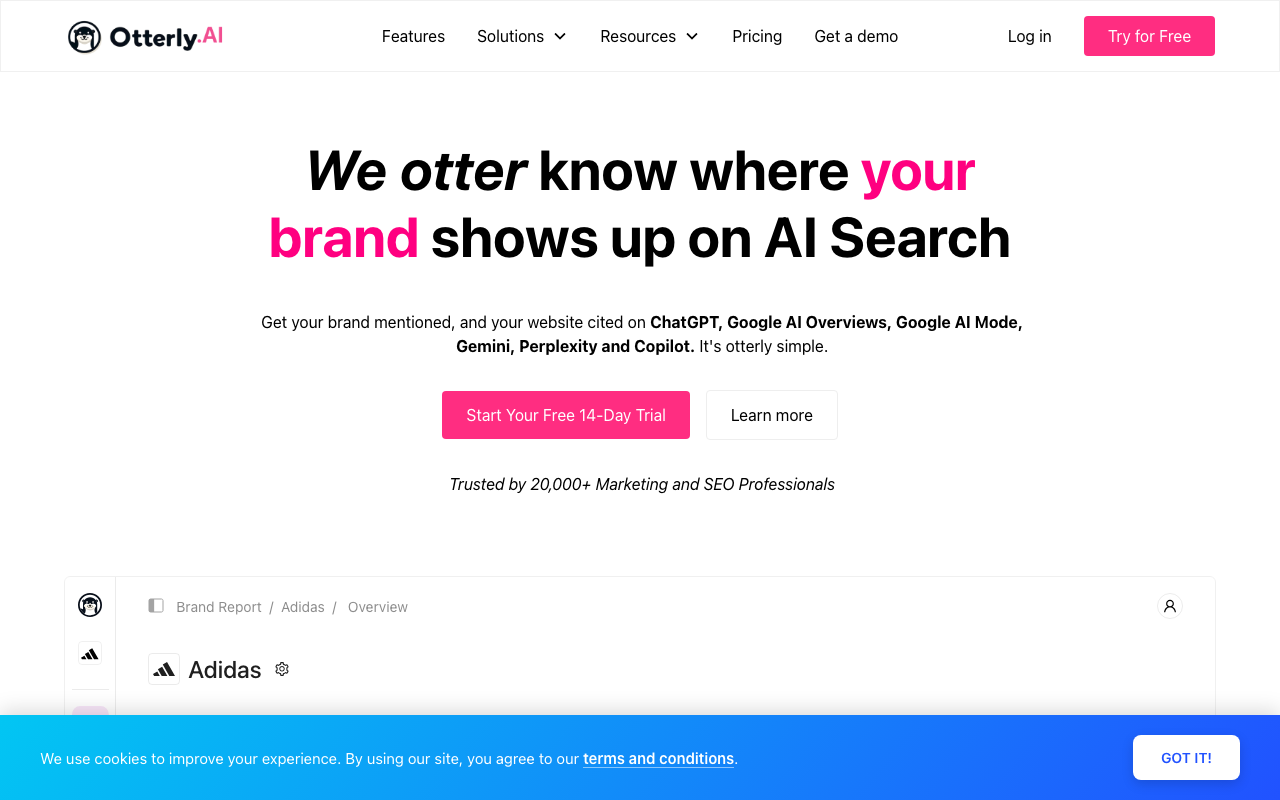
Otterly AI punches well above its price point. At $29/mo for the Starter plan, it’s the most affordable entry into full-featured AI visibility tracking among tools with genuine third-party validation: G2 High Performer in the AEO category, Gartner Cool Vendor 2025 (AI in Marketing), and OMR Reviews Top Rated + Leader. That combination of affordable pricing and award recognition makes it the default recommendation for smaller teams and solo SEOs exploring AI search for the first time.
Despite its small team (2-10 employees), Otterly has built a platform that covers 6 AI engines, 40+ countries, and includes a GEO Audit covering 25+ on-page factors. It’s used by 20,000+ marketing and SEO professionals, which gives its 4.9/5 (250 reviews) rating meaningful credibility. For teams that want to understand how to rank in ChatGPT and other AI platforms without enterprise pricing, Otterly is the clearest starting point.
Key features:
- AI keyword research and prompt discovery — Find the prompts users are asking in your category
- Brand mention tracking — Across ChatGPT, AI Overviews, AI Mode, Perplexity, Gemini, Copilot
- Citation and link tracking — See which URLs appear alongside your brand mentions
- Share of voice — Market share of AI mentions vs competitors
- GEO Audit — 25+ on-page factors checked for AI readiness
- Automated weekly reports — Sent to stakeholders without manual work
- Multi-language monitoring — 40+ countries supported
Pricing:
| Plan | Price |
|---|---|
| Starter | $29/mo |
| Growth | $189/mo |
| Business | $489/mo |
| Enterprise | Custom |
Add-ons: AI Mode & Gemini tracking $9-149/mo depending on plan tier. 14-day free trial, no credit card.
Pros:
- Most affordable entry point ($29/mo) with genuine award recognition
- 40+ countries and 6 AI engines on paid plans
- 95% of customers report measurable insights within 1 month
- Gartner Cool Vendor 2025 (rare for a tool at this price)
Cons:
- Small team (2-10 employees) may limit support capacity and development speed
- Add-on pricing for AI Mode & Gemini can get expensive on lower tiers
- Austria-based (timezone challenges for US customers)
Customers: Opera, Bacula Systems, XXXLutz, Avis Budget Group, Auto1, SmartRecruiters, A1 Telekom, Campaign Monitor. 20,000+ marketing/SEO professionals.
“2x increase in both our visibility in AI search engines and incoming traffic.” — Rebecca Anderson, Instant Commerce
Website: otterly.ai
10. AthenaHQ
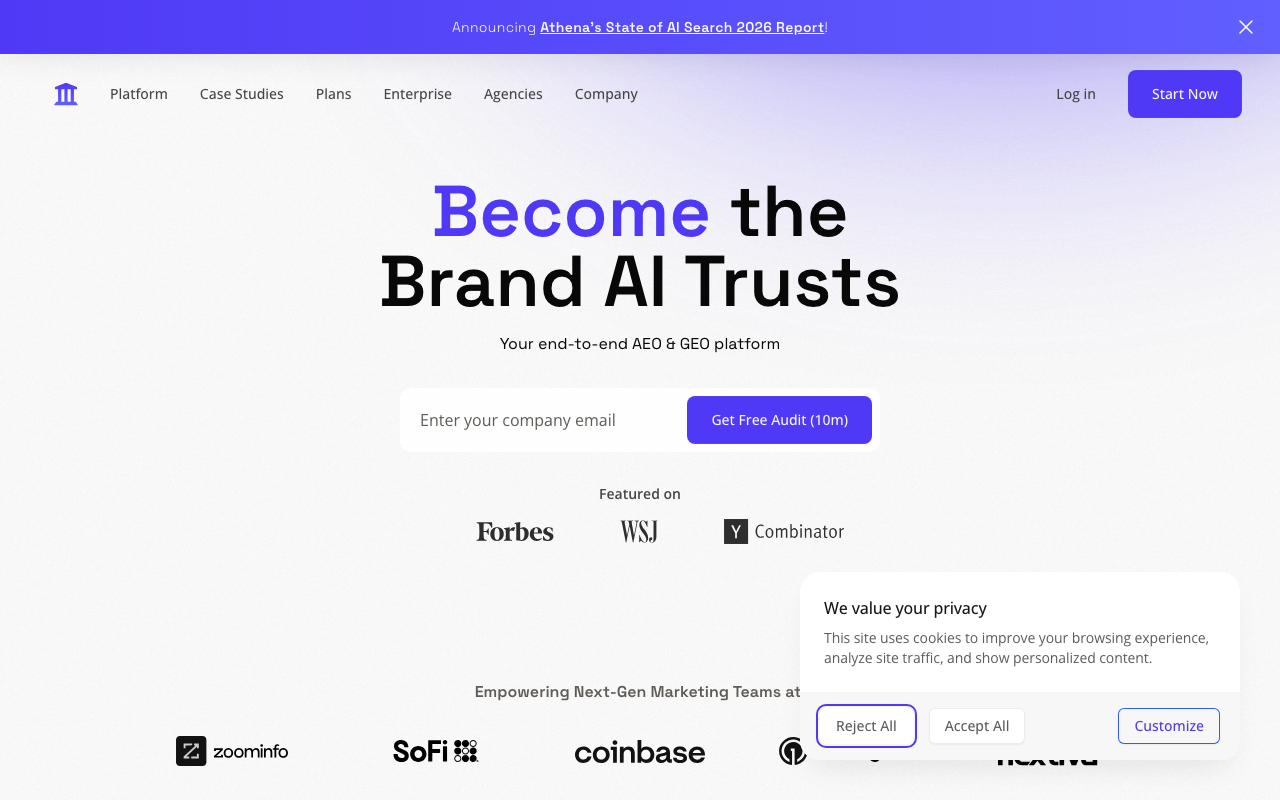
AthenaHQ is Y Combinator-backed with advisors from OpenAI, Anthropic, and DeepMind, and its case studies are the strongest in this category. Rootly achieved ~10x citation rate growth and $126K incremental media value. Lago saw a 50% increase in demos from AI search. Gruns went from 2% to 12.6% share of voice in 60 days. Those aren’t just impressions — they’re pipeline and revenue outcomes directly attributed to AI SEO improvements.
Its Self-Serve plan at $295/mo ($95/mo annually in year one with a first-month 67% discount) is competitive for what you get: 8 LLMs tracked, unlimited seats with RBAC, GA4 and Google Search Console integration, and what AthenaHQ calls “AI blindspot detection” — finding queries where competitors appear but you’re completely absent. For enterprise, the ACE citation engine and AI agent with Deep Research add content optimization capabilities that few tools match.
Key features:
- Flexible AI visibility tracking — 8 LLMs including ChatGPT, Perplexity, Google AI Overviews, AI Mode, Gemini, Claude, Copilot, Grok
- Citation intelligence — Which sources AI models cite when answering questions in your category
- AI blindspot detection — Queries where competitors appear and you’re invisible
- On/off-page GEO analysis — Identifies technical and content barriers to AI visibility
- Impersonation detection — Flags when AI describes your brand inaccurately
- Unlimited seats with RBAC — On all plans
- Enterprise: ACE citation engine + Deep Research AI agent — Content optimization at scale
Pricing:
| Plan | Monthly | Annual |
|---|---|---|
| Self-Serve | $295/mo | $95/mo (first year, 67% off month 1) |
| Enterprise | Custom | Custom |
$300 free credit on signup. Self-Serve integrations: GA4, Google Search Console, Shopify, Webflow.
Pros:
- Exceptional case studies (10x citation growth, $126K media value, 50% increase in demos)
- YC-backed with advisors from OpenAI, Anthropic, DeepMind
- Unlimited seats with RBAC on all plans
- 8 LLMs tracked on Self-Serve (including Claude and Grok, which many competitors exclude)
Cons:
- $295/mo monthly pricing is steep for small teams
- Self-Serve limited to single language/region
- Credit-based system (3,600 credits/mo) can be confusing
Customers: ZoomInfo, SoFi, Coinbase, OneSignal, Nextiva, Paperless Post, Volkswagen, Render, Rootly, Lago, Gruns.
Website: athenahq.ai
11. Scrunch AI
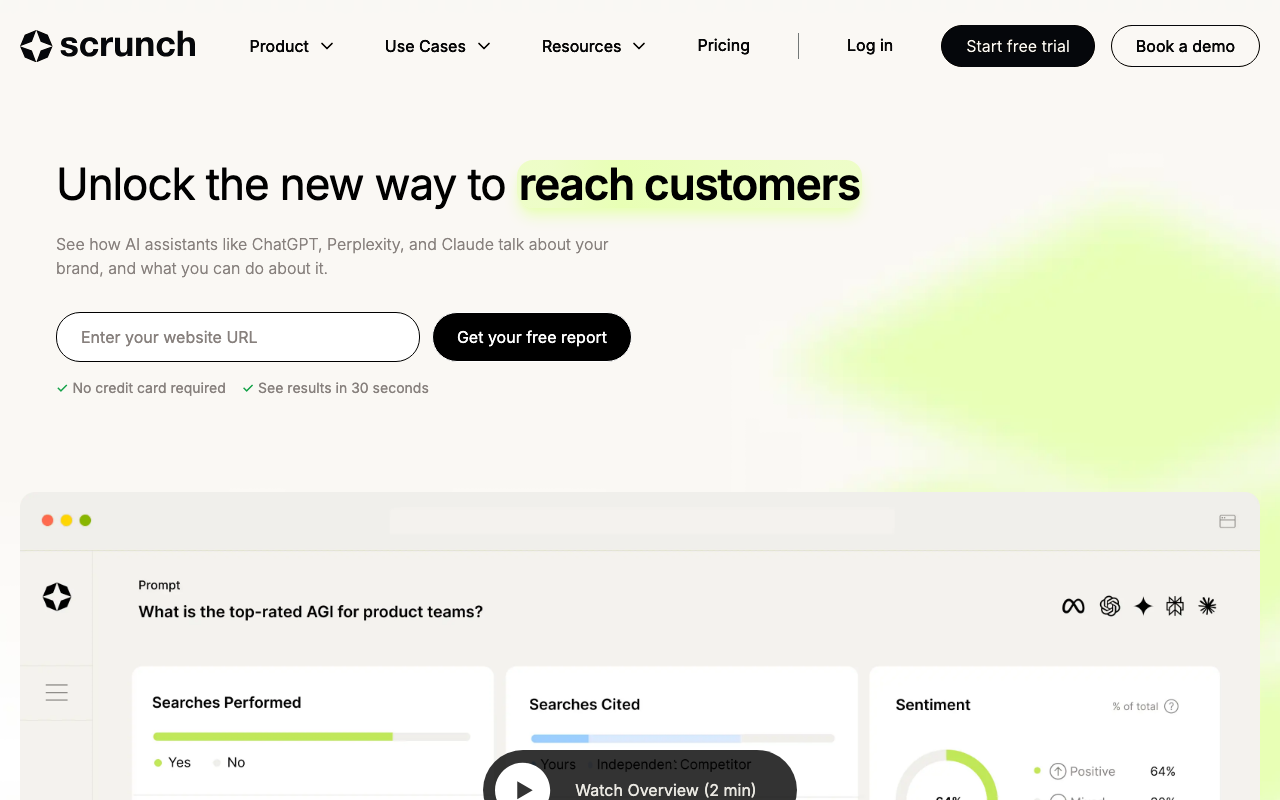
Scrunch AI has two products that together represent one of the more complete enterprise AI SEO offerings: a monitoring and analytics platform tracking brand presence across 9+ LLMs, and an Agent Experience Platform (AXP) that actively optimizes content delivery for AI agents visiting your site. Where most tools stop at tracking, Scrunch also changes what AI agents receive — in one documented case, reducing a page from 263,220 bytes to 4,578 bytes (98% size reduction) to make it far more digestible for LLMs.
That AXP differentiator makes Scrunch worth considering for brands that want to do more than measure — they want to actively shape what AI systems retrieve from their site. It’s Enterprise-only for AXP, but the Core plan at $250/mo gives you monitoring across 4 LLMs with 125 prompts, Looker Studio integration, and a 7-day free trial.
Key features:
- Monitoring & Insights — Brand presence tracking across 9+ LLMs, competitor/persona/topic/geo comparisons, prompt analytics, citation source discovery
- AI bot traffic feed — Real-time visibility into which AI crawlers are visiting and what they’re accessing
- Error and crawl issue detection — Identifies technical problems stopping AI from properly indexing content
- AXP (Agent Experience Platform) — Delivers AI-optimized content versions to AI agents visiting your site (Enterprise)
- Data API — For internal dashboards and AI workflows
- Looker Studio integration — Core plan includes connector for custom reporting
Pricing:
| Plan | Price | Prompts | LLMs |
|---|---|---|---|
| Core | $250/mo | 125 | 4 (ChatGPT, Perplexity, Google AIO, Copilot) |
| Enterprise | Custom | Custom | 9+ (+ Claude, Gemini, Meta AI, AI Mode, Grok) |
7-day free trial. Annual discount: 2 months free.
Pros:
- Unique AXP platform optimizes content delivery for AI agents (not just tracking)
- Strong enterprise customer base (Lenovo, Clerk, Skims)
- Looker Studio integration for custom reporting on Core plan
- $15M+ funding from credible backers
Cons:
- $250/mo Core plan is the highest entry price of the tools listed here
- AXP is Enterprise-only (the most compelling differentiator is behind a sales call)
- Only 4 LLMs on Core
Customers: Lenovo, BairesDev, Clerk, Skims, BigTime, Penn State University, Crunchbase. 500+ companies total.
“Within weeks, we went from invisible to cited right alongside the biggest players in the space.” — Danilo Vaccalluzzo, Digital Marketing Manager
Website: scrunch.com
12. Writesonic GEO
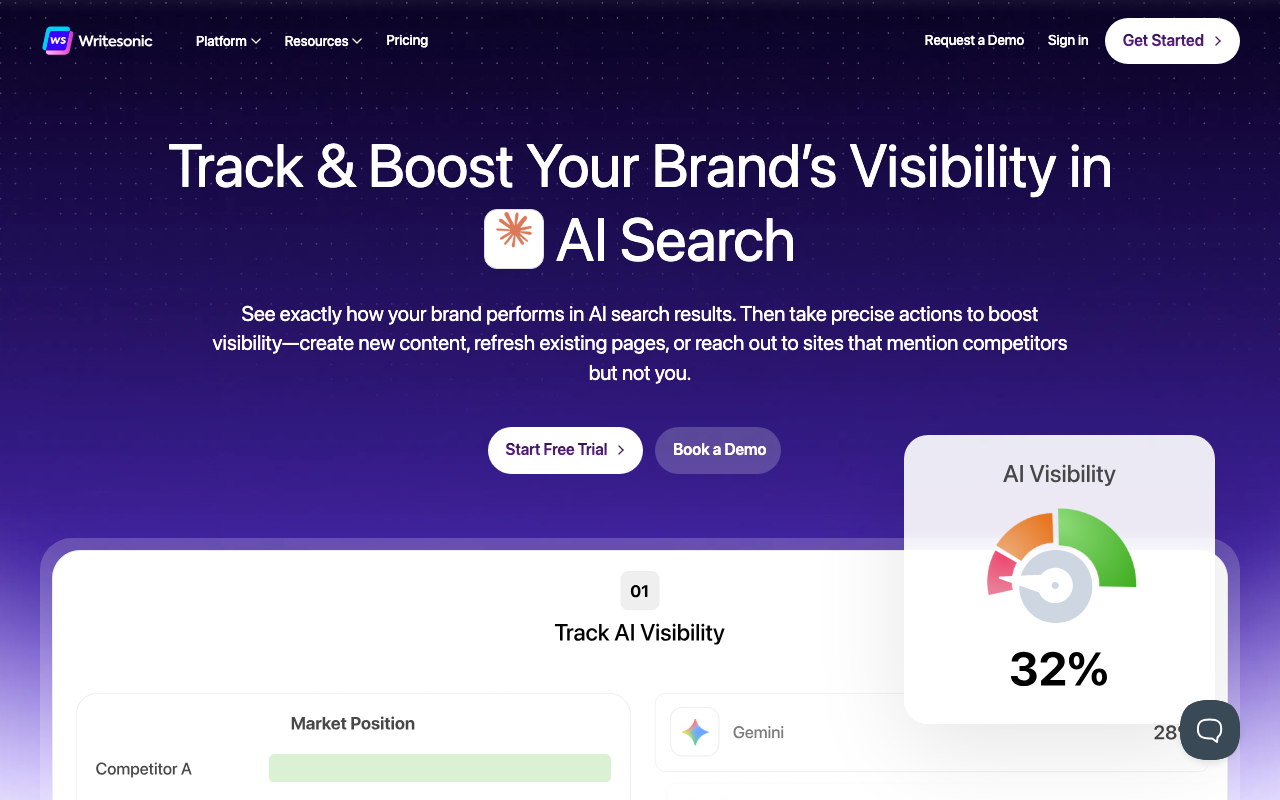
Writesonic is primarily known as an AI content platform — 20,000+ teams use it, backed by Y Combinator, with 6,000+ reviews across platforms. Its GEO (Generative Engine Optimization) module adds AI visibility tracking to that content production foundation, making it the most complete tool on this list for teams that want to produce and track AI SEO content in one platform.
The AI Search Volume Explorer is a standout feature: powered by 120M+ proprietary AI chatbot conversations, it shows actual query volume in AI platforms rather than inferred data. Combined with Ahrefs and Google Keyword Planner integration for traditional SEO, the platform covers keyword research across both traditional and AI search. If your team needs to do 10 technical SEO improvements for AI search alongside content production, Writesonic GEO handles both.
Key features:
- AI Visibility Tracking — Real-time rankings across 10+ platforms, visibility scores, sentiment monitoring, citation tracking, share of voice
- AI Visibility Action Center — Citation gap analysis, outreach templates, content opportunity recommendations, technical barrier detection, Reddit/Quora/forum discovery
- AI Search Volume Explorer — Powered by 120M+ AI chatbot conversations; natural language prompt tracking with actual volume data
- SEO Suite — Ahrefs + Google Keyword Planner integration, AI-powered topic clusters, automated technical SEO fixes
- Content Engine — 100+ source-backed articles with auto fact-checking, internal linking, EEAT signals
Pricing:
| Plan | Monthly | Annual | GEO Features |
|---|---|---|---|
| Lite | $49/mo | $39/mo | No GEO tracking |
| Standard | $99/mo | $79/mo | No GEO tracking |
| Professional | $249/mo | $199/mo | ChatGPT, Perplexity, AI Overviews; 100 prompts; daily refresh |
| Advanced | $499/mo | $399/mo | + Gemini; 200 prompts; sentiment analysis |
| Enterprise | Custom | Custom | All 10+ platforms; custom configuration |
GEO/AI Search Visibility requires Professional plan or higher.
Pros:
- AI Search Volume Explorer with 120M+ actual chatbot conversations (unique)
- Full-service: SEO + content production + AI visibility in one platform
- Ahrefs + Google Keyword Planner integration for keyword research
- Strong case studies (25% AI traffic growth, $200K in new revenue from AI visibility)
Cons:
- GEO features only available on Professional plan ($249/mo) and above
- Lite and Standard plans don’t include any AI visibility tracking
- Professional plan limited to 1 region/language
Customers: 20,000+ teams. Case studies: Viscaweb (+25% AI traffic), Best Arctic (3x content output), Bookmundi (60% cost reduction).
“We landed two $100,000 clients who found us through ChatGPT. That’s $200,000 in revenue directly from AI visibility.” — Dennis Yu, Co-founder, BlitzMetrics
Website: writesonic.com
How to choose the right AI SEO tool
If you’re new to AI SEO and want to start fast: Airefs ($24/mo) or Otterly AI ($29/mo) give you the lowest entry point with genuine tracking capabilities and no enterprise commitment.
If you’re already paying for Semrush or Ahrefs: Use their AI visibility features before adding another tool. Semrush AI Toolkit ($99/mo) and Ahrefs Brand Radar integrate directly with your existing workflow. Note that Ahrefs Brand Radar has documented accuracy issues at its price point.
If you need unified Google SEO + AI visibility: SEOmonitor handles both with a single keyword-based pricing model and unlimited seats. Morningscore is the more affordable option for SMBs. Both reduce tool sprawl for agencies managing multiple clients.
If you need enterprise-grade tracking with proven ROI: Profound (G2 Leader, $58.5M funded, MongoDB/Ramp customers) and AthenaHQ (YC-backed, 10x citation growth case studies) are the strongest options. AthenaHQ includes Claude and Grok tracking that Profound’s Growth plan misses.
If your team produces a lot of content: Writesonic GEO combines content production and AI visibility in one platform. At $249/mo Professional, it’s competitive with standalone AEO tools once you factor in content tool costs.
If you need to optimize what AI agents receive from your site: Scrunch AI’s AXP platform (Enterprise) actively shapes content delivery to AI crawlers — not just monitoring, but intervention.
FAQ
What is an AI SEO tool?
An AI SEO tool is a platform that tracks your brand’s visibility in AI-generated answers (ChatGPT, Perplexity, Google AI Overviews, Gemini, etc.), identifies opportunities to improve that visibility, and often helps with the content and technical work required to act on those opportunities. They’re distinct from older AI-assisted SEO writing tools — these platforms focus specifically on AI search visibility, not just content generation.
How is AI SEO different from traditional SEO?
Traditional SEO focuses on ranking in Google’s blue link results. AI SEO focuses on appearing in AI-generated answers — the responses ChatGPT, Perplexity, and Google AI Overviews give when users ask questions. The key difference: AI answers pull from a specific set of trusted sources (articles, Reddit, reviews), so improving your AI visibility means understanding and influencing those sources rather than just optimizing individual page metadata.
Does AI visibility actually drive traffic and leads?
Yes — and the case studies are now substantial enough to trust. Ramp saw 7x AI visibility increase with Profound. Rootly attributed $126K in incremental media value to AthenaHQ’s recommendations. Dennis Yu’s agency landed $200K in new revenue from AI visibility improvements tracked via Writesonic GEO. AI search drives less traffic than Google today, but the traffic tends to be higher-intent — users who’ve already been recommended your brand by an AI are closer to conversion.
Which AI platforms should I track?
Start with ChatGPT and Google AI Overviews — they account for the majority of AI search volume for most B2B and B2C queries. Add Perplexity if your audience skews technical. Claude and Gemini are worth tracking for enterprise software brands. The tools that charge per-platform (Peec AI, Ahrefs Brand Radar) get expensive quickly if you add every LLM — prioritize the platforms your buyers actually use.
Do I need a separate tool for AI SEO, or can I use my existing SEO platform?
If you use Semrush or Ahrefs, try their AI visibility add-ons first. If you need more depth — source-level citation data, Reddit monitoring, daily refresh, or multi-LLM tracking — a dedicated AI SEO tool like Airefs, Profound, or AthenaHQ will give you significantly more actionable information. Most teams end up using both: their existing SEO platform for traditional tracking and a dedicated AEO tool for AI visibility.
How often should AI visibility data refresh?
Daily refresh is the standard for most dedicated AEO tools. Weekly updates (SEOmonitor’s AI Search tracking) are acceptable for strategic monitoring but too slow for catching emerging sources or prompt-level changes. Ahrefs Brand Radar lets you set custom schedules (daily/weekly/monthly) per query.
What’s the most important metric in AI SEO?
Citation rate — how often your brand appears in AI answers to relevant prompts — is the most direct measure of AI visibility. Share of voice (your citations vs competitors) tells you where you stand relative to the market. Source tracking (which URLs AI cites when mentioning you) is the most actionable data point because it tells you exactly what to create or engage with to improve your citation rate.
AI search is no longer a trend to monitor — it’s where buying decisions are already happening for many B2B and B2C categories. The tools in this list give you the data to see where you stand, the intelligence to understand why, and in the best cases, the workflow to do something about it. Start with the platform that fits your current stage and budget, then expand as AI search becomes a larger part of your acquisition mix.