

To get ahead in B2B marketing, figuring out how to rank in ChatGPT isn’t just a good idea anymore—it’s essential. This means shifting your mindset from old-school SEO to something we call Answer Engine Optimization (AEO). The game has changed. It’s now about getting your brand cited in AI-generated answers by creating sharp, authoritative content that nails your audience’s conversational questions.
The New Frontier: Why Getting Cited in ChatGPT Is Non-Negotiable
The way your customers find information is fundamentally different now. They aren’t just punching keywords into a search bar. They’re having conversations with AI assistants like ChatGPT, asking complex questions and expecting direct answers. This is a whole new discovery channel, and it doesn’t play by the same rules as the Google search results we’ve all spent years trying to master.
This new discipline is Answer Engine Optimization (AEO). It’s got SEO in its DNA, but the goal is different. You’re not just trying to land the #1 organic link; you’re fighting to become a trusted source inside the AI’s answer.
The real difference comes down to intent. SEO targets people looking for a list of websites to browse. AEO targets people who want a definitive answer, and your brand needs to be part of that final answer.
Traditional SEO vs. Answer Engine Optimization (AEO)
To really get what’s different, it helps to see the two side-by-side. While some of the principles overlap, the execution and end goals are worlds apart.
| Factor | Traditional SEO (Google Search) | Answer Engine Optimization (ChatGPT) |
|---|---|---|
| Primary Goal | Rank #1 in SERPs (Search Engine Results Pages) | Become a cited source within the AI’s direct answer |
| User Intent | Navigational, informational, transactional (user browses results) | Conversational, direct questions (user wants a single, synthesized answer) |
| Key Signals | Backlinks, domain authority, on-page keywords, schema | Factual accuracy, source credibility, clear snippets, off-site mentions (e.g., Reddit, forums) |
| Content Focus | Long-form content, keyword density, E-E-A-T | Highly specific, factual, easily digestible “snippets” of information |
| Measurement | Keyword rankings, organic traffic, bounce rate | Brand mentions, citations, share of voice for key prompts, referral traffic |
As you can see, AEO isn’t just a new name for SEO; it’s a completely different playbook. You’re optimizing for clarity and authority in a way that an algorithm can trust and relay.
Why B2B Brands Can’t Afford to Ignore This
For B2B companies, this isn’t some side experiment—it’s a critical new layer of the funnel. Your prospects are already using ChatGPT for their initial research, to compare vendors, and to find solutions to their problems. If your brand never comes up in those conversations, you’re invisible during a crucial part of the buying journey.
And this isn’t a small trend. According to Similarweb, ChatGPT is the dominant force in the AI chat market, attracting over 60% of traffic among its peers. In a single month, it can draw over 1.8 billion visits (Similarweb, 2024). When you add in Microsoft’s Copilot, which is also powered by OpenAI’s technology, the reach is immense.
To win here, you need a new framework. We call it the AI Visibility Funnel, and it breaks down into four stages:
- Prompts: The actual questions your ideal customers are asking ChatGPT.
- Impressions: The moment the AI model considers your brand or content as a potential source.
- Citations: The finish line—getting your brand explicitly mentioned or linked in the answer.
- Traffic: The follow-on effect when a citation drives a high-intent user to your site.
Getting a handle on this funnel is the first step. If you want to go deeper, our comprehensive AI Search Optimization guide walks through everything from prompt research to content optimization, showing you how to turn AI answers into a real source of inbound leads.
Mastering Prompt Research to Find Customer Questions
If you want your brand cited by AI, you have to get inside your customers’ heads and figure out the exact questions they’re asking. This isn’t your old-school keyword research. It’s about finding the conversational, high-intent prompts people use when they need real answers, not just a list of blue links.
People turn to AI for help with complex problems. They want direct solutions, quick vendor comparisons, and validation before they pull out their credit card. Your job is to map out that entire conversational landscape. A study by Parse.ly in 2024 found that AI chat referrals are already driving 12% more traffic than social media for many publishers, underscoring the importance of this new channel.
Uncovering Your Prompt Universe
Think of your “Prompt Universe” as the complete collection of questions your ideal customers ask at every stage of their journey. These prompts aren’t just hiding in SEO tools—they’re sitting right inside your own company and echoing across public forums.
The best place to start is with your internal data. It’s the most authentic, and frankly, most overlooked source of customer language.
- Customer Support Tickets: Look at the exact phrasing people use when they’re stuck or confused. Those tickets are full of ready-made prompts.
- Sales Call Recordings: Fire up those Gong or Chorus transcripts. Listen to how prospects describe their pain points and the questions they ask when sizing you up against the competition. It’s pure gold.
- Onboarding Questionnaires: What goals and challenges do new customers list right after signing up? This tells you exactly what problems they hired you to solve.
When you analyze your own internal conversations, you’re not just guessing what your customers might ask—you’re using their own words. That kind of authenticity is precisely what AI models are trained to find and reward.
Tapping Into Public Conversations
Once you’ve mined your internal data, it’s time to head out into the wild. Your audience is openly discussing their challenges on public platforms, and these are the very same places LLMs go for training data.
Reddit and Quora are your best friends here. Search for subreddits or topics in your industry and hunt down threads where people ask for advice or recommendations. A classic B2B prompt might be something like, “what are the best project management tools for a remote engineering team?” That’s a high-intent question you absolutely need to be answering.
These community discussions are incredibly influential. A recent analysis of over 14 million AI search results revealed that conversations on platforms like Reddit have a massive impact on which brands LLMs recommend. You can explore the full analysis of AI search results here.
Organizing Prompts by Buyer Stage
Okay, you’ve got a big list of questions. Now what?
The next step is to organize them by where the customer is in their buying journey. This simple structure helps you create content that meets people at the right moment, with the right answer.
Here’s a simple way to frame it:
| Buyer Stage | Prompt Focus | Example Prompt |
|---|---|---|
| Problem Discovery | Figuring out they have a pain point | ”how to reduce manual data entry for my sales team” |
| Solution Comparison | Evaluating different types of tools | ”zapier vs make for automating workflows” |
| Vendor Vetting | Comparing specific brands head-to-head | ”is asana or monday.com better for marketing agencies” |
You have to track these opportunities systematically. Tools like Airefs let you monitor these prompts, see how often your brand gets mentioned, and check how you stack up against competitors. This turns prompt research from a one-off project into a continuous, data-driven strategy for winning in AI answers.
Getting Your Content Ready for AI
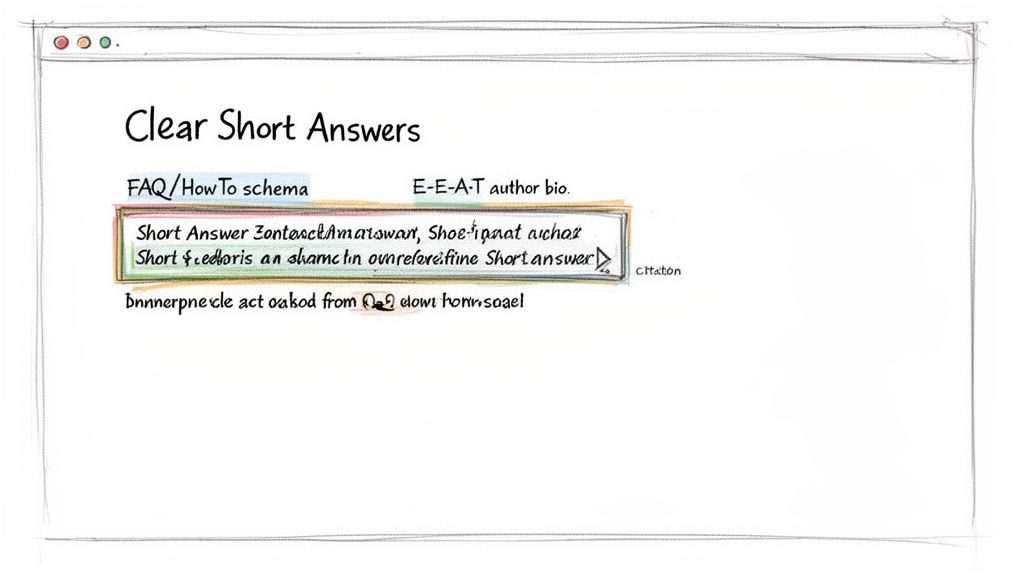
Once you’ve figured out what people are asking, the next step is building content that gives them the perfect answer. This isn’t about old-school SEO tricks. It’s about making your content dead simple for an AI to digest, verify, and ultimately, cite. You’re aiming to create clean, fact-based snippets that nail the prompts you found earlier.
And this is a massive opportunity. According to a 2023 study by Writer.com, 76% of business leaders believe generative AI will give their company a competitive edge. Much of this advantage comes from how their prospects use AI for research. Your content has to be ready for this new way of finding information.
Make Your Content Easy to Scan
AI models, just like hurried human readers, love content that’s logically structured and easy to pull apart. Forget long walls of text—they’re a dead end. Instead, think in discrete, self-contained blocks of information that an AI can lift and use.
- Write Descriptive Headings (H2s & H3s): Don’t just say “Features.” Say “How Our Platform Automates Reporting.” This gives instant context.
- Keep Paragraphs Short: Stick to one to three sentences per paragraph. Each one should have a single, clear idea.
- Use Lists: Bullet points and numbered lists are your friends. They break down complex ideas and steps into a format that’s incredibly easy for an AI to process.
This strategy doesn’t just help you figure out how to rank in ChatGPT; it also makes your website better for human visitors. It’s a classic SEO win-win. For a deeper dive, understanding how AI-powered knowledge management unlocks value from your scattered content is a game-changer for AI performance.
Ditch the Sales Pitch for a Neutral Tone
Large language models are trained to avoid biased, salesy language. They prefer sources that sound neutral, factual, and authoritative. Your amazing landing page copy might convert visitors, but it’s not going to get cited in an AI answer.
Key Takeaway: You need to shift your writing from “selling” to “informing.” Provide objective facts, data, and clear explanations. Write as if you’re creating an encyclopedia entry—direct, clear, and trustworthy.
Imagine a prompt like, “What are the pros and cons of using a CRM with AI features?” An answer that neutrally explains both the good (like predictive lead scoring) and the bad (like higher costs or data privacy issues) is far more likely to get sourced than content that only talks up your own product.
E-E-A-T is More Important Than Ever
Google’s E-E-A-T framework—Experience, Expertise, Authoritativeness, and Trustworthiness—is now table stakes for AEO. Since AI models often lean on search results to gather information, content that Google already trusts has a huge head start.
Here’s how to dial in your E-E-A-T signals for AI:
- Author Bios That Matter: Clearly show who wrote the content and why they’re qualified. Add their credentials, experience, and links to social profiles or other work.
- Cite Your Sources: If you drop a statistic, link out to the original source. This proves you’ve done your homework and builds trust with both humans and AI crawlers.
- Go Deep on Topics: Cover a subject from all angles. Answer related questions and provide the complete picture to show you’re a true authority — the modern equivalent of what latent semantic indexing was trying to reward.
Use Schema Markup to Add Context
Schema markup is basically a set of labels you add to your site’s code. It doesn’t change how your page looks, but it explicitly tells search engines (and AIs) what your content is about.
For AEO, a couple of schema types are especially powerful:
- FAQ Schema: This is perfect for marking up Q&A sections. It creates a direct map between your content and the prompts users are asking.
- HowTo Schema: If you’re explaining a process, use this to outline the steps. It’s a highly structured format that AI models love for step-by-step instructions.
Getting these on-page elements right is fundamental. If you want to get more into the weeds, these 10 technical SEO tips for AI search are a great resource for schema and other critical details.
Building Influence with Off-Site AEO Strategies
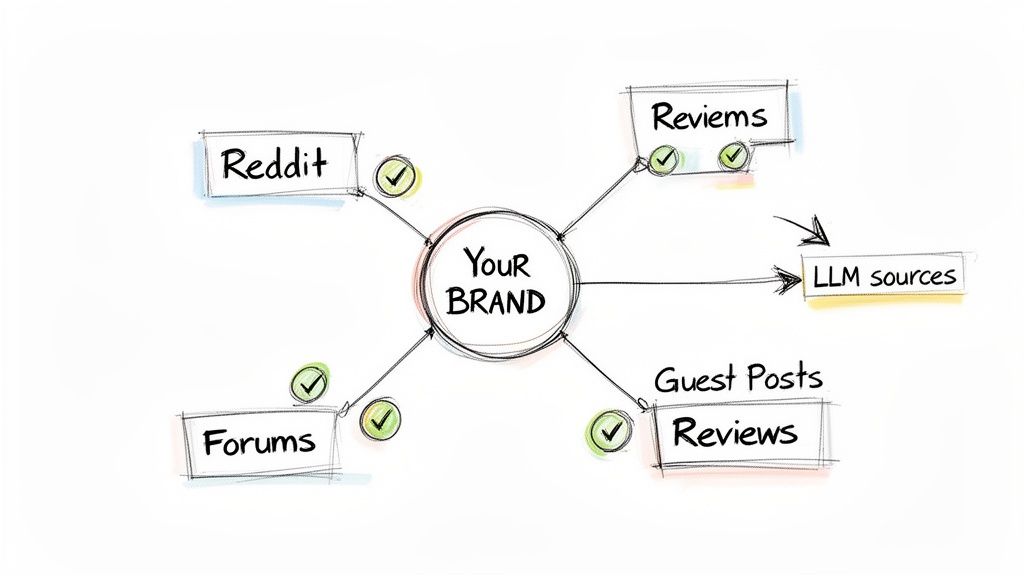
Getting cited by ChatGPT isn’t just about what you publish on your own site. What happens off your website is often far more influential.
Large language models are trained to find consensus. They look for credibility across a massive range of sources, so your off-site reputation acts as a powerful trust signal. If a dozen independent sources are mentioning your brand as a top solution, the AI is far more likely to agree than if you’re the only one singing your own praises.
This is where a deliberate off-site Answer Engine Optimization (AEO) strategy comes in.
Why Reddit Is Your AEO Goldmine
If there’s one platform to focus on, it’s Reddit. Its influence on AI models is immense. Winning in ChatGPT is less about your own domain and more about being present in the sources it already trusts.
Reddit is a top contender because its community discussions heavily shape LLM outputs. Plus, Reddit content has surged onto Google’s first page for many commercial queries, giving it a powerful one-two punch for both SEO and AEO. A deep dive on ChatGPT stats from Backlinko confirms that the platform has over 430 million active monthly users, generating a massive volume of conversational data.
The platform is a huge repository of real, human conversations—exactly the kind of data LLMs value. A single well-reasoned comment in a relevant subreddit can become a key data point for an AI, shaping how it answers questions about your industry for months to come.
Your goal on Reddit isn’t to spam links. It’s to become a genuinely helpful voice where your ideal customers hang out.
- Monitor Relevant Subreddits: Find 5-10 subreddits where your audience asks for advice (e.g., r/saas, r/marketing, r/projectmanagement).
- Find Contribution Opportunities: Look for posts where people are asking for recommendations, comparing solutions, or describing a problem your product solves.
- Add Genuine Value: Provide thoughtful, detailed answers that actually help. Mention your product only when it’s a natural fit, and always be transparent about your affiliation.
Pro Tip: The best Reddit contributions often don’t even link to your site. A simple, well-articulated comment that names your brand as a solution can be more powerful than a forced link that gets downvoted or removed by moderators.
Expanding Beyond Reddit to Build a Web of Trust
While Reddit is a powerhouse, a truly solid off-site strategy diversifies its signals across multiple high-authority platforms. Each channel helps demonstrate your credibility to AI models in a different way.
We saw this firsthand in our case study on how Interact became #1 in its category in ChatGPT by mastering these off-site signals. The goal is to create a consistent narrative about your brand’s expertise across the web, making it an unavoidable choice for an AI seeking the best information.
High-Impact Off-Site AEO Channels
Here’s a quick overview of other key platforms to focus on, along with the primary goal for each.
| Platform | Primary Goal | Example Tactic |
|---|---|---|
| Industry Forums | Establish Niche Expertise | Answering technical questions in specialized forums like Stack Overflow or niche B2B community boards. |
| Software Review Sites | Build Social Proof | Encouraging happy customers to leave detailed reviews on G2, Capterra, or TrustRadius. |
| Guest Articles | Borrow Authority | Publishing a data-driven article on a respected industry publication, with your brand mentioned in the author bio. |
| Q&A Platforms | Answer Direct Questions | Providing clear, helpful answers to relevant questions on platforms like Quora. |
A successful off-site AEO strategy is a long game. It requires consistent effort to build relationships and contribute value across different communities. But the payoff is a durable, defensible brand reputation that AI models learn to trust and recommend.
How to Measure and Improve Your AEO Performance
You can’t improve what you don’t measure. If you’re serious about getting results from Answer Engine Optimization (AEO), you have to turn it into a data-driven, repeatable process. Otherwise, you’re just guessing what works.
Effective measurement isn’t about tracking the usual SEO metrics like keyword ranks or organic traffic. Instead, you need to zero in on metrics that actually reflect your visibility inside the AI-generated answers.
Key Metrics for AEO Success
The whole point is to quantify your brand’s presence in AI conversations. Before we get into the specifics, it helps to have a solid grasp of what is marketing attribution and how it helps connect your efforts to real outcomes.
Here are the metrics that truly matter:
- Citation Frequency: This is your core visibility score. It’s the total number of times your brand is mentioned or linked across a set of relevant prompts.
- Share of Answer: This metric pits you against your competitors. If ChatGPT mentions your brand in 3 out of 10 answers for a key prompt, your Share of Answer is 30%. Simple as that.
- Citation Quality: Not all mentions are created equal. A top recommendation is worth far more than being buried in a long list. You need to analyze the sentiment and positioning of your citations to get the full picture.
Why You Need a Specialized Tool
Let’s be real: manually checking dozens of prompts every day just doesn’t work. It’s not scalable, and AI models are constantly changing, meaning their answers can vary from one minute to the next. This is exactly why specialized prompt tracking tools are a must-have for anyone serious about showing up in ChatGPT.
These platforms automatically rerun your target prompts on a schedule, giving you a clear, historical view of your performance. They turn chaotic, one-off checks into a reliable dataset you can actually use to spot trends and measure the impact of your work.
Without that automation, you’re just taking snapshots in time. It becomes nearly impossible to connect a specific action—like publishing a new blog post or engaging on Reddit—to a real change in your AI visibility. Tools like Airefs are built to track ChatGPT mentions over time, giving you the data needed to move from guessing to knowing.
A Simple Framework for Testing and Improvement
Once you have reliable tracking in place, you can start running tests to systematically improve your results. This approach turns AEO into a more scientific process, helping you prove ROI and learn what actually moves the needle for your brand.
Just follow this simple, three-part cycle:
- Form a Hypothesis: Start with an educated guess. For example: “If we get our brand mentioned in three high-authority Reddit threads about ‘best CRM for startups,’ our citation frequency for that prompt will increase.”
- Execute the Change: Now, put that hypothesis into action. This might mean updating an article, securing a guest post, or jumping into specific online discussions.
- Measure the Results: Keep an eye on your AEO dashboard for the next few weeks. Did your Share of Answer for the target prompt go up? Did the AI start citing the new source you created?
By repeating this cycle, you start building an internal playbook of what works for your brand. You stop throwing content at the wall and start making strategic moves backed by data, systematically growing your brand’s presence in the AI conversations that matter.
Your Action Plan for Ranking in ChatGPT
Alright, let’s turn theory into action. Knowing the “what” and “why” is great, but getting results comes down to having a clear, repeatable process. This is the exact playbook we use to move from just talking about how to rank in ChatGPT to actually seeing our visibility improve.
We’ll break this down into a few core phases. Think of it as a continuous loop—each part feeds into the next, creating a system for Answer Engine Optimization (AEO).
First, Do Your Prompt Research
Everything starts here. Your first job is to build what we call a Prompt Universe.
Forget guesswork. Dig into your internal data—what are the real questions people ask on sales calls or in support tickets? That’s gold. Then, go hang out where your audience is. Scour relevant Reddit communities and industry forums to see the exact language they use and the problems they’re trying to solve.
This isn’t about keywords; it’s about understanding the conversational landscape.
Next, Optimize Your On-Site Content
With your prompts in hand, it’s time to audit your existing content. The goal isn’t to write massive new blog posts. Instead, you’re looking for opportunities to create concise, citable snippets that give a direct answer to a specific prompt.
This means structuring your articles with clean, descriptive headings, writing in a neutral and authoritative voice, and signaling E-E-A-T with detailed author bios and clear source citations. Make it easy for an AI to see you as a credible source.
This simple flow chart shows how we turn this into a cycle of constant improvement.
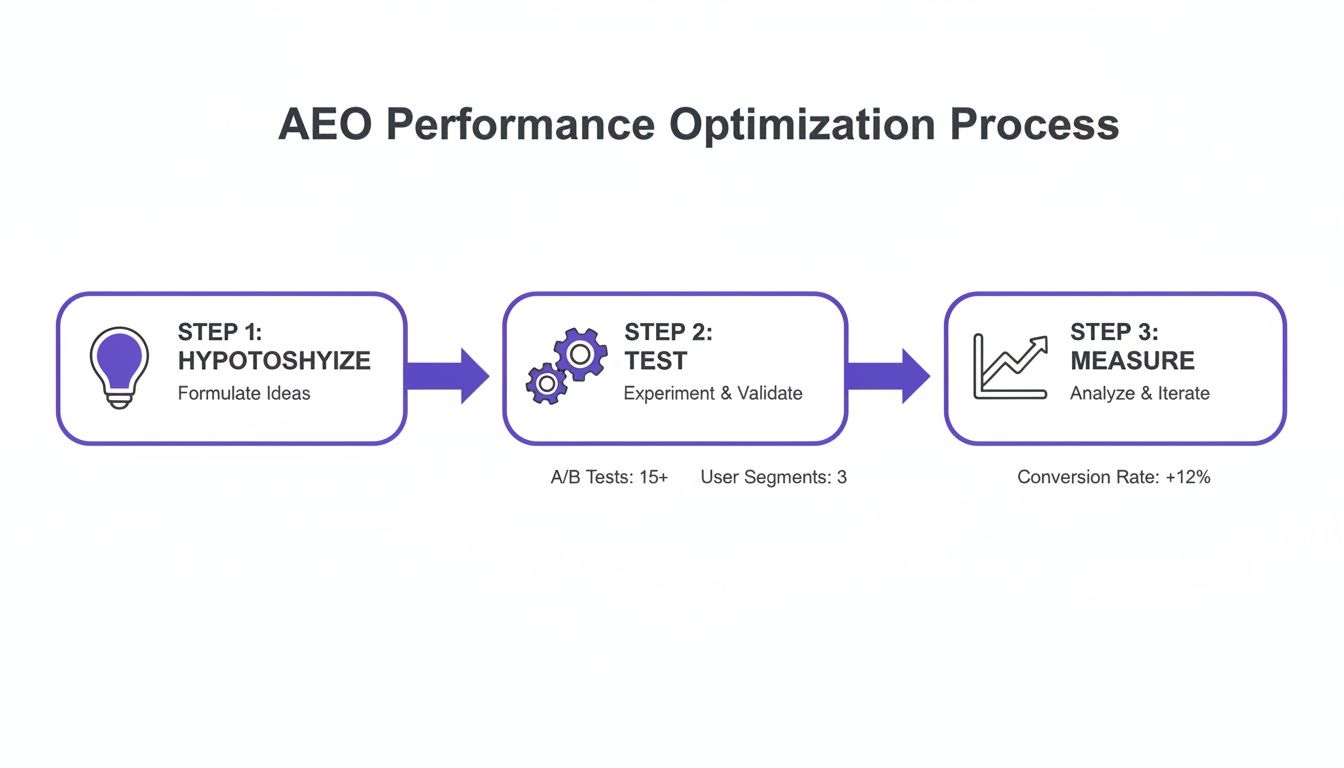
It boils down to a simple loop: Form a hypothesis, test it with a specific action (like adding a new snippet), and then measure whether it moved the needle on your citation frequency.
Finally, Engage Off-Site and Measure Everything
Your content can be perfect, but it needs to be part of the conversation. This is where you kick off your off-site strategy. Find those high-value discussions on platforms like Reddit and other forums and contribute genuinely helpful insights. Don’t just drop links.
At the same time, you need to know if any of this is actually working. Set up a tracking tool like Airefs to monitor your “Share of Answer” for the target prompts you identified earlier.
This is how you connect the dots between your on-site tweaks and your off-site engagement. You get measurable results that prove the ROI of your AEO efforts and systematically increase your brand’s voice in AI-generated answers.
Ready to stop guessing and start measuring your brand’s visibility in AI search? Airefs is the platform that turns AI answers into a measurable marketing channel. Track your Share of Answer, discover the sources driving competitor citations, and get actionable content opportunities to win more mentions.
Start tracking your AI search performance with Airefs
Frequently Asked Questions (FAQ)
What is Answer Engine Optimization (AEO)? Answer Engine Optimization (AEO) is the process of optimizing your brand and content to be cited as a trusted source by AI tools like ChatGPT. Unlike traditional SEO which focuses on ranking webpages, AEO’s goal is to be featured directly within the AI’s generated answer.
How does AEO differ from traditional SEO? Traditional SEO aims to rank webpages at the top of search engine results pages (SERPs). AEO focuses on getting a brand mentioned or linked inside the conversational answer provided by an AI. This requires a greater emphasis on factual accuracy, clear and concise content snippets, and off-site credibility signals from community platforms like Reddit.
Why is ranking in ChatGPT important for B2B marketing? B2B buyers increasingly use AI tools for initial research, vendor comparisons, and problem-solving. According to Gartner, 80% of B2B sales interactions between suppliers and buyers will occur in digital channels by 2025. Being cited in ChatGPT puts your brand in front of potential customers during this critical digital discovery phase, building credibility and driving high-intent traffic.
Where does ChatGPT get its information? ChatGPT uses a combination of its vast training data (a snapshot of the internet including articles, books, and websites) and, for newer models, live web searches via search engines like Bing. This means both your historical web presence and your current SEO performance influence your visibility in AI answers.
What is the best content format for AEO? The best format is content that is highly structured and easy for an AI to parse. This includes using clear H2/H3 headings, short paragraphs, bullet points, numbered lists, and Q&A sections marked up with FAQ schema. The tone should be neutral and informative, not sales-focused.
How long does it take to see results from AEO efforts? Results can vary. On-page content optimizations might take a few weeks to be indexed and reflected in AI answers. Off-site activities, such as getting mentioned in a popular Reddit thread, can sometimes have a faster impact. It’s best to track performance over a period of 4-8 weeks to identify clear trends.