

Searchable launched in November 2025 and immediately generated six figures in ARR within 24 hours of its invite-only soft launch. The founding team is exceptional: Chris Donnelly (Verb Brands 8-figure exit, Lottie 9-figure valuation), Arya Nagabhyru (two-time YC founder, MIT/NASA background), and Sam Hogan (founding AEO engineer at Origami Agents). Freestyle VC led the $4M seed at a £40M valuation. The GA4, GSC, HubSpot, and Salesforce integrations available from $50/mo are rare in the AEO category at any price.
The limitations are the limitations of any platform launched three months ago. Searchable has no G2 or Capterra presence and no quantified third-party testimonials. The Starter plan (1 domain, 50 prompts, $50/mo) is the most restrictive entry tier of any non-enterprise AEO platform—competitors offer more at the same or lower price. The 12,000+ user count, while impressive, hasn’t yet produced the documented case study library that more established platforms offer.
This guide covers the 5 best Searchable alternatives for 2026, each with stronger validation credentials, more proven track records, or different capabilities that fill the gaps in Searchable’s young product.
What are the best Searchable alternatives?
The top 5 Searchable alternatives are Airefs, Otterly AI, Profound, Peec AI, and Promptmonitor.
Airefs at $24/mo undercuts Searchable’s $50/mo Starter by more than half and adds Reddit monitoring—an active opportunity discovery layer Searchable doesn’t offer. Otterly AI at $29/mo brings Gartner Cool Vendor 2025 and G2 High Performer credentials plus a GEO Audit that Searchable’s newer product doesn’t yet match. Profound at $99/mo is the G2 Winter 2026 Leader with 10 AI platforms and prompt volume data for enterprise teams that need more than Searchable’s current platform scope. Peec AI at $89/mo offers 115+ languages and documented enterprise outcomes for global brands that need depth Searchable’s 2025 launch can’t yet demonstrate. Promptmonitor at $29/mo covers 8 AI platforms including Claude, Grok, DeepSeek, and Meta AI—more than Searchable’s 7—for significantly less.
Top Searchable alternatives — Comparison table
| Platform | Starting Price | AI Platforms | Best For | Key Differentiator | Free Trial |
|---|---|---|---|---|---|
| Airefs | $24/mo | ChatGPT by default (+ other LLMs on request) | Startups, SMBs, agencies | Reddit monitoring + done-for-you option | Yes (7-day) |
| Otterly AI | $29/mo | ChatGPT, AI Overviews, AI Mode, Perplexity, Gemini, Copilot | Teams needing validated credentials | Gartner Cool Vendor 2025 + G2 High Performer | Yes (14-day) |
| Profound | $99/mo | 10+ platforms | Enterprise teams | G2 Winter 2026 Leader + prompt volume data | Free AEO Report |
| Peec AI | $89/mo | ChatGPT, Perplexity, AI Overviews (+ add-ons) | Global brands | UI scraping + 115+ languages | Yes (14-day) |
| Promptmonitor | $29/mo | ChatGPT, Perplexity, Gemini, Copilot, Claude, Grok, DeepSeek, Meta AI (8) | Teams wanting 8-platform breadth for less | Most platforms per dollar | Yes (7-day) |
1. Airefs: Best Searchable alternative for proactive opportunity discovery
Searchable is built around measuring AI visibility and connecting it to analytics data you already have. Airefs is built around identifying what you should do next to improve AI visibility—the Reddit threads forming opinions about your category, the competitor URLs getting cited, the content gaps AI models are filling from sources other than yours. At $24/mo, it’s less than half of Searchable’s $50/mo Starter with a more action-oriented philosophy.
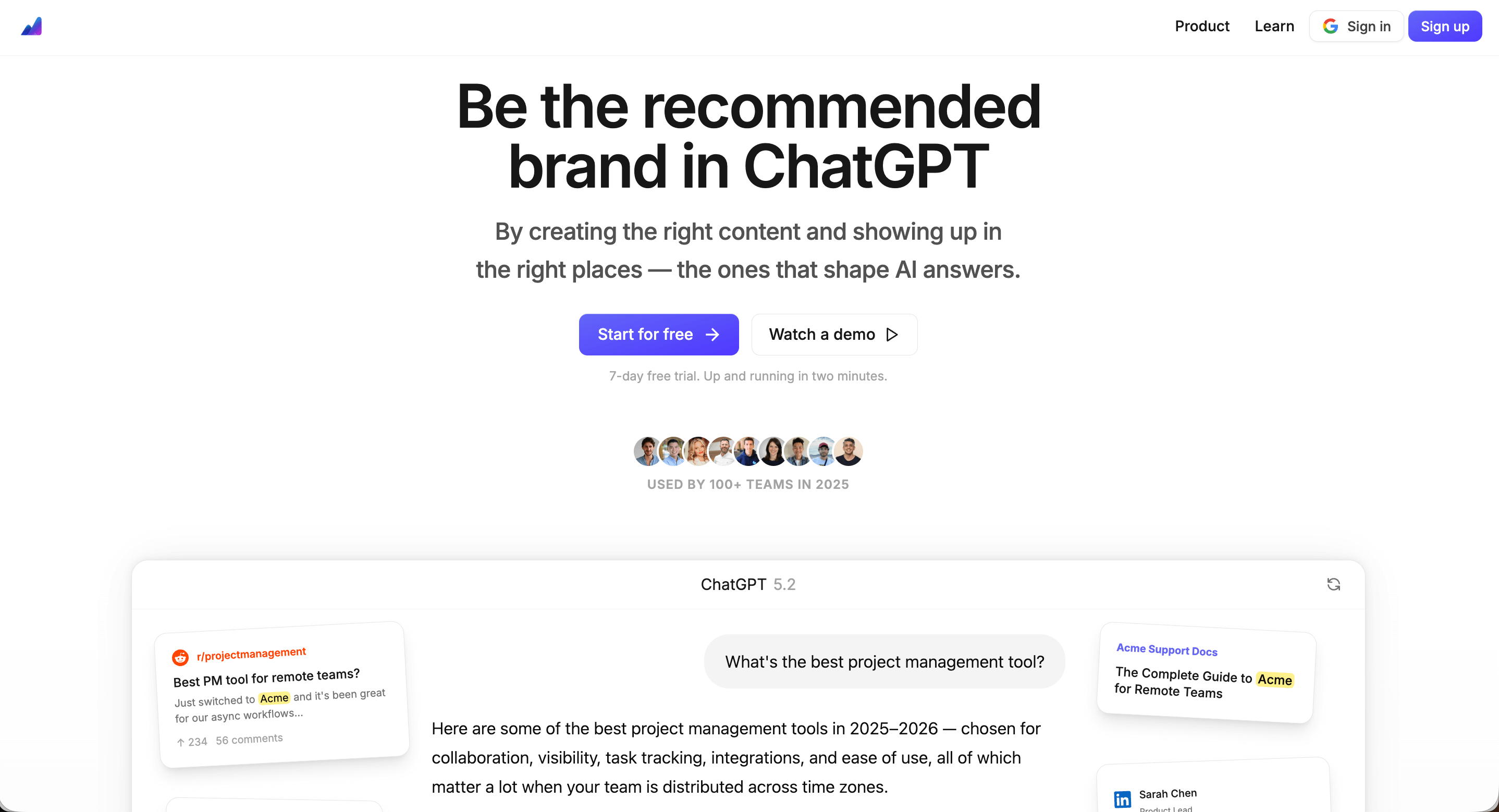
Searchable’s analytics integrations (GA4, GSC, HubSpot, Salesforce) help you measure what’s already happened—AI-driven traffic correlations and brand visibility trends. Airefs’ Reddit monitoring shows you what’s about to happen—the discussions that will become AI sources before they’re established. For teams that want to get ahead of AI citations rather than retroactively analyze them, Airefs provides earlier-stage intelligence.
The done-for-you service tier ($249/mo) handles content creation and community participation on your behalf—Searchable has no service layer at any price.
Key features
- ChatGPT-first tracking: Daily refresh on paid plans; other LLMs on request
- Reddit keyword monitoring: Track up to 30 keywords to surface future citation sources before they become established
- AI Search Analytics: Real AI-driven traffic and crawler monitoring on your site
- Competitor source analysis: Which sources competitors are cited in that you’re not
- Content opportunity identification: The specific articles and discussions AI models rely on in your market
Pricing
- Lite: $24/mo — 1 domain, 3 competitors, 25 prompts, 3 Reddit keywords
- Pro: $49/mo — 3 domains, 60 prompts, 10 Reddit keywords, 7-day free trial
- Expert: $83/mo — Unlimited domains, 150 prompts, 30 Reddit keywords, AEO strategist
Pros & cons
Pros:
- $24/mo vs $50/mo — less than half the cost of Searchable’s entry plan
- Reddit monitoring identifies future AI citation sources before Searchable’s tracking registers them
- 5.0/5 customer rating with documented testimonials; Searchable has no third-party reviews yet
- Done-for-you tier executes on insights — Searchable has no service offering
Cons:
- No GA4, GSC, HubSpot, or Salesforce integration — Searchable’s analytics layer is a genuine differentiator
- No GEO Audit or AI readiness audit — Searchable’s Audit module identifies technical crawler obstacles
- Fewer AI platforms by default; Searchable tracks 7 from Starter
Customers
Airefs serves 100+ teams across startups, agencies, and B2B SaaS. 5.0/5 customer rating.
While every other AI search visibility tool showed me whether I was being cited, Airefs showed me all 571 URLs that were being cited.
— Lillian P, Fractional CMO
2. Otterly AI: Best Searchable alternative for validated credentials
Searchable launched in November 2025 and has no G2 or Capterra presence. Otterly AI has Gartner Cool Vendor 2025 in AI in Marketing, G2 High Performer, and a 4.9/5 rating across 250 verified reviews—for $29/mo. For teams evaluating AEO tools where procurement requires third-party validation, Otterly’s credential profile is dramatically stronger than Searchable’s launch-stage documentation.
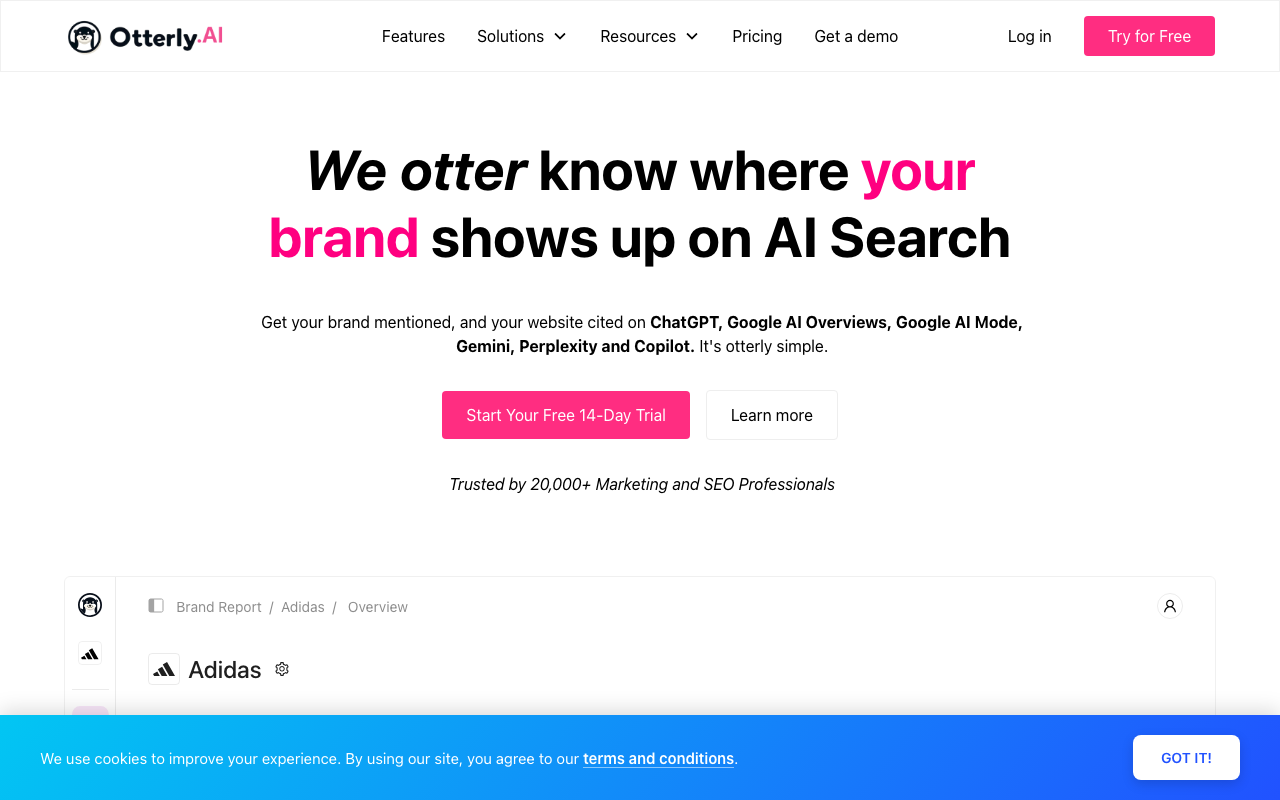
Otterly’s GEO Audit analyzes 25+ on-page factors and delivers a prioritized optimization checklist—a capability Searchable’s current product doesn’t replicate. The 14-day free trial with no credit card gives teams more evaluation time on a more validated product, backed by an established user base of 20,000+ for reference checks.
Key features
- 6-platform tracking: ChatGPT, AI Overviews, AI Mode, Perplexity, Gemini, Copilot
- GEO Audit: 25+ on-page factors with actionable optimization recommendations
- Brand mention and citation tracking: Sentiment, position, share of voice
- 40+ country support: Multi-language, global market monitoring
- Automated weekly reports: Regular summaries for team updates
Pricing
- Starter: $29/mo — 14-day free trial, no credit card
- Growth: $189/mo
- Business: $489/mo
- Enterprise: Custom
Pros & cons
Pros:
- $29/mo vs $50/mo — 40% cheaper than Searchable’s entry plan
- Gartner Cool Vendor 2025 and G2 High Performer — Searchable has no third-party category recognition
- 4.9/5 across 250 reviews vs Searchable’s zero public reviews
- GEO Audit covers on-page optimization Searchable’s product doesn’t yet provide
- 20,000+ users vs Searchable’s 12,000 — established community for reference checks
Cons:
- No GA4, GSC, HubSpot, or Salesforce integration — Searchable’s analytics connectivity is unique at this price
- Only 6 AI platforms — Searchable covers 7 including Grok
- Add-ons for AI Mode and Gemini inflate the true base cost
- Small team (2-10 employees, Austria-based)
Customers
Otterly AI serves Opera, Bacula Systems, XXXLutz, Avis Budget Group, Roadsurfer, Auto1, Storyblocks, A1 Telekom, SmartRecruiters, and Campaign Monitor.
2x increase in both our visibility in AI search engines and incoming traffic.
— Rebecca Anderson, Instant Commerce
3. Profound: Best Searchable alternative for enterprise teams
Searchable’s $400/mo Scale plan covers 7 AI platforms with 2,000 prompts. Profound’s Growth plan at $399/mo covers 10+ AI platforms with unlimited prompts, G2 Winter 2026 Leader status, prompt volume data showing actual AI search demand, and ChatGPT Shopping tracking. For enterprise teams that need more than Searchable’s current platform scope and a more established enterprise track record, Profound is the natural step up.
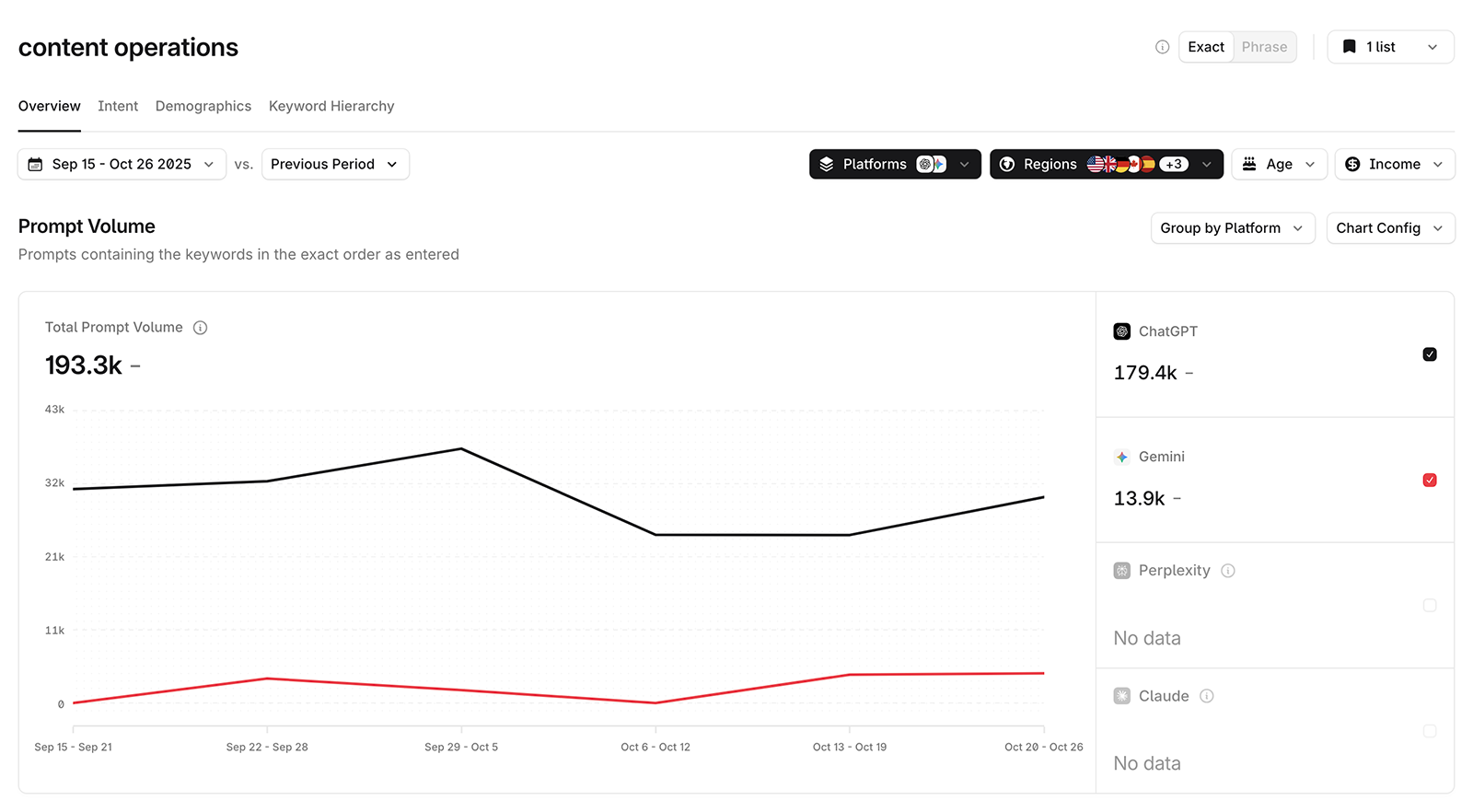
Profound’s prompt volume data shows how often real users query AI about topics in your category—a strategic input Searchable’s analytics integrations don’t provide in the same form. Where Searchable tells you how AI-driven traffic correlates with your existing GSC data, Profound tells you the scale of AI search demand for topics your brand could own. For enterprise strategy conversations, prompt volume data is often the more persuasive input.
Key features
- 10+ AI platform tracking: ChatGPT, Perplexity, Gemini, Copilot, Claude, Grok, DeepSeek, AI Overviews, AI Mode, and more
- Prompt volume data: Actual AI search demand for topics in your category
- ChatGPT Shopping tracking: Visibility in AI-driven product recommendations
- Share of voice and citation analytics: Brand position across all tracked platforms
- AI content generation: Draft content optimized for AI citation
Pricing
- Starter: $99/mo — ChatGPT only, 50 prompts
- Growth: $399/mo — 10+ platforms, unlimited prompts
- Enterprise: Custom
Pros & cons
Pros:
- G2 Winter 2026 Leader — the strongest category recognition of any AEO platform
- Prompt volume data shows AI search demand — a strategic layer Searchable’s analytics don’t cover
- 10+ platforms vs Searchable’s 7 — broader coverage at comparable Growth-tier pricing
- TripAdvisor, HubSpot, McKinsey, Ramp as customers — proven enterprise track record
Cons:
- $99/mo Starter covers only ChatGPT — Searchable’s $50/mo Starter covers 7 platforms
- No GA4 or CRM integrations — Searchable’s analytics connectivity is a genuine differentiator
- No free trial — only a free AEO Report on the starter tier
Customers
Profound serves TripAdvisor, HubSpot, McKinsey, and Ramp, among others.
Profound has become an indispensable tool in our arsenal for AI search.
— Profound enterprise customer
4. Peec AI: Best Searchable alternative for global brands
Searchable’s 7-platform coverage with GA4 and GSC integration is strong for English-language markets. Peec AI’s 115+ language support with UI scraping accuracy and documented enterprise outcomes fills the international gap that Searchable’s 2025-launch product hasn’t yet addressed. For brands running AEO programs across multiple languages and regions, Peec AI’s language depth is a capability Searchable can’t currently match.
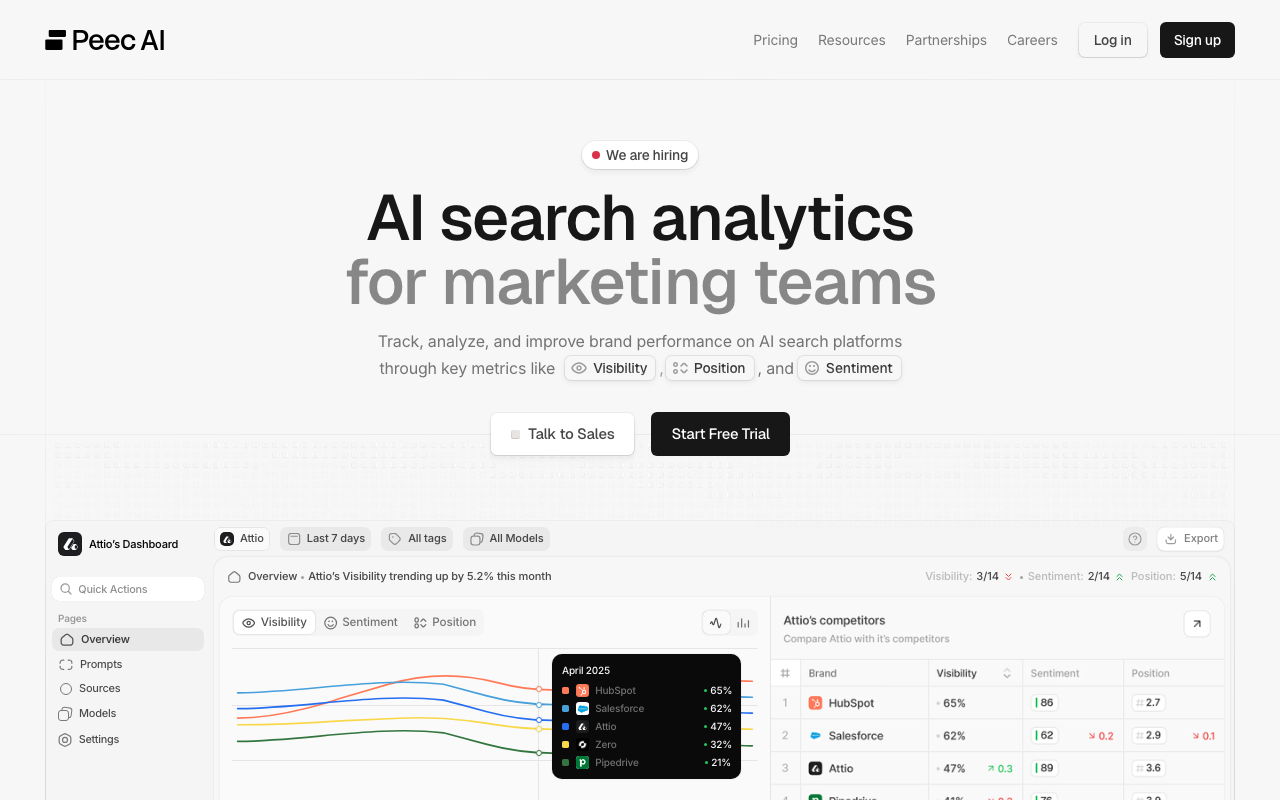
Peec AI’s UI scraping methodology actually interacts with AI interfaces as a real user would, capturing full response context including formatting, positioning, and qualifications that API-based tracking misses. For brands where the quality and framing of AI mentions matters as much as their frequency, this accuracy difference is material.
Key features
- 115+ language support: Monitor AI visibility across major global markets and languages
- UI scraping accuracy: Real browser interactions for complete response capture
- Competitor citation analysis: Which sources competitors appear in across platforms
- Campaign measurement: Before/after visibility measurement for content and optimization campaigns
- 14-day free trial: Full platform access without credit card
Pricing
- Starting: $89/mo — 14-day free trial
- Higher tiers: Custom pricing for enterprise volume
Pros & cons
Pros:
- 115+ languages — Searchable has no documented international language support
- UI scraping captures full response context that API-based tracking misses
- Documented enterprise outcomes with named case studies — Searchable has no published case studies
- 14-day free trial without credit card
Cons:
- No GA4, GSC, HubSpot, or Salesforce integration — Searchable’s analytics layer is absent here
- $89/mo entry vs $50/mo — more expensive than Searchable’s Starter
- Smaller platform than Searchable’s 7 by default (ChatGPT, Perplexity, AI Overviews + add-ons)
Customers
Peec AI serves enterprise brands and agencies running multilingual AI visibility programs. 14-day free trial available.
Peec AI gave us the cross-language visibility data we needed to run a coordinated AEO program across six markets.
— Peec AI enterprise customer
5. Promptmonitor: Best Searchable alternative for broadest platform coverage per dollar
Searchable covers 7 AI platforms from $50/mo. Promptmonitor covers 8—including Claude, Grok, DeepSeek, and Meta AI that Searchable’s current platform doesn’t track—for $29/mo. For teams whose primary requirement is cross-platform coverage at the lowest possible cost, Promptmonitor provides more platforms per dollar than Searchable at launch.
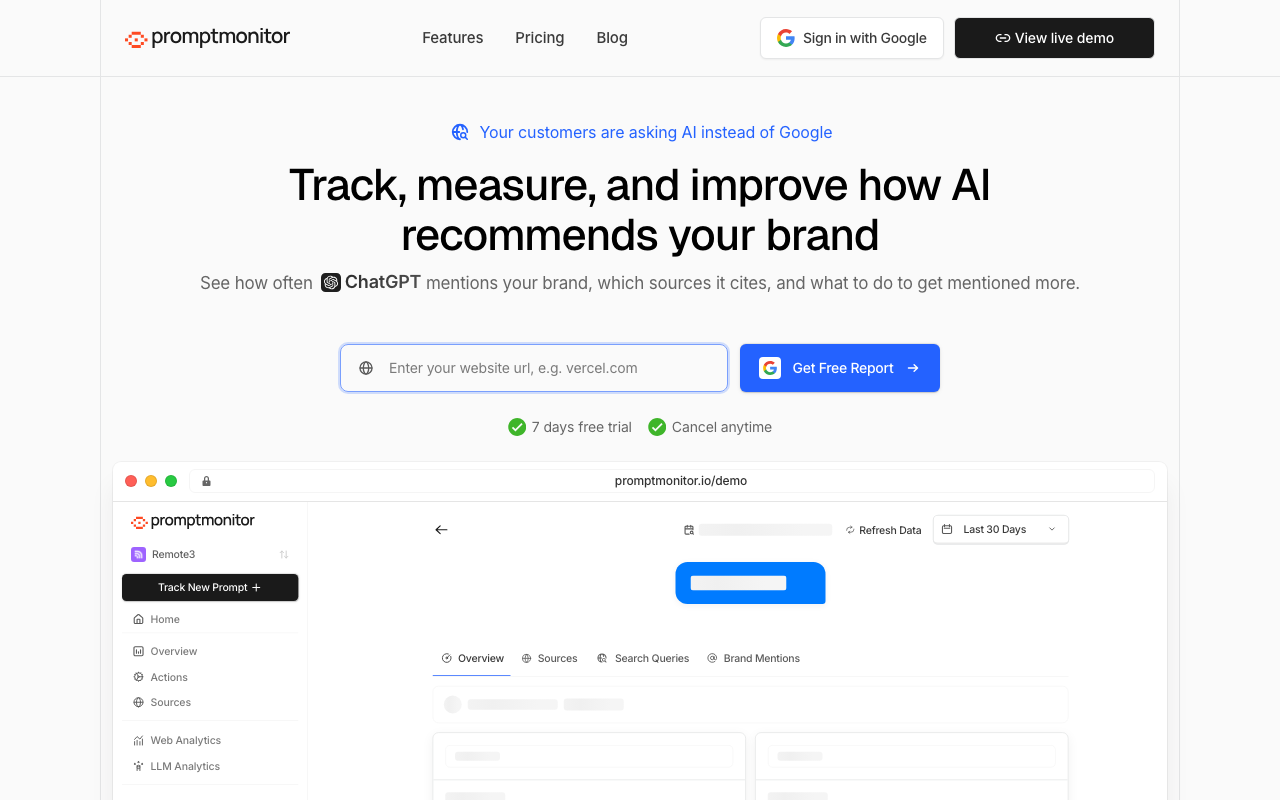
The publisher contact extraction feature surfaces author emails and social profiles from AI-cited sources, enabling outreach workflows that no other tool in this comparison offers. For teams that want to build relationships with AI-cited publications and content creators, this is a differentiating capability that Searchable’s analytics-focused architecture doesn’t support.
Key features
- 8-platform tracking: ChatGPT, Perplexity, Gemini, Copilot, Claude, Grok, DeepSeek, Meta AI
- Publisher contact extraction: Author emails and social profiles from AI-cited sources
- Brand mention monitoring: Citation frequency, share of voice, sentiment
- Competitor benchmarking: Visibility comparisons across all 8 platforms
- 7-day free trial: Full access before billing
Pricing
- Starter: $29/mo — 7-day free trial
- Pro: $129/mo
Pros & cons
Pros:
- 8 platforms vs Searchable’s 7 — includes Claude, Grok, DeepSeek, Meta AI for less
- $29/mo vs $50/mo — 40% cheaper than Searchable’s entry plan
- Publisher contact extraction enables outreach Searchable’s analytics-first approach doesn’t support
- 7-day free trial
Cons:
- Solo indie founder (Yogesh) — Searchable has a three-co-founder team with Freestyle VC backing
- No G2 reviews or named customer case studies — Searchable has 12,000+ users and press coverage
- No GA4, GSC, or CRM integrations — Searchable’s analytics connectivity is absent
- No GEO Audit or AI readiness technical analysis
Customers
Promptmonitor serves independent marketers, agencies, and SEO professionals globally.
A surprisingly complete picture of where your brand stands across 8 AI engines—at a price that makes it accessible for teams of any size.
— Promptmonitor user
Frequently asked questions
Why look for Searchable alternatives?
Searchable is a strong early product with a talented team and serious funding. The case for alternatives is timing: no G2 or Capterra reviews yet, no published customer case studies, and a Starter plan more restrictive than most alternatives at the same price point ($50/mo for 1 domain and 50 prompts). Teams that need validated third-party credentials or documented customer outcomes have stronger options in this guide.
Does any alternative match Searchable’s GA4, GSC, HubSpot, and Salesforce integrations?
Not at comparable pricing. Searchable’s analytics integrations available from $50/mo are genuinely rare in the AEO category. AthenaHQ ($295/mo) offers GA4 and GSC integration, and Profound offers some analytics connectivity at higher price points. Under $125/mo, Searchable is the only AEO platform with GA4, GSC, HubSpot, and Salesforce available from the entry plan.
Which alternative has the strongest third-party validation?
Otterly AI: Gartner Cool Vendor 2025, G2 High Performer, 4.9/5 across 250 verified reviews at $29/mo. Profound: G2 Winter 2026 Leader. Airefs: 5.0/5 customer rating. Searchable has no third-party review presence yet. For procurement-sensitive teams, Otterly AI is the strongest-credentialed alternative.
How many AI platforms do these alternatives cover?
Promptmonitor: 8 (ChatGPT, Perplexity, Gemini, Copilot, Claude, Grok, DeepSeek, Meta AI). Searchable: 7 (ChatGPT, Claude, Perplexity, AI Overviews, Copilot, Gemini, Grok). Profound: 10+. Peec AI: ChatGPT, Perplexity, AI Overviews + add-ons. Otterly AI: 6. Airefs: ChatGPT by default with other LLMs on request.
Is there a free trial for these alternatives?
Airefs: 7-day trial on Pro ($49/mo). Otterly AI: 14-day trial, no credit card. Peec AI: 14-day trial, no credit card. Promptmonitor: 7-day trial. Profound: free AEO Report. Searchable: 14-day Pro trial, no credit card. Peec AI and Otterly AI offer the most generous no-credit-card trial windows.
What’s the main thing Searchable offers that alternatives don’t?
Native GA4, GSC, HubSpot, and Salesforce integrations from the $50/mo Starter plan—connecting AI visibility metrics to the analytics and CRM stack most marketing teams already use. No alternative in this guide offers this combination at comparable pricing.
Conclusion: Choosing your Searchable alternative
For teams that want proactive opportunity discovery at the lowest cost, Airefs at $24/mo identifies Reddit threads and content opportunities before they become established AI sources—for less than half of Searchable’s $50/mo entry plan.
For teams that need validated third-party credentials before committing budget, Otterly AI at $29/mo delivers Gartner Cool Vendor 2025 recognition, G2 High Performer status, and 250 verified reviews—the most credentialed affordable option in the category while Searchable builds its review base.
For enterprise teams that need broader platform coverage and proven outcomes, Profound at $99/mo covers 10+ AI platforms with G2 Winter 2026 Leader status and customers including TripAdvisor, HubSpot, and McKinsey—a track record Searchable’s 2025 launch can’t yet match.
For global brands running multilingual AEO programs, Peec AI at $89/mo delivers 115+ language support and documented enterprise outcomes that Searchable’s first year of product development hasn’t produced.
For teams prioritizing platform breadth at the lowest cost, Promptmonitor at $29/mo covers 8 AI platforms—including Claude, Grok, DeepSeek, and Meta AI—for $21/mo less than Searchable’s Starter.
Want to start tracking AI visibility for less than Searchable’s monthly cost? Try Airefs free for 7 days — $24/mo with Reddit monitoring and daily tracking.