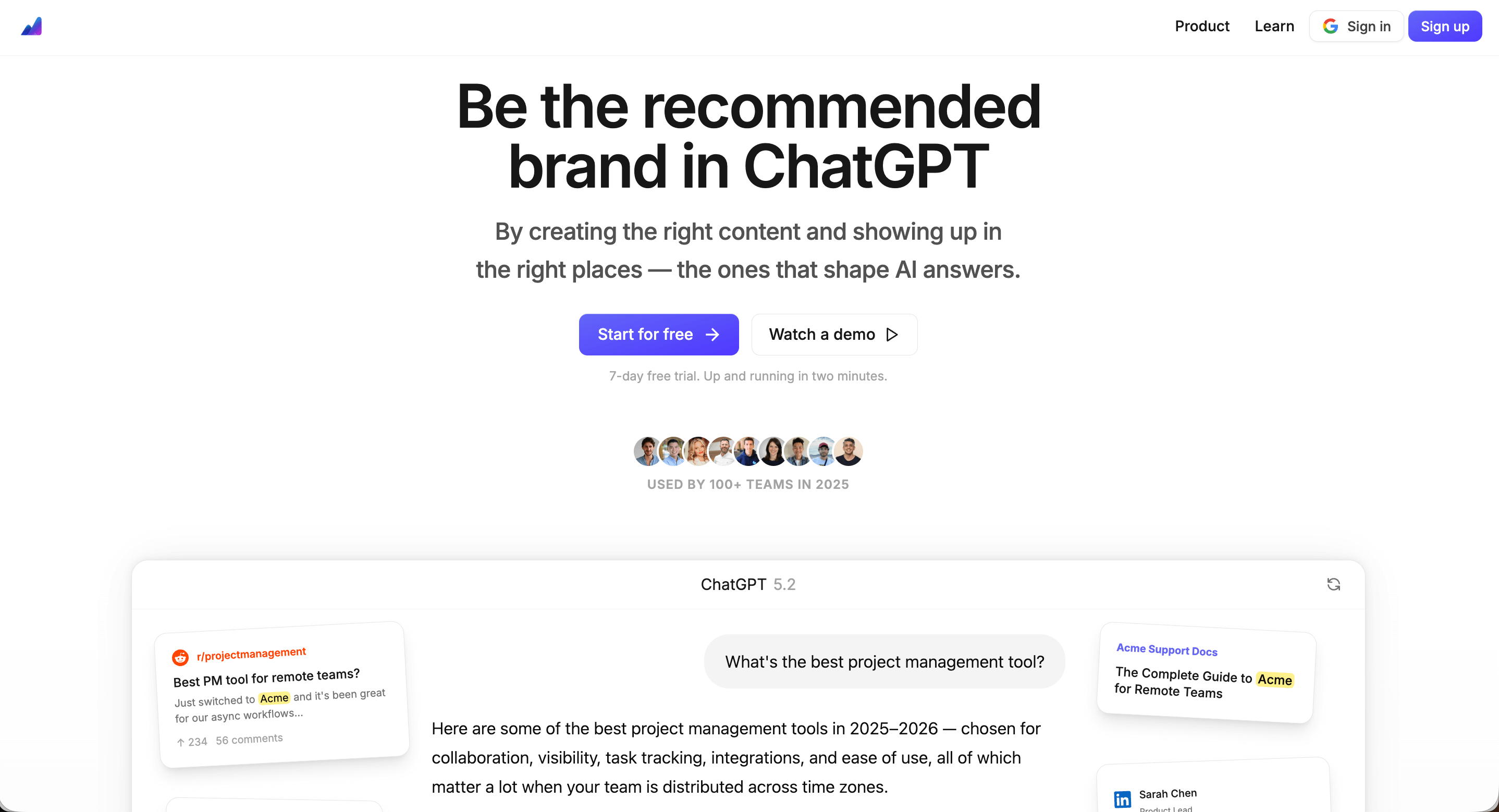
ChatGPT is now the world’s sixth most-visited website. One of our customers, Genlook, gets 30% of its signups from ChatGPT — more than from Google. Most brands don’t know if they appear in AI answers at all.
That’s the problem answer engine optimization is designed to solve.
What is answer engine optimization?
Answer engine optimization (AEO) is the practice of structuring your content and brand presence so that AI-powered tools — ChatGPT, Perplexity, Google AI Overviews, and similar platforms — can understand, trust, and cite you when someone asks a relevant question.
Traditional SEO earns you a position in a ranked list. AEO earns you a mention in a generated answer. The distinction matters because AI answers often cite one or two sources and skip the rest — and many users never click through to a website at all.
AEO is also referred to as GEO (Generative Engine Optimization), LLMO (Large Language Model Optimization), and AI SEO. They mean roughly the same thing. AEO is the term most widely used by SEO tools including Semrush.
Why AEO matters now
400 million people use OpenAI products every week. Perplexity processed over 600 million queries in January 2026 alone. These platforms aren’t niche anymore — they’re primary research tools for buyers, journalists, and decision-makers.
The business impact is showing up in the data. NerdWallet saw revenue grow even as organic traffic declined, because AI-driven discovery was compensating for lost clicks. Companies that aren’t visible in AI answers are losing ground quietly — their traffic numbers may look fine while their brand presence in AI recommendations erodes.
How answer engine optimization differs from traditional SEO
The underlying goal is similar — get in front of people looking for what you offer — but the mechanics are different in almost every respect.
| Traditional SEO | AEO | |
|---|---|---|
| Goal | Rank in search results | Be cited in AI-generated answers |
| Traffic type | Click-through to your website | Zero-click brand mentions and citations |
| Primary signals | Backlinks, on-page optimization, domain authority | Content quality, citation patterns, discussion presence |
| Key platforms | Google, Bing | ChatGPT, Perplexity, Google AI Overviews, Claude |
| Content format | Keyword-optimized long-form pages | Direct answers, structured comparisons, FAQ-style content |
| Community signals | Social shares, external links | Reddit, Quora, review platforms, industry forums |
| Measurement | Rankings, organic traffic, CTR | Share of voice, citation frequency, mention rate per prompt |
| Feedback loop | Google Search Console, rank trackers | Specialized AEO tracking tools |
| Timeline to results | Months to years | Weeks to months |
The most important practical difference: 99% of URLs cited in AI responses also rank in Google’s top 20 organic results (Profound, 2025). SEO and AEO are not competing strategies — ranking authority helps with citations. But ranking alone doesn’t guarantee you’ll be mentioned. Many pages that rank #1 for a keyword never appear in AI answers on related prompts.
What AEO actually involves
AEO has three main inputs: the content AI models cite, the discussions they draw from, and the technical accessibility of your site.
Content AI models cite
Articles, comparison pages, and guides are the primary citation sources. The content doesn’t have to live on your own website — it just needs to be indexed by Google. LLMs use Google’s index as a proxy for what’s trustworthy and worth citing. A guest post on an industry publication, a detailed answer on Quora, a comparison article on a review site — if Google has indexed it and it’s relevant, AI models can cite it.
Content that performs well tends to be direct — it answers the question in the opening paragraph, uses clear question-based headings, and avoids padding. A 1,500-word post that leads with a 50-word definition and uses structured comparisons gets cited more reliably than a 3,000-word post that buries the answer in section four.
The format matters as much as the substance. AI models extract information efficiently from comparison tables, numbered lists with clear labels, and FAQ-style sections. Prose-heavy writing without visual structure is harder to pull from.
Schema markup helps too — FAQ schema, Article schema, and Organization schema are signals that help AI crawlers understand what your content is and who produced it.
Community and off-site signals
AI models don’t just read your website. They draw from a much wider set of public sources, and understanding which ones matters for where you focus effort.
Reddit is the most significant community signal for most categories. Threads where users compare tools, ask for recommendations, or share real-world experiences are frequently cited in AI answers. A single high-quality thread can appear in AI responses across thousands of related prompts. Participating in those threads — or being present in new ones early — builds a citation footprint that your own website can’t replicate.
Quora plays a similar role, particularly for educational and how-to queries. Detailed, specific answers on Quora have a long shelf life and appear frequently in AI responses to informational questions.
Review platforms — G2, Capterra, Trustpilot, and Product Hunt — are heavily weighted for software and SaaS categories. AI models treat review site listings as authoritative third-party validation. If ChatGPT is asked to recommend a tool in your category, it will commonly cite G2 or Capterra profiles, not just vendor websites. A well-maintained profile with real customer reviews and clear feature descriptions is an AEO asset.
LinkedIn articles and posts from recognized practitioners are cited in professional and B2B contexts. If you’re building authority in a specific domain, original research or perspective pieces published on LinkedIn can reach AI training data and citation pools in ways that a new blog post can’t.
YouTube transcripts are indexed by several AI platforms, particularly Perplexity. Tutorial videos, product walkthroughs, and expert interviews all create additional citation surface area — especially for audiences who research via video.
Industry publications and press — being covered by relevant trade publications, newsletters, or news sites adds third-party credibility that AI models use as a trust signal. A mention in a sector publication carries more weight than the equivalent content on your own domain.
The practical implication: AEO is not a single-channel strategy. Your website is one input. The conversation about your brand across Reddit, review sites, and industry media is often more influential.
Technical accessibility
If AI crawlers can’t access and read your content, they can’t cite it. The main things to check:
- robots.txt — the major AI crawlers (GPTBot for ChatGPT, ClaudeBot, PerplexityBot, and others) respect robots.txt. Many sites inadvertently block them with catch-all rules. Check which AI crawlers are visiting your site and make sure the important ones aren’t excluded.
- Page structure — clean HTML with logical heading hierarchy makes it easier for AI models to extract and attribute information correctly. JavaScript-heavy pages that require rendering are harder to crawl.
How to measure AEO
AEO can’t be measured with Google Analytics or Search Console. Those tools only capture clicks — they miss zero-click mentions entirely, and they significantly undercount ChatGPT traffic that does make it to your site.
Dedicated AEO tools run prompts against AI platforms and record whether your brand appears, how often, in what context, and alongside which competitors. The key metrics are:
- Mention rate — what percentage of relevant prompts include your brand
- Share of voice — your mentions relative to competitors across the same prompt set
- Citation sources — which of your pages (or third-party pages about you) AI models are drawing from
- Sentiment — whether mentions characterize your brand positively, neutrally, or negatively
- AI crawler impressions — how often AI bots are visiting your site, which correlates with citation activity
The most reliable signal, though, is simpler: ask new customers how they found you. Self-reported signup source data consistently shows AI platforms — ChatGPT in particular — converting at rates that automated tools undercount. When someone says “I asked ChatGPT which tool to use and it recommended you,” that’s AEO working. Tracking that directly, through onboarding surveys or signup forms, gives you ground truth that no crawler-based metric can replicate.
Tracking these metrics over time shows whether your content and community efforts are translating into actual AI visibility — and which specific prompts you’re winning or losing.
AEO and SEO are not competing priorities
A common concern is whether optimizing for AI answers means diverting effort from traditional SEO. It doesn’t, for two reasons.
First, the content that works for AEO — direct, well-structured, authoritative — is also good for SEO. There’s no version of AEO where you build low-quality content. Second, the off-site presence that helps with AEO (Reddit discussions, review platforms, third-party mentions) has indirect SEO value through brand signals and referral links.
The channels reinforce each other. The same content strategy that earns AI citations also tends to strengthen Google rankings and build community credibility — not as a side effect, but because the underlying quality signals overlap.
Frequently asked questions
Is AEO the same as GEO or LLMO?
Effectively yes. GEO (Generative Engine Optimization), LLMO (Large Language Model Optimization), GAIO (Generative AI Optimization), and AEO all refer to optimizing your brand presence for AI-generated answers. The terminology is still unsettled. AEO and GEO have the most traction among SEO tools and practitioners as of 2026.
Do I need to do AEO if I already rank well on Google?
Ranking well on Google helps — most URLs cited in AI answers are also in Google’s top 20 results. But it’s not sufficient. Ranking #1 for a keyword doesn’t guarantee you’ll be mentioned when someone asks a related question in ChatGPT. AEO requires additional work: content structured for extraction, a presence on review platforms and discussion sites, and monitoring to understand which prompts you’re actually appearing in.
How long does it take to see results from AEO?
For most brands in competitive categories, expect 6–12 weeks to see measurable shifts in mention rate. The timeline depends on how much content you already have that’s structured for AI extraction, how active your competitors are, and how established your presence is on third-party platforms like Reddit and G2. Categories with less established AI citation patterns tend to move faster.
Does AEO require a big content budget?
No. The most impactful early actions — auditing what AI currently says about you, identifying the prompts you’re missing from, and participating in existing Reddit and Quora discussions — cost time, not money. Content creation matters, but a few well-structured articles targeting specific prompts outperform dozens of generic posts.
Which AI platforms should I prioritize?
ChatGPT first. It has the largest user base by a significant margin and drives the most measurable traffic. Perplexity and Google AI Overviews are the next priority for most categories. Claude, Gemini, and Grok matter for specific use cases and audiences but have a smaller share of AI search behavior currently.
Does AEO apply to every type of business?
AEO matters most for categories where buyers use AI to research options before making a decision — software, services, B2B products, and considered consumer purchases. If someone can ask “what’s the best [tool/service/product] for [use case]?” and your category fills that blank, AI visibility is relevant. For commodity or impulse purchases where people go straight to a marketplace, AEO has less direct impact.
How do I know if AI models are mentioning my brand?
You need a tool that runs prompts against AI platforms and records the outputs — you can’t rely on traffic analytics alone. Airefs tracks your mention rate, share of voice, and which sources AI models are citing across ChatGPT and other platforms. There’s a 7-day free trial on the Pro plan.