
AI-driven content optimization is not just another marketing buzzword. It represents a fundamental shift in how people find information.
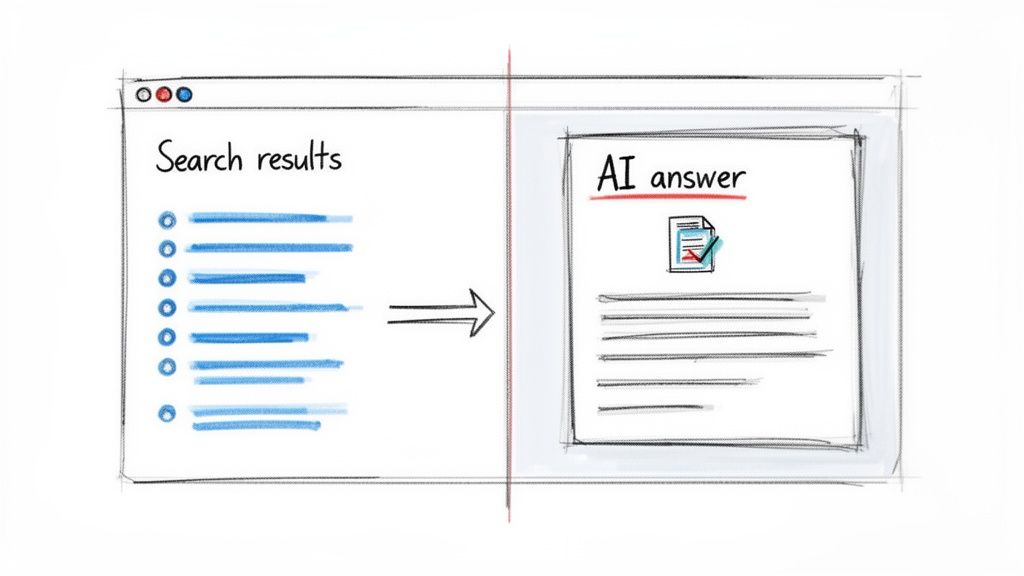
The goal is no longer to get a click from a list of blue links. It’s to become the trusted, cited source inside AI-generated answers. Your content needs to be the answer the AI relies on, whether in a Google AI Overview or a response from ChatGPT.
Why AI Driven Content Optimization Is The New Standard
For years, SEO was a straightforward game: win a top spot on the SERP, get the click. That battlefield has moved. The new front line is inside the AI answer box, where a user might get everything they need without ever clicking to a website.
The goal has changed from being found to being the answer.
This calls for a new playbook. We must obsess over the prompts and questions our audience asks AI assistants, not just keywords. Success means understanding how these AI models think and what sources they trust.
From Rankings To Recommendations
This new approach aims to make you the default recommendation in your industry. When someone asks an AI for advice, you want your brand, product, or perspective presented with confidence. An AI’s implied endorsement is far more powerful than a simple #1 ranking.
Getting there boils down to two key activities.
- Analyzing AI Sources: You have to figure out which articles, forum threads, and reviews the AI models are already citing.
- Strategic Participation: Once you know what the AI trusts, you need to be part of that conversation.
This guide on AI in Marketing for B2B is a great starting point for a broader overview.
The objective is to make your content so clear, authoritative, and well-structured that AI systems prefer it over your competitors’ when constructing an answer. It’s about becoming an indispensable part of the AI’s knowledge base.
The Business Impact Of AI Visibility
Getting cited inside AI answers drives highly qualified traffic. When your brand is named as the source for a solution, the user who clicks through arrives with a high level of trust. This is a quality of visitor you don’t get from a standard organic search click.
Here’s a quick breakdown of how the old and new worlds compare.
Traditional SEO vs AI Driven Content Optimization
| Metric | Traditional SEO Focus | AI Driven Content Optimization Focus |
|---|---|---|
| Primary Goal | Rank #1 on the SERP for keywords. | Become the cited source in AI answers. |
| Key Activity | Keyword research and backlink building. | Prompt analysis and source participation. |
| Success Metric | Organic traffic and click-through rate (CTR). | Share of voice in AI answers for key prompts. |
| User Intent | Matching keywords to landing pages. | Answering conversational user questions directly. |
| Content Strategy | Long-form, keyword-optimized articles. | Clear, concise, and highly-structured content. |
The game has clearly changed. The focus is now on tracking your “share of voice” within AI answers for your most important prompts. You must measure how that visibility impacts your bottom line.
This new model moves beyond old metrics. Learn more about this evolution in our guide on AI Search Engine Optimization.
How to Define and Track Your AI Visibility
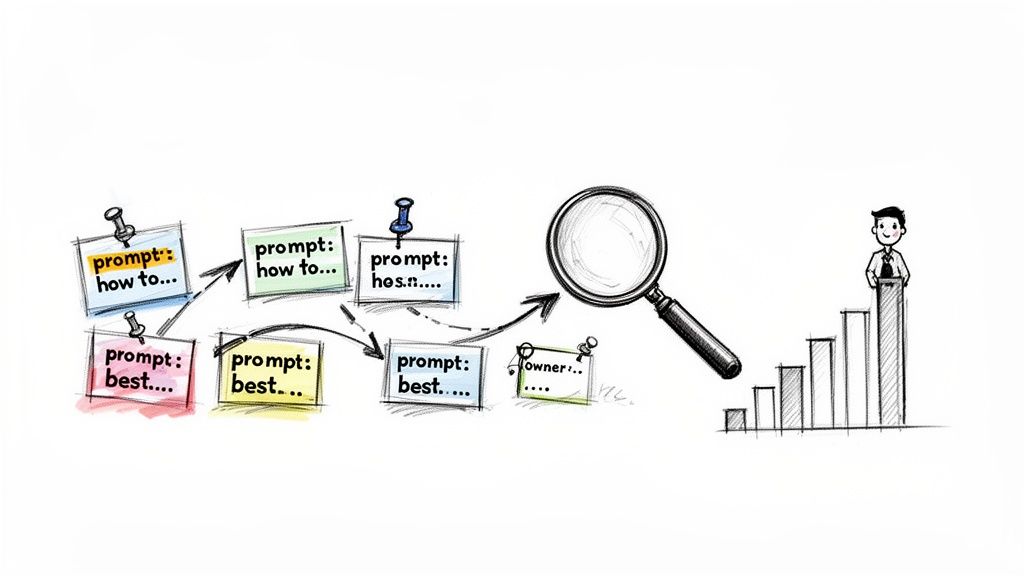
You can’t improve what you don’t measure. Before winning visibility inside AI answers, you must define which conversations matter to your business. This means shifting from a keyword mindset to a prompt-first approach.
Pinpoint the exact questions your ideal customers ask when researching solutions. These are rarely simple keywords; they are complex, multi-part problems. Think less “best CRM software” and more “how to manage sales leads for a small remote team.”
This deep understanding of user intent is the foundation of your entire strategy. It dictates the content you create, the discussions you join, and the metrics you track.
Building Your High-Value Prompt List
To build your prompt list, map your customer’s journey. What problems do they face right before they need a solution like yours? What comparisons are they making between different options?
Talk to your customer-facing teams to uncover these prompts.
- Sales teams hear direct questions about competitors and specific use cases every day.
- Customer support knows the exact pain points that drive users to seek help.
- Product teams understand the core problems your solution was built to solve.
Gather these insights in a spreadsheet. Focus on quality and relevance to create a curated list of 20–30 core prompts. These represent the most critical conversations in your market.
From Prompts to Benchmarks
With your curated prompt list, it’s time to establish a benchmark. You need a system to consistently monitor how your brand shows up in AI answers for these specific questions. This is an ongoing process, not a one-time check.
This tracking reveals your AI share of voice. This critical metric shows how often you are mentioned or cited compared to competitors. A low share of voice is a clear signal pointing to your biggest growth opportunities.
AI has changed the game for marketers, with 89% now using it for content creation or optimization. A platform like Airefs is essential for tracking prompts across different AI models, countries, and languages. This lets you measure consistent recommendations over your rivals.
The objective isn’t just to be mentioned once. It’s to become the brand that AI models consistently and confidently recommend when a user asks a high-value question related to your industry.
Setting Up Your Tracking System
A reliable tracking system needs consistency and structure. Manually checking dozens of prompts across multiple AI tools is a massive time sink and prone to inaccuracy. You need a dedicated platform to automate this.
Look for a tool that can:
- Monitor specific prompts on a recurring schedule.
- Track multiple AI models like ChatGPT, Perplexity, and Google’s AI Overviews.
- Analyze competitor mentions to give you a clear share of voice comparison.
- Identify the sources the AI is using to formulate its answers.
That last point is crucial. Knowing which content influences the AI gives you a precise roadmap for your optimization efforts. For more on this, check out our guide on AI Overviews tracking.
Analyzing the Sources That Power AI Answers
AI models don’t create answers from scratch. They synthesize information from a massive library of public content. Understanding what content they use is the key to AI-driven content optimization.
Digging into the sources reveals the articles, forum threads, and reviews shaping the AI’s “opinion” of your market. This uncovers the specific content that AI models trust for your most important prompts. It turns your strategy from a guessing game into a precise operation.
Deconstructing the AI’s Knowledge Base
First, spot the patterns in the content AI models cite. Do they reference long-form guides, technical documentation, or user reviews on Reddit? This tells you what kind of content carries weight in your niche.
This analysis separates sources into two buckets.
- Owned Content: Articles, blog posts, and docs on your site that an AI is already using.
- Third-Party Mentions: Forum discussions, product reviews, and articles on other websites you don’t control.
This distinction is your roadmap. Update your owned content for quick wins while building a long-term plan to engage in third-party conversations. It tells you which content and platforms hold the most sway over your AI visibility.
Here’s what source analysis looks like inside a platform like Airefs.
This view doesn’t just show you if a brand was mentioned. It reveals the exact articles and discussions the AI used to form its answer.
Finding Your Content Gaps and Opportunities
With a list of sources, you can hunt for strategic openings. Find where your content is missing or isn’t as good as what the AI prefers. This process gives your team clear, actionable next steps.
For example, if an AI consistently cites a competitor’s case study, you need a more compelling one. If it’s pulling answers from a three-year-old Reddit thread, publish a fresh, authoritative blog post on that exact topic.
This approach is non-negotiable as tools like ChatGPT and Google’s AI Overviews take over. When AI summaries appear, traditional click-through rates plummet to just 8%. Smart brands are optimizing to become the citation, not just chasing clicks.
Your goal isn’t to trick the algorithm. It’s to create content so genuinely helpful and well-structured that AI models have no choice but to cite you as the most reliable source.
Prioritizing Your Source-Driven Actions
A deep source analysis can produce a long list of tasks. To avoid getting bogged down, prioritize based on impact and effort.
Here’s a simple way to frame the opportunities you’ll find.
- High-Impact, Low-Effort: Updating an existing blog post that’s already getting cited.
- High-Impact, High-Effort: Creating a new, definitive guide to fill a major content gap.
- Low-Impact, Low-Effort: Joining a Reddit or forum discussion that an AI is already referencing.
This methodical approach ensures you’re always focused on tasks that will move the needle on your AI visibility. Sharpen your priorities using principles from our guide on leveraging search marketing intelligence.
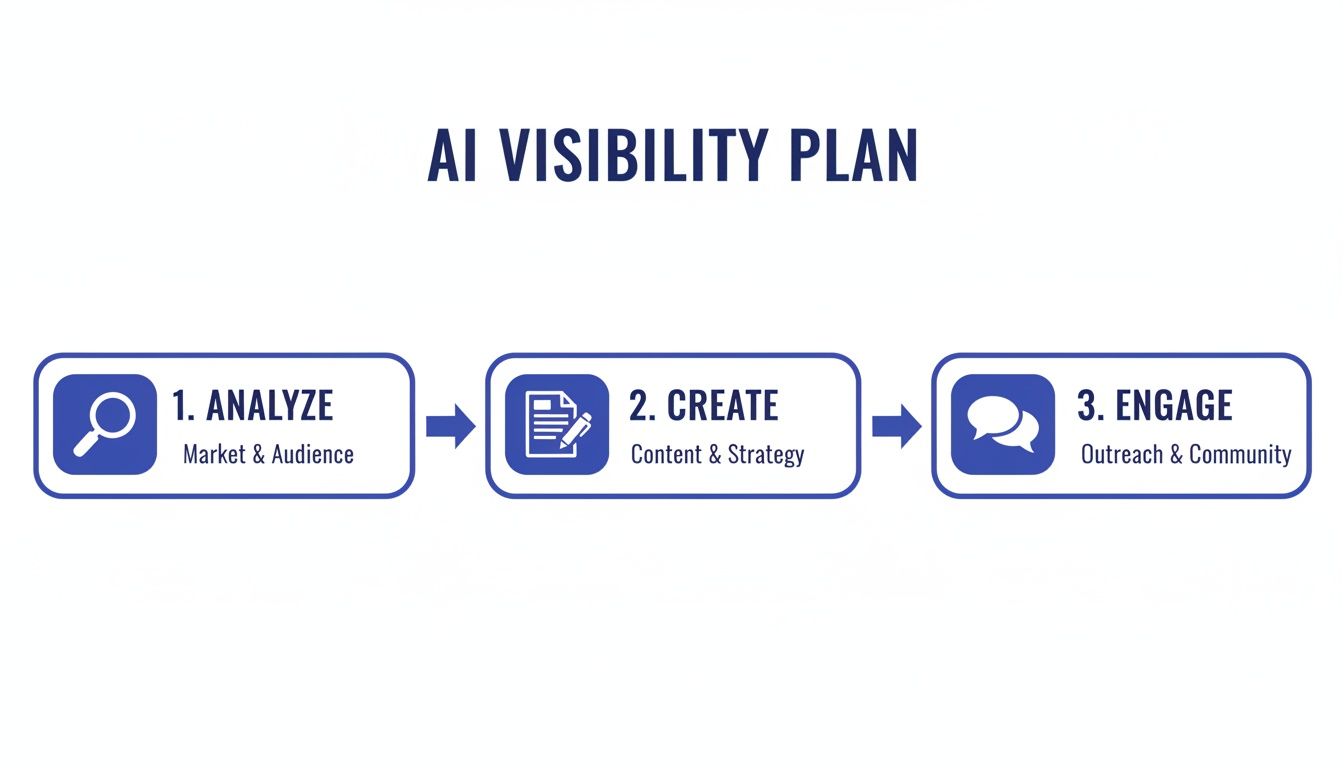
Putting Your High-Impact Optimization Plan Into Action
You’ve done the analysis and have a clear map of where you stand. Now it’s time to turn those insights into results. The game plan for AI-driven content optimization involves sharpening on-page content and joining off-site discussions.
Your source analysis has already provided a list of content that AI models trust. Use this to decide which new articles to create or which old pages need a refresh. The goal is to make your content the most authoritative and easily citable resource.
The other half of the battle is on platforms like Reddit and industry forums. Get in there and add value to shape future AI answers. This isn’t about spamming links; it’s about being genuinely helpful.
Prioritizing On-Page Content Opportunities
Your own website is the best place to start. It’s faster to improve content that’s already on the radar than to build from scratch. Your source analysis is the key to spotting these low-hanging-fruit opportunities.
Before you dive in, know your baseline by conducting a comprehensive SEO audit. This helps spot technical snags or content weaknesses holding you back.
With that baseline, hunt for these scenarios in your source data.
- You’re cited, but a competitor gets more mentions. Update your page with more depth, fresher stats, or a clearer structure to make it the undisputed best source.
- An old, outdated article is still getting referenced. Refresh it with new info and better examples.
- A competitor owns the answer for a high-value prompt. Create content on that topic that’s more thorough, helpful, and better structured than theirs.
The objective is to make your content so clear and authoritative that AI systems prefer it over everything else. Every single update should be focused on making your page the most reliable and digestible source on that topic.
The table below breaks down how these insights translate into specific, actionable tasks.
Actionable Opportunities from Source Analysis
| Insight | On-Page Action | Off-Site Action |
|---|---|---|
| You’re cited for a “how-to” prompt, but the answer is incomplete. | Update the existing article with a more detailed step-by-step guide, including visuals or a video. | Find forum questions about that process and answer them, linking back to your updated guide. |
| A competitor’s comparison article is the top source for “X vs. Y”. | Create a more comprehensive comparison article with a feature table, pros/cons, and real user quotes. | Join Reddit threads debating “X vs. Y” and offer a balanced view, mentioning your detailed comparison. |
| An old industry report of yours is still being cited for data. | Publish a new version of the report with the latest 2024 statistics and insights. | Share the key findings of your new report in relevant LinkedIn groups and forums. |
| AI cites a Reddit thread to answer a question your blog ignores. | Write a definitive blog post that directly answers that question, structuring it in a Q&A format. | Go to the original Reddit thread (if still active) and add a helpful comment linking to your new post. |
By turning each data point into a concrete action, you systematically improve your AI visibility. You are basing your work on what the models are already telling you.
Structuring Content for AI Consumption
How you write is just as important as what you write. AI models don’t read articles like people do; they parse them for reusable chunks of information. Clean, logical formatting makes it simple for them to extract and cite your key points.
Make your content “snippable”—easy for an AI to lift into an answer.
Here are effective ways to do that:
- Use Clear Headings: Your H2s and H3s should act like a table of contents. Frame them as questions, like “What Is the Main Benefit of X?”.
- Incorporate Q&A Formats: Directly answer common questions with a tight response. This format is a perfect match for how AI models build their answers.
- Lean on Lists and Tables: Bullet points and numbered lists break down complex topics. A comparison table is incredibly powerful for “X vs. Y” prompts.
For more details, check out our full guide on how to optimize content for AI search.
Engaging Strategically in Off-Site Discussions
Many AI answers are pulled from conversations on Reddit, Quora, and industry forums. Your source analysis will point you to the exact threads influencing the models. Getting involved in these discussions is a direct way to shape future AI responses.
The key is to add real value, not just drop a link.
Here’s how to approach it.
- Set Up Alerts: Use a monitoring tool to track keywords related to your priority prompts on sites like Reddit.
- Answer the Question First: Give a genuinely helpful, detailed answer to the original poster to earn credibility.
- Mention Your Brand Naturally: Reference your product or link to a blog post as an additional resource, not a sales pitch.
This authentic engagement builds a library of positive, third-party mentions. It reinforces your authority and makes it more likely you’ll be included in future answers.
Measuring the Business Impact of AI Optimization
Getting your brand cited in AI answers is a leading indicator, not the end goal. To keep investing in AI-driven content optimization, you must connect your efforts to business results. This means proving the ROI.
You need to draw a straight line from your AI share of voice to traffic, leads, and revenue. It’s about turning visibility into a sustainable, high-converting customer acquisition channel.
Connecting AI Visibility to Website Traffic
The first connection to make is between AI citations and referral traffic. While not every AI answer includes a link, many do, especially in Google’s AI Overviews and tools like Perplexity. Your job is to find and track this specific slice of traffic.
Set up custom tracking to isolate these visitors. Build specific UTMs for links in content you know is getting cited, or segment traffic from AI domains in your analytics. This separates AI-driven visitors from the rest of your organic search traffic.
Being featured as a source isn’t just a vanity win; it has a direct impact on user behavior. Data shows that being a cited source in AI Overviews can nearly double the click-through rate from 0.6% to 1.08%.
This distinction is key because traffic from AI answers often converts much better.
Analyzing Conversion Rates from AI Traffic
Once you can isolate traffic from AI citations, determine its quality. The magic of this channel is that it sends you people who already trust you. An AI has just recommended your brand, which works as powerful social proof.
This pre-qualified interest can lead to impressive conversion rates.
Ahrefs, for example, saw 12.1% more signups from AI traffic, even though it was only 0.5% of visitors. ChatGPT traffic converted at 15.9% and Perplexity at 10.5%, crushing the 1.76% from standard organic search. You can find more stats like these at position.digital.
To see this for yourself, set up conversion goals in your analytics platform for your AI traffic segment. Watch metrics like:
- Goal Completions: How many AI visitors sign up for a demo, start a trial, or download a resource?
- Lead-to-Customer Rate: What percentage of leads from AI become paying customers?
- Revenue per Visitor: How does the value of an AI-referred visitor compare to one from traditional organic search?
This is the data that builds your business case. Our guide on search engine marketing reporting can help you create reports that tell a clear story.
Correlating Share of voice with Business KPIs
The final step is to tie everything back to your AI share of voice. Over time, you should be able to show a clear relationship between your growing share of voice and a lift in key business KPIs.
Build a dashboard that puts these two data sets side-by-side. On one chart, plot your share of voice trend for your top priority prompts. Next to it, plot your inbound leads or trial signups.
When your AI-driven content optimization program is working, you’ll see both lines moving up and to the right. That visual proof is the most powerful way to show stakeholders that your work is growing the business.
FAQ: Your AI Optimization Questions Answered
What is AI-driven content optimization?
It’s the process of making your content the trusted source for AI-generated answers in tools like Google AI Overviews and ChatGPT. The goal is to be the citation the AI relies on, not just a link on a results page. This prioritizes influence and authority within the AI’s knowledge base.
How is this different from traditional SEO?
Traditional SEO focuses on keywords and backlinks to rank high on a search engine results page (SERP) and earn a click. AI optimization focuses on prompts and source analysis to become the direct answer within an AI-generated response. The objective shifts from winning the click to being the answer.
Is it necessary to create all new content?
Not at all. A core part of this strategy involves identifying and enhancing the content you already have that AI models could cite. Improving these proven assets is often the fastest and most efficient way to boost your visibility in AI answers.
Why are prompts more important than keywords now?
Prompts reflect the natural, conversational language people use when interacting with AI. They capture complex user intent far better than traditional keywords. Understanding prompts gives you a clearer picture of the user’s actual problem and what information they need.
Ready to stop guessing and start measuring your visibility in AI answers? Airefs is the platform built to track your AI share of voice, analyze the sources behind AI recommendations, and uncover your next high-impact content opportunities. See how you stack up against the competition at https://getairefs.com.