

AI Overviews tracking is monitoring how your brand appears in Google’s AI-generated answers. It’s a shift away from tracking traditional blue-link rankings. The new goal is measuring your mentions inside the AI summary itself.
This matters because if you’re not in the AI answer, you’re invisible to a growing group of searchers.
Why You Can’t Afford to Ignore AI Overviews Tracking
The old deal between search engines and websites is broken. For decades, the goal was to earn a click from the search results page. AI Overviews now provide direct answers, so that click is no longer guaranteed.
Visibility inside the AI answer is the new prime real estate.
This trend directly threatens your traffic, authority, and leads. We are in the era of “zero-click searches,” where users get answers without visiting a webpage. If your content fuels an AI answer but your brand isn’t credited, you’ve given Google your expertise for free.
The New Search Visibility Landscape
Google’s AI Overviews are no longer a small experiment. They have expanded to reach 2 billion monthly users as of early 2026. This scale is too massive to ignore.
The data reveals a clear trend. AI search traffic increased 527% in one year. Other studies show nearly 60% of searches now result in zero clicks.
Users get their answers from AI summaries, changing the game entirely. You can explore more data in the AI SEO statistics research from Semrush.
This zero-click environment makes old rules obsolete. A #1 organic ranking is a hollow victory if an AI summary above it satisfies the user. Your brand must be part of that summary to compete.
The old SEO game was about landing on page one. The new goal is getting your brand mentioned inside the AI-generated answer. Your ‘Share of Voice’ within these answers is the new critical KPI for survival.
A New Set of Rules and Metrics
Winning in this new environment requires a different mindset and new metrics. We are used to tracking keyword rankings, click-through rates, and organic traffic. These metrics don’t measure your influence in the new AI-powered search experience.
This represents a shift from traditional metrics to those that matter for AI visibility.
Here’s a quick comparison of the old world versus the new:
Traditional SEO vs AI Overview Metrics
| Metric Focus | Traditional SEO (Blue Links) | AI Overviews Tracking (AI Answers) |
|---|---|---|
| Visibility | Keyword ranking position (e.g., #3) | Brand mentions within the AI answer |
| Engagement | Click-Through Rate (CTR) | Source citations & links in the answer |
| Success KPI | Organic traffic volume | ”Share of Voice” within a topic |
The focus has clearly moved from getting clicks to gaining influence.
Here’s what that looks like in practice:
- From Rankings to Mentions: Instead of tracking URL position, you count how often your brand appears in AI answers for key queries.
- From Clicks to Source Citations: Visibility now includes getting cited as a source link within the AI Overview, which builds authority.
- From Traffic to Share of Voice: The ultimate goal is measuring your brand’s presence relative to competitors inside the AI content for a topic.
Understanding these new rules provides a massive advantage. While competitors chase old-school rankings, you can become an authoritative source that AI models trust. We cover this strategy in our guide on AI search engine optimization.
This all depends on a dedicated AI Overviews tracking strategy. Without it, you’re flying blind. Tracking is the first critical step toward shaping how AI talks about your brand.
Building Your AI Tracking Workflow
An effective AI Overviews tracking system relies on knowing what your ideal customers ask AI assistants. This isn’t traditional keyword research. It’s about mapping the conversational prompts that lead from curiosity to purchase.
Think through the entire customer journey. A user might start with “what are the best project management tools for remote teams?”. They might then ask, “compare Asana vs Trello for small business.”
Your first task is to list these questions and group them by intent. This creates a clear snapshot of your customer’s mindset at every stage.
1. Define Your Core Prompt Groups
Before tracking, you must categorize your prompts to prioritize your focus. This tells you whether to build top-of-funnel awareness or target bottom-funnel, ready-to-buy questions. Any solid AI tracking workflow starts here.
Break them down by user intent:
- Informational Prompts: These are broad, top-of-funnel questions like “how to improve team productivity.”
- Navigational Prompts: Users look for a specific brand, such as “Airefs pricing.”
- Commercial Prompts: This is where comparisons happen, with queries like “best AEO tools.”
- Transactional Prompts: The user is ready to act, using prompts like “sign up for a free trial of Airefs.”
Mapping these prompts reveals how users move from problem to solution. The modern search journey is changing. Users now get answers from AI without clicking a single link.
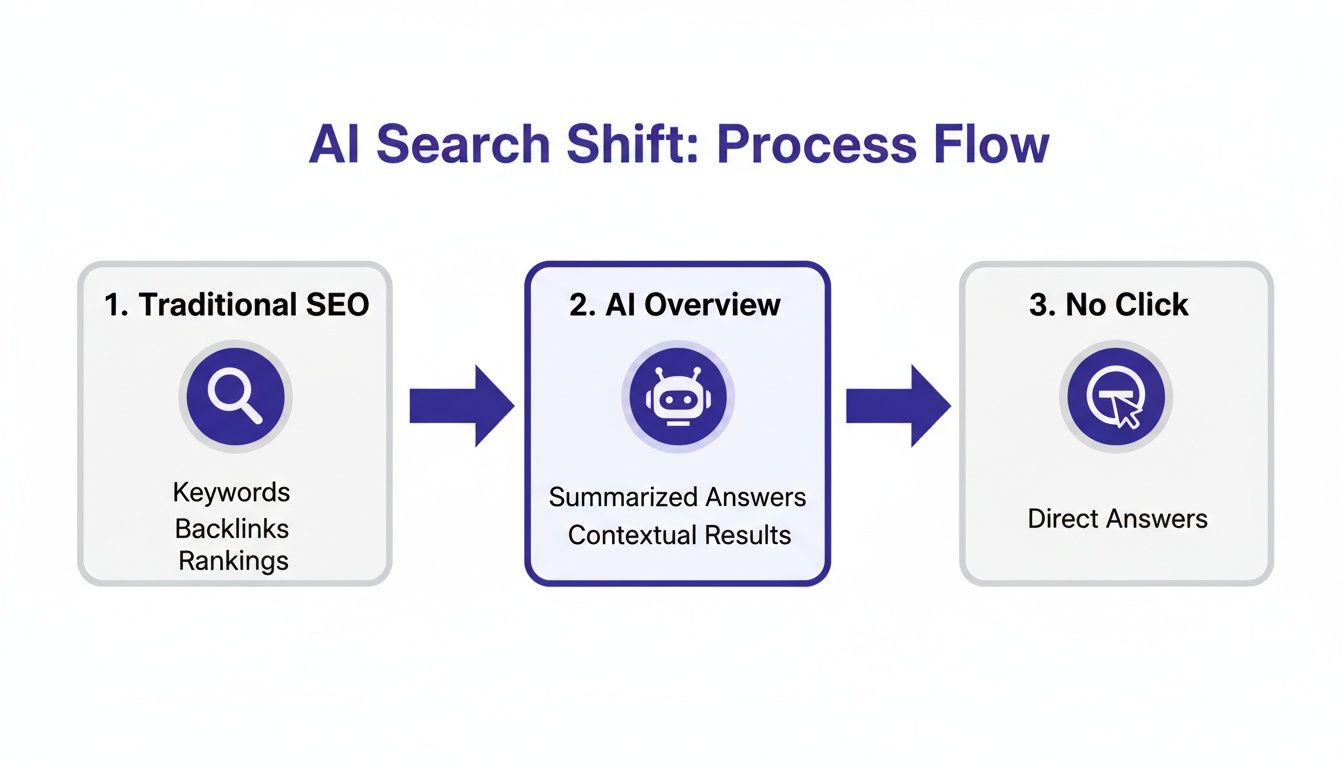
This new funnel often ends in a zero-click result, with the answer appearing directly on the search page. That is the new reality.
2. Uncover Your True AI Competitors
Your competitors in AI Overviews may not be who you think they are. The brands and websites cited in AI answers are your real competition. You could be competing against industry publications, bloggers, or even a popular Reddit thread.
Run your core prompts through AI models and see who shows up. This exercise is often eye-opening. You may find a single, high-authority blog post from another industry dominates the conversation for your top commercial prompts.
Your competitor isn’t just the company with a similar product anymore. In the world of AI search, your competitor is any source the AI model trusts more than you for a specific topic. You absolutely have to track this.
A project management software company might find its main AI competitor is a productivity blog, not another SaaS tool. Recognizing this is the first step toward influencing the AI’s source preferences.
3. Establish Your Baseline Metrics
With your prompts defined and competitors identified, you must establish a baseline. This snapshot shows where you stand right now. Without it, you can’t measure progress or prove the value of your work.
Your baseline for each core prompt needs three key metrics:
- Brand Mention Frequency: How many times does your brand appear in the AI Overview?
- Source Citations: Does the answer link to your website as a source?
- Share of Voice: What percentage of the AI Overview mentions your brand versus competitors?
Capture this data for your top 20-30 prompts. This initial dataset is the foundation of your tracking program. It provides a clear benchmark to measure against as you work to influence AI answers.
How To Figure Out The Sources Fueling AI Answers
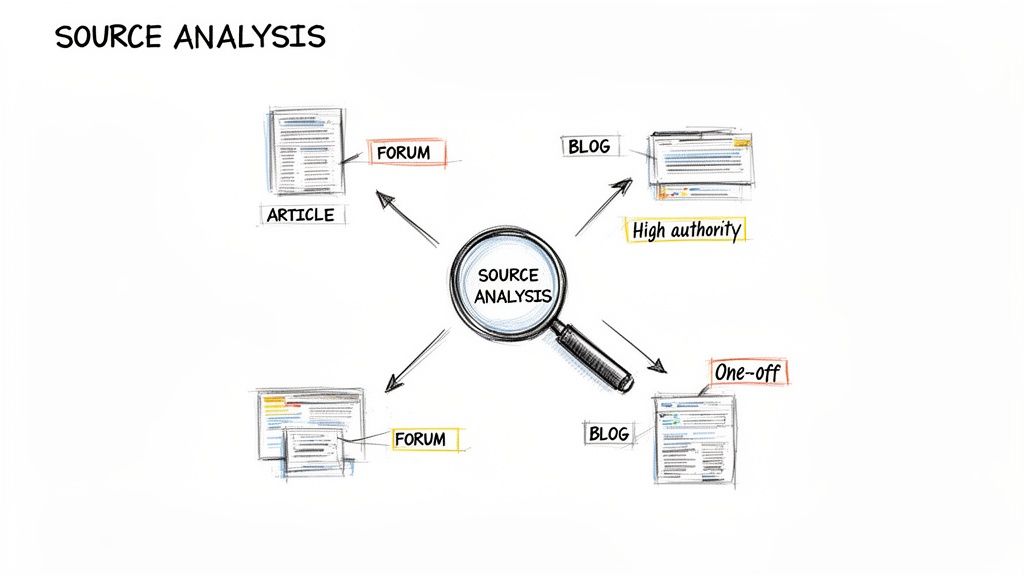
AI models synthesize answers from content they find across the web. To influence AI Overviews, you must first discover what they are reading. This process is called source analysis.
Source analysis is the heart of any effective AI overviews tracking strategy.
It shows you where to focus your content and engagement efforts. It turns tracking data into a real-world roadmap. If you skip this step, you are just guessing.
Start With The Obvious: Decoding AI Citations
The most direct way to find sources is by looking at the citations. These are the links an AI Overview includes to credit its information. Think of them as low-hanging fruit.
Not all sources are equal. You must distinguish between high-authority domains that appear repeatedly and one-off mentions. Documenting these cited sources for each key prompt is the first layer of your analysis.
This manual review helps you find patterns quickly. For a prompt like “best project management software,” you might see the AI always cites articles from the same three tech review sites. Those are your primary targets.
Don’t just look at the links; analyze the type of content being cited. Is it a listicle? A how-to guide? A product comparison? A forum thread? The format often matters just as much as the domain itself.
To understand this better, learn the deeper mechanics of how AI ranks content, which is covered well in AI SEO: How to Rank in LLM Answers.
Dig Deeper: Uncovering The Implicit Sources
AI models learn from a massive dataset beyond the links they cite in a single answer. These are “implicit sources”—the content that shapes the AI’s general understanding of a topic. Finding them requires strategic digging.
Implicit sources often include:
- Community Discussions: Reddit and Quora threads are goldmines, filled with conversational language that AI models use.
- High-Ranking Organic Content: Pages that consistently rank in the top 5 of traditional search results are often core training material.
- Authoritative Industry Publications: Niche blogs and established journals build the topical authority that AI systems trust.
Tracking these less obvious sources is where the real work begins. They represent the foundational knowledge the AI draws from. This makes them powerful targets for your long-term influence strategy.
Categorize And Prioritize Your Source Targets
Once you have a list of explicit and implicit sources, you need to organize them. This helps you allocate your resources effectively. Not every source deserves the same amount of time or budget.
A clear understanding of the AI’s sources lets you tailor your strategy. Influencing a Wikipedia page is different from participating in a Reddit conversation.
Here’s a simple way to break down common sources and how to approach them.
Common Sources Influencing AI Overviews
| Source Type | Description | Example Action |
|---|---|---|
| High-Authority Blogs | In-depth articles from trusted industry domains. | Create superior, more comprehensive content on your own blog. |
| Community Forums | Threads on Reddit, Quora, or niche forums. | Participate authentically in relevant discussions, adding value and mentioning your brand where appropriate. |
| Review Websites | Platforms like G2, Capterra, or Trustpilot. | Encourage happy customers to leave detailed, honest reviews. |
| News & Publications | Articles from major news outlets or online magazines. | Engage in digital PR to earn mentions and build brand authority. |
| Video Content | YouTube tutorials, reviews, and explainers. | Produce high-quality video content that directly answers user questions. |
This structured approach transforms a messy list of URLs into a prioritized action plan. It tells you exactly where to invest your energy.
An Actionable Strategy to Influence AI Overviews
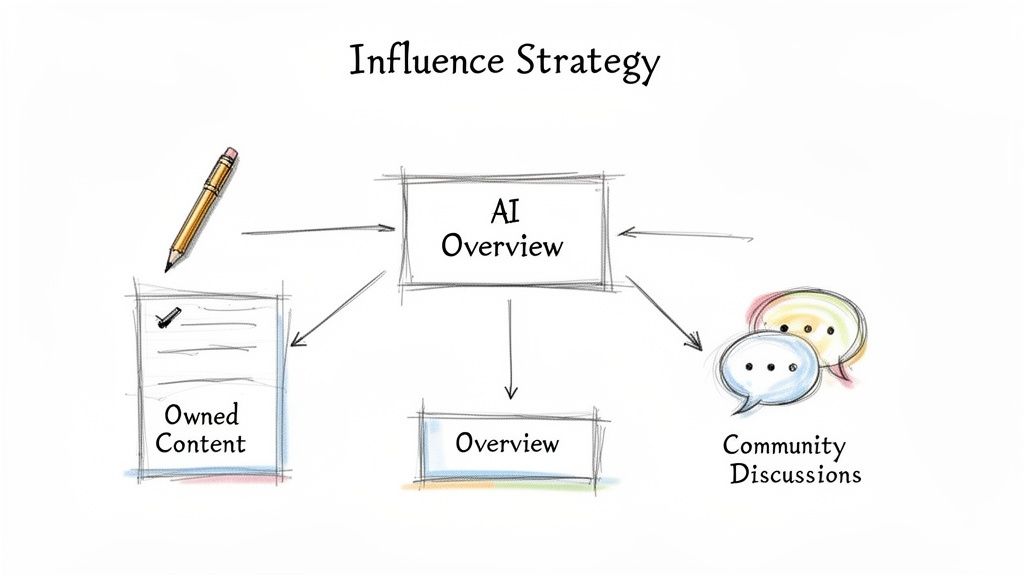
Once you understand the sources fueling AI answers, you can start taking action. Influencing AI Overviews is not about tricking an algorithm. It’s about becoming the most helpful, authoritative voice in your niche.
Your strategy has two main battlegrounds: your own content and community discussions.
This is a proactive approach. Instead of hoping AI models find you, you strategically place your expertise where they already look. The goal is to make your brand an unavoidable part of the conversation.
1. Optimize Your Owned Content to Become a Primary Source
Your website and blog are your most powerful assets. Here, you control the narrative and can build content structured to be useful to AI. Start with a content audit using your AI overviews tracking data.
Look for pages on your site that are already getting cited. These are your low-hanging fruit. Simple tweaks like adding a Q&A section or updating stats can boost their chances of being used as a source.
For example, if an AI Overview pulls an outdated number from a competitor, update your own article with the most current data. Make your content the most reliable and up-to-date resource on the topic.
The objective is to make your content so clear, factual, and well-structured that it becomes the path of least resistance for an AI model seeking to generate a helpful answer. Think of it as creating “AI-friendly” content.
This strategy requires your content to be discoverable. This is where Mastering SEO of a company is fundamental to ensuring your site is seen as authoritative.
2. Create New Content to Fill Critical Gaps
Your source analysis will reveal topics where you have no content, but AI models see them as important. These are your content gaps. Filling them is a direct way to increase visibility.
Prioritize creating articles that answer the prompts you’re tracking. If a common question gets answers from random forum threads, write the definitive blog post on that subject.
Structure these new pages for maximum impact:
- Use Clear Headings: Organize content with H2s and H3s that mirror user questions.
- Provide Direct Answers: Start sections with a concise summary before diving into details.
- Incorporate Structured Data: Use lists, tables, and bullet points to create scannable, factual chunks.
This methodical approach turns your blog into a library of answers that AI models will learn to rely on.
3. Engage Strategically in High-Value Community Discussions
Many influential sources for AI Overviews are not corporate blogs. They are platforms like Reddit and Quora. Your tracking data will point you to the exact threads shaping the AI’s understanding of your market.
Participate authentically, not by spamming. Add genuine value while naturally introducing your brand as a helpful resource. A single well-regarded comment in a high-traffic Reddit thread can get cited in AI answers for months.
For instance, if you sell project management software and see an AI citing a relevant Reddit thread, a thoughtful response can make a difference.
- A Bad Comment: “You should check out our product, Airefs! It’s the best.”
- A Good Comment: “Great question. I’ve seen success with tools that prioritize simple task boards. For example, our tool, Airefs, was built for that use case, but others like Trello are also solid. The key is finding a workflow that sticks.”
The second approach offers value and builds credibility. It is more likely to be seen as a helpful contribution by users and AI models. Learn more in our guide on how to rank in Google AI Overviews.
How To Measure Success And Refine Your Approach
Tracking your AI Overview visibility is an active feedback loop, not a monthly task. It connects your monitoring efforts to real business results. This proves that the new channel is worth the effort.
The point is to move beyond counting mentions to understanding their impact. This means analyzing trends and linking AI visibility to your downstream metrics. Use the data to tweak your strategy and gain a competitive edge.
Interpret Your AI Visibility Trends
Over time, your tracking data will tell a story. The main character is your Share of Voice (SoV) for important prompt groups. If your SoV is climbing, your content and engagement strategy is working.
For example, your SoV for “informational prompts” might jump two weeks after publishing a large guide. This is a direct signal that AI models found your new content useful. If your SoV for “commercial prompts” drops, a competitor may have released a better comparison article.
Looking at these movements helps you connect cause and effect. You can see which actions get the best results and double down on what works. This is a data-driven approach to influencing AI.
Think of your AI tracking dashboard as a real-time map of the information landscape, not just a scorecard. Use it to spot when AI models start preferring different sources and react before those preferences become locked in.
This landscape changes fast. ChatGPT’s user base is projected to hit 800 million weekly active users by October 2025. However, its market share is expected to slide from 76.4% to 61.3% by January 2026 as competitors grow.
With users turning to conversational AI for 17% of search inquiries, you must monitor these shifts. Find more data on this market at hashmeta.ai.
Set Up Proactive Alerts and Monitoring
Waiting for a weekly report is playing defense. A better strategy is setting up alerts for new opportunities and threats. This is crucial for platforms like Reddit, which are major source pools for AI.
Set up keyword alerts for your brand, competitors, and high-value topics. When a new discussion starts, you get a notification. This lets you join the conversation early and shape the narrative.
This proactive monitoring puts you in control. Instead of reacting to an AI Overview citing a negative thread, you can be part of the conversation from the start.
Connect AI Mentions To Business KPIs
Tracking is only useful if it ties back to business goals. You must correlate your AI visibility metrics with your core Key Performance Indicators (KPIs). This is how you prove ROI and get buy-in for your strategy.
Look for patterns between your AI data and website analytics.
- Increased Branded Search Volume: As your brand gets cited more in AI Overviews, do more people search for your brand directly?
- Rise in Direct Traffic: Does more visibility lead to more users typing your URL into their browser?
- Higher Conversion Rates: For products with positive AI mentions, are you seeing a lift in conversions?
Drawing these lines is critical. It turns AI overviews tracking from a niche metric into a business indicator of brand health. Check out different AI search visibility tools to pull this data together.
Refine Your Strategy Based On Performance
Your tracking data tells you what to do next. It points you to where you need to refine your approach.
Build a simple, iterative cycle of improvement:
- Analyze: Look at your latest SoV and source data. Identify wins and weaknesses.
- Act: Launch a targeted content update or community engagement push.
- Measure: Track how your actions impacted your AI visibility metrics.
- Repeat: Apply what you learned to your next move.
This cycle of refinement keeps your strategy agile. It ensures you focus on activities that will move the needle on your presence in AI answers.
FAQ
What is AI Overviews tracking? AI Overviews tracking is the process of monitoring your brand’s visibility inside Google’s AI-generated answers. It focuses on measuring brand mentions and source citations within the AI summary, rather than traditional search rankings.
How is this different from traditional SEO? Traditional SEO aims to rank a webpage to earn a click. AI Overviews tracking focuses on getting your brand’s information cited directly within the AI answer, influencing users who may not click through to a website.
What types of content best influence AI Overviews? AI models prefer clear, factual, and well-structured content from authoritative sources. This includes in-depth articles, expert blog posts, and helpful discussions on platforms like Reddit and Quora that provide direct answers to specific questions.
How do I measure the ROI of AI Overviews tracking? Measure ROI by correlating your “Share of Voice” in AI answers with core business KPIs. Look for increases in branded search volume, direct website traffic, and conversion rates for products or services mentioned positively in AI Overviews.
How often should I track AI Overviews? Check your most important commercial prompts daily or weekly to monitor competitors. For broader informational topics, a bi-weekly or monthly check is usually sufficient to identify major trends.
Ready to stop guessing and start influencing how AI sees your brand? Airefs provides the tools you need to track your visibility, analyze the sources AI models trust, and take action to become the go-to answer in your category. See how you stack up against the competition by visiting https://getairefs.com.