

AirOps has one of the most credible case study libraries in the AI search space. Webflow grew AI-attributed signups from 2% to over 10% in under a year. Chime tripled citations in under 4 weeks.
Carta achieved a 75% citation rate increase. Ramp generated a 10x ROI on its Reddit strategy—all without adding headcount. The platform’s customers include Notion, HubSpot, Brex, Apollo.io, Monday.com, LegalZoom, and Docebo.
The friction is transparency. AirOps doesn’t publish pricing for its Solo, Pro, or Enterprise plans. The free Insights plan covers 1 user and 1,000 tasks per month—generous for exploration, but limiting for anything serious.
Upgrading requires a sales conversation before you can evaluate cost. This review covers what the platform actually does, what users say, where it stops, and what it costs to do something meaningful with it.
What is AirOps?
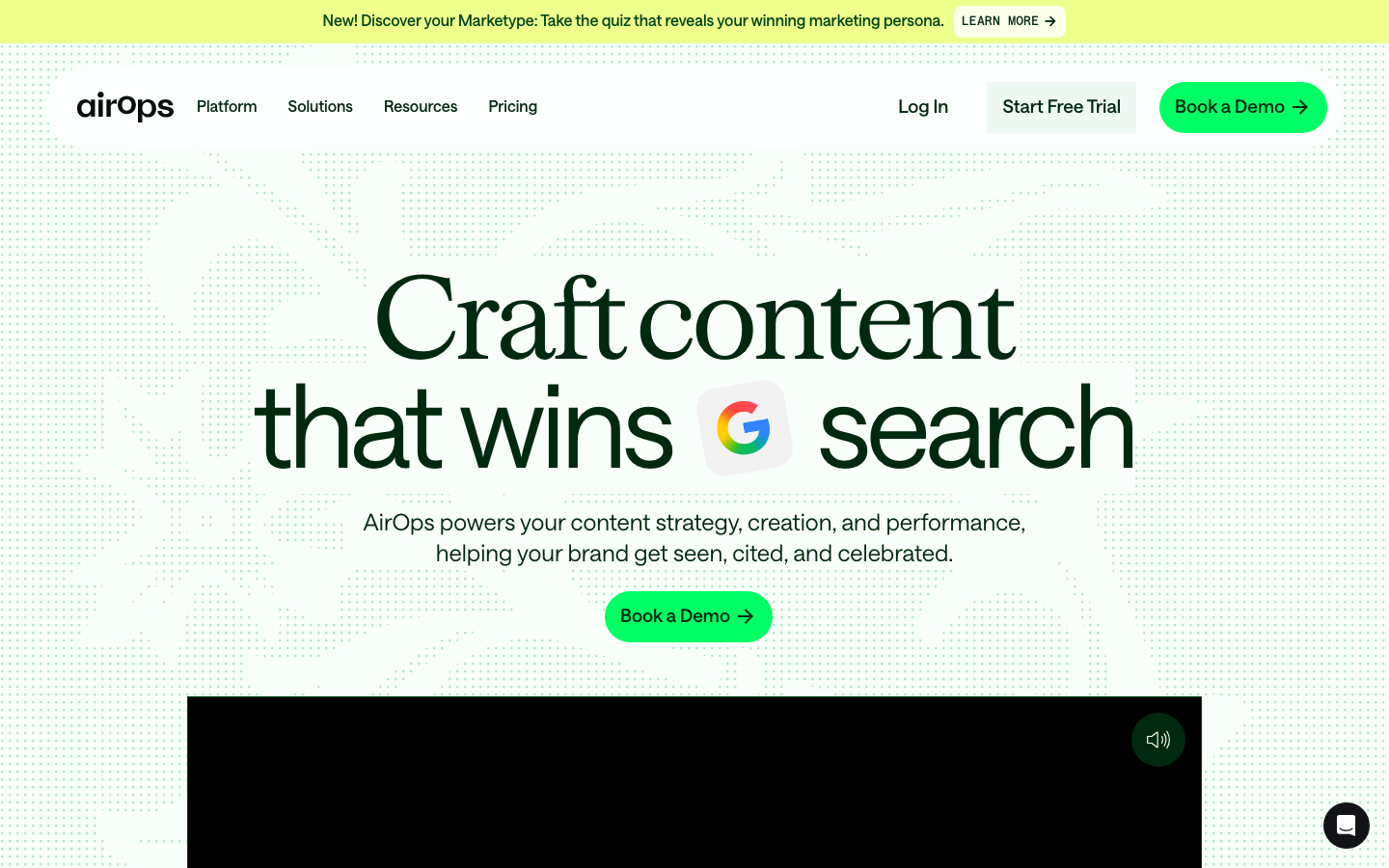
AirOps is an AI search visibility and content production platform. Unlike monitoring-only tools, it’s built to improve citations through content creation. Power Agents, Grids, and an Opportunities module combine tracking with the infrastructure to act on what you find.
The platform tracks brand presence across AI search responses and identifies gaps. CMS integrations with Webflow, WordPress, and Shopify let teams publish directly from the platform.
Who’s behind AirOps?
AirOps is headquartered in San Francisco and is SOC 2 Type II certified. The customer list—Webflow, Chime, Ramp, Carta, LegalZoom, Docebo, Apollo.io, Monday.com, Notion, HubSpot, and Brex—reflects genuine enterprise adoption. Webflow and Chime are not logos that appear in case studies without meaningful platform usage.
The platform began as an AI workflow tool. It has since matured into a full AEO content platform—combining the tracking capabilities of a monitoring tool with the production capabilities of a content system.
What do users say about AirOps?
The consistent praise centers on workflow depth. AirOps connects opportunity identification to content creation in a single platform. Brand knowledge bases ensure AI-generated content stays on-brand across all output.
Users who’ve tried multiple AEO tools describe Power Agents as genuinely different from dashboard-only tools. The ability to build custom pipelines that run automatically is a meaningful step beyond reviewing a report.
The consistent criticism covers four areas. No pricing transparency—the free plan is the only tier with a published price, making cost planning impossible without a sales call. Steep learning curve—Power Agents and Grids require significant setup before producing useful output.
Teams without an existing content strategy find the platform difficult to direct. The platform is also desktop-only. The 1,000 free tasks on Insights deplete faster than expected under any real query volume.
AirOps features
AirOps organizes its capabilities across four primary modules: Power Agents, Grids, Opportunities, and Pages.
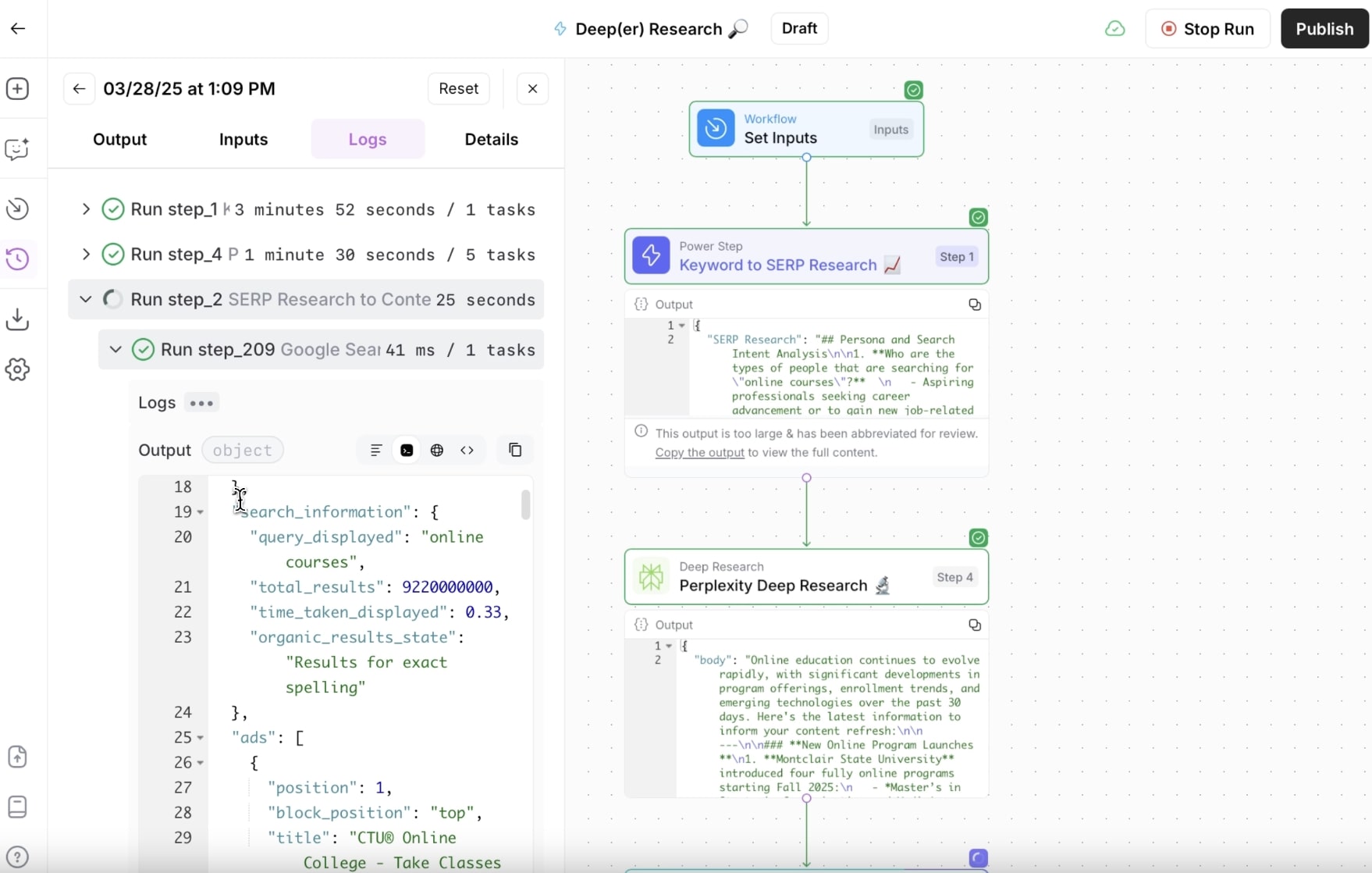
Power Agents. AirOps’ core content production capability. Power Agents are custom multi-step AI workflows built in a visual node editor. They chain research, writing, and enhancement steps into automated pipelines.
A typical workflow takes a keyword, runs SERP analysis, performs deep research, generates a content brief, and produces a final article draft—all in a single automated run.
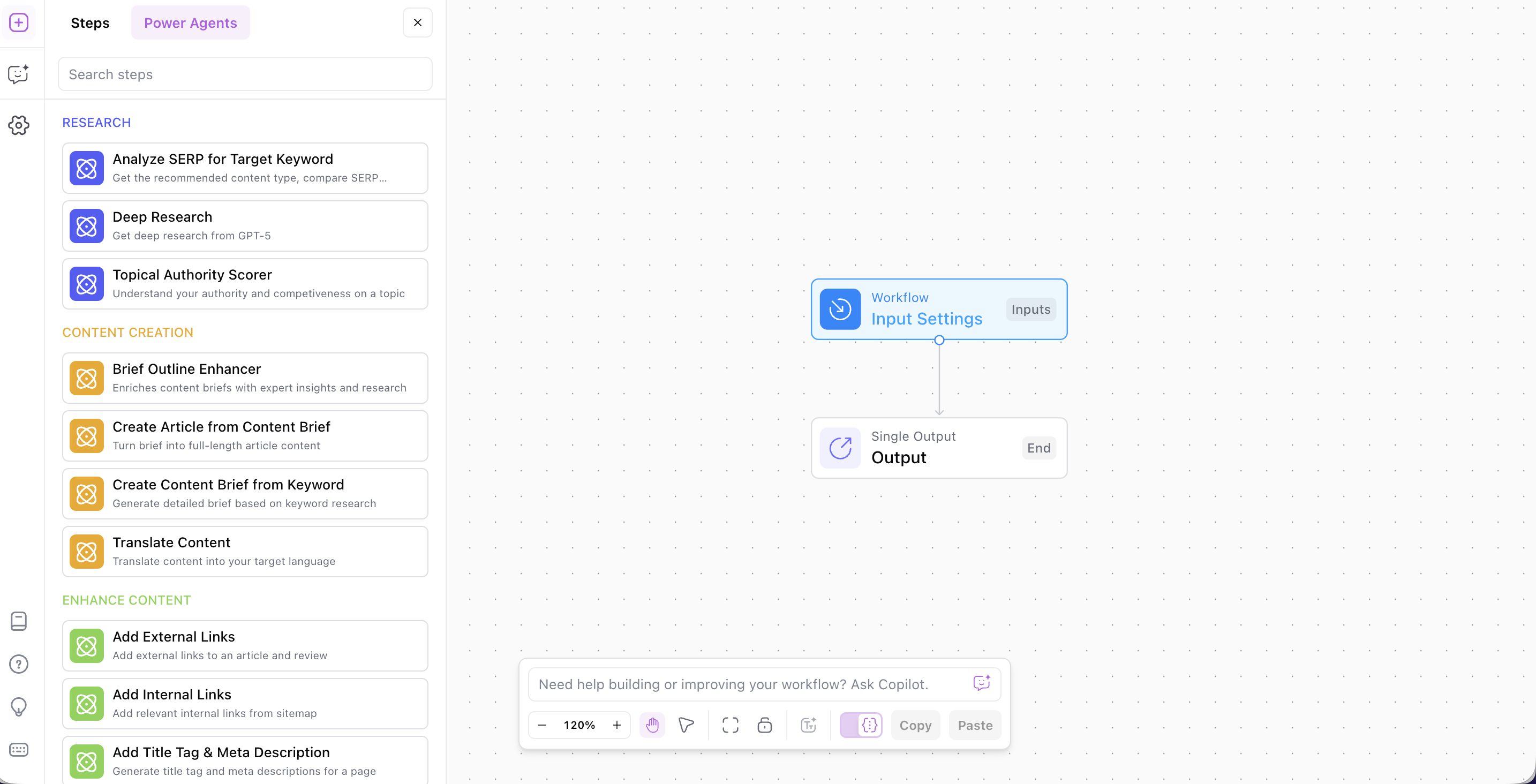
The step library determines what those pipelines can do. Steps fall into three categories: Research, Content Creation, and Enhance Content.
Research steps include Analyze SERP, Deep Research (powered by GPT-5), and Topical Authority Scorer. Content Creation covers Create Content Brief from Keyword, Create Article from Content Brief, Write Article Outline, and Translate Content. Enhance Content adds External Links, Internal Links, and Title Tag & Meta Description.
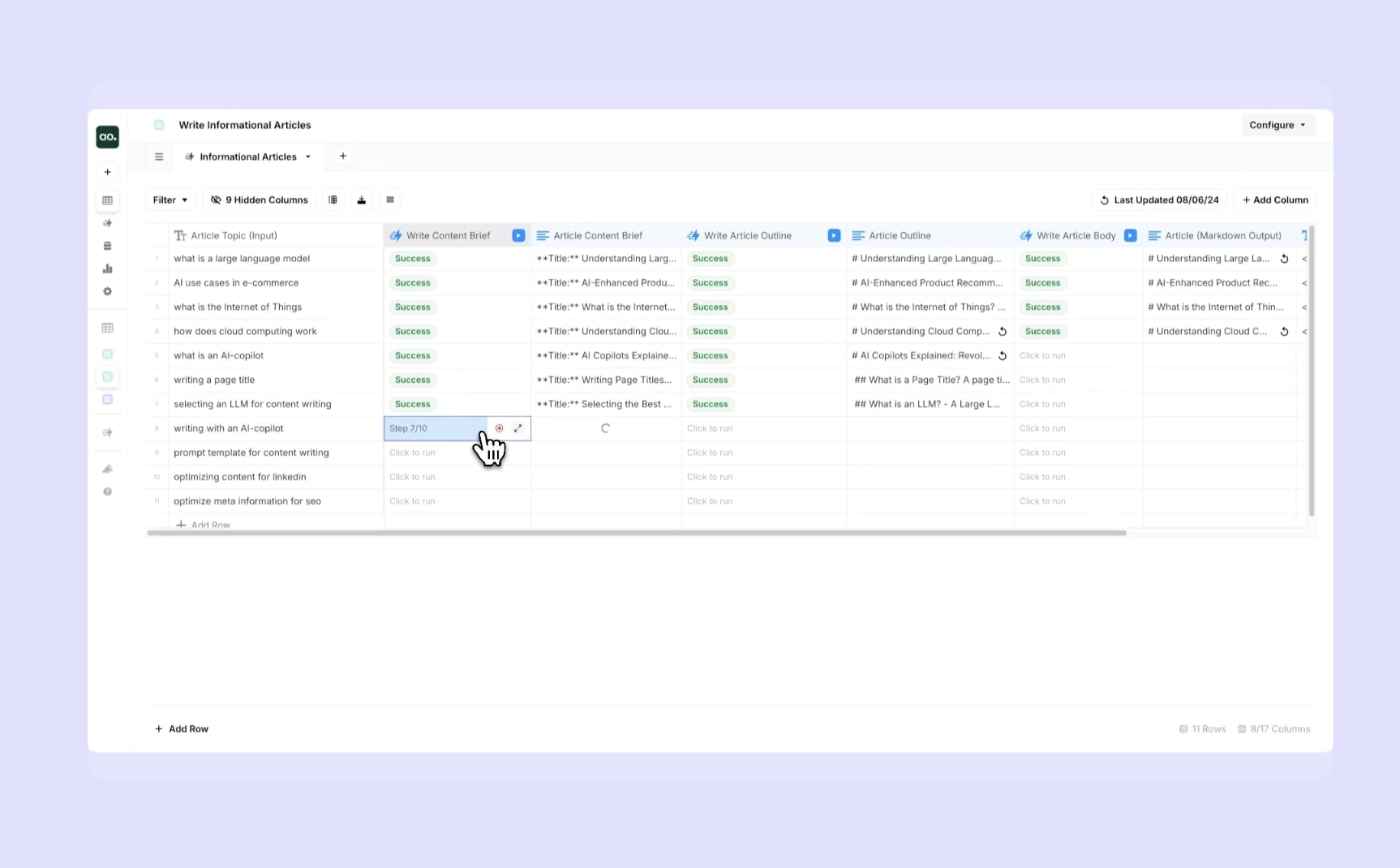
Grids. Grids is AirOps’ spreadsheet-style bulk content interface. Where Power Agents build individual pipelines, Grids runs them across many rows simultaneously.
A “Write Informational Articles” grid starts with a list of article topics. Each row runs the full production pipeline—Content Brief → Article Outline → Article Body—producing Markdown output. Teams producing dozens of pieces per month use Grids to eliminate the repetitive setup between articles.
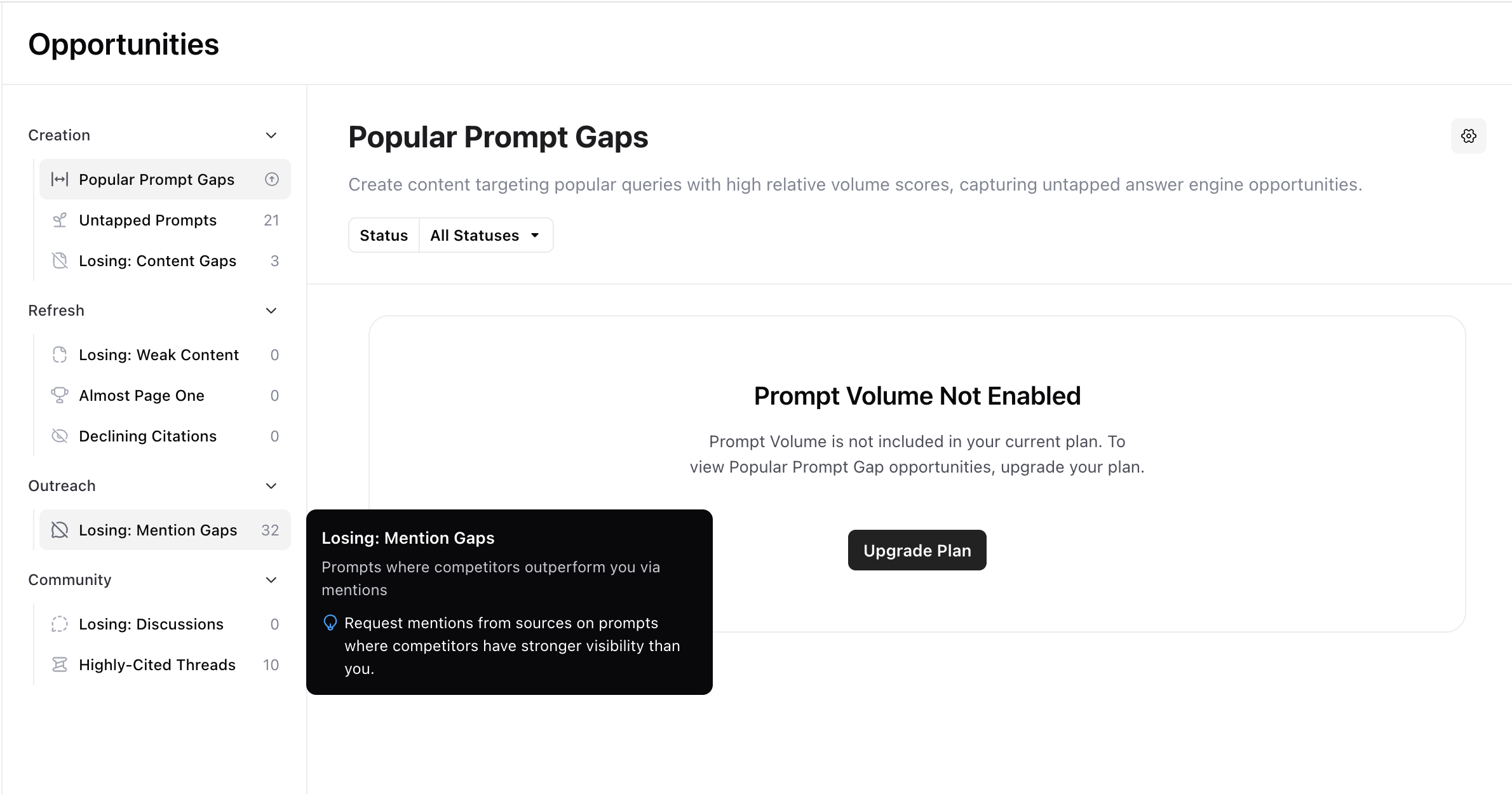
Opportunities. The Opportunities module identifies what to create based on your current AI search performance. Categories are split by workflow type.
Creation covers Popular Prompt Gaps, Untapped Prompts, and Content Gaps. Refresh covers Weak Content, Almost Page One, and Declining Citations. Outreach covers Mention Gaps and Discussions; Community covers Highly-Cited Threads.
Popular Prompt Gaps requires Prompt Volume to be enabled—a plan-dependent feature. It shows which high-volume AI queries you’re not appearing in.
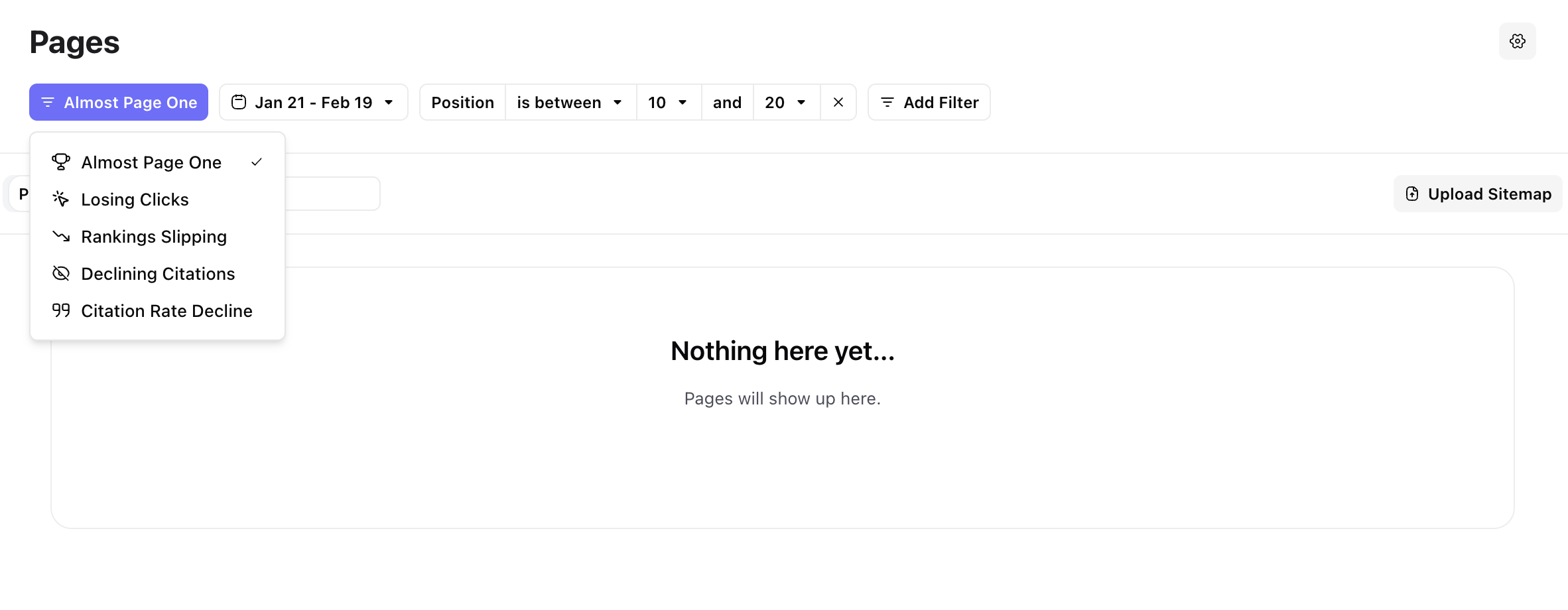
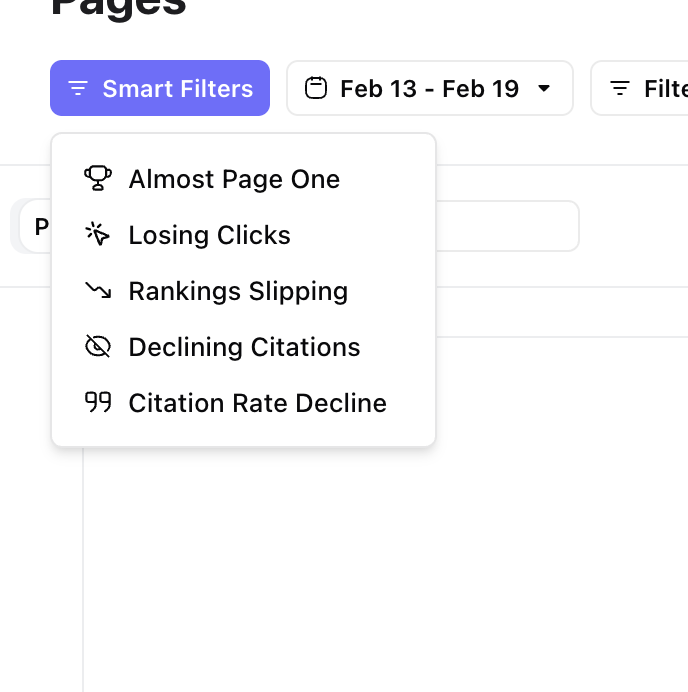
Pages and Smart Filters. Pages is AirOps’ content inventory view. It gives a unified look at your existing pages and their AI search performance.
Smart Filters surface the most actionable segments without manual digging. Options include Almost Page One, Losing Clicks, Rankings Slipping, Declining Citations, and Citation Rate Decline. For large content libraries, they eliminate the need to review every page manually.
Brand Knowledge Bases. AirOps stores brand guidelines, tone-of-voice documentation, and product information in Knowledge Bases. Power Agents reference these during content generation to keep output on-brand.
The Insights plan includes 5 KBs. Solo gets 3, and Pro gets unlimited.
Page360. The Page360 view gives a unified AI performance picture for each individual page. It combines citations, rank position, AI-generated traffic, and improvement recommendations in a single panel.
CMS integrations. AirOps publishes directly to Webflow, WordPress, and Shopify. This eliminates the copy-paste step between content production and CMS publishing. For teams that publish frequently, it’s a meaningful workflow advantage over platforms that generate content but leave distribution manual.
Pros and cons
Pros:
- Strongest case studies in the AEO category — Webflow, Chime, Ramp, Carta results are publicly documented
- Power Agents enable genuinely custom content pipelines — not just presets, but fully configurable multi-step workflows
- Grids for bulk content production — run full pipelines across dozens of topics simultaneously
- Opportunities module categorizes actions by type (Create, Refresh, Outreach, Community) — not just a list of gaps
- Pages Smart Filters surface the highest-value existing content without manual review
- CMS integrations (Webflow, WordPress, Shopify) allow publishing directly from AirOps
- Brand Knowledge Bases ensure content at scale stays on-brand
- SOC 2 Type II — enterprise-ready for security-gated procurement
- 14-day free trial with 50K free credits to Scale features
Cons:
- No published pricing for Solo, Pro, or Enterprise — cost evaluation requires a sales conversation
- Steep learning curve — Power Agents and Grids require meaningful setup investment before producing output
- Desktop-only — no mobile access
- Requires existing content strategy — the platform amplifies a strategy but doesn’t replace having one
- 1,000 free tasks on Insights deplete quickly with any real volume; Solo overages at $0.025/task can add up
- Opportunity depth (Popular Prompt Gaps, Prompt Volume) gated by plan tier
- AI platform coverage limited on Solo (ChatGPT only) — multi-engine tracking requires Pro
How much does AirOps cost?
AirOps publishes one tier with full pricing details. The rest require a sales call.
| Plan | Price | Tasks/mo | Prompts | AI Platforms | Notable limits |
|---|---|---|---|---|---|
| Insights | Free | 1,000 | — | 30+ (content creation) | 1 user, 5 KBs |
| Solo | Contact sales | 20,000 | 100 | ChatGPT only | 1 user, 3 KBs, monthly opportunity reports |
| Pro | Contact sales | 75,000 | 250 | ChatGPT, Google, Perplexity, AI Studio | Unlimited seats, weekly opportunity reports |
| Pages | Contact sales | Custom | Custom | Custom | Page360 + Pages module |
| Enterprise | Contact sales | Custom | Custom | All platforms | Multi-region/persona/language, unlimited KBs, dedicated account manager |
A 14-day free trial gives access to Scale features with 50,000 free credits. That’s enough to run Power Agents and explore Grids before committing.
Solo overages are billed at $0.025 per task beyond the 20,000 monthly allocation. You can’t budget for AirOps without talking to sales first—a genuine friction point regardless of platform capability.
How does it compare with Airefs?
AirOps and Airefs address adjacent problems from different directions. AirOps is a content production platform built for teams running high-volume content programs. Airefs is a tracking and opportunity discovery platform with a done-for-you tier.
| AirOps | Airefs | |
|---|---|---|
| Starting price | Free (Insights) / Contact sales for paid | $24/mo |
| Content generation | Power Agents + Grids (Solo+) | Done-for-you at $299/mo |
| Opportunity finding | Opportunities module (tiered) | On-site citation gap analysis + community discussion monitoring |
| Community monitoring | Discussions + Highly-Cited Threads (in Opportunities) | Reddit, LinkedIn, Quora, Medium — proactive keyword tracking |
| CMS publishing | Webflow, WordPress, Shopify | Not included |
| AI platforms tracked | ChatGPT (Solo), multi-engine (Pro+) | ChatGPT default; others on request |
| Free trial | 14-day, 50K credits | 7-day (Pro plan) |
| Pricing transparency | Free plan only | Full published pricing |
AirOps’ Opportunities module finds gaps in your existing content program. Airefs surfaces cited community discussions across Reddit, LinkedIn, Quora, and Medium—and shows gaps in your own citation coverage. These are complementary, not competing, capabilities.
Teams with large existing content libraries benefit from AirOps’ refresh and gap analysis. Teams building AI visibility from scratch often find more leverage in discovering which discussions AI will cite before they become established sources.
The pricing difference is significant. Airefs’ done-for-you option at $299/mo includes content creation and community participation. AirOps’ lowest paid tier requires a sales call to evaluate—making Airefs the more accessible starting point for teams that need to know costs upfront.
Conclusion
AirOps is the most capable content production platform in the AI search category. Power Agents, Grids, and the Opportunities module address a real problem: teams that need to create content at scale for AI search. The case studies from Webflow, Chime, and Ramp are the strongest published evidence in the AEO category of what’s possible.
The question isn’t whether AirOps works. It’s whether your team is at the stage where a content-engineering platform is the right investment.
If you’re still figuring out which community discussions and sources drive AI citations in your category, Airefs starts at $24/mo. The done-for-you tier at $299/mo handles content execution without a sales call.
Want to compare AirOps to other options? See all AirOps alternatives or try Airefs free for 7 days — community discussion monitoring, prompt tracking, and done-for-you content from $24/mo.