

Answer Engine Optimization (AEO) is about making your brand the answer. When people ask AI for help, you want to be the recommendation.
Traditional SEO is a race to get on a list of results. AEO makes you the direct recommendation from a trusted expert—the AI itself. This is a huge shift because users now get complete answers without ever clicking a link.
What Answer Engine Optimization Really Means
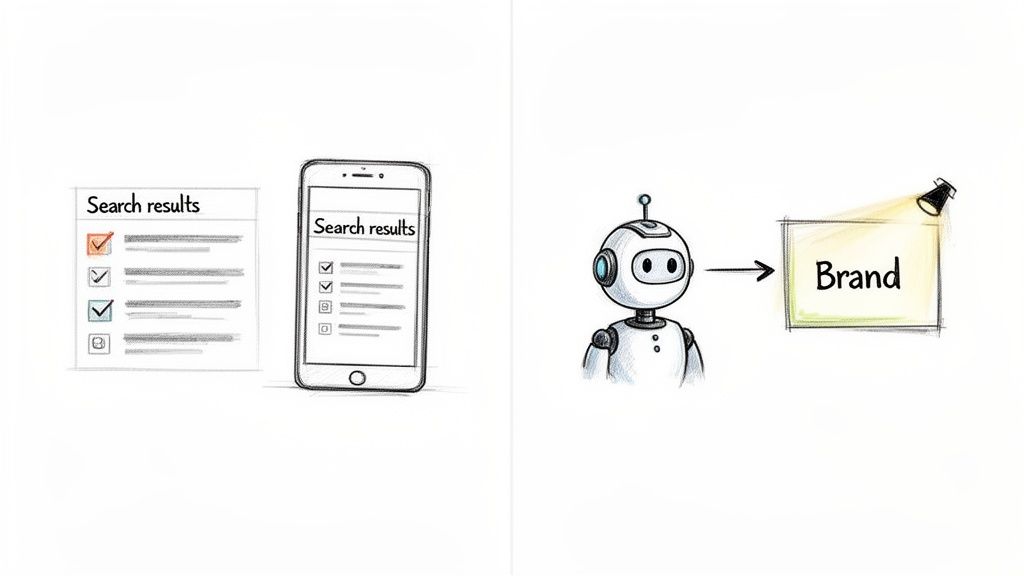
AEO is the next evolution of digital marketing. The goal is to influence AI models like Google’s AI Overviews, Perplexity, and ChatGPT. You want your brand woven directly into an AI-generated response.
SEO helps a customer find your store in a directory. AEO convinces the store clerk (the AI) to personally recommend your product. Visibility is no longer about being #1; it’s about becoming the answer itself.
Why AEO Is a Non-Negotiable Strategy
People now ask conversational questions and get a single, synthesized answer. If your brand isn’t part of that answer, you’re invisible.
This creates a new economy where direct mentions and citations are the new clicks. The upside is massive.
- Builds Instant Authority: An AI citation is a powerful, unbiased endorsement.
- Drives High-Intent Traffic: Users who click from an AI answer are further in their buying journey.
- Future-Proofs Your Brand: AEO aligns your marketing with the shift toward AI-driven discovery.
The core of AEO is moving from optimizing for clicks to optimizing for influence. Your objective is to become a foundational source that AI models trust and rely on to form their understanding of your industry.
The AEO Mindset Shift for Marketers
Marketers must change their perspective from keywords and rankings to relationship-building. AEO means consistently feeding AI models clear, structured, and authoritative information.
Your content must provide direct solutions and give the answer away immediately. You can learn more about the differences in our guide on the new acronyms of search. This requires using clean headings, structuring articles logically, and showing up in online discussions.
This guide will show you how to build a strategy that makes your brand a go-to source for answer engines.
The Critical Shift From SEO to AEO
The line between a classic search and an AI-powered answer is blurring. This fundamental shift demands a new playbook for digital marketing.
Search Engine Optimization (SEO) focused on ranking pages to get clicks from a list of links. Answer Engine Optimization (AEO) aims to become a trusted source for an AI, earning direct mentions inside its answers.
This is an evolution, not a replacement. SEO signals like backlinks and domain authority still matter. But the new objective is to become a foundational piece of the AI’s understanding of your topic.
Why Clicks Are No Longer the Whole Story
People expect direct, conversational answers instead of a list of links. This behavioral shift changes how brands get discovered and how we measure success.
AI-generated answers have disrupted traditional search traffic. The average click-through rate (CTR) for the #1 spot dropped 64% after AI Overviews became widespread. This is driven by the fact that 60% of US and EU searches now result in zero clicks. Find out more about the state of Answer Engine Optimization in 2026.
This screenshot from Airefs shows the new reality. You can track every brand mention in an AI answer for the specific prompts you care about.
The real game-changer is seeing your “Share of Voice” within AI. It’s not just if you were mentioned, but how you stack up against competitors.
SEO vs. AEO Key Differences
SEO and AEO have different goals, tactics, and metrics. Understanding these differences is the first step to building a working AEO strategy. It helps shift your mindset from chasing traffic to building influence.
| Attribute | Traditional SEO (Search Engine Optimization) | AEO (Answer Engine Optimization) |
|---|---|---|
| Primary Goal | Rank web pages to earn high click-through rates. | Get cited or mentioned directly in AI-generated answers. |
| User Interaction | User scans a list of links and clicks one to find an answer. | User receives a direct, synthesized answer without leaving the interface. |
| Key Metric | Organic traffic, keyword rankings, and backlinks. | Share of voice in AI answers, source citations, and brand mentions. |
| Content Focus | Comprehensive articles targeting keywords to attract visitors. | Concise, “answer-first” content formatted for easy extraction by AI. |
Your existing SEO work provides the credibility an AI needs to find you. But AEO is the crucial next layer of structuring your information for AI models. Our article on search marketing intelligence digs deeper into this new landscape.
Adapting your strategy is a requirement for staying visible.
How AI Answer Engines Actually Work
AI models don’t “think.” They are infinitely patient research assistants that digest a massive library of information and synthesize it into a coherent answer.
Your AEO opportunity lies in that “information diet.” This is about source influence. An AI’s answer is a direct reflection of the data it’s been fed and the live sources it can access.
Stop asking, “how do I rank #1?” and start asking, “how do I become the source of truth for the AI?”
The Information Synthesis Process
When you ask an AI a question, it builds an answer from scratch every time. This is where your AEO strategy makes a difference.
Here’s a simplified breakdown:
- Intent Interpretation: The model uses NLP to understand what you really mean.
- Source Identification: It scans its index or performs web searches to find relevant content.
- Information Extraction: The AI pulls key sentences and facts from the most promising sources.
- Answer Generation: Finally, it synthesizes that info into a fresh response, often citing its sources.
This diagram shows the fundamental split between old-school SEO and modern AEO.
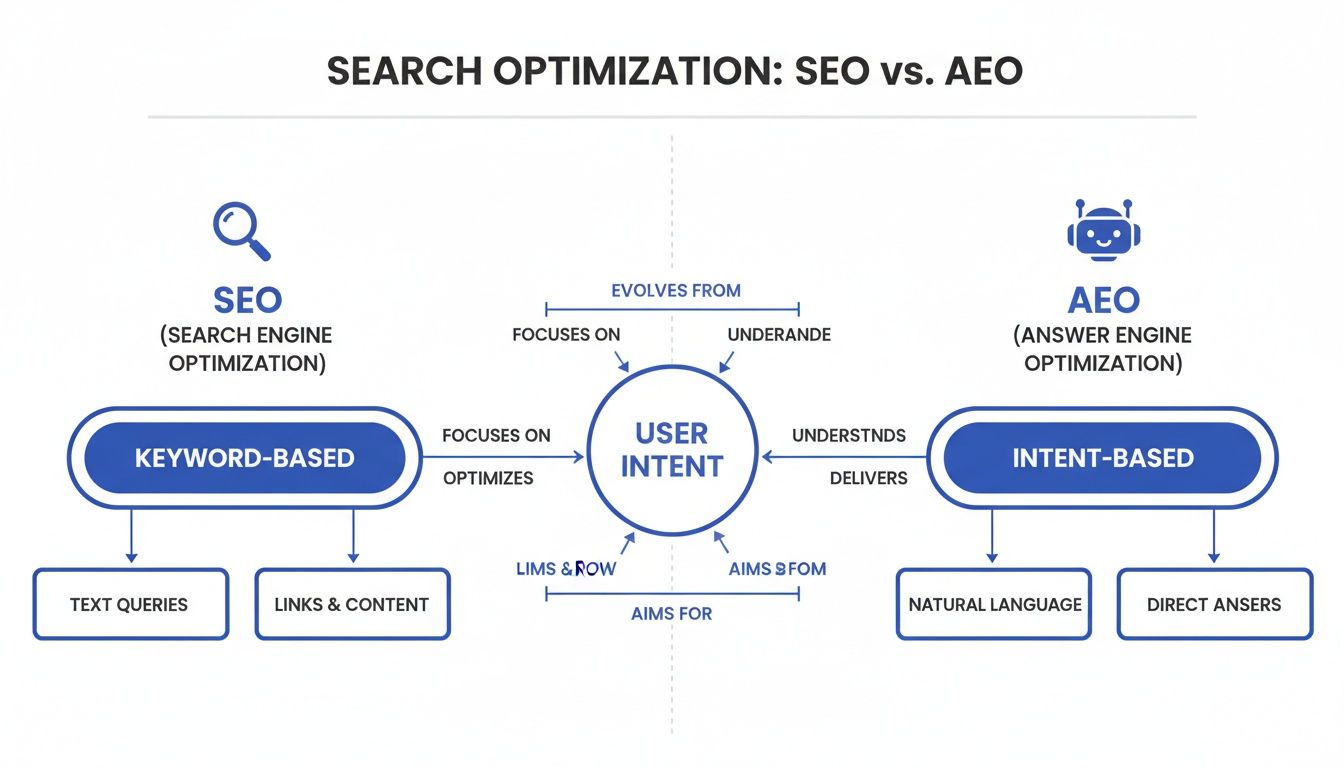
SEO is about winning a spot on a list. AEO is about becoming the raw material the list is built from.
What Makes a Source “Credible” to an AI?
AI models look for signals of expertise, authority, and trustworthiness.
An AI’s answer is only as good as the data it learns from. By creating clear, authoritative, and well-structured content, you are essentially feeding the AI the exact ingredients it needs to recommend you.
AI models are built to find and reward clarity. They look for signals that a piece of content is a reliable go-to for a specific topic. For a deeper dive, check out our guide on how LLMs process text.
The most important credibility signals include:
- Content Structure: Clear headings (H2s, H3s), bullet points, and short paragraphs.
- Topical Authority: Consistently publishing deep, insightful content on a specific niche.
- External Validation: Backlinks and frequent mentions in online discussions act like votes of confidence.
Focusing on these areas positions your content to become a go-to source for AI.
Your AEO Strategy Framework
A smart Answer Engine Optimization strategy is a system. This repeatable process is built around four core pillars.
Each pillar builds on the one before it. This creates a cycle that moves you from guesswork to a data-backed approach for earning AI visibility.
Pillar 1: Prompt Tracking
First, you must know what questions your audience is asking AI. Prompt tracking is the process of finding, monitoring, and prioritizing these conversational queries.
Forget traditional keywords. This is about understanding user intent in its rawest form. Tools like Airefs let you track a portfolio of prompts related to your products.
Pillar 2: Source Analysis
Next, where is the AI getting its answers? Source analysis involves digging into the specific websites, articles, and forums that AI models cite. This critical pillar gives you a roadmap to influencing AI responses.
Analyzing these sources reveals patterns and opportunities:
- Who are the authorities? Find out which sites are consistently treated as credible.
- Where are the gaps? Identify questions where the AI struggles to find a clear answer.
- What are competitors doing? See which rivals are already showing up as go-to sources.
Source analysis demystifies the AI’s “thinking” process. It shows you the exact digital breadcrumbs you need to follow to get your brand into the conversation and become a trusted source yourself.
Pillar 3: Content Creation
With insights from your analysis, you can begin content creation. This isn’t about churning out more generic blog posts. It’s about building content designed to be the best, most digestible answer for an AI.
Your content needs to be “answer-first.” Give a direct, concise answer at the top, then flesh it out with details. For a full breakdown, see our guide on how to rank in AI Overviews.
Your efforts should fall into three buckets:
- Create New Content: Build articles that directly tackle high-priority prompts.
- Optimize Existing Content: Update your best pages with answer-first formatting.
- Fill the Gaps: Create content for topics where analysis showed a lack of authority.
Pillar 4: Discussion Engagement
The final piece is discussion engagement. AI models learn from conversational data on communities like Reddit and Quora. These platforms are goldmines of user-generated content.
Jumping into these discussions lets you influence the AI’s knowledge base directly. By providing helpful answers and mentioning your brand where it makes sense, you create new source material.
This proactive approach builds your brand’s authority in the exact places AI models look for authentic conversations.
Essential AEO Tactics You Can Start Today
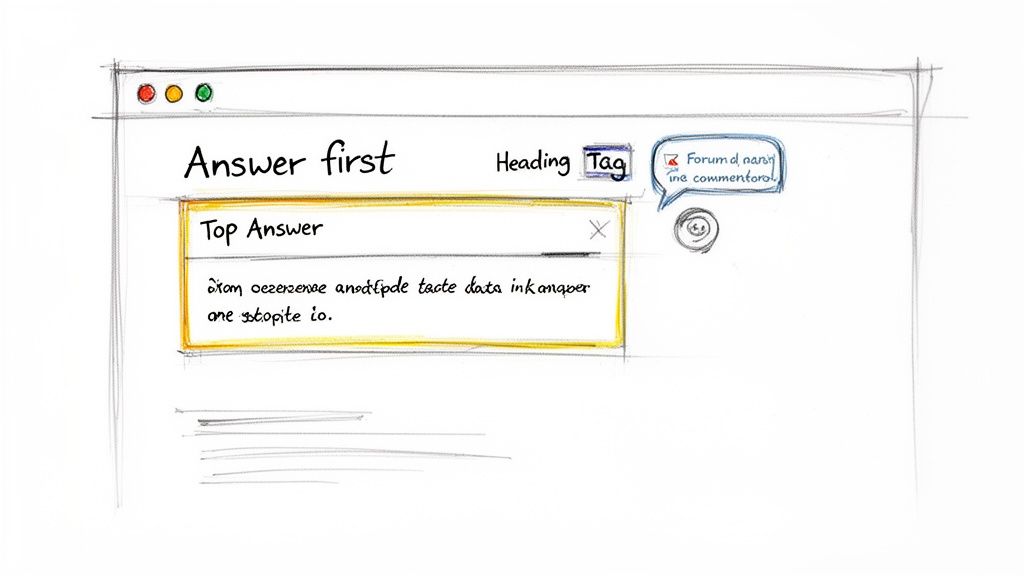
Let’s move from theory to action. The single most important thing you can do for AEO today is create “answer-first” content.
Put a clear, direct answer to the user’s question right at the top of your article. No long intros, no fluff. Just the solution.
This format makes your content incredibly easy for AI models to parse and cite.
Create Content Designed for AI Consumption
Don’t forget the goldmine you’re already sitting on. Start with an audit of your best-performing articles. Give pages already getting traffic from question-based searches an answer-first makeover.
In traditional SEO, the answer could be buried halfway down the page. Answer engines don’t have that kind of patience. An effective AI strategy for content creation workflow ensures everything you produce is built for AI.
Here are three practical ways to format your content:
- Use the Inverted Pyramid: Start with the direct answer, then follow up with supporting details.
- Add FAQ Sections: Use Schema markup to signal that you’re answering specific questions.
- Lean on Lists and Tables: Bullet points, numbered lists, and simple tables are easy for AI to interpret.
Influence AI Through Community Engagement
AEO isn’t just about what you publish on your own site. AI models learn from conversational platforms like Reddit and Quora. Engaging in these communities gives you a direct line to influence an AI’s knowledge base.
Think of it like this: participating in relevant online discussions is like adding your expertise to the AI’s source library. When you provide helpful, authentic answers in threads that AI models are watching, you create new, citable material that connects your brand to a solution.
This approach also builds topical authority and creates positive brand associations that AI models notice.
A Practical Reddit Engagement Playbook
Jumping into Reddit requires a delicate touch. The goal is to be genuinely helpful, not to spam.
- Find Your Subreddits: Identify communities like r/SaaS or r/marketing where your audience hangs out.
- Monitor for Mentions: Set up alerts for keywords, your brand name, and competitors.
- Provide Real Value First: Answer questions thoroughly without immediately pitching your product.
- Mention Your Brand Naturally: Bring up your brand only when it’s a direct, relevant solution.
This value-first approach ensures the community sees you as a contributor, not an advertiser.
Measuring Success In Answer Engine Optimization
Traditional SEO metrics don’t cut it for Answer Engine Optimization. Success isn’t about clicks—it’s about influence. It’s measured by your visibility inside AI-generated answers.
Measuring AEO is about proving your brand’s authority. The goal is to connect your optimization efforts to real business outcomes.
Key Metrics For Your AEO Dashboard
You need a different kind of dashboard to know if you’re winning. These metrics provide a clear view of your brand’s presence in AI answers.
Here are the AEO metrics that actually matter:
- Share of Voice (SoV): Your market share in AI conversations for a set of tracked prompts.
- Source Penetration: How many of your owned web pages are cited as sources by an AI.
- Branded vs. Unbranded Mentions: Direct brand shout-outs versus citations of your content.
The heart of AEO measurement is tracking a portfolio of strategic prompts. By monitoring how AI recommendations and citations change over time for these key questions, you can directly tie your progress back to your content and engagement efforts.
Connecting AEO To Business Outcomes
You must connect the dots back to the bottom line. Proving that connection justifies your budget.
Here’s how to link AEO performance to tangible results:
- Monitor Branded Search Volume: An uptick in searches for your brand name signals AEO is building recall.
- Track Referral Traffic from AI Engines: Keep an eye on referrals from platforms like Perplexity.ai. A variety of AI search visibility tools can help with this.
- Analyze Lead Quality: Users who arrive after an AI recommendation are often pre-qualified.
Tracking both AEO-specific metrics and their downstream business impact gives you the full picture.
| AEO Metrics for Marketers | | :--- | :--- | :--- | | Metric | What It Measures | Why It Matters | | Share of Voice (SoV) | Your brand’s mention frequency vs. competitors for key prompts. | Shows your dominance in critical AI-driven conversations. | | Source Penetration | The number of your web pages cited as sources in AI answers. | A direct indicator of how much the AI trusts your content. | | Branded Search Volume | The number of people searching for your brand name on Google. | Signals that AI mentions are successfully building brand recall. | | Referral Traffic | Clicks to your site directly from AI answer engines. | Captures high-intent traffic from users ready to act. | | Lead Quality | The conversion rate of visitors from AI-driven channels. | Proves that AEO attracts users who are a better fit for your product. |
This table lays out the core KPIs that bridge your AEO activities with tangible business value.
Frequently Asked Questions About Answer Engine Optimization
What is the core goal of AEO?
The primary goal of Answer Engine Optimization is to get your brand, product, or content cited directly within AI-generated answers. It’s about becoming a trusted source for AI models like Google’s AI Overviews and Perplexity. Success is measured by influence and mentions, not just clicks.
Is AEO going to replace SEO?
No, AEO is an evolution of SEO, not a replacement. Strong SEO provides the foundation of authority and visibility that AI models need to find you. AEO builds on that by structuring your content specifically for AI consumption and citation.
How can I start AEO without a big budget?
Begin by optimizing your existing high-performing content. Adopt an “answer-first” structure by placing a direct answer at the top of your articles. Engage in relevant online communities like Reddit to build authority and create new source material for AIs to find.
What’s the most important AEO metric to track?
Start by tracking Share of Voice (SoV) for a small set of 5-7 core business prompts. This metric shows how often your brand is mentioned compared to competitors in AI answers. It provides a clear benchmark for your AEO performance.
How long does it take to see results from AEO?
Building a dominant Share of Voice takes several months of consistent effort. However, you can see earlier wins by optimizing existing, high-authority content. These pages can sometimes get cited in AI answers within a few weeks.
Ready to see how your brand stacks up in AI answers? Airefs gives you the tools to track your share of voice, analyze the sources AI trusts, and find actionable opportunities to become the go-to answer in your industry. See where you stand today at https://getairefs.com.