


The way people find information is changing. Instead of scrolling through links, they now ask AI models for answers, recommendations, and solutions. This is where ChatGPT tracking comes in.
It’s the simple act of monitoring how often your brand, products, or content appear in AI-generated answers. Think of it as the new SEO. You’re aiming to be the trusted source the AI recommends directly.
What Is ChatGPT Tracking and Why It Matters Now
This shift from searching to asking means your brand’s visibility isn’t just about traditional search rankings anymore. It’s now about becoming a reliable part of an AI’s knowledge base.
If a potential customer asks an AI for a recommendation in your category and your brand isn’t mentioned, you don’t exist. This makes AI Engine Optimization (AEO) a non-negotiable channel for customer acquisition.
The New Battlefield for Brand Visibility
This new world is a massive opportunity. By early November 2023, ChatGPT was already pulling in 100 million weekly active users. It hit 1.8 billion monthly visits back in April 2023.
With billions of these interactions happening, even a tiny slice of the “AI share of voice” can send significant business your way.
The first step is to figure out where you stand. You need answers to a few key questions:
- What questions trigger mentions of our brand?
- When the AI recommends us, what sources is it citing?
- How do we stack up against competitors inside these AI conversations?
The core idea is simple: if AI systems are the new interface between users and information, brands need a way to see when they are recommended, why they are recommended, and what they can do to become the default answer in their category.
From Reactive to Proactive Strategy
Understanding this landscape lets you actively shape how AI models talk about you. It’s a complex ecosystem. Tools like a ChatGPT humanizer add another layer for brands to consider.
Effective ChatGPT tracking provides the data to build a real plan. It’s similar to how SEOs track keyword rankings. The focus is on conversational prompts and AI-driven citations.
This is how you ensure your brand shows up where it matters most.
Who’s Actually Using AI for Work Research?
To win in AI search, you must know who is asking the questions. The people using these tools are the exact audience most B2B companies want to reach.
This is a seismic shift in how people find information. Younger professionals, in particular, use AI as their go-to tool for solving problems and discovering products.
The Generational Shift to AI
The numbers don’t lie. By mid-2025, 34% of U.S. adults had already used ChatGPT. That figure jumps to 58% for people under 30.
Work-related use among employed adults hit 28%. That’s a massive 20-point leap in just two years.
Your prime B2B audience is already inside these AI chat windows. They’re asking for software recommendations and comparing vendors. Getting in front of them in this new funnel is everything.
ChatGPT tracking isn’t just a technical task. It’s how you connect with this new wave of decision-makers. By understanding what they’re asking, you can position your brand as the answer on the platforms they already trust.
How AI Research Habits Are Different
People talk to an AI differently than they use a search engine. Queries are conversational, specific, and detailed. This demands a new way of thinking about visibility.
A few key differences you’ll notice:
- Long-form, conversational queries: Instead of “CRM for startups,” a user might ask, “What are the best CRM platforms for a B2B SaaS startup with a limited budget that needs strong email automation features?”
- Trust in direct answers: Users see the AI’s response as a solid recommendation, skipping the step of clicking through a dozen blue links.
- Iterative refinement: People have a back-and-forth with the AI, asking follow-up questions to narrow down their needs.
Getting a handle on these new habits is critical. Our guide on how to rank in ChatGPT explains how to structure your content to match. Exploring AI prompts can also provide deeper insight into user questions.
Why This Matters for Your Marketing Funnel
This shift in behavior changes the marketing funnel. Traditional SEO catches people at the top of the funnel. AI search blows that process up.
A single AI conversation can take a customer from awareness to consideration in seconds. If your brand gets mentioned, you’re instantly on their shortlist. If you’re not mentioned, you’ve lost a high-intent lead.
That’s why effective ChatGPT tracking is so important. It helps you get your brand into these critical, high-stakes conversations. It’s about showing up at the exact moment a customer asks for a solution like yours.
The Three Pillars of Effective ChatGPT Tracking
Tracking your brand in ChatGPT requires a system to understand—and influence—how AI models see you. A good framework takes you from guesswork to a data-backed strategy.
This approach rests on three core pillars. Each one answers a critical question about your visibility in AI-generated answers.
Pillar 1: Prompt Tracking
First is Prompt Tracking. This is the process of figuring out what questions your ideal customers are asking AI models.
Think of prompts as the new keywords. They reveal the specific problems and needs that lead people to search for solutions like yours. An AI prompt is often far more detailed and conversational than a short keyword.
When you monitor these prompts systematically, you can see when your brand gets mentioned, how often, and in what context. This data is your baseline. It tells you which conversations you’re winning and where you’re invisible.
Pillar 2: Source Analysis
Next is Source Analysis. This involves working backward from an AI’s answer to find the websites, articles, and forums it used as source material.
AI models build their knowledge from data on the public web. When ChatGPT recommends a product, it’s summarizing information it learned from specific online sources. Finding these sources is like discovering an AI’s “influencers.”
For instance, you might find that for “best project management tools,” ChatGPT cites the same three tech blogs. That’s pure gold. It tells you exactly where you need to build your presence.
Key Insight: AI models don’t just form opinions out of thin air. They stitch together information from content that already exists online. Source analysis shows you the exact content shaping the AI’s answers, giving you a clear roadmap to influence them.
Tools like Airefs can pinpoint these content opportunities for you.
This shows you exactly which discussions and articles are already influencing AI answers, so you know where to focus your efforts.
Pillar 3: Competitive Benchmarking
The final pillar is Competitive Benchmarking. It’s not enough to know if your brand is mentioned. You need to know how your visibility stacks up against your competition.
Here, you track the same important prompts for your brand and your top competitors. The main metric is AI Share of Voice. It calculates the percentage of times your brand appears in AI answers compared to competitors.
Let’s say you track 100 relevant prompts. If your brand shows up in 30 answers and your competitor appears in 60, their AI Share of Voice is double yours. This data helps you understand your market position and learn from what competitors are doing right. Our guide to search marketing intelligence explains this further.
Benchmarking lets you measure the impact of your work over time. As you publish new content, your AI Share of Voice should climb.
Before moving on, let’s summarize the core tracking methods.
Three Pillars of ChatGPT Tracking
| Tracking Method | What It Measures | Why It’s Important |
|---|---|---|
| Prompt Tracking | The specific questions your audience asks AI models. | Reveals user intent and tells you which conversations to monitor. |
| Source Analysis | The web content (blogs, forums, etc.) an AI uses to form its answers. | Pinpoints the exact content you need to create or engage with to influence AI. |
| Competitive Benchmarking | Your brand’s visibility (AI Share of Voice) compared to competitors. | Puts your performance in context and measures the impact of your efforts over time. |
Nailing these three areas gives you a complete system for turning AI into a real growth channel.
Key Metrics for Measuring Your AI Visibility
So you’re tracking your brand in AI, but how do you measure success? Traditional SEO metrics like keyword rankings don’t work here. You need a new vocabulary for this conversational channel.
These metrics turn raw tracking data into reports that make sense. They help you justify investment and make smarter strategic calls.
The whole process boils down to tracking prompts, analyzing sources, and comparing against the competition.
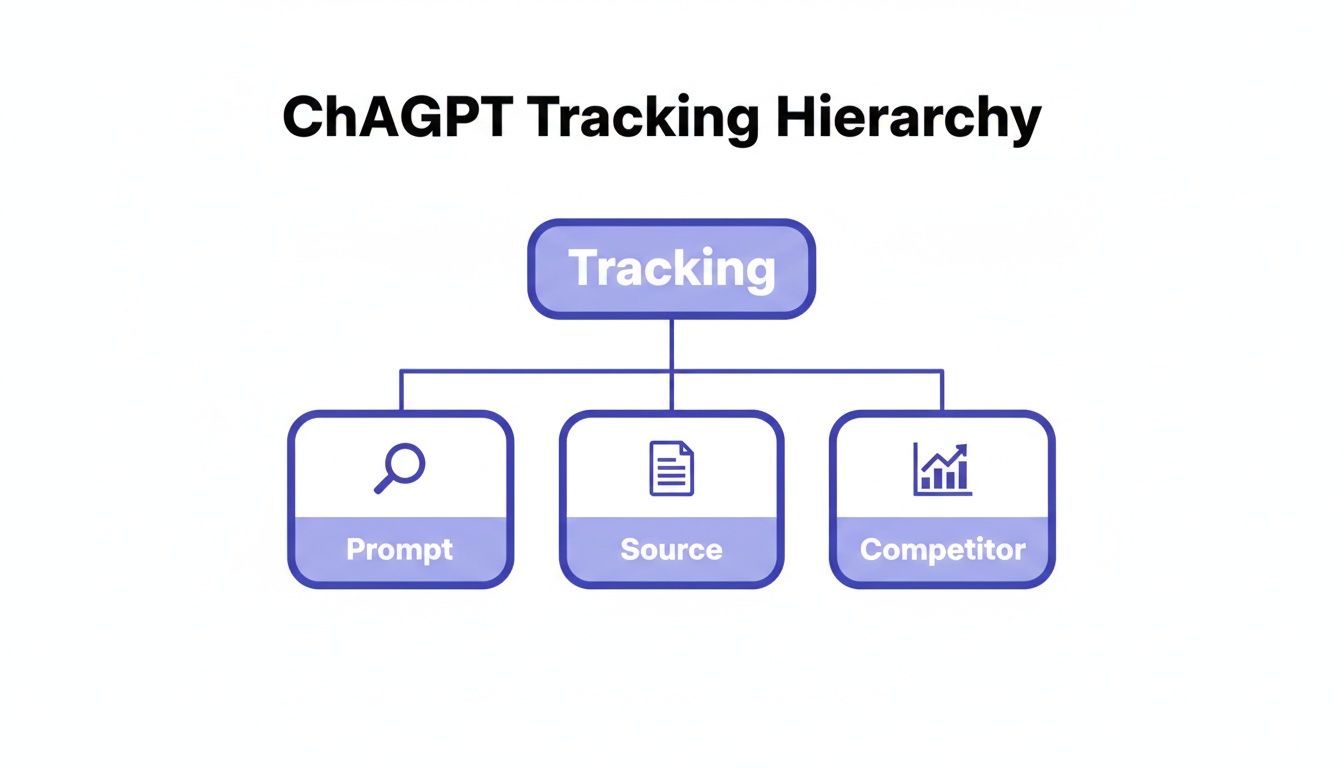
Each of these pillars needs its own set of metrics to give you the full picture.
AI Share of Voice
First, and most important, is AI Share of Voice (SOV). This KPI tells you how often your brand gets mentioned in AI answers compared to your competitors. It’s the direct parallel to share of voice in advertising.
Calculating it is simple. If you track 100 relevant prompts and your brand shows up in 20 answers, your AI SOV is 20%. That single number puts your performance into context.
Think of AI SOV as your north star for market position inside AI conversations.
Mention Frequency
Next is Mention Frequency. This tracks how often your brand appears across a huge volume of prompts on a specific topic. It’s about the breadth of your visibility.
Unlike SOV, which is relative, Mention Frequency is an absolute count of your presence. A high frequency means the AI consistently connects your brand with a user’s intent.
For example, a brand with a 97% Mention Frequency for “best cancer care hospital” is a dominant name in the AI’s knowledge base.
Source Authority Score
A Source Authority Score helps you figure out which websites the AI trusts most. Think of it like Domain Authority, but for AI influence. This score helps you prioritize where to focus your efforts.
Not all sources are equal. A mention on a popular tech blog carries more weight than one from an obscure forum.
By scoring each source based on how often AI models reference it, you can zero in on the highest-impact opportunities. This is how you build presence where it will actually shape future AI answers.
Understanding source authority also helps explain why your AI SOV is what it is. If you notice GA4 under-reporting traffic, analyzing sources can uncover high-value referral paths. Our guide on why GA4 often under-reports ChatGPT traffic digs into this.
How to Build a ChatGPT Tracking Workflow
Turning ChatGPT tracking into a workflow builds a competitive advantage. It’s about creating a repeatable process that finds opportunities and measures impact. This transforms random monitoring into an engine for AI-sourced demand.
The process itself isn’t complicated. Find the questions your customers ask, track the AI’s answers, analyze the sources, and create better content.
Step 1: Identify and Prioritize Core Prompts
Your workflow starts with pinpointing high-value prompts. Think of these as new-age keywords. They’re long-form, conversational questions that signal a user is ready to make a decision.
Brainstorm questions related to your product, use cases, and competitors. The goal is to build a focused list of queries representing important conversations.
Once you have a list, prioritize it. Zero in on prompts that hit on pain points or directly compare solutions.
Step 2: Automate Tracking and Set Up Alerts
With your core prompts locked in, automate the tracking. Manually checking dozens of prompts isn’t scalable. You need a system that monitors AI responses for you.
Specialized ChatGPT tracking tools are non-negotiable here. They run your prioritized prompts on a schedule, recording which brands get mentioned.
You should also set up alerts for brand mentions on places like Reddit. These discussions often become source material for AI models. Our guide to AI search visibility tools explores your options.
Step 3: Analyze Sources and Pinpoint Opportunities
Automated tracking tells you what is being said. Digging into sources tells you why. This is the most critical part of your workflow.
This analysis will surface two main types of opportunities:
- Content Opportunities: You’ll spot the articles and reports that AI models consistently trust. These are your blueprints for creating new, authoritative content.
- Discussion Opportunities: You’ll find specific threads on Reddit or industry forums that influence AI answers. Participating is a direct way to get your brand into the AI’s consideration set.
Your workflow should set aside time each week just to review this source data. It’s the raw material for your entire AI visibility strategy.
Step 4: Integrate and Execute
The final step is to fold these findings into your existing marketing operations. AI visibility tasks shouldn’t live in a silo.
Schedule a recurring meeting to go over tracking data and assign action items. This creates accountability and ensures you’re consistently executing. Over time, this disciplined workflow will steadily increase your AI Share of Voice.
Your Action Plan to Improve AI Visibility
Let’s move from theory to action. A solid ChatGPT tracking workflow gives you the data. This five-step plan turns that data into measurable improvements.
This isn’t a one-and-done project. Think of it as a continuous cycle where each step builds on the last.
1. Create AI-Friendly Content Based on Source Analysis
Use your source analysis to guide your content calendar. Pinpoint the articles, guides, and reports that AI models already cite for your target prompts.
Now, create something better. Build assets that are more comprehensive, better structured, and more data-driven. Use clear headings and bullet points to make your content easy for AI models to parse.
2. Strategically Engage in High-Value Discussions
Act on the community opportunities your tracking uncovers. Your analysis will point you to the exact threads on Reddit, Quora, and forums shaping AI answers.
Join these conversations and offer genuinely helpful insights. Where it feels natural, mention your brand. This isn’t about spamming; it’s about seeding your brand into discussions AI models learn from.
A single, well-placed comment in a high-authority Reddit thread can have more impact on your AI visibility than a dozen blog posts. Focus your efforts on the communities that AI models already trust.
3. Optimize Existing Content for AI Sourcing
You’re probably sitting on a goldmine of existing content. Go back through your top-performing blog posts and reformat them to be more “AI-friendly.”
This means doing things like:
- Adding summary sections at the top of long articles.
- Using FAQ schema to structure content in a Q&A format.
- Updating data and statistics to ensure information is current.
4. Build a Library of Factual, Data-Centric Assets
AI models feast on factual, verifiable information. Dedicate a section of your site to data-driven resources like original research reports or case studies.
These assets act like powerful “source magnets,” attracting citations from AI models and other websites. A report packed with unique stats is highly likely to be referenced. This builds your site’s authority.
5. Monitor and Iterate Based on Performance
Finally, close the loop. Keep a close eye on your key metrics like AI Share of Voice and Mention Frequency. This feedback loop tells you what’s working and what to do next.
If a new data report becomes a heavily cited source, double down on that format. If Reddit engagement boosts mentions, find more threads to join. This iterative process ensures your strategy gets smarter over time.
FAQ: ChatGPT Tracking
What’s the difference between ChatGPT tracking and SEO?
Traditional SEO focuses on ranking on a search results page to earn a click. ChatGPT tracking is about becoming part of the AI’s direct answer. The goal is for the AI to cite your brand or data as a source of truth.
Can I pay to be featured in ChatGPT?
No, you cannot pay for placement in organic ChatGPT answers. Visibility is earned by creating authoritative content that AI models trust and reference. It’s a long-term strategy built on credibility, not an ad buy.
What kind of content influences AI models?
Clear, well-structured, and factual content wins. AI models prefer information that is direct and answers a user’s question without fluff. Data-backed reports, in-depth guides, and expert discussions on platforms like Reddit are often cited.
How often should I track my AI visibility?
For most B2B brands, tracking weekly or bi-weekly is ideal. This frequency is enough to spot trends and new opportunities without getting lost in daily noise. A regular check-in helps you see if your efforts are moving the needle over time.
Ready to stop guessing and start measuring your AI visibility? Airefs gives you the tools to track your brand, analyze sources, and find actionable opportunities to win in AI search. See how you stack up against the competition at https://getairefs.com.