
Enterprise rank tracking used to mean one thing: monitoring keyword positions in Google. In 2026, that definition has split in two. Traditional SERP rank tracking still matters — for the organic blue links driving a large share of traffic. But a second channel has emerged alongside it: AI-generated answers in ChatGPT, Perplexity, and Google AI Overviews, where brands are being recommended (or ignored) before users ever reach a search results page.
The best enterprise teams now track both. They use measuring SEO performance for real business growth as the standard — not vanity rankings, but visibility that connects to pipeline and revenue. That means knowing your position in Google AND knowing whether your brand appears when a buyer asks ChatGPT to recommend a vendor in your category.
This guide covers the 12 best enterprise rank tracking software platforms in 2026 — the first three focused on AI search visibility, the remainder covering traditional enterprise SERP tracking at scale. Each section includes pricing, key features, and honest tradeoffs to help you pick the right tool for your team’s needs.
What are the best enterprise rank tracking software platforms in 2026?
The top 12 are Airefs, Profound, SEOmonitor, Semrush, Ahrefs, seoClarity, Conductor, BrightEdge, STAT Search Analytics, AccuRanker, Advanced Web Ranking (AWR), and Nozzle.
Top enterprise rank tracking platforms — Comparison table
| Tool | Core focus | AI platforms tracked | Starting price |
|---|---|---|---|
| Airefs | ChatGPT citation tracking + source discovery | ChatGPT (default), others on request | $24/mo |
| Profound | Enterprise AEO; 10+ AI platforms | ChatGPT, Perplexity, Claude, Gemini, Grok, + more | $99/mo |
| SEOmonitor | Unified Google rank tracking + AI visibility | ChatGPT, Gemini, Perplexity, AI Overviews | EUR 99/mo |
| Semrush | All-in-one SEO suite + AI Visibility Toolkit | ChatGPT, AI Overviews, AI Mode, Perplexity, Gemini | $129.95/mo + $99/mo AI add-on |
| Ahrefs Enterprise | Research-first SEO suite + Brand Radar | ChatGPT, Perplexity, Gemini, Copilot, AI Overviews, AI Mode | Custom |
| seoClarity | Real-time enterprise rank intelligence | Google AI Overviews | Custom |
| Conductor | Enterprise SEO + AI SERP reporting | Google AI Overviews | Custom |
| BrightEdge | Fortune 1000 rank + content performance | Google AI Overviews | Custom |
| STAT Search Analytics | Big-data SERP tracking, API-first | Google AI Overviews | Custom |
| AccuRanker | Speed/accuracy; on-demand updates | Google AI Overviews | From ~$129/mo |
| AWR | Rank tracking specialist; hourly updates | Google AI Overviews | From ~$99/mo |
| Nozzle | Usage-based SERP pulling; BigQuery access | Google AI Overviews | Usage-based |
1. Airefs
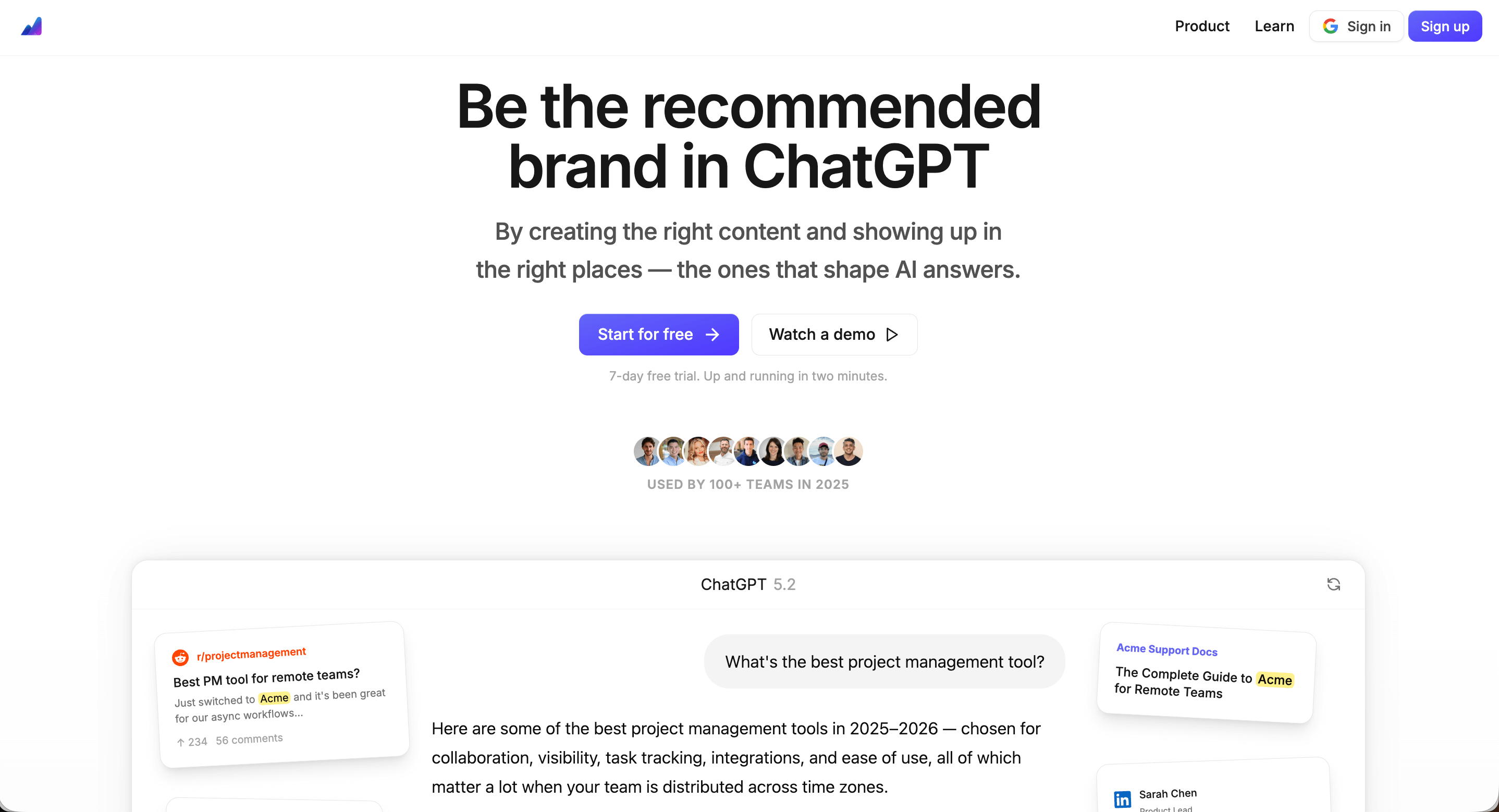
Airefs is the platform enterprises reach for when they want to track — and influence — their brand’s position in ChatGPT responses. While traditional rank trackers tell you where you sit in Google’s blue links, Airefs tells you whether your brand appears when buyers ask AI chatbots to recommend products in your category. More importantly, it goes one level deeper: it identifies the exact articles, forum threads, and Reddit discussions that ChatGPT is citing to form those answers.
That source-level data is what separates Airefs from tools that only report a mention percentage. Knowing you appear in 12% of tracked prompts is useful. Knowing the 47 specific URLs that are driving your competitors’ citations — and which of those you need to create, update, or participate in — is actionable. For enterprise content and SEO teams, that’s the difference between a dashboard and a work order.
Key features:
- Prompt tracking — Runs defined buyer-intent queries on ChatGPT (by default) and logs whether your brand, specific pages, or competitors appear in the answer
- Source-level citation discovery — Identifies the exact URLs (articles, Reddit threads, reviews) that AI models pull from when answering queries in your category
- AI crawler analytics — Tracks real visits from GPTBot, PerplexityBot, ClaudeBot, and other AI crawlers; shows which pages are being accessed and how frequently
- Reddit monitoring — Alerts when new discussions relevant to your tracked keywords appear, before they become established AI sources
- Competitor benchmarking — Side-by-side citation rate and source analysis vs up to 10 tracked competitors
- Done-for-you execution — Agency package includes an AEO strategist, content creation, and human participation in relevant forums and discussions
Pricing:
| Plan | Price | Prompts | Domains |
|---|---|---|---|
| Lite | $24/mo | 25 (ChatGPT by default) | 1 |
| Pro | $49/mo | 60 | 3 |
| Expert | $83/mo | 150 | Unlimited |
| Done-for-you | $299/mo+ | Included | Unlimited |
7-day free trial on Pro.
Pros:
- Source-level citation data translates directly into content briefs and outreach targets
- Combines prompt tracking with AI crawler analytics — two signals most tools treat separately
- Reddit monitoring catches emerging sources before competitors do
- Lowest entry price ($24/mo) among full-featured AI rank trackers
Cons:
- Prompt tracking defaults to ChatGPT; other LLMs available on request, not self-serve on all plans
- Focused on AI search visibility — pairs best with a traditional rank tracker for Google SERP monitoring
Customers: 100+ teams across B2B SaaS, agencies, and content-led companies.
“While every other AI search visibility tool showed me whether I was being cited, Airefs showed me all 571 URLs that were being cited.”
— Lillian P, Fractional CMO
Website: getairefs.com
2. Profound
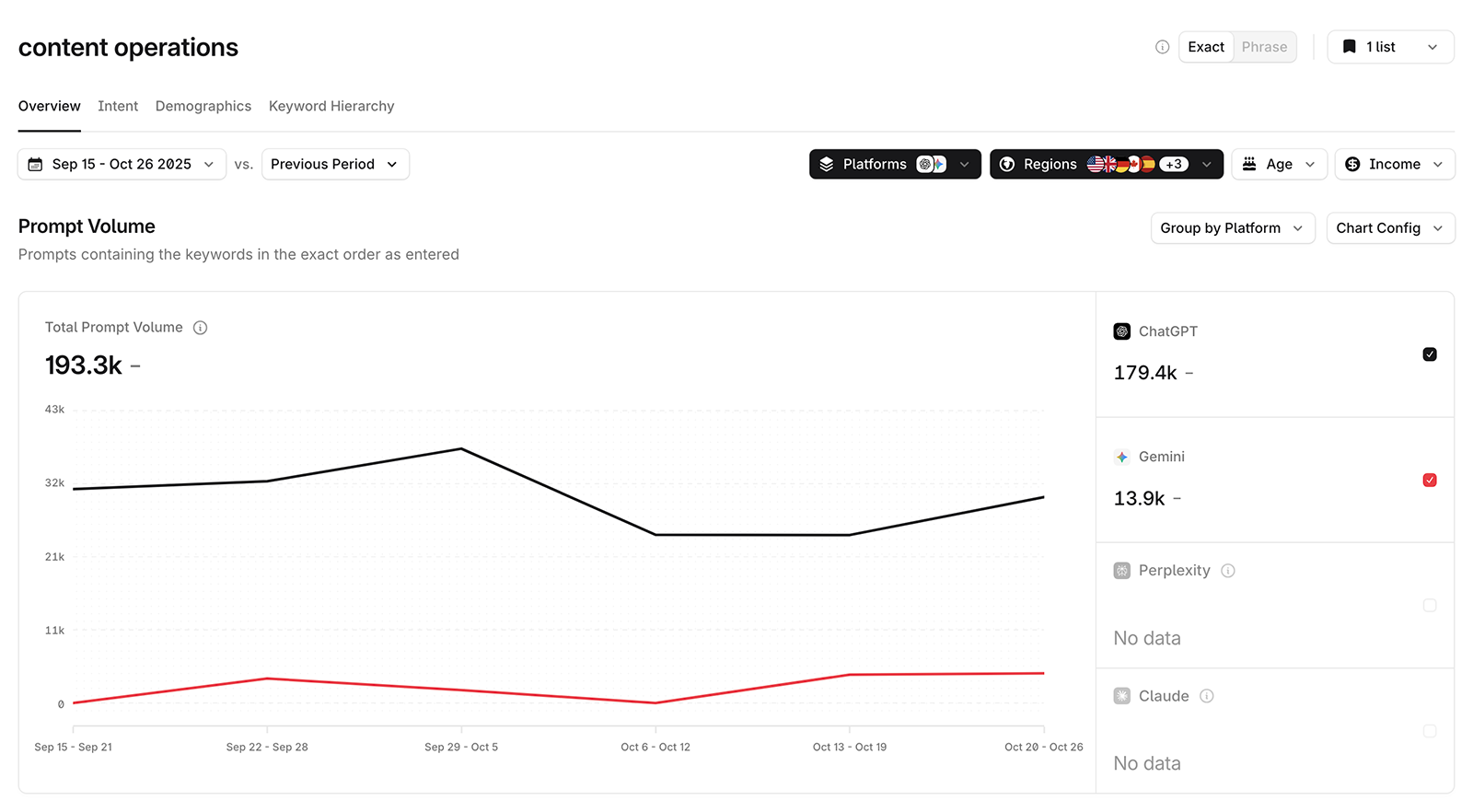
Profound is the most-funded enterprise AEO platform in the market — $58.5M across seed (Khosla), Series A (Kleiner Perkins + NVIDIA), and Series B (Sequoia) — and the scale of investment reflects the depth of its platform. Where most AI visibility tools track a handful of LLMs, Profound tracks 10+: ChatGPT (including ChatGPT Shopping), Perplexity, Claude, Gemini, Grok, Copilot, Meta AI, DeepSeek, and Google AI Overviews. Its customer list — MongoDB, Ramp, Figma, Zapier, Docusign, Indeed — is as strong as any enterprise software vendor in the AEO category.
Profound’s enterprise value comes from two capabilities that go beyond monitoring. First, its Prompt Volumes feature shows the actual AI search volume for queries in your category — not just whether you appear, but how many people are asking those questions across AI platforms. Second, its Content Agents automate the production of AI-optimized content (listicles, comparisons, how-tos) with human-in-the-loop review, turning data into output at scale. You can read an analysis of how AI search results break down across platforms to understand what enterprise AI visibility programs are working with.
Key features:
- Answer Engine Insights — Brand mention tracking, AI response analysis, and citation discovery across 10+ platforms
- Agent Analytics — AI crawler visibility, traffic attribution from AI bots, content performance in AI answers
- Prompt Volumes — AI search volume data and trend discovery across platforms; shows demand, not just supply
- ChatGPT Shopping — Shopping visibility tracking, shopping trigger analysis, product recommendation data
- Content Agents — AI-optimized content creation at scale with human review and custom pipeline integrations
- Daily automated refresh — Data updates every 24 hours across all tracked platforms
Pricing:
| Plan | Price | Prompts | Platforms |
|---|---|---|---|
| Starter | $99/mo | 50 | ChatGPT only |
| Growth | $399/mo | 100 | ChatGPT, Perplexity, Google AI Overviews |
| Enterprise | Custom | Custom | All 10+ AI models |
Annual billing discount available. API access is Enterprise-only.
Pros:
- Most comprehensive AI platform coverage (10+ models including ChatGPT Shopping, DeepSeek)
- Prompt volume data shows AI search demand — a feature almost no other platform offers
- G2 Winter 2026 AEO Leader; proven enterprise results (Ramp: 7x visibility increase)
- SOC 2 Type II, SSO, daily automated backups
Cons:
- Starter limited to ChatGPT only with 50 prompts
- Growth plan ($399/mo) is a significant step up from Starter
- Enterprise pricing requires a sales conversation
Customers: MongoDB, Indeed, Mercury, Docusign, Zapier, Ramp, Figma, Zocdoc, G2, US Bank, Chime, Clay, 8Sleep, Mejuri, Ashby, SeatGeek, NP Digital, Workable, Rho, Golin.
“Ramp boosted AI visibility 7x and became the 5th most visible fintech brand globally within weeks.” — Profound case study
Website: tryprofound.com
3. SEOmonitor
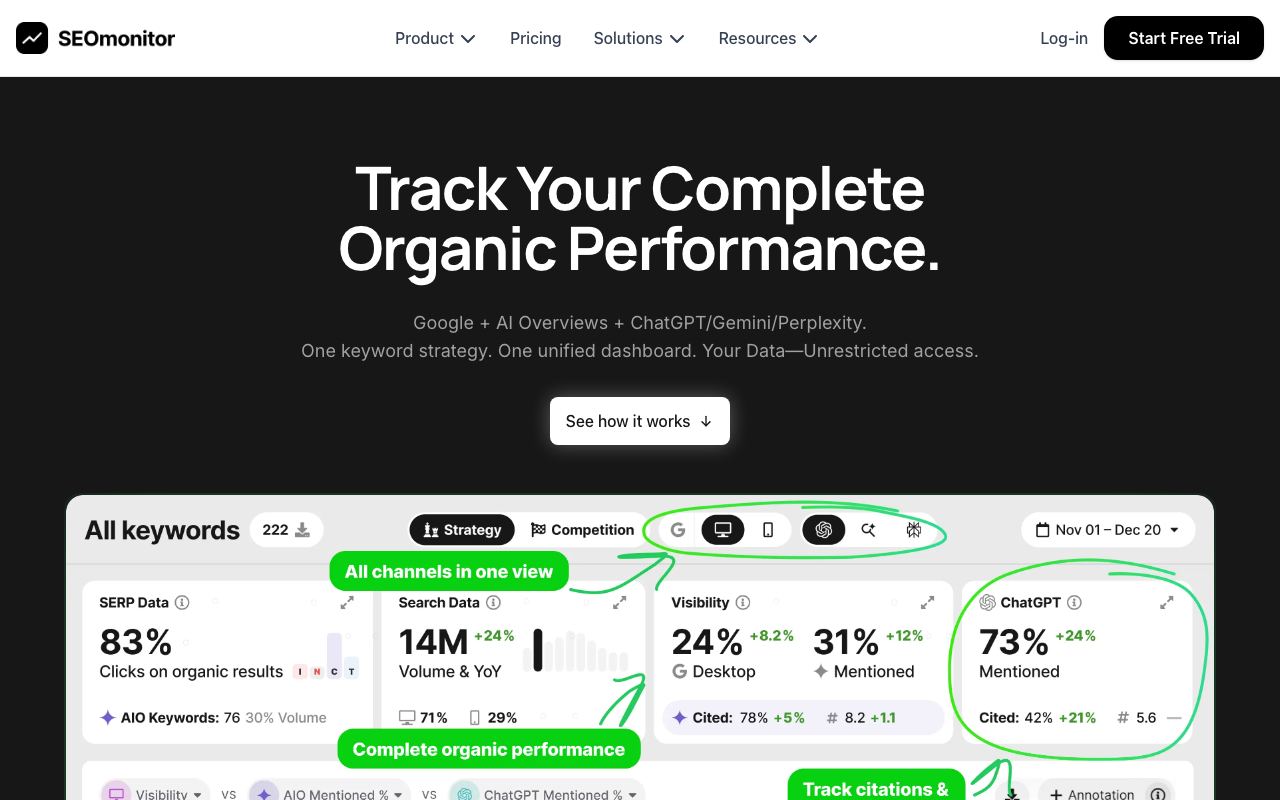
SEOmonitor is the most compelling option on this list for enterprise SEO agencies: it combines Google rank tracking, Google AI Overview monitoring, and ChatGPT/Gemini/Perplexity visibility into a single platform, priced per keyword tracked rather than per seat. Unlimited users is standard. That model is unusual and highly valuable for agencies where per-seat costs accumulate across account managers, strategists, analysts, and client stakeholders.
Its unified dashboard is the main argument for SEOmonitor: one view shows your Google ranking, whether you appear in AI Overviews for that query, and whether you appear in ChatGPT or Perplexity answers — without switching platforms or reconciling data from different sources. Its Autonomous Content Writer extends that into content production, going from topic discovery to CMS publishing to performance tracking. Published stats are notable: 80% of articles written using the tool rank within 30 days, and 52% get cited in Google AI Overviews.
Key features:
- Unified rank tracking dashboard — Google positions, AI Overview monitoring, and AI search visibility (ChatGPT, Gemini, Perplexity) in one view
- Autonomous Content Writer — Topic discovery → AI draft → CMS publishing → performance tracking; includes internal linking and EEAT signals
- SEO forecasting — Seasonality, year-over-year trends, CTR curves, AI Overview impact modeling
- Keyword research — Auto-clustering, search intent detection, irrelevant keyword filtering
- PITCH/WIN workflow — PITCH phase (campaign setup) is free; WIN phase (activating tracking) triggers payment — useful for agencies pitching new clients
- Full API access (API 3.0) and Agency Dashboard
- Google Analytics and Search Console integration with CMS direct publishing
Pricing:
| Plan | Price | Notes |
|---|---|---|
| Starter | EUR 99/mo | Pay-per-keyword; unlimited users |
| Pro | EUR 299/mo | Advanced features |
| Writer add-on | EUR 25/mo | Autonomous Content Writer |
14-day free trial,
Pros:
- Pay-per-keyword with unlimited users — the most agency-friendly pricing model in this list
- Unified Google + AI tracking in one dashboard eliminates tool sprawl
- Autonomous Content Writer with full publishing pipeline is unique at this price point
- Impressive published results: 80% rank in 30 days, 52% cited in AI Overviews
Cons:
- AI Search tracking (ChatGPT, Gemini, Perplexity) updates weekly — daily available only for Google rankings and AI Overviews
- EUR pricing is less convenient for US-based teams
- PITCH/WIN phase structure adds onboarding complexity
Customers: Vodafone, Publicis, Performics, Marks & Spencer, Gymshark, Omio, Miro, TUI, Brainlabs, Wavemaker. G2 rating: 4.7/5.
“10x team productivity. The AI Content Writer alone saves us 100+ hours monthly.” — Radu Marcusu, CEO, Upswing
Website: seomonitor.com
4. Semrush (Business/Enterprise)
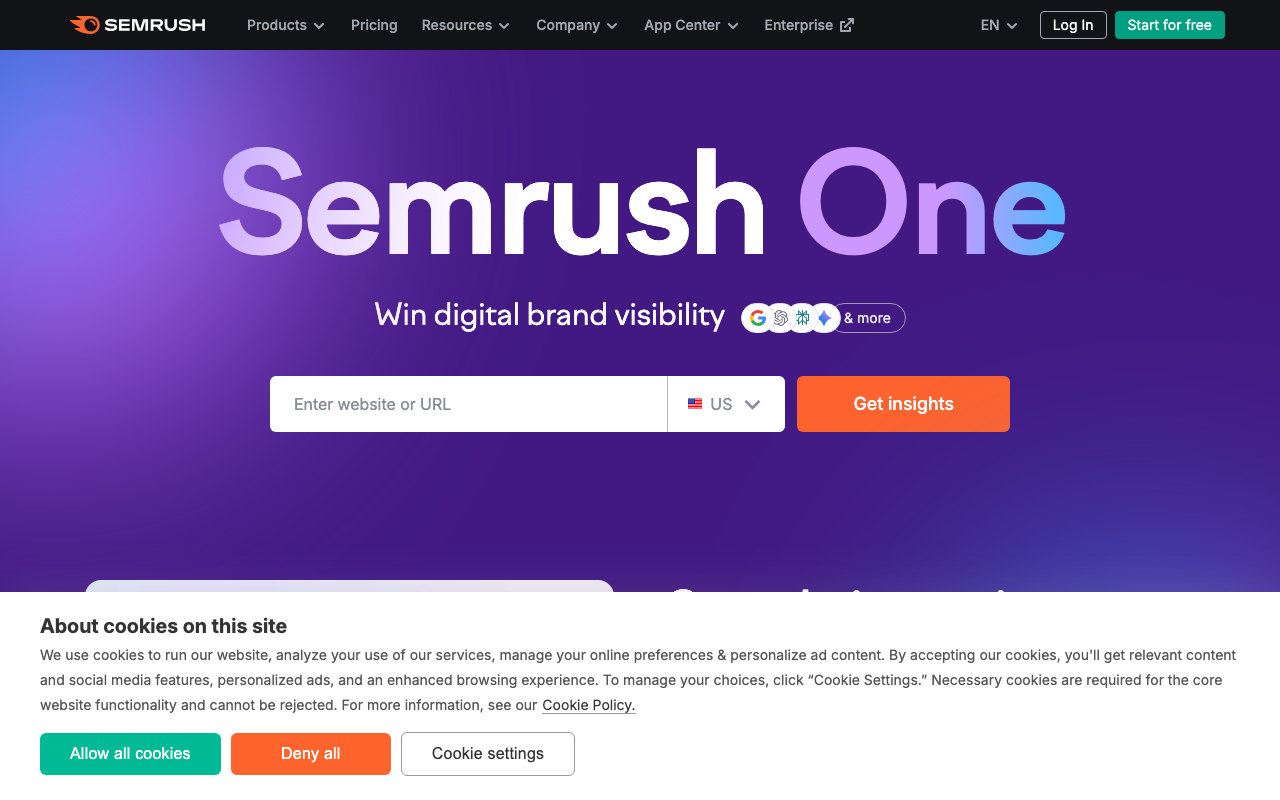
Semrush’s Position Tracking is one of the most-used enterprise rank tracking tools in the market — daily updates across devices, locations, and competitors, with Share of Voice as the headline metric for C-suite reporting. For enterprises already using Semrush for keyword research, site audits, and competitive analysis, rank tracking is a natural extension of the same platform rather than an additional vendor relationship to manage.
The AI Visibility Toolkit ($99/mo add-on) extends this into AI search, tracking your brand across ChatGPT, Google AI Overviews, AI Mode, Perplexity, and Gemini with a branded AI Visibility Score. The integration means SEO and AI visibility data live in the same platform, which simplifies reporting. Understanding the broader AI search engine optimization landscape helps contextualize how these two rank tracking disciplines are converging in enterprise SEO programs.
Key features:
- Position Tracking — Daily rank updates by device (desktop/mobile), location (national to local), and competitor across Google and Bing
- Share of Voice — Market-level visibility metric benchmarked against tracked competitors
- AI Visibility Score — Brand impression percentage across AI platforms vs up to 9 competitors ($99/mo add-on)
- AI SEO audit — Crawlability analysis across devices and LLMs for technical barrier detection
- Integrated SEO suite — Backlink analysis, site audits, keyword research, content optimization all in one platform
- API access and Looker Studio connector — On Business plan and above
- Local SEO tracking — Google Business Profile visibility via Map Rank Tracker add-on
Pricing:
| Plan | Price | Keywords | Notes |
|---|---|---|---|
| Pro | $129.95/mo | 500 | No API |
| Guru | $249.95/mo | 1,500 | — |
| Business | $499.95/mo | 5,000 | API + Looker Studio |
| AI Visibility Toolkit (add-on) | +$99/mo | — | Per domain; 25 prompts |
| Additional 50 prompts | +$60/mo | — | — |
Annual billing saves 17%.
Pros:
- Most widely adopted enterprise SEO platform globally — mature, trusted, well-supported
- Position Tracking + AI Visibility Toolkit covers both SERP and AI search in one vendor
- Share of Voice is the clearest market-level KPI for executive reporting
Cons:
- AI Visibility Toolkit is expensive to scale (+$99/mo per domain, +$99/mo per user, +$60/mo per 50 prompts)
- No free trial for AI toolkit; demo reports only
- Keyword-based tracking approach is less aligned with natural language AI queries
Customers: 10M+ users globally. Agency customers include Coalition Technologies, Sure Oak, Chargeblast.
Website: semrush.com
5. Ahrefs Enterprise
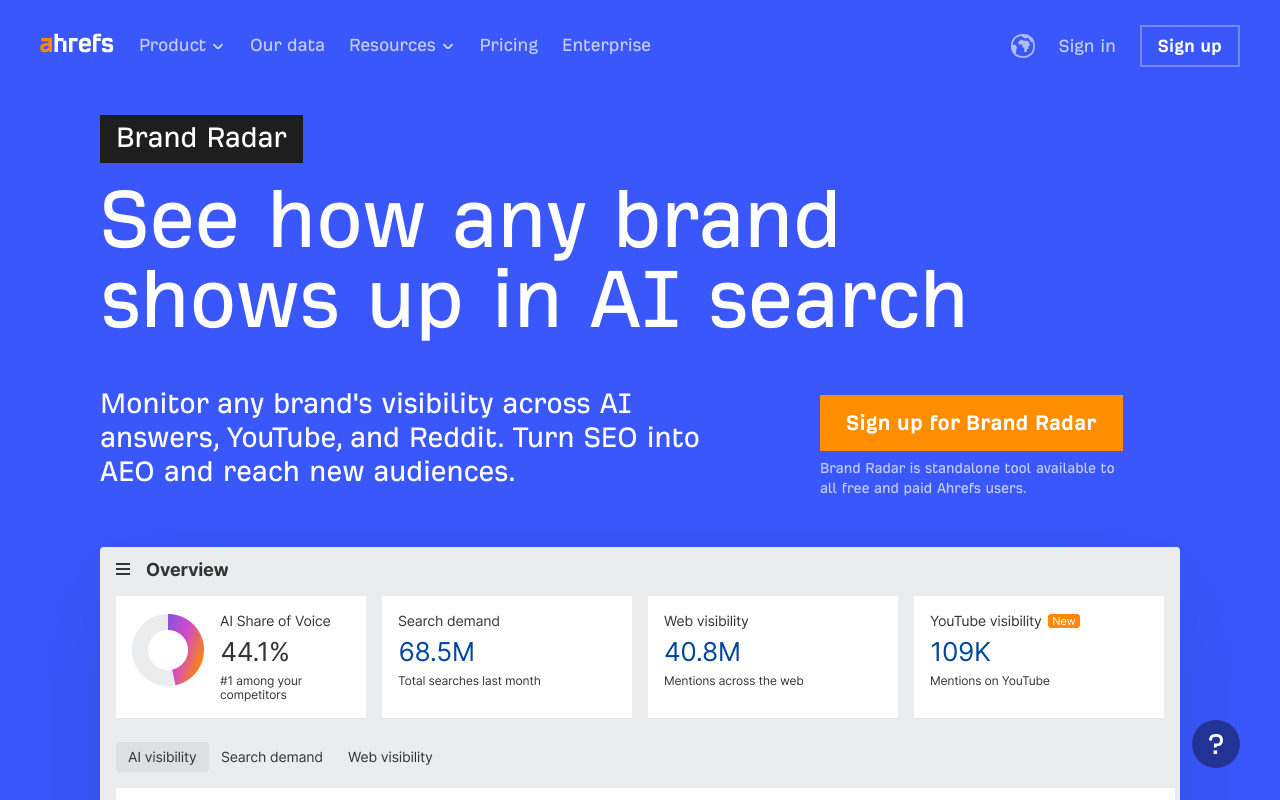
Ahrefs Enterprise is the choice for teams where backlink analysis and keyword research drive the SEO strategy — and who want rank tracking integrated into that research workflow rather than siloed in a separate tool. The Rank Tracker module provides daily tracking (as an add-on to the default weekly), SERP feature monitoring, and access to Ahrefs’ historical ranking data, which stretches back further than most competitors.
Brand Radar, Ahrefs’ AI visibility add-on, brings the same data-scale approach to AI search: 253M+ monthly prompts tracked from real search data (not synthetic queries), industry segmentation, and custom scheduling. The integration with Site Explorer and Keywords Explorer means AI citation data lives alongside backlink profiles and keyword metrics — useful for teams whose optimization work spans traditional and AI search simultaneously.
Key features:
- Rank Tracker — Weekly by default; daily tracking available as add-on; SERP feature tracking; historical data
- Brand Radar — AI Share of Voice across ChatGPT, Perplexity, Gemini, Copilot, AI Overviews, AI Mode; 253M+ monthly prompts
- Cited domains & pages — Identifies top sources cited in AI responses mentioning your brand
- Industry segmentation — Filter AI visibility by vertical (e.g., separate a conglomerate’s product lines)
- Custom prompt scheduling — Daily, weekly, or monthly tracking per query
- Enterprise controls — SSO, audit logs, dedicated support, elevated API access
- Full SEO suite integration — Site Explorer, Keywords Explorer, Site Audit, Content Explorer
Pricing:
| Plan | Monthly |
|---|---|
| Lite (base) | EUR 119/mo |
| Advanced (base) | EUR 449/mo |
| Enterprise (base) | Custom |
| Brand Radar — single AI index | +EUR 179/mo |
| Brand Radar — all 6 indexes | +EUR 654/mo |
Minimum for Brand Radar with full coverage: ~EUR 773/mo.
Pros:
- Largest AI prompt database (253M+ monthly, search-backed not synthetic)
- Historical ranking and AI visibility data gives a baseline most competitors lack
- Strongest backlink and keyword research integration of any tool in this list
Cons:
- Most expensive option by a significant margin (EUR 773/mo minimum)
- Independent testing found significant AI tracking undercounting (3 mentions reported vs 123 actual)
- Weekly rank tracking by default; daily is an extra cost
Customers: 10M+ Ahrefs users globally.
Website: ahrefs.com
6. seoClarity
seoClarity is an enterprise-grade SEO platform built for organizations managing massive keyword portfolios across multiple domains and international markets. Its Rank Intelligence module provides near real-time tracking — a critical feature for industries where daily SERP fluctuations directly impact revenue — with unlimited competitor tracking and advanced segmentation by device, location, content tag, or business unit.
The platform’s strength is its data integration depth. seoClarity connects directly to BigQuery, Looker, Tableau, and Redshift, making it a strong fit for enterprises with existing BI infrastructure that need to pull SEO ranking data into central analytics warehouses for custom modeling. Its AI Overview tracking is built into the rank monitoring workflow, so teams can see how AI-generated features are displacing traditional organic results for their tracked keywords.
Key features:
- Rank Intelligence — Near real-time tracking with unlimited competitor views and deep segmentation by device, location (down to zip code), and custom tags
- BI integrations — Native connectors for BigQuery, Redshift, Looker, Tableau, and Databricks
- SERP feature tracking — Monitors AI Overviews, featured snippets, local packs, and other features alongside organic rank
- Content Fusion — AI-powered content optimization module (add-on)
- Site auditing and technical SEO — Integrated crawling and technical analysis
- Multi-domain management — Built for enterprise portfolios with granular user permissions and workflow controls
- Dedicated account management — Enterprise support with SLAs
Pricing: Custom pricing based on tracked keywords, domains, and selected modules. Demo required.
Pros:
- Near real-time rank data is rare among enterprise tools
- Best-in-class BI integrations for teams with existing data infrastructure
- Unlimited competitor tracking on all plans
- Local tracking down to zip code level
Cons:
- Pricing opacity requires a sales conversation
- All-in-one platform can be more than teams with narrow rank tracking needs require
- Significant implementation investment for complex organizations
Customers: Enterprise and mid-market organizations across ecommerce, publishing, and B2B SaaS.
Website: seoclarity.net
7. Conductor
Conductor is an enterprise SEO and content intelligence platform with a notable advantage for teams migrating from other tools or starting new tracking programs: immediate access to up to two years of historical keyword data upon setup. Most platforms require a data accumulation period before trend analysis becomes possible; Conductor eliminates that wait.
Its AI search capabilities go beyond basic AI Overview monitoring — Conductor tracks visibility within generative AI results and provides specialized reporting to help teams understand how their organic presence is being affected by AI-driven SERP changes. For enterprises investing in technical controls around how LLMs access their content, Conductor’s reporting connects technical optimization to measurable ranking outcomes.
Key features:
- Daily and weekly rank tracking — Across Google and Bing, with granular location and device segmentation
- 2-year historical data — Available immediately upon setup for newly tracked keywords (rare differentiator)
- AI SERP tracking — Specialized filters and reports for visibility in AI-generated results
- Cannibalization detection — Identifies internal keyword conflicts across large content libraries
- Content intelligence — Integrates rank tracking with content creation workflow tools
- Advanced segmentation — Custom content tags, business unit filters, and flexible reporting
- Enterprise onboarding — Structured implementation with dedicated strategic support
Pricing: Custom quote-based. Typically aligned with enterprise software budgets. Free trial available.
Pros:
- 2-year historical data available immediately — strongest historical baseline in this list
- AI SERP tracking integrated into the main rank tracking workflow
- Cannibalization detection useful for large, mature content libraries
Cons:
- Custom pricing with no public tiers
- Can be expensive relative to the scope needed by some teams
- Content intelligence features may overlap with existing tooling
Customers: Enterprise organizations across media, retail, and B2B.
Website: conductor.com
8. BrightEdge
BrightEdge is the default choice for Fortune 1000 SEO teams — particularly those that need to justify SEO investment to executive leadership. Its StoryBuilder feature generates presentation-ready reports that connect keyword rankings to business outcomes (traffic, leads, revenue), which is the format C-suite stakeholders respond to. Its Data Cube provides extensive market-level keyword intelligence for strategic planning alongside operational rank tracking.
BrightEdge’s long-standing enterprise presence means it integrates with the governance structures large organizations require: granular user permissions, workflow controls, and executive reporting that scales across global, decentralized SEO teams. Its AI Overview tracking is part of the standard SERP feature monitoring suite, giving visibility into how AI results are changing the click landscape for tracked keywords.
Key features:
- Position tracking — Daily monitoring across devices, locations, and competitors for large keyword portfolios
- StoryBuilder — Customizable, presentation-ready executive reports connecting rank to business outcomes
- Data Cube — Market-level keyword intelligence for gap analysis, opportunity discovery, and competitive benchmarking
- Content performance measurement — Tracks how content ranking changes translate to traffic, engagement, and conversions
- SERP feature tracking — Includes AI Overviews, featured snippets, local packs alongside organic positions
- Enterprise governance — Granular user permissions, workflow controls, and audit capabilities
- Custom integrations — API access for BI and analytics platform connections
Pricing: Quote-only. Premium pricing aligned with Fortune 1000 software budgets.
Pros:
- StoryBuilder for executive reporting is a standout — few tools connect rank to revenue as clearly
- Battle-tested with Fortune 1000 enterprise governance requirements
- Data Cube provides market intelligence alongside operational tracking
Cons:
- Premium pricing is significant; justified primarily for large, complex SEO programs
- Implementation can be involved for organizations with complex domain structures
- Less suited to agile, smaller teams than some alternatives
Customers: Widely adopted across Fortune 1000, particularly retail, financial services, and media.
Website: brightedge.com
9. STAT Search Analytics
STAT is purpose-built for one thing: high-volume, high-frequency SERP data at enterprise scale. It’s not an all-in-one SEO suite. It’s a specialized data provider for organizations that need to monitor millions of keywords daily across local and mobile search environments — and pipe that data directly into their own analytics infrastructure via a robust API. For monitoring brand visibility in LLMs and AI-driven search changes, the granularity of STAT’s SERP data is a strong complement to dedicated AI visibility tools.
The platform’s API-first philosophy is its defining characteristic. Organizations build custom dashboards, data warehouse pipelines, and business intelligence models on top of STAT’s raw SERP output rather than relying on the platform’s UI for analysis. This makes STAT the right choice for teams with in-house data science capability — and a poor fit for teams that need a self-contained reporting interface.
Key features:
- Daily tracking at scale — Millions of keywords tracked daily across any global location, down to city level
- Mobile and local SERP tracking — Granular device and location segmentation including local pack visibility
- SERP feature monitoring — Tracks AI Overviews, featured snippets, knowledge panels, shopping results alongside organic rank
- API-first data delivery — Robust API designed for direct integration into BI tools and data warehouses
- Unlimited competitor analysis — Track any number of competing domains against your keyword set
- Historical SERP data — Access to historical ranking data for trend analysis
- Enterprise support — Dedicated technical assistance for API implementation
Pricing: Custom enterprise pricing based on keyword volume and tracking frequency. No public self-serve tier.
Pros:
- Designed for millions of keywords — the highest ceiling of any tool in this list
- API flexibility allows custom modeling that no vendor UI can replicate
- Moz owns STAT, providing backing and development continuity
Cons:
- Not a self-contained analytics platform — requires in-house technical resources to leverage
- No out-of-the-box dashboard for non-technical stakeholders
- Enterprise pricing only; not appropriate for smaller teams or budgets
Customers: Large agencies, enterprise in-house teams, and SEO data companies with high-volume tracking needs.
Website: getstat.com
10. AccuRanker
AccuRanker’s core differentiator is speed: on-demand rank updates on any keyword at any time, with daily scheduled tracking as the baseline. In markets where algorithm updates or competitor moves can shift rankings within hours, the ability to pull fresh data immediately — rather than waiting for the next scheduled crawl — is a meaningful operational advantage. Unlimited domains and unlimited users across all plans makes it highly scalable for agencies managing large client portfolios.
AccuRanker’s enterprise credentials extend to its data infrastructure. It provides a full read/write API, a native Google BigQuery connector, and access to raw SERP HTML on enterprise plans — giving technical SEO teams the raw material for custom analysis without secondary data costs.
Key features:
- On-demand rank updates — Fresh data for any keyword instantly, plus daily automated tracking
- Unlimited domains and users — No per-seat or per-domain pricing on any plan
- Google BigQuery connector — Native integration for direct data export to BigQuery
- Full read/write API — Programmatic access to ranking data and account management
- Raw SERP HTML access — Available on enterprise plans for granular competitive research
- SERP feature tracking — AI Overviews, featured snippets, local packs alongside organic positions
- Advanced tagging and filtering — Custom content tags, keyword segmentation, flexible reporting
Pricing: Transparent tiered pricing based on keyword volume. Plans start around $129/mo for 1,000 keywords; custom pricing above 25,000 keywords. No per-user or per-domain fees.
Pros:
- On-demand updates are genuinely differentiated — no other enterprise tool matches this flexibility
- Transparent, keyword-volume-only pricing is unusual and refreshing in this market
- Unlimited domains and users on all plans — great for agencies
Cons:
- Focused narrowly on rank tracking; needs to be paired with other tools for content, links, and technical SEO
- SERP feature tracking for AI results is less sophisticated than dedicated AEO platforms
Customers: Agencies and enterprise in-house teams across ecommerce, publishing, and B2B.
Website: accuranker.com
11. Advanced Web Ranking (AWR)
Advanced Web Ranking (AWR) is a rank tracking specialist that handles two things most enterprise tools don’t combine: on-demand hourly keyword updates and transparent, keyword-volume-based pricing with no custom quote required. Enterprise plans start at 35,500 weekly keywords, with custom plans for higher volumes. That pricing transparency is rare at this scale and makes AWR easier to evaluate and budget for compared to the quote-only enterprise tools above.
Its white-label reporting capabilities make it a natural fit for agencies delivering branded SEO reports to clients. The native Looker Studio connector streamlines the reporting workflow without requiring custom engineering. As AI-generated answers change how search traffic is attributed, understanding why GA4 under-reports traffic from ChatGPT is relevant context for AWR users building reporting models that account for AI channel traffic alongside organic.
Key features:
- On-demand hourly updates — Plus daily and weekly scheduled tracking; among the most flexible update frequencies in this list
- Enterprise keyword volumes — Plans starting at 35,500 weekly keywords; custom plans above that
- Native Looker Studio connector — Direct integration for custom dashboard building
- Full developer API — Programmatic data access for custom integrations and automation
- White-label reporting — Branded, client-facing performance reports for agencies
- Multi-search engine tracking — Google, Bing, Yahoo, Baidu, and others
- SERP feature monitoring — Tracks AI Overviews, featured snippets, local packs alongside organic rank
Pricing: Transparent tiered pricing based on keyword volume and update frequency. No custom quote required for standard plans.
Pros:
- On-demand hourly updates give more operational flexibility than daily-only tools
- Transparent pricing at enterprise scale is unusual and valuable for budget planning
- White-label reporting is a strong differentiator for agency use cases
Cons:
- Narrowly focused on rank tracking; not an all-in-one SEO platform
- White-label reporting is an older feature set that some agencies may not need
- Less comprehensive SERP feature coverage than dedicated enterprise suites
Customers: Digital marketing agencies and enterprise in-house teams managing large keyword portfolios.
Website: advancedwebranking.com
12. Nozzle
Nozzle is built for data-first enterprise organizations that want direct control over their SERP data rather than consuming it through a vendor’s interface. Its model is usage-based — you pay per SERP pull, not per keyword or per month — which gives technical teams precise control over tracking frequency, device, location (down to zip code), and costs. Every plan includes API and BigQuery access with no additional fees, making it the best option for in-house data science teams that want to run ranking data through proprietary models.
The tradeoff is the UI: Nozzle’s front-end is functional but intentionally minimal. Its value is in data delivery, not dashboard visualization. For teams with the engineering capacity to build on top of raw SERP data, that’s a feature, not a limitation.
Key features:
- Usage-based SERP pricing — Pay per SERP pull, not per keyword; precise cost control based on actual tracking needs
- BigQuery and API access on all plans — No extra fees for direct data export to analytics infrastructure
- No keyword limits — Track any number of keywords; billing based entirely on SERPs pulled
- Granular location tracking — Down to zip code level for any market
- Unlimited competitor tracking — Any number of competing domains tracked without additional cost
- SERP feature tracking — AI Overviews, featured snippets, local packs, and other features
- Flexible update frequency — Daily, weekly, or any interval based on tracking needs
Pricing: Usage-based (billed per SERP pull). Planning required to estimate monthly costs. No per-user fees.
Pros:
- Most flexible pricing model — costs scale precisely with actual usage
- BigQuery and API access on all plans — no extra cost for data infrastructure teams
- No keyword limits or competitor caps
Cons:
- Usage-based pricing requires planning to avoid unexpected costs
- Minimal UI — not suitable for teams that need a self-contained analysis environment
- Less visibility into SERP features and AI results compared to all-in-one platforms
Customers: Analytics-first organizations and large enterprises with in-house data science capability.
Website: nozzle.io
How to choose enterprise rank tracking software
If AI search visibility is your primary gap: Start with Airefs for ChatGPT citation tracking and source discovery. Add Profound if you need 10+ AI platforms and enterprise-grade content generation. SEOmonitor covers both Google rankings and AI visibility if you want to reduce tool count.
If you need unified SEO + AI tracking: Semrush covers the most ground in a single platform (Google rank tracking + AI Visibility Toolkit). Ahrefs Enterprise covers the same ground with stronger backlink research and a larger AI prompt database. Both require add-on spend for AI features.
If you’re managing millions of keywords: STAT and Nozzle are the only tools built to handle that volume with the API flexibility to route data into custom BI infrastructure. AccuRanker is the better choice if you also need a usable front-end and on-demand update flexibility.
If you need executive reporting: BrightEdge’s StoryBuilder is the strongest option for connecting rank data to revenue for C-suite stakeholders. Conductor’s 2-year historical data makes trend narratives easier to build. seoClarity’s near real-time tracking is best for high-velocity markets.
If you’re an agency: SEOmonitor’s unlimited-seat pricing model is the most economical for large teams. AWR’s white-label reporting is purpose-built for client-facing deliverables. AccuRanker’s unlimited domains across all plans makes portfolio management straightforward.
FAQ
What is enterprise rank tracking software?
Enterprise rank tracking software monitors keyword positions and search visibility at scale — typically thousands to millions of keywords across multiple domains, search engines, countries, and devices. Enterprise tools add high-frequency updates (daily or faster), API access for BI integration, advanced segmentation, and AI search visibility tracking alongside traditional SERP monitoring.
What’s the difference between traditional rank tracking and AI rank tracking?
Traditional rank tracking monitors your position in Google’s organic blue links for specific keywords. AI rank tracking monitors whether your brand appears in AI-generated answers (ChatGPT, Google AI Overviews, Perplexity, Gemini) when users ask questions in your category. The mechanisms are different: organic rank responds to backlinks and on-page factors; AI visibility responds to which sources AI models cite. Both now matter for enterprise visibility strategy.
Do I need separate tools for Google rank tracking and AI visibility?
Not necessarily. SEOmonitor combines both in one platform. Semrush and Ahrefs cover both via add-ons. But for teams with dedicated budget for both channels, specialist tools often outperform combined platforms — Airefs or Profound for AI visibility, STAT or AccuRanker for Google rank tracking at scale.
How often should enterprise rank data refresh?
Daily is the baseline for most enterprise use cases. On-demand (AccuRanker) is valuable in fast-moving markets where algorithm updates or competitor moves require immediate reaction. Weekly is acceptable for strategic monitoring but too slow for operational SEO management. AI visibility data typically refreshes daily on paid plans.
How do AI Overviews affect traditional rank tracking?
AI Overviews appear above organic results for an increasing share of queries, absorbing clicks that previously went to position 1-3 results. Enterprise rank trackers that include AI Overview tracking (seoClarity, Conductor, BrightEdge, Semrush, Ahrefs) show when an AI Overview is present for a tracked keyword, which provides context for CTR changes that wouldn’t be explained by rank position alone.
What integrations matter most for enterprise rank tracking?
The most-used integrations for enterprise teams: Google Search Console (cross-reference rank data with actual impressions/clicks), BigQuery (custom modeling and data warehousing), Looker/Tableau (executive reporting and BI dashboards), Google Analytics (connect rank changes to traffic and conversion outcomes). Tools with API access allow custom integration beyond these standard connectors.
How should I evaluate enterprise rank tracking tools before committing?
Run a parallel trial with your actual keyword set — not a demo dataset. Enterprise tools can behave differently at scale. Key things to test: accuracy of reported rankings vs manual spot-checks, update frequency and data freshness, how intuitive the segmentation tools are for your team’s workflow, and whether the API or BI connectors work smoothly with your existing data infrastructure.