
Optimizing for AI search means making your content a direct, citable source for models like Google AI Overviews. You must structure information so it’s clear, authoritative, and easy for an AI to parse. The goal shifts from getting clicks to getting cited.
The New Search Landscape of AI Answers
Traditional SEO aimed to rank at the top of a list of blue links, measuring success in clicks and traffic. AI search flips that model on its head. The new goal is to become the answer the AI gives.
Mentions and citations within platforms like Google AI Overviews are the new key metrics. This is driven by a massive shift in user behavior. Millions now turn to AI for immediate, synthesized answers, bypassing the need to click websites.
Why This Shift Is Urgent
This trend is not in the future; it’s happening now. The adoption rate of AI for search is staggering. The number of American adults using AI for search is projected to rocket from 13 million in 2023 to 90 million by 2027.
That represents a nearly seven-fold increase. For a deeper dive, see the full research on AI search statistics from seo.com.
This rapid adoption forces a new way of thinking about content discovery. When users get answers directly from an AI, your website’s ranking in a traditional SERP matters less. What matters is whether an AI model trusts your content enough to feature it as a source.
The core difference is simple but profound. Traditional SEO asks, “How can I rank?” AI search optimization asks, “How can my content become the answer?”
A proactive AI search strategy is essential for staying visible. Companies adapting now are seeing real results. Nearly 70% of businesses already report a higher ROI from incorporating AI into their SEO efforts.
Key Changes to Understand
To win, you must internalize the differences between old and new search paradigms. It’s more than a tech change; it’s a new definition of online visibility.
Here are the critical shifts:
- From Clicks to Citations: Your new goal is to have AI mention your brand and cite your content. Clicks are a bonus, not the primary objective.
- From Keywords to Conversations: Focus on answering detailed, conversational questions people ask AI assistants.
- From Rankings to Reliability: AI models prioritize trustworthy and authoritative content. This makes E-E-A-T (Experience, Expertise, Authoritativeness, Trustworthiness) more critical than ever.
This infographic drives home the dramatic impact AI is having on search.
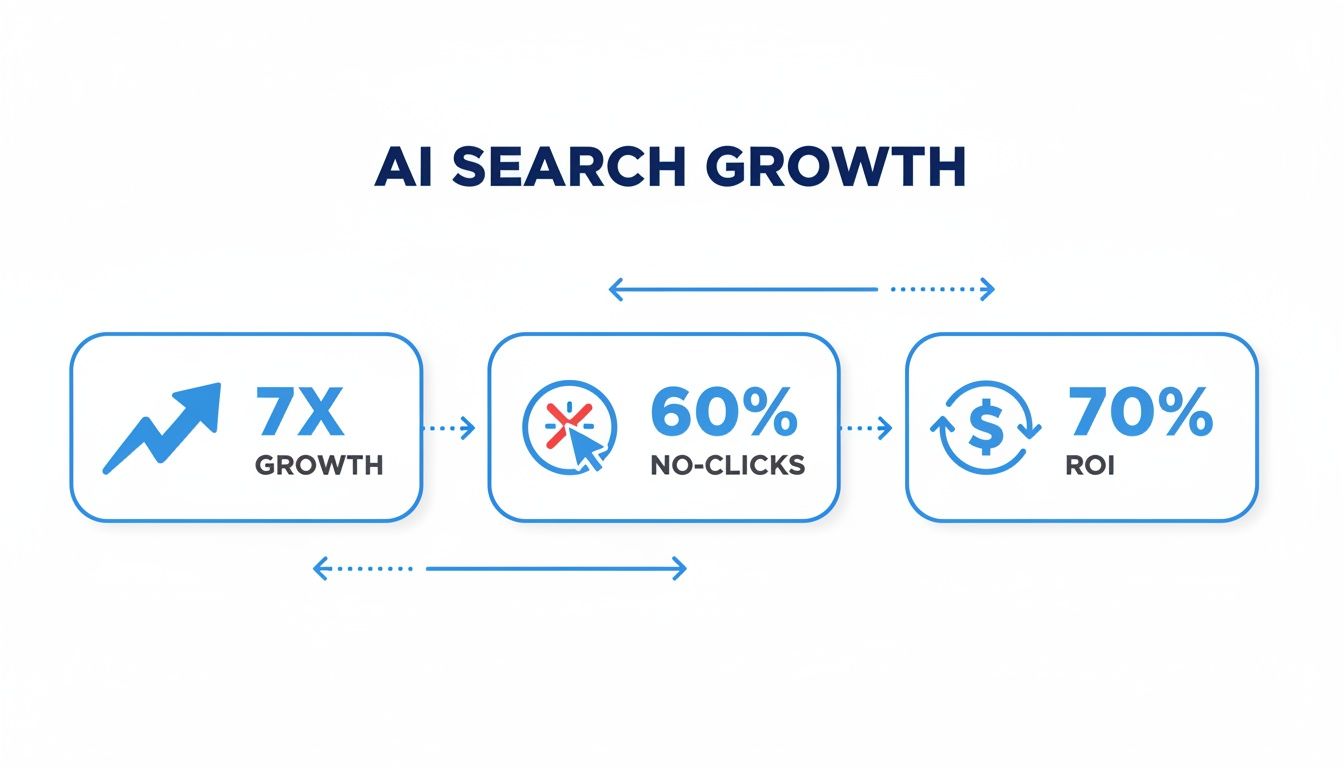
The data shows that AI search creates a world where most sessions end without a click. This reinforces why optimizing for citations is non-negotiable. To get ahead of this trend, learn more about how to rank in AI Overviews in our article.
The table below breaks down the core differences.
Key Differences Between Traditional SEO and AI Search Optimization
| Factor | Traditional SEO | AI Search Optimization (AEO) |
|---|---|---|
| Primary Goal | Rank high in a list of blue links to drive clicks and traffic. | Become a citable source within AI-generated answers. |
| Key Metric | Organic traffic, click-through rate (CTR), keyword rankings. | Citations, brand mentions, visibility within AI answers. |
| Content Focus | Targeting short-tail and long-tail keywords. | Answering specific, conversational user questions directly. |
| Source of Truth | Your website page. | The synthesized AI answer, which may cite your page. |
| User Journey | User sees SERP -> clicks link -> visits website. | User asks question -> gets direct answer -> may or may not visit a source. |
| Core Principle | Gaining visibility in a ranked list. | Building trust and authority with AI models. |
While some principles overlap, the mindset and metrics for success have fundamentally changed.
What is the difference between AEO and SEO?
SEO (Search Engine Optimization) is about ranking your website in a traditional list of blue links. AEO (Answer Engine Optimization) is about making your content the direct source for AI-generated answers. The goal shifts from clicks to citations.
Do I still need to care about keywords?
Yes, but differently. Prioritize the long-tail, conversational questions your audience is likely to ask an AI. The goal is to match their exact query with a clear, direct answer in your content.
Why are clicks less important in AI search?
Clicks are less important because AI provides direct answers in the interface. This often eliminates the user’s need to visit another website. Success is measured by how often your content is used as a source, not by clicks.
How AI Models Find and Use Your Content
To win at AI optimization, you must understand how these models “think.” Large Language Models (LLMs) evaluate your content’s potential to deliver a trustworthy, direct answer. They don’t just “crawl” your site; they parse it.
AI models break your content into smaller, structured chunks to assess authority and relevance. These pieces are then stitched together into a coherent response, often pulling from multiple websites at once.
The New Rules of AI Visibility
The way AI systems find and cite content demands a total strategy rethink. We’re moving from ranked lists to synthesized answers that compress multiple sources into one.
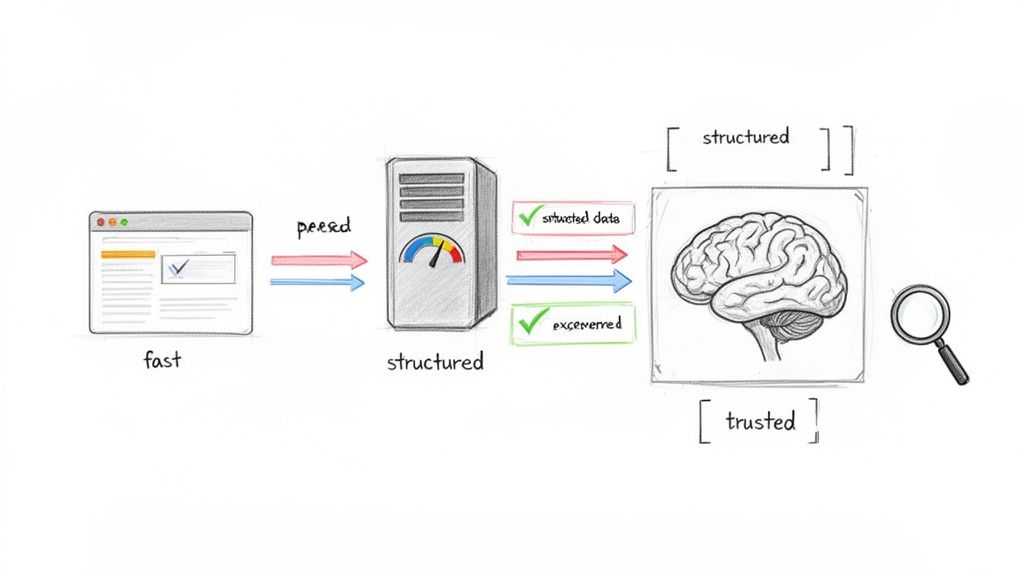
This brings a new vocabulary. Retrieval windows replace crawl budgets, and a selection rate replaces PageRank. For an AI to consider your content, site speed is make-or-break.
Sites with server response times under 200 milliseconds see a huge performance boost. Those loading in under 1 second get three times more requests from LLM crawlers like GPTBot. You can read the full research about these new AI search factors on growth-memo.com.
Technical Performance Is Now Table Stakes
Technical SEO is a non-negotiable entry fee for AI search. LLM crawlers are biased toward fast, technically sound websites because they can process information more efficiently. A slow server response time can get your content booted from consideration.
Data shows that a staggering 96.45% of URLs in AI Overviews return a proper HTTP 200 status code. Your site needs to be technically flawless and easy to access. Any friction is a dealbreaker.
If an AI crawler struggles to access your content, it won’t try again—it will simply move on to a faster, more reliable source. Technical excellence is the new entry fee for AI visibility.
Ensuring your site is fast and error-free is one of the most direct ways to boost your chances. For more specific actions, check out our guide on 10 technical SEO tips for AI search.
Why Structure and Clarity Matter More Than Keywords
Keywords still matter, but AI models are more interested in structured data and clear language. An AI isn’t just matching words; it’s grasping meaning and context. Formatting is one of your most powerful optimization tools.
Think about what an AI is looking for:
- Direct Answers: Question-and-answer formats are a goldmine for AI.
- Logical Hierarchy: Proper use of H2s and H3s acts like a table of contents.
- Scannable Formats: Bullet points, lists, and tables break down complex ideas.
This structural clarity helps AI models quickly pinpoint and lift key information. A wall of text, no matter how well-written, is far less likely to be used as a source. Make it easy for a machine to read and understand you.
FAQ: How AI Finds Content
How do AI models decide which content to trust? AI models use signals like E-E-A-T, citations from other reputable sources, and a site’s technical performance. A fast, well-structured site with verifiable claims has a much better shot at being trusted.
What is a retrieval window? A retrieval window is how an AI gathers relevant information from its index to answer a prompt. It is a real-time process designed to find the best “chunks” of content to build an immediate answer.
Why is page speed so important for AI search? Speed is crucial because AI models must process enormous amounts of information quickly. Slow pages create processing bottlenecks, causing AI crawlers to favor faster, more reliable websites.
Crafting Content for AI Consumption
To get your content picked up by AI, stop writing articles and start engineering answers. AI models don’t read from top to bottom; they slice content into logical pieces. They weigh each one for relevance and stitch them together to answer a prompt.
Your job is to make that process ridiculously easy for the machine. Build your content around questions, use clean formatting, and leverage structured data. This is how you become a trusted source for AI.
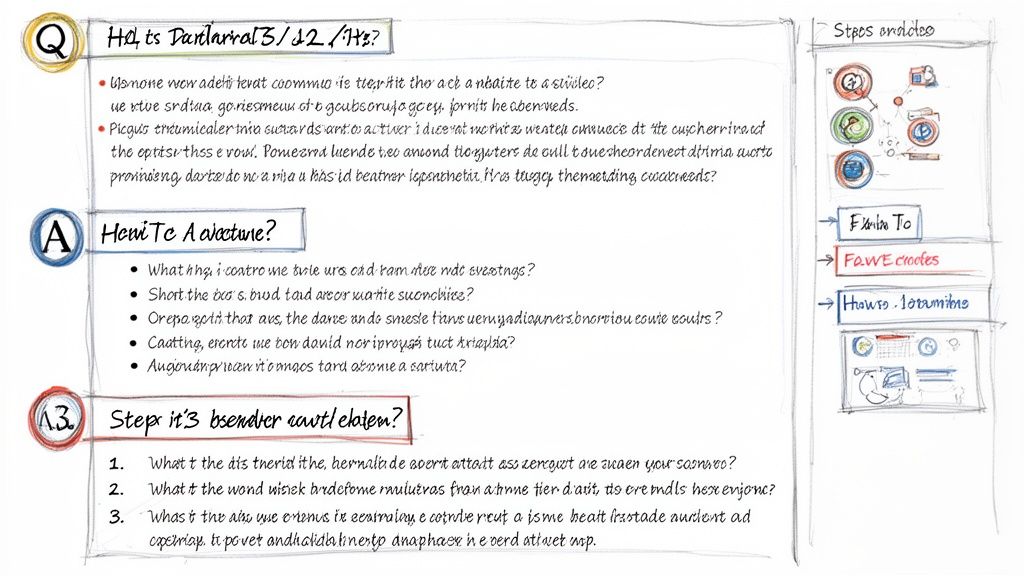
This sketch nails the concept perfectly. You’re building a modular outline that helps both people and AI find direct answers, fast.
Adopt a Question-First Content Structure
The most effective way to optimize for AI is to structure your content around questions. Treat your headings (H2s and H3s) as the questions. Treat the paragraphs immediately following them as direct, self-contained answers.
This approach mirrors the conversational way people use AI. They ask full questions like, “What’s the best project management tool for a remote team under $50?” An article with a section labeled “Best Tools for Budget-Conscious Remote Teams” has a massive advantage.
Your headings are no longer just organizational tools for human readers. They are direct signals to an AI, telling it exactly what question a specific chunk of text is built to answer.
To master this, you need to understand the mechanics of LLM SEO. It’s all about creating content that aligns with how language models process information.
Make Your Content Scannable with Smart Formatting
AI models behave like human skimmers—they love content that’s easy to parse. Long, dense paragraphs create friction. Strategic formatting is your best friend.
Use these elements to create clean, machine-readable blocks of information:
- Bulleted and Numbered Lists: Perfect for highlighting features, steps, or benefits.
- Tables: Ideal for direct comparisons of products or pricing plans.
- Blockquotes: Use these to pull out key takeaways, stats, or expert quotes.
Prioritizing this structured content makes it 40% more likely to be cited by an AI. The goal is to remove all guesswork and present information in its most direct form. For a deeper dive, check out our guide to Answer Engine Optimization.
Implement Structured Data with Schema Markup
While formatting helps an AI guess content meaning, structured data tells it explicitly. Schema markup is code that labels your information. It turns text into organized data that machines can understand without interpretation.
This is a non-negotiable step. Think of it as giving the AI a detailed map of your page. It eliminates ambiguity and boosts the AI’s confidence in using your information.
These schema types are especially powerful for AI optimization:
- FAQPage Schema: Directly flags your question-and-answer sections for AI responses.
- HowTo Schema: Breaks down instructions into a clean, step-by-step format.
- Product Schema: Provides structured details like price, availability, and reviews.
Structured data helps search engines understand the purpose of a page, removing any doubt. It’s the ultimate way to provide clear context that an AI can trust.
Building Authority Beyond Your Website
To get noticed by AI, think bigger than your own domain. On-site content is one piece of the puzzle. AI models learn from the entire web, so off-site signals tell them you’re a trustworthy source.
The goal is to establish your brand as a recognized expert across the web. Show up where the real conversations in your niche are already happening. AI learns from the dynamic, human discussions on forums, social media, and Q&A platforms.
Target Influential Online Communities
Identify where important discussions happen on platforms like Reddit and Quora. These are modern-day watering holes where AI models learn about sentiment and expertise. Strategic participation can directly influence future AI-generated answers.
Here’s a look at a typical Reddit discussion—the kind of content AI models analyze for authentic opinions.
Jumping into threads with genuinely helpful, non-promotional answers creates new data points. These connect your brand with valuable insights.
Your participation must be authentic. Dropping a link and running won’t work. A thoughtful comment that solves a problem, however, can be picked up as an authoritative source. Find influential communities using AI search visibility tools.
Turn Mentions into Authority Signals
Focus on getting your brand, products, and experts cited in authoritative third-party content. Every mention creates another data point that reinforces your expertise to AI models. It’s about building a web of trust signals that all point back to you.
Think of each external mention as a vote of confidence. When a reputable industry blog links to your research, it tells AI you’re a credible source. These signals often carry more weight because they provide independent validation.
In the world of AI search, you are who the internet says you are. Third-party validation from trusted sources is one of the strongest signals of authority you can build.
While AI search brings new tactics, many foundational principles are still critical. Integrating solid SEO best practices ensures your content is discoverable and authoritative.
High-Impact Platforms for Off-Site AI Optimization
Certain platforms carry more weight when influencing AI models. Focus your efforts where they’ll have the most impact.
The table below breaks down key platforms and actions.
High-Impact Platforms for Off-Site AI Optimization
| Platform | Primary Value for AI | Key Action |
|---|---|---|
| Sourcing real-world user sentiment and niche expertise. | Answer questions genuinely in relevant subreddits. | |
| Quora | Providing direct answers to specific user questions. | Create a detailed profile and provide expert answers. |
| Industry Forums | Understanding deep, technical expertise and community consensus. | Become a recognized and helpful member of the community. |
| Authoritative Blogs | Gathering validated information from trusted publishers. | Contribute guest posts or earn natural mentions and links. |
| Wikipedia | Sourcing foundational, factual information. | Ensure your brand’s page is accurate and well-sourced. |
By actively engaging on these platforms, you aren’t just reaching a human audience. You’re shaping the training data that future AI models will use.
FAQ: Building Authority Off-Site
Why do off-site signals matter so much for AI search? AI models synthesize information from the entire web to determine what’s trustworthy. Mentions and discussions on third-party sites provide the external validation an AI needs before it will trust your content.
What’s the difference between a backlink and an AI citation? A backlink is a hyperlink used for navigation and passing authority in traditional SEO. An AI citation is when an AI model mentions your brand or content in its answer, which may or may not include a link.
How can I find relevant discussions to join? Set up keyword alerts on platforms like Reddit or use specialized monitoring tools. Search for your core topics, brand name, and competitor names to find active conversations where you can provide value.
How to Measure Your AI Search Strategy
How do you know if your AI search optimization is working? Forget traditional SEO metrics. Keyword rankings and organic traffic no longer tell the whole story.
The game has changed. Instead of asking, “How high did my page rank?” you must ask, “Did my content become part of the answer?” Success is about directly influencing the information AI serves up.
It’s Time to Look Beyond Clicks and Rankings
This shift from ranked links to AI answers is massive. As of 2025, AI-written content shows up in over 17% of Google’s top search results. That’s a huge leap from just 2.27% in 2019.
This is critical because even when your content is cited, it doesn’t guarantee a website visit. Google’s AI Overviews can slash clicks by as much as 34.5%. Your measurement must embrace this “zero-click” world by valuing the citation itself.
The New KPIs for the AI Search Era
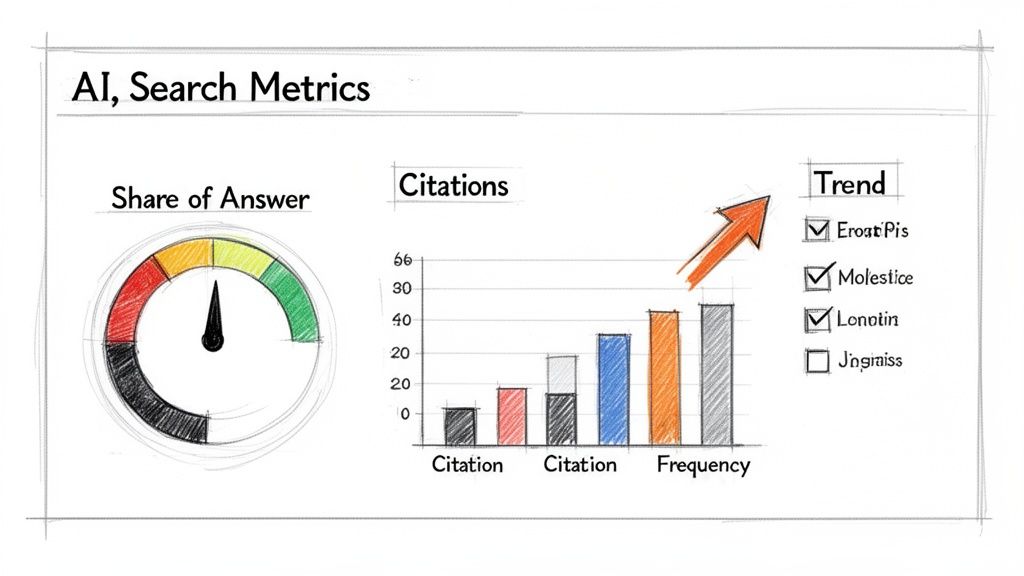
To track progress, you need a new dashboard of KPIs. These should measure your influence and authority inside the AI ecosystem.
Here are the core metrics you should start tracking:
- Share of Answer: Measures the percentage of AI-generated answers for your target prompts that cite your brand.
- Citation Frequency: How many times is your content used as a source across different AI platforms?
- Source Diversity: Are AI models referencing your product pages, documentation, and case studies?
- Branded Search Volume Lift: A successful strategy often leads to more people searching directly for your brand.
Monitoring these numbers gives you a clear picture of how well your content is performing.
Build a Data-Driven Feedback Loop
Tracking these new KPIs creates a powerful feedback loop to steer your content strategy. Use tools that monitor your brand’s visibility in AI answers. This is how you benchmark against competitors and find your edge.
For instance, you might see that your step-by-step guides are cited more often than thought leadership pieces. That’s gold. It tells you exactly what kind of content AI models prefer from you.
The goal is to move from guessing what AI wants to knowing what it uses. A data-driven approach lets you systematically refine your content to increase your influence and become the default answer in your niche.
This cycle of measuring, analyzing, and refining is the key to winning. For more, check out our guide on search marketing intelligence.
FAQ: Measuring AI Search Success
What is “Share of Answer” and why does it matter? Share of Answer shows how often your brand is cited in AI-generated responses for specific prompts. It’s the most direct way to measure your influence in a world where clicks are less important.
How do I track citations if they don’t always link to my site? You’ll need specialized tools built for AI search analytics. These platforms monitor AI answers and can spot brand mentions and source citations even without a direct link.
Should I stop tracking traditional SEO metrics like traffic and rankings? No, just see them in a new light. Organic traffic and rankings still have value, but they’re no longer the whole picture. Analyze them alongside AI-specific metrics for a complete view of your performance.
Still Have Questions About AI Search?
As you shift your strategy, questions are bound to pop up. Moving from classic SEO to AI optimization means new tactics and a new end goal. Here are the most common questions.
What’s the Real Difference Between AEO and SEO?
The core difference is the finish line.
Traditional SEO (Search Engine Optimization) is a race to the top of a list of blue links. The prize is clicks and organic traffic.
AEO (Answer Engine Optimization) is about becoming the direct, citable source for an AI-generated answer. Success is measured by how often systems like ChatGPT use your content. The goal is to be the answer.
How Long Until I See AEO Results?
It can be shockingly fast—much faster than traditional SEO. While climbing ranks for a keyword can take months, you can influence an AI answer almost overnight. If your content perfectly nails a prompt, it can get cited right away.
But that speed is for individual wins. Building the authority to be a consistent source is a long-term game. That comes from creating high-quality, well-structured content repeatedly.
You might see quick wins on specific prompts, but sustainable success in AI search is a marathon, not a sprint. It relies on building deep, verifiable authority in your niche.
Should I Still Care About Keywords?
Absolutely, but change how you think about them.
The focus is shifting from short keywords to long-tail, conversational questions. These are the queries people are more likely to ask an AI.
Your research process should now be about finding these exact questions. The goal is to create content that perfectly matches a user’s prompt with a direct answer. Think less “keyword density” and more “prompt alignment.”
How Do AI Models Deal With Conflicting Information?
AI models are designed to find a consensus. They look at multiple sources and weigh the authority of each when they find conflicting facts. A claim from a respected industry site will almost always win out.
This is why building your site’s E-E-A-T is so important.
To win when there’s conflicting information, ensure your claims are verifiable and backed by data. The stronger your authority signals, the more likely an AI is to trust your version of the facts.
Ready to stop guessing and start measuring your AI search performance? Airefs is the platform that shows you exactly how you appear in AI-generated answers. Track your share of voice, discover what sources AI trusts, and find actionable opportunities to become the default answer in your industry. See how it works at https://getairefs.com.
FAQ: Optimizing Content for AI Search
1. What is the single most important change I should make for AI search? Structure your content using a question-and-answer format. Use H2s and H3s for the questions and provide direct, concise answers in the following paragraph. This makes it incredibly easy for AI to parse and cite your information.
2. Does AI search optimization replace traditional SEO? No, it builds on it. Foundational SEO practices like technical performance, site speed, and building authority are more critical than ever for AI. Think of AI optimization as the next layer of your SEO strategy, not a replacement.
3. How can I find the right “conversational questions” to target? Use tools that analyze “People Also Ask” sections, Reddit, and Quora. Look for the full-sentence questions your audience is asking. These are the exact prompts you should build your content around.
4. Is it better to create new content for AI or update existing articles? Start by updating your existing high-performing articles. Reformat them with clear headings, lists, and structured data to make them AI-friendly. This is often the fastest way to see initial results before creating entirely new content.