

If you want to show up in Google’s AI Overviews, you need a different game plan. It’s all about creating content that’s so clear, factual, and well-structured that the AI has to use it as a source.
This means dialing up your E-E-A-T (demonstrable expertise), getting smart with structured data like schema markup, and building real authority—not just on your own site, but across places like Reddit where real people talk. The mission is simple: be the most reliable, easy-to-digest answer out there.
The New Search Landscape of AI Overviews
Google AI Overviews (AIO) are no longer some side experiment. They’ve fundamentally changed how people find information online, and for modern marketers—especially in crowded spaces like B2B SaaS—getting cited in these summaries is quickly becoming a must-win battle.
Think of AIOs as a new, powerful layer sitting between your brand and your audience. They pull info from multiple sources to give people answers directly on the search results page. That comfortable old list of blue links? It’s no longer the finish line.
Understanding the Impact on Search Behavior
The scale of this shift is hard to overstate. As of May 2024, Google began rolling out AI Overviews to all U.S. users, with a goal of reaching over a billion users by the end of the year (Source: Google I/O 2024).
And it’s not just for obscure queries. Data from industry giants like Semrush and SE Ranking shows that AIOs appear in roughly 13% of global searches. In the U.S., they show up for about 16% of all desktop keywords, based on a massive index of 156 million search terms. If you want to dive deeper, you can read more about the extensive reach of Google’s AI Overviews and see the full research.
This isn’t just a new feature; it’s changing how people behave. Instead of clicking through a bunch of links to stitch together an answer, users get an instant summary. Being visible at this new “top of the funnel” is everything.
Take a query like “best CRM for small business.” The AI Overview won’t just point to one review site. It’ll synthesize features, pricing details, and user opinions from several trusted sources into one neat, concise answer.
Here’s a real-world example of what an AIO looks like for a typical B2B software search.
See how the AI cites its sources with clickable links? That’s your new goal. Those citations create a powerful new stream of referral traffic, and this guide is your playbook for earning them.
AIO vs. Traditional SEO: A Quick Comparison
While the fundamentals of good SEO still matter, optimizing for AI requires a different mindset. The strategic focus has definitely shifted.
Here’s a look at how things have changed.
AIO vs Traditional SEO Key Differences
| Factor | Traditional SEO Focus | AI Overview Optimization (AEO) Focus |
|---|---|---|
| Content Goal | Attract clicks with catchy headlines and meta descriptions. | Provide direct, factual, and easily citable answers right in the content. |
| Authority Signal | Primarily backlinks and domain authority. | Demonstrable expertise (E-E-A-T), verifiable facts, and community validation. |
| Technical Element | On-page optimization, site speed, and mobile-friendliness. | Heavy emphasis on structured data (Schema), semantic HTML, and absolute clarity for AI parsing. |
The game has moved from just ranking for keywords to becoming a citable source of truth for specific questions. That’s the core of AEO.
Key Takeaway: Success in this new environment means shifting from simply ranking for keywords to becoming a citable source of truth for specific questions. This guide is your tactical roadmap to achieving that goal.
Cracking the Code on How AI Overviews Pick Sources
To get cited in Google’s AI Overviews, you have to stop thinking like a traditional SEO and start thinking like the AI. At its core, Google is trying to find and stitch together the most helpful, reliable, and clear information it can find. This isn’t about gaming an algorithm; it’s about making your content the undeniable authority on a subject.
The whole process is built on the same principles that have driven search for years, but now there’s an AI layer on top. The model isn’t just scanning for keywords. It’s truly evaluating the substance of your content through the lens of E-E-A-T—Experience, Expertise, Authoritativeness, and Trustworthiness.
Why E-E-A-T and People-First Content Are Everything
Helpful, people-first content is your ticket to the game. It’s the foundation. In fact, a study by Authoritas found that online brand mentions had the strongest correlation to getting cited by AI—even stronger than many classic SEO signals. What this means is your reputation across the entire web is now a direct ranking factor for AIO.
Google’s AI is being trained to spot and prioritize content that shows you actually know what you’re talking about from real-world experience.
- Firsthand Experience: Are you including unique insights, case studies, or personal stories? AI models are getting smarter every day at sniffing out generic, rehashed content.
- Unique Data & Research: If you publish original research, surveys, or data analysis, you become a primary source. That’s pure gold for an AI trying to synthesize information.
- Clear, Factual Language: The AI favors a straightforward, almost neutral tone. Cut the marketing fluff and vague statements. The goal is clarity, not just persuasion.
Think about it this way: If a human expert was digging into a topic, they’d look for primary sources, firsthand accounts, and respected authors. Google’s AI is just trying to do that same thing, but at a massive scale.
Understanding some Natural Language Processing (NLP) basics is a huge advantage here. NLP is the engine that lets the AI actually comprehend and weigh the quality of content across the web.
Reverse-Engineer Existing Overviews to Find What Works
One of the most powerful things you can do is analyze the AI Overviews that already exist for your target queries. Don’t just read the summary—click through and dissect the sources it cites. This reverse-engineering process gives you a direct peek into the kind of content and domains Google’s AI already trusts for a specific topic.
When you look at the cited sources, ask yourself:
- How is their content structured? Are they using a lot of subheadings, bullet points, or data tables?
- What’s their tone like? Is it super technical, conversational, or more journalistic?
- What evidence are they using? Are they leaning on original data, quotes from experts, or customer reviews?
This analysis is your blueprint. If you see the AI consistently pulling from pages with detailed FAQ sections, that’s a clear signal to build out your own. If it loves content with original statistics, it’s time to invest in creating some.
You can even take this a step further with technical analysis, like digging into your server logs to see how AI crawlers are interacting with your site. If you want to go deeper on that, our guide on AEO log file analysis is a great place to start.
Don’t Sleep on Forums and Community Content
We’re also seeing a huge shift toward community-driven content. Google’s “Perspectives” filter is proof of this, often highlighting discussions from platforms like Reddit and Quora. In fact, a partnership between Google and Reddit announced in early 2024 gives Google access to Reddit’s content to train its AI models, making these platforms even more critical (Source: Reuters).
These forums are absolute goldmines of authentic, experience-based content. When a real person shares a real problem and gets a real solution from another user, that creates a powerful E-E-A-T signal. AI Overviews are tapping into these conversations more and more to provide nuanced answers that a standard corporate blog post could never capture.
This means building a presence and sharing your expertise on these platforms isn’t just a community management chore anymore—it’s a critical part of getting your brand cited in AI Overviews.
Optimizing Content for AI Citation
If you want your content to get cited in AI Overviews, you have to stop writing fluffy marketing copy. It’s time for a fundamental shift toward clarity, structure, and giving the AI explicit context.
The goal is to make your content so ridiculously easy for a machine to parse and verify that it becomes the most logical source to pull from. Think of it this way: AI models are trained to sniff out and ignore promotional language. Your job is to present information that’s undeniably helpful and dead simple to understand.
By optimizing your content, you’re essentially making it machine-readable, which is a huge part of learning how to rank in Google AI Overviews.
This diagram breaks down the process of how AI finds, analyzes, and cites content.
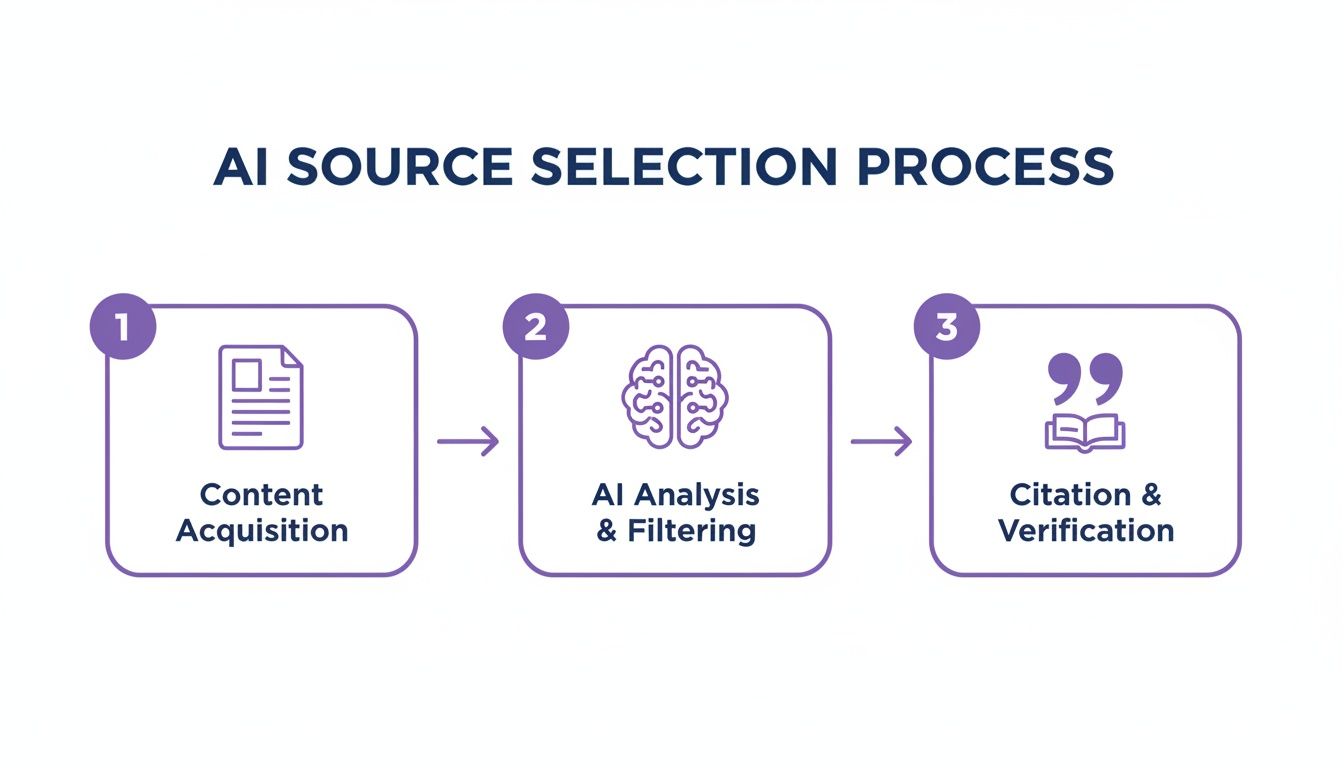
As you can see, becoming a citable source starts with creating well-structured content that an AI can easily process and trust.
Crafting Content with a Clear, Factual Tone
First things first: adopt a neutral, factual writing style. Vague claims and over-the-top superlatives are red flags for AI systems. Instead, ground everything in verifiable facts, data, and direct answers.
A study from Onely found that content written in a neutral, journalistic tone was 45% more likely to be cited in AI Overviews than content with a heavy marketing slant. Your content needs to deliver the kind of certainty the AI is looking for.
- Prioritize Direct Answers: Don’t bury the lede. Start sections with a direct answer to a user’s likely question before you elaborate.
- Use Simple Language: Aim for a 6th to 8th-grade reading level. Complex jargon is a liability unless you define it clearly.
- Avoid Ambiguity: Ditch phrases like “might be helpful.” Replace them with assertive statements like “this process improves efficiency by…”
This approach doesn’t just appease the AI; it makes your content more scannable and valuable for your human readers, too.
Strategic Formatting for Machine Readability
How you structure your content is just as important as what you write. AI models rely on semantic HTML and clean formatting to figure out the hierarchy of information on a page.
Think of headings (H2s, H3s), lists, and bolding as signposts for the machine.
Expert Insight: Treat your article’s structure like a logical outline. If an AI can’t quickly grasp the main points from your headings and lists, it’s going to move on to a source that’s easier to digest.
For example, don’t write a long, dense paragraph explaining a process—break it into a numbered list. Don’t cram a bunch of features into one sentence—use bullet points. This granular structure makes individual facts and steps easily extractable for an AI summary.
You can learn more about how these on-page factors fit into a bigger strategy in our guide to AI search engine optimization.
Unlocking Citation Potential with Structured Data
Structured data, especially Schema markup, is your secret weapon for giving Google explicit context about your content. It’s like adding a layer of descriptive labels that search engines can read, eliminating any guesswork.
While there are hundreds of schema types, a few are particularly powerful for AI Overviews:
- FAQPage Schema: Use this to mark up questions and answers. It’s a direct signal to Google that you’re answering common queries, making it a prime target for AI citations.
- HowTo Schema: Perfect for step-by-step guides. This schema breaks down a process into a clear sequence that an AI can easily follow and present in its answer.
- Product Schema: For product pages, this provides structured data on price, availability, and reviews—all things that often get pulled into commercial AI Overviews.
Implementing the right schema is a game-changer. You’re no longer just hoping the AI understands your page; you’re explicitly telling it what your page is about and how the information is organized.
Building Authority Beyond Your Website
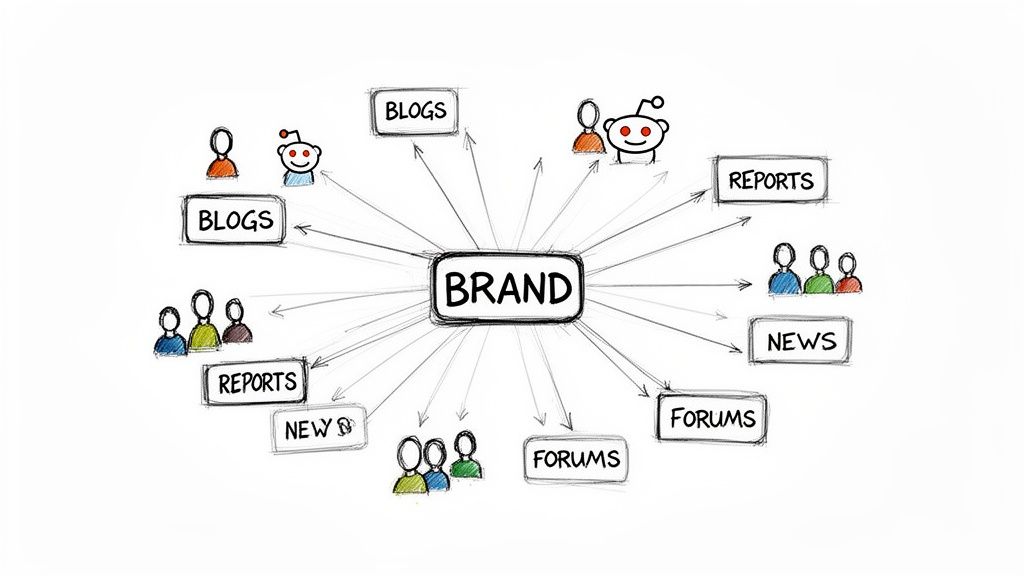
Google’s AI doesn’t see your website in a vacuum. It scours the entire web to understand your brand’s reputation, treating every mention, discussion, and citation on other platforms as a powerful vote of confidence. If you want to show up in AI Overviews consistently, you have to build authority far beyond your own domain.
This goes a step beyond traditional link building. We’re talking about citation building. The aim is to get your brand, your data, and your unique point of view mentioned on other authoritative sites—even when there’s no direct hyperlink back to your website.
In fact, recent analysis by Authoritas shows that online brand mentions have one of the strongest correlations with being cited by AI. That’s a huge signal that your digital footprint is more important than ever.
Embracing Off-Site Citation and Brand Mentions
Think of it this way: every time your brand gets name-dropped on a respected industry blog, news outlet, or forum, it’s another dot connected for the AI. These models are designed to find patterns. When they repeatedly see your company discussed in the context of “B2B analytics,” they start to recognize you as an authority on the topic.
This is where a solid grasp of online reputation management becomes critical. It’s not a passive activity. You have to proactively shape the conversations happening about your brand online, making sure that when AI models search for trusted sources, your name is part of the expert consensus.
This is a fundamental piece of learning how to rank in Google AI Overviews. It’s not just about what you publish, but what others say about you.
Tapping Into Community Platforms like Reddit
Don’t sleep on community platforms, especially Reddit. They’ve become incredibly influential sources for Google’s AI. There’s a reason the “Perspectives” filter pulls so heavily from these real-world conversations, and AI Overviews are doing the same. These platforms are overflowing with firsthand experience—the “E” in E-E-A-T.
But you have to engage authentically. This isn’t about spamming links. It’s about systematically finding relevant subreddits where people are asking questions your brand can genuinely answer. You need to show up as a helpful expert, not a marketer pushing a product.
For example, a CFO from a SaaS company could drop an incredibly insightful comment in r/smallbusiness about managing cash flow, mentioning their company’s philosophy without a hard sell. That single comment builds topical authority and creates an expert footprint right where Google’s AI is looking.
Here’s how a tool like Airefs can pinpoint those exact, high-value Reddit threads for you to jump into.
When you start identifying these opportunities, you can join conversations that directly shape how AI perceives your brand’s expertise.
Authentic participation in relevant online communities is no longer a “nice to have” for brand building. It is a direct and measurable tactic for influencing AI-generated answers and getting cited in AI Overviews.
Building off-site authority takes a systematic approach. You need a process for tracking brand mentions and spotting new places to engage. For a full breakdown, check out our guide on how to monitor your brand visibility in LLMs.
On-Site vs Off-Site AEO Tactics
To win with AI Overviews, you need a two-pronged attack: optimizing your own content (on-site) while building your reputation across the web (off-site). Here’s a quick breakdown of how they work together.
| Tactic Type | Primary Goal | Examples |
|---|---|---|
| On-Site AEO | Make your content easy for AI to parse and trust. | Structured data (Schema), clear H2/H3 structure, factual tone, direct answers. |
| Off-Site AEO | Build brand authority and E-E-A-T signals across the web. | Answering questions on Reddit/Quora, getting brand mentions, guest appearances on podcasts. |
Both sides of this coin are essential. Your perfectly structured content won’t get cited if the AI doesn’t see your brand as a trusted authority across the wider internet.
Measuring and Refining Your AEO Strategy
You can’t improve what you don’t measure. Optimizing for AI Overviews can feel like shouting into a black box, but a methodical approach brings some much-needed clarity. If you want to figure out how to rank in Google AI Overviews, you need a solid framework for tracking what’s working and what isn’t.
The old world of SEO was simple: track a list of keywords and watch your little blue link climb up or down. That model is officially dead. The new reality is that visibility isn’t just about a single rank; it’s about how often you’re cited inside an AI-generated answer.
This requires a fundamental shift from keyword tracking to prompt tracking.
Introducing Prompt Tracking
Instead of just watching keywords, prompt tracking means monitoring a curated set of high-intent questions—the exact kinds of things your ideal customers ask when they’re researching solutions. The goal is to see how often your brand gets cited in the AI Overviews for those specific prompts.
This is a far more direct way to measure your actual influence. You’re not just tracking a position on a list; you’re tracking your share of voice within the answer itself.
This shift is critical because AI Overviews are already changing user behavior. Analysis from Gartner predicts that by 2026, search engine volume will drop by 25% as users turn to AI chatbots and other generative AI tools. Furthermore, many publishers are reporting initial traffic drops of 20–40% for affected queries since the AIO rollout (Source: various publisher reports compiled by Search Engine Land). This is all happening while 58% of all Google searches already end without a single click, a trend largely driven by answers appearing directly on the results page (Source: SparkToro).
Key Takeaway: Traditional rank tracking is a lagging indicator in the AEO world. Prompt tracking, which measures your citation frequency for specific user questions, is the new standard for understanding your visibility and influence in AI-generated search results.
Key Metrics to Monitor in Your AEO Dashboard
Once you start tracking prompts, you need to focus on a new set of metrics. These go beyond simple rankings and give you a real feel for your performance.
- Citation Frequency: What percentage of the time does your brand get cited when a specific prompt is run? This is your core visibility metric.
- Share of Voice: Of all the brands mentioned for a set of prompts, what percentage of those citations do you own? This is how you measure up against the competition.
- Competitor Visibility: Which competitors are getting cited for your target prompts? Tracking this helps you see who the AI currently trusts and what kind of content is resonating.
- Source Analysis: What specific URLs (yours and your competitors’) are being used as sources? This tells you which content assets are actually hitting the mark.
Monitoring these metrics requires a different kind of tool. A standard keyword tracker can tell you if you rank #3, but you need a specialized platform to track citations inside dynamic AI answers. For larger operations, using dedicated enterprise rank tracking software built for this new reality isn’t just nice to have—it’s essential.
A Practical Testing and Iteration Workflow
Measurement is only useful if it leads to action. The key is to create a continuous feedback loop to refine your strategy and steadily increase how often you’re cited.
Here’s a simple but powerful workflow to follow:
- Identify a Target Prompt: Start with a high-value question your ideal customer would ask. Something like, “what are the best alternatives to Salesforce for a startup?”
- Analyze the Current Sources: Run the prompt and dig into the AI Overview. Click every single source it cites. Look at their content structure, tone, and the specific facts or data points that are being pulled.
- Optimize Your Content: Armed with that intel, go update or create a piece of content on your own site. If the AI cited a competitor’s pricing comparison table, your job is to build one that’s more comprehensive and easier to read. If it pulled a statistic, find a more recent one and present it with better context.
- Monitor the Results: After you publish your optimized content, add the prompt to your tracking system. Watch it over the next few weeks. Did your new content get picked up as a source? How did it affect your citation frequency?
This iterative process—identify, analyze, optimize, and monitor—turns AEO from a guessing game into a methodical path to improvement. Each cycle gives you valuable data on what the AI values, letting you sharpen your content strategy over time.
Frequently Asked Questions About AI Overviews
Here are answers to some of the most common questions about ranking in Google’s AI Overviews.
Does Traditional SEO Still Matter for AI Overviews?
Absolutely. In fact, foundational SEO is the price of admission. AI models lean heavily on established authority signals—things like high-quality backlinks, solid technical site health, and mobile-friendliness—to figure out which sources are trustworthy enough to cite in the first place. Think of it this way: traditional SEO gets you on the shortlist. AI Overview Optimization (AEO) is what gets your name called from that list. The two work hand-in-hand. To really dig in, check out these 10 technical SEO tips for AI search that bridge the gap between both worlds.
How Long Does It Take to Get Cited in an AI Overview?
There’s no magic number here. Unlike traditional rankings that can take weeks or months to shift, getting cited in an AIO can happen surprisingly fast if your content is the perfect fit for a specific query. That said, building the underlying authority needed for consistent citations is a long-term game. A single, perfectly optimized page might get picked up within days, but becoming the go-to source for an entire topic will take months of consistent, focused effort.
Is It Better to Create New Content or Update Old Content?
Always start by updating what you already have. Your older, established pages likely have some authority and backlinks baked in. Optimizing them with clearer language, fresh stats, and structured data is often the fastest way to get cited. A study by ZipTie found that 63% of businesses have already reported a positive impact from AI Overviews since their full rollout, suggesting that optimizing current assets is a powerful way to tap into existing authority for quick wins. Once you’ve shored up your core pages, then you can start creating new content to fill gaps in your topic clusters and answer those specific, long-tail questions that AI Overviews love.
Can I Be Cited Without a Direct Link?
Yes, and it happens all the time. AI models often pull information from multiple sources to synthesize an answer, and they might mention your brand or data without a clickable link. While a link is obviously great for traffic, don’t discount the power of an unlinked mention—it’s still a huge signal of brand authority. These mentions contribute to your overall digital footprint and reinforce to the AI that your brand is a relevant, trusted entity in your niche.
What is the biggest mistake to avoid when optimizing for AIO?
The biggest mistake is writing for the AI instead of for people. Don’t stuff your content with awkward phrasing just because you think a machine will like it. The core principle of “helpful, people-first content” is more important than ever. AI models are trained to recognize and reward content that is clear, genuinely useful, and demonstrates real expertise. Focus on creating the best possible answer for a human, and the AI will follow.
How do I track my visibility in AI Overviews?
Traditional rank trackers are not built for this. You need to shift from “keyword tracking” to “prompt tracking” using specialized tools. These platforms monitor specific questions (prompts), track how often your brand is cited within the AI-generated answers, and measure your share of voice against competitors. This is the only way to get a true measure of your performance in the new search landscape.
Ready to stop guessing and start measuring your impact on AI search? Airefs is the action platform designed to help you track your visibility in AI Overviews, analyze the sources driving answers, and uncover the exact content and community opportunities you need to influence them. See how often you’re cited, benchmark against competitors, and turn AI into a predictable demand channel. Discover how Airefs can help you shape the conversation.