
To show up in ChatGPT searches, your brand must become a trusted source for the AI. This means influencing conversations on platforms like Reddit and Quora. The goal is to make your brand the most cited and recommended answer.
The game is no longer about winning clicks. It’s about shaping the AI’s knowledge base.
The Shift From Clicks to AI Conversations
For years, SEO was simple: rank for keywords, get clicks, and drive traffic. Traffic was the center of the marketing universe. This model is changing.
AI answer engines like ChatGPT are the new digital front door. Visibility now means being the brand cited inside the AI’s direct answer. The goal is to be mentioned and recommended within the conversation itself.
This shift makes website clicks a secondary metric. Success is measured by your influence on the AI’s core knowledge. Becoming the trusted, default solution is the new north star.
Introducing Answer Engine Optimization
This new world demands a new playbook: Answer Engine Optimization (AEO). AEO is the practice of making your brand easy for large language models to find, understand, and trust. You can learn more in our guide to AI search engine optimization.
AEO differs from traditional SEO. It focuses on source authority, conversational relevance, and off-site influence.
By 2026, ChatGPT was already fielding 2.5 billion requests every day. As zero-click searches become the norm, brands must adapt to a world where the answer is the destination. Explore broader AI-powered marketing strategies to see how all the pieces fit together.
This isn’t just a trend; it’s a complete realignment of how information is accessed. Brands that adapt to AEO will build a durable competitive advantage by becoming the embedded answer for their category. Those who don’t will become invisible.
Traditional SEO vs. Answer Engine Optimization (AEO)
AEO requires a shift away from familiar SEO metrics. The old KPIs do not capture what happens when a brand gets mentioned inside a chatbot. The following table breaks down the key differences.
| Metric | Traditional SEO (Google Search) | Answer Engine Optimization (ChatGPT) |
|---|---|---|
| Primary Goal | Rank web pages to earn clicks and drive traffic. | Get the brand cited or recommended directly within the AI-generated answer. |
| Key Performance Indicator (KPI) | Keyword rankings, click-through rate (CTR), organic traffic. | Brand mentions, citation frequency, share of voice for key prompts. |
| Core Tactic | On-page optimization, backlink building, technical SEO. | Creating definitive source content, influencing external knowledge bases (Reddit, Quora, reviews). |
| Content Focus | Structured for search engine crawlers, often targeting specific long-tail keywords. | Structured for natural language understanding, answering questions directly and conversationally. |
| Success Measurement | Increase in website sessions and conversions attributed to organic search. | Increase in direct/branded search traffic, self-reported attribution (“How did you hear about us?”). |
Traditional SEO gets people to your website. AEO gets your information into the answer, wherever that answer is delivered. The two require different strategies.
Tracking Your Prompts and Competitors
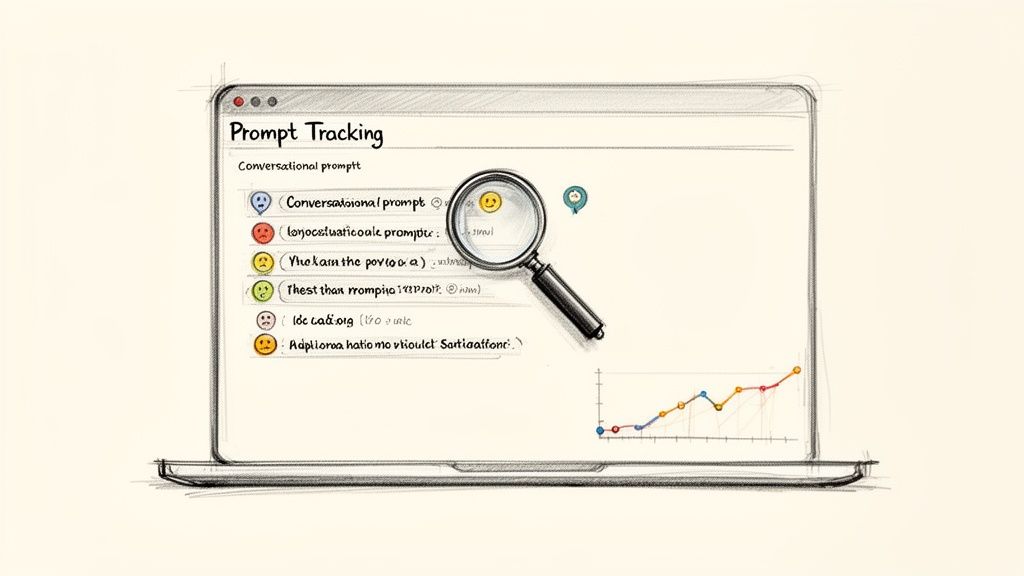
You cannot improve what you do not measure. The first step to increase visibility in ChatGPT searches is understanding what your audience is asking. This means moving beyond simple keywords into conversational queries.
To win, you must define the battlefield. Build a solid list of high-value prompts that reflect real user intent.
Identify Your Core Prompts
Brainstorm the questions your ideal customers ask when they need your product. Think like a human, not a search engine. Instead of “email marketing software,” a user might ask, “What’s the best tool for sending a newsletter to 1,000 subscribers?”
Your initial list should include several prompt categories.
- Problem-Aware Prompts: Queries like “How do I reduce customer churn for my SaaS?”
- Solution-Aware Prompts: Questions such as “best project management software for small teams.”
- Brand Comparison Prompts: Head-to-head queries like “Asana vs Trello for agile development.”
- “Best of” Prompts: Classic list-seeking questions like “top 5 CRM tools for startups in 2024.”
Pull together an initial list of 15-20 core prompts. This provides a solid foundation for tracking without overwhelming you. You can always add more later.
Establish a Visibility Baseline
With your prompts identified, you need a baseline. This is your starting point for measuring the impact of your efforts.
The goal is to determine your current “Share of Voice” inside AI answers. This metric measures how often your brand gets mentioned for a prompt compared to competitors. Think of it as the AEO version of market share.
For the prompt “best accounting software for freelancers,” your data might show that FreshBooks is mentioned in 8 of 10 responses while your brand is mentioned in only 1. This data tells you who the AI models currently favor and gives you a real number to improve. Learn more in this guide to ChatGPT tracking.
Establishing a baseline is non-negotiable. It turns your AEO strategy from a series of random acts into a data-driven campaign where you can see exactly what moves the needle.
Analyze Your Competitors’ AI Strategy
With a baseline, you can reverse-engineer what works for competitors. For every prompt a competitor dominates, ask why. Identify the sources the AI is leaning on to form its opinions.
Platforms like Airefs are built to answer this question. They show you the specific articles, Reddit threads, and review sites the AI cites in its answers. This uncovers the exact content shaping the AI’s perception of your market.
Digging into these sources provides a ready-made roadmap for your strategy. You might find a competitor is constantly mentioned due to a single, massive guide on their blog. This is the intel you need to build a strategy to increase visibility in ChatGPT searches.
Make Your Website an AI’s Favorite Source
Large language models learn from the public web. Your website is the primary source of truth about your brand. To increase visibility in ChatGPT searches, treat your site like a direct feed into the AI’s brain.
Your goal is to become the definitive source for your product and industry. Get this right, and your content becomes the raw material for future AI answers.
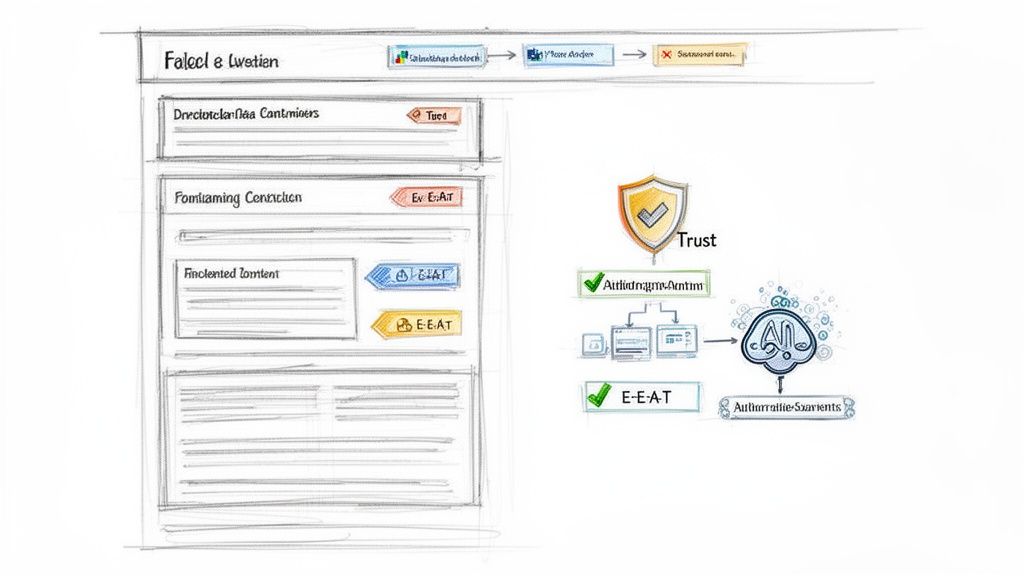
First, Build Trust With E-E-A-T Signals
Google’s E-E-A-T principles (Experience, Expertise, Authoritativeness, and Trustworthiness) are critical for AEO. AI models use these signals to decide if your content is credible. An AI will not cite a source it cannot trust.
Build trust by focusing on fundamentals.
- Author Bios: Show who wrote your content and why they are an expert.
- A Killer About Us Page: Tell your company’s story and show the people behind the brand.
- Clear Contact Info: Provide a physical address, phone number, and contact form.
- Proof, Not Promises: Use case studies and testimonials to show real-world results.
Structure Your Content for a Robot Reader
AI models parse content, breaking it down into logical chunks. A giant wall of text is a dead end for an AI. You must structure your content with a clear hierarchy and smart formatting.
This makes your key information “snippable” and easy for an AI to repurpose into an answer. Clear structure is the fastest way to get cited.
An AI model is like a librarian frantically organizing a massive library. Content with clear chapter titles (headings), indexes (tables of contents), and highlighted quotes (formatting) gets cataloged correctly and recommended to others.
ChatGPT handles over 200 million daily queries and pulls heavily from trusted online sources. Research shows 87% of ChatGPT citations come from pages ranking in Bing’s top 20 results. Well-structured content is a huge factor in getting noticed.
Double Down on Factual, Definitive Content
AI models prioritize unambiguous, factual information. Vague marketing fluff gets ignored. Your content needs to be the most comprehensive and direct resource on its topic.
Create pages like these.
- Comprehensive “What Is” Guides: Own the foundational concepts in your industry.
- Transparent Pricing Pages: Clearly lay out your pricing as a trust signal.
- Detailed Product Documentation: Make your help docs public and easy to crawl.
- Original Research and Data: Publish reports with unique data to become a primary source.
Audio and video are important, too. Use AI transcription apps to make spoken content accessible to text-based AI models.
Nail the Technical SEO for AI
A solid technical foundation ensures AI models can find and interpret your content. Many classic SEO practices are even more critical for Answer Engine Optimization. A technically sound website is a trustworthy one.
Focus your efforts here.
- Schema Markup: Use schema (like
FAQPage,Product) to spoon-feed information to machines. - Clean URL Structure: Keep URLs simple and descriptive to help machines understand your site’s hierarchy.
- Smart Internal Linking: Connect relevant pages to show the relationships between concepts.
A solid technical setup holds your content strategy together. To see how these pieces fit, check out our guide on optimizing content for AI search.
Get Involved In Off-Site Conversations on Key Platforms
AI models learn from the entire internet, not just your website. To show up in answers from tools like ChatGPT, you must be part of conversations happening off your site. The AI is listening there.
Your on-site content is your foundation for authority. Your off-site presence shapes the AI’s real-world understanding of your brand and reputation.
Identify High-Impact Digital Hangouts
AI models give significant weight to platforms with high user engagement and authentic discussions. These are the places where problems get solved and products get recommended.
Figure out where these conversations are happening in your niche.
- Reddit: A goldmine of unfiltered user opinions and niche community discussions.
- Quora: The Q&A format is a natural fit for how people query AI.
- Industry Forums: Niche communities provide specific, expert-level chat that AIs trust.
- Product Review Sites: Platforms like G2, Capterra, or Trustpilot offer structured data and user sentiment.
Finding the right community is everything. A B2B SaaS company will get more value from a subreddit like r/sysadmin than from a generic Facebook group. Find where your ideal customers go when they’re stuck.
Pinpoint AI-Sourced Threads
Once you know which platforms matter, find the exact threads AI models already use as source material. This is not a guessing game. Use a tool built for AEO to see the specific URLs that models cite.
Reddit is a primary learning ground for AI because it is where people discuss products with brutal honesty. A small number of influential threads often get referenced repeatedly. These are the “knowledge hubs” for the AI on a given topic.
A single, well-crafted comment in a high-authority Reddit thread that an AI already trusts can be more effective than publishing three new blog posts. You’re injecting your brand’s value directly into a conversation the AI is already paying attention to.
Join Conversations with Authenticity and Value
Parachuting into a forum to drop your brand name is spam. The goal is to join the conversation authentically and provide real value first. Your brand mention should feel like a natural, helpful part of the answer.
Follow the Solve, then Suggest framework. First, give a detailed answer that solves the original poster’s problem. Then, suggest your product as a tool to help implement that solution. You can learn more by reading how to use Reddit to get AI mentions.
This approach builds trust. It positions your brand as a helpful expert, not just another company trying to make a sale. These valuable contributions become part of the training data for future AI models.
Measuring and Scaling Your AI Visibility
Getting your brand mentioned by AI is one thing. Turning it into a repeatable growth channel requires solid data. Without it, you are just guessing.
Let’s break down how to measure impact and build a system that scales.
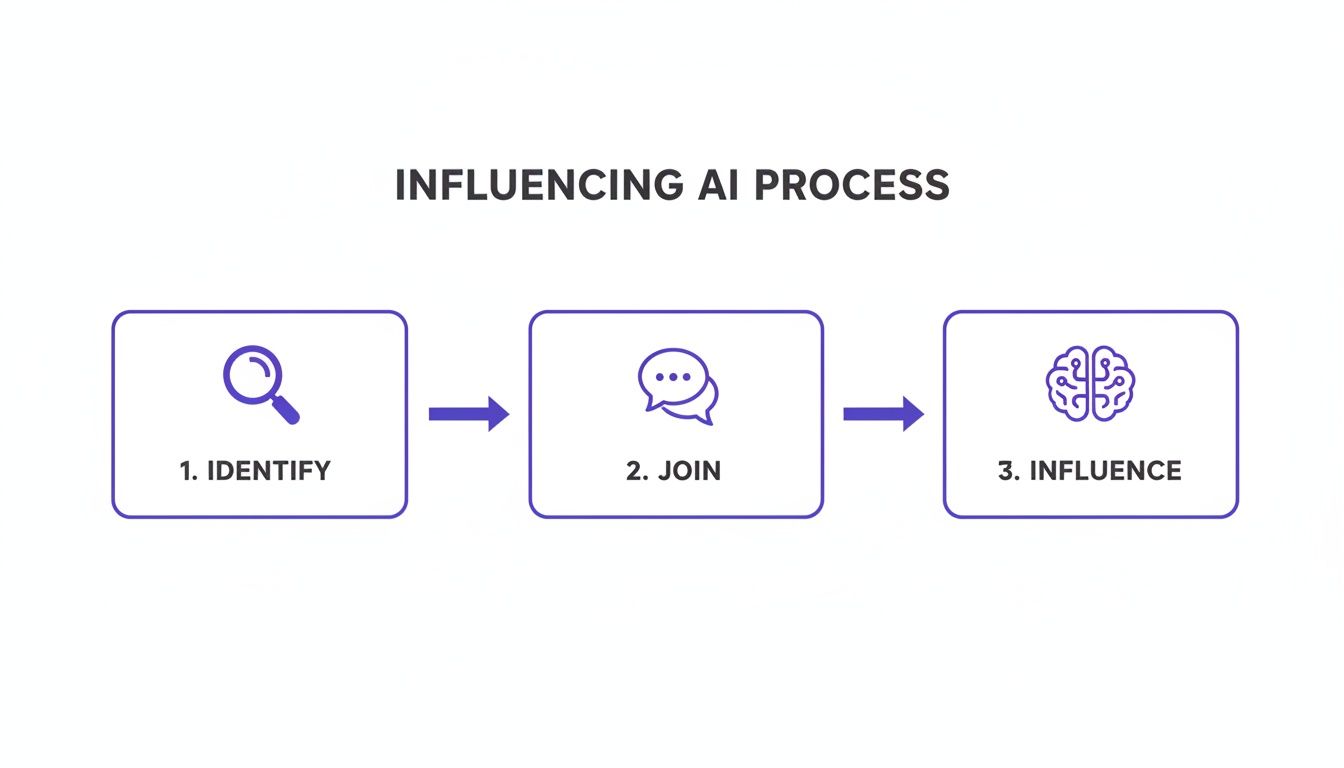
The process is a repeatable loop. First, Identify important prompts and conversations. Then, Join those discussions. Finally, Influence the AI’s knowledge base.
Defining Your Key Performance Indicators
To know if you’re making progress, you must look past old-school SEO metrics. Clicks and rankings still matter, but Answer Engine Optimization (AEO) requires a different set of KPIs.
Track these metrics.
- Share of Voice (or Share of Model): Your north star. It’s the percentage of time your brand gets mentioned for a target prompt compared to competitors.
- Citation Frequency: How often your domain is cited as a source in an AI answer.
- Mention Sentiment: Are mentions positive, neutral, or negative?
These metrics give you a clear, data-driven picture of what’s happening inside the AI.
Connecting AI Visibility to Business Outcomes
Visibility is only valuable if it drives real business results. The final piece is connecting your AEO metrics to these bottom-line outcomes.
This can be tricky since AI platforms don’t pass referral data. Monitor increases in direct and branded search traffic that correlate with your AEO campaigns.
A rising tide of branded searches (e.g., people Googling “Airefs reviews”) is a strong indicator that people are discovering you through non-clickable channels like AI conversations.
Better yet, just ask. Add a “How did you hear about us?” field to your signup forms. This qualitative data is gold for proving ROI.
Building a Scalable Workflow
Once you see results, you need a system to scale your efforts. A scalable AEO workflow has a few key parts.
- Automated Monitoring: Use tools to set up alerts for new discussion opportunities.
- Content Feedback Loop: Let prompt tracking inform your content strategy.
- Regular Reporting: Set up a review of your share of voice, citation frequency, and sentiment trends.
This turns AEO from a reactive tactic into a proactive growth engine. Learn more in our guide to AI search visibility tools.
Still Have Questions About AEO?
Jumping into Answer Engine Optimization can feel like learning a new language. Let’s clear up some of the most common questions about how to increase visibility in ChatGPT searches.
My goal here is to give you straight answers on what it takes to get cited and recommended by AI. We’ll cover everything from timelines to tactics.
What Is the Difference Between SEO and AEO?
Search Engine Optimization (SEO) is about winning clicks from search engines like Google. The main goal is to drive traffic to your website. Success is measured in keyword rankings and organic sessions.
Answer Engine Optimization (AEO) is about getting your brand cited directly in the AI’s answer. The goal is to become the source of truth that the AI trusts and recommends. Success is measured by brand mentions and “Share of Voice.”
SEO gets people to your site, while AEO gets your information into the answer itself.
How Long Does It Take to See Results?
AEO often moves much faster than traditional SEO. You can sometimes see initial changes in AI answers within just a few weeks of focused effort. AI models are constantly scraping the web and updating their knowledge base.
A single, high-value comment on a relevant Reddit thread can get noticed quickly. For consistent gains in visibility, a 2-3 month timeframe is a realistic expectation.
Can I Just Focus on My Website Content?
Optimizing your website is a must, but it’s only half the battle. AI models learn from the entire public web, not just your official site.
AI models are built to understand real-world consensus. They do this by analyzing millions of conversations on platforms like Reddit, Quora, and industry forums where real people discuss problems and recommend solutions with unfiltered honesty.
Ignoring off-site discussions means you miss a huge chance to shape how the AI understands your market. For a deeper dive, check out our guide to Answer Engine Optimization.
What Are the Most Important Metrics to Track?
The single most important metric in AEO is your Share of Voice. This tells you how often your brand gets mentioned for key prompts compared to your competitors. It is the cleanest signal of your visibility inside AI.
Beyond that, keep an eye on citation frequency and mention sentiment. You must also connect the dots back to business goals. Look for changes in direct traffic and branded search volume.
Frequently Asked Questions (FAQ)
What exactly is Answer Engine Optimization (AEO)? Answer Engine Optimization (AEO) is the practice of increasing a brand’s visibility and citations within AI-generated answers from models like ChatGPT. It focuses on becoming a trusted source for the AI.
How is AEO different from traditional SEO? SEO aims to rank web pages to get clicks from search engines. AEO aims to get your brand’s information and recommendations directly into the AI’s answer, focusing on mentions over clicks.
How quickly can I expect to see results from AEO? Unlike SEO, which can take 6+ months, AEO can show initial results in just a few weeks. A realistic timeframe for consistent, measurable improvement in visibility is 2-3 months.
Should I focus on my website or on other platforms like Reddit? Both are critical. Your website establishes your authority (on-site AEO), while participating in communities like Reddit and Quora shapes the AI’s real-world understanding of your brand (off-site AEO).
What is the most important AEO metric to track? Share of Voice (or Share of Model) is the #1 metric. It measures how often your brand is mentioned for key prompts compared to competitors, giving you a clear benchmark for your AI visibility.
Ready to stop guessing and start measuring your AI visibility? Airefs gives you the tools to track your share of voice, uncover competitor strategies, and find actionable opportunities to get mentioned in ChatGPT. Start tracking your prompts today.