

To get your content in AI answers, you need to think differently. The goal is to create clear, structured, and citation-worthy information. This content must directly answer the conversational questions your audience asks.
This isn’t about ranking for keywords. It’s about becoming a trusted source that AI models like ChatGPT and Google’s AI Overviews reference. Your new job is to be the answer, not just another link.
The New Rules of Search Visibility
Visibility used to be about climbing a list of ten blue links. Now, it’s about getting featured directly inside AI-generated answers. This is the new frontline for organic growth.
People have shifted from short keywords to detailed, conversational prompts. Since AI is the new discovery engine, old-school SEO tactics won’t work. You must switch your mindset from chasing rankings to earning mentions.
From Rankings to Answers
Search is moving from a list of pages toward providing a single, direct answer. This shift completely changes how you should approach content strategy.
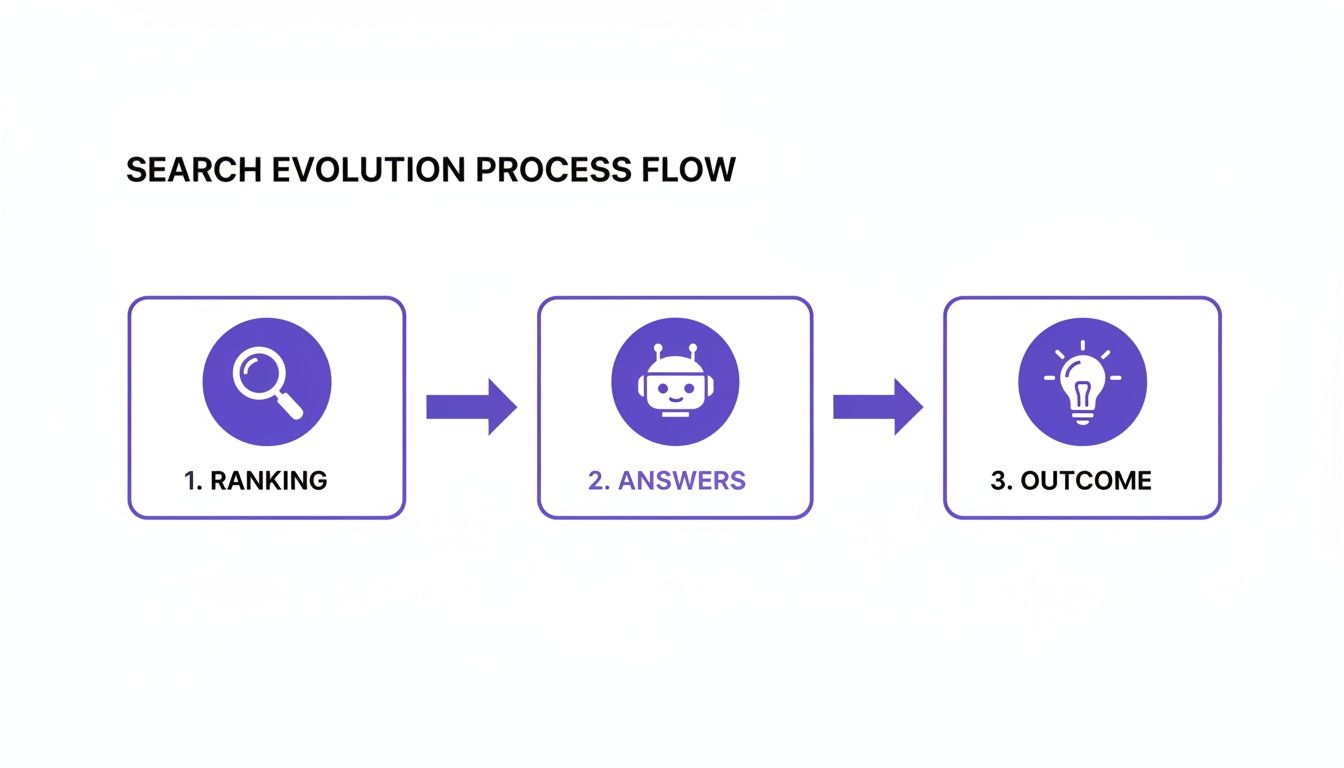
This diagram shows the transition from a complex ranking game to a simple outcome. It’s all about getting the right answer to the user.
AI models are built for efficiency. They prioritize content that delivers a clear, concise, and trustworthy answer.
Why This Shift Demands a New Playbook
The numbers show AI-driven traffic has exploded by 527% year-over-year. AI-generated content now makes up 17.31% of top Google results. The brands influencing AI today will own the discovery channels of tomorrow.
The challenge isn’t just creating content. It’s structuring that content so an AI can parse, trust, and cite it as a definitive source.
The Generative Engine Optimisation (GEO) master framework is a great starting point. It lays out the path to “rank” in an era of synthesized answers. This guide provides the strategies to make your content the go-to source for AI.
Traditional SEO vs AI Search Optimization
Seeing the old and new approaches side-by-side makes the shift concrete. The table below breaks down the key differences between traditional SEO and AI search.
| Focus Area | Traditional SEO (Ranking-Focused) | AI Search Optimization (Answer-Focused) |
|---|---|---|
| Primary Goal | Rank a URL on the first page of Google. | Get your information cited within an AI-generated answer. |
| Key Metric | Keyword rankings, organic traffic, backlinks. | Share of voice (mentions), citations, assisted conversions. |
| Content Focus | Long-form content targeting specific keywords. | Concise, factual, and easily verifiable snippets of information. |
| User Intent | Matching keywords to broad user needs. | Fulfilling specific, conversational, and multi-layered prompts. |
| Source of Truth | The ranking page itself. | A network of trusted, authoritative, and consistent sources. |
The fundamental difference is becoming part of the answer, not just a potential click. This requires a deeper focus on the quality and structure of your information.
Map Your Market’s AI Prompts
To appear in AI answers, you must know the exact questions your audience is asking. This is a shift from targeting keywords to capturing full conversational prompts. Your goal is to map this conversational landscape to guide your content strategy.
Success starts with listening. The best place to find high-value prompts is the unfiltered voice of your customers.
Uncover Prompts from Your Own Data
Your company’s data is a goldmine of prompt-worthy questions. Sales calls, customer support tickets, and onboarding sessions are filled with precise language. These conversations are raw, authentic, and packed with intent.
Dig through transcripts to find recurring questions and pain points. For instance, a customer might ask, “How does your tool handle integrations compared to Competitor X?” This is a perfect, high-value prompt waiting for an answer.
Organize these findings into thematic clusters. Grouping similar questions reveals the core topics your market cares about. This process creates a content plan that meets real-world needs.
Mining internal conversations provides direct evidence of what people ask AI. It closes the gap between the content you make and the answers prospects seek.
Find Prompts in Public Conversations
After analyzing internal data, look where potential customers gather online. Communities like Reddit, Quora, and industry forums are where people discuss challenges. These public discussions are a real-time feed of the questions training AI models.
Monitor relevant subreddits or forums for your audience. Look for threads starting with phrases like:
- “How do I solve [problem]?”
- “What’s the best software for [task]?”
- “Has anyone tried [your product type] for [use case]?”
Each thread contains related prompts. The original post is the main prompt, while comments reveal valuable long-tail variations.
Prioritize and Track Your Target Prompts
You now have a long list of potential prompts, but you can’t tackle them all. Prioritize prompts that align with your product’s strengths and show commercial intent.
Use a simple framework for prioritization:
- Relevance: Does the prompt relate to a problem your product solves?
- Intent: Does the person seem to be in a research or buying phase?
- Volume: Is this a common question across different channels?
Track your target prompts in a spreadsheet or a dedicated tool. This “Prompt Map” becomes your strategic guide for all content. It ensures every piece you publish answers a specific, high-value question.
To measure performance, explore methods for tracking brand mentions in AI answers. Learning about ChatGPT tracking can provide a framework to measure performance against target prompts.
Analyze AI Sources and Competitor Mentions
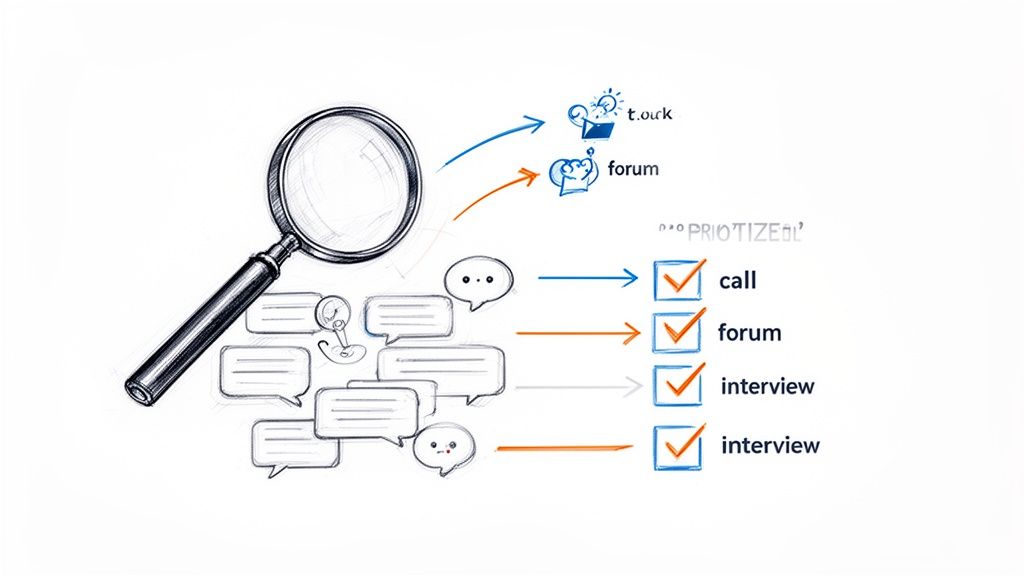
AI models build answers from a web of trusted sources. Your job is to become one of those sources. This means reverse-engineering the process.
Find out which articles, forums, and documents models already cite for your target prompts. Understanding why competitors get mentioned turns the AI “black box” into a clear plan.
Deconstruct AI-Generated Answers
Run your high-priority prompts through models like ChatGPT and Google’s AI Overviews. Don’t just read the response; take it apart. Pay close attention to the cited sources.
Note the domains, content types, and specific pages referenced. This audit reveals the “source DNA” for your topics and shows patterns in what AI models prefer. This is the foundation of modern AI Search Engine Optimization.
Your goal is to map the citation landscape for your most important prompts. This benchmarks your visibility and reveals the authority signals AI is looking for.
Identify Your “Source Competitors”
In AI search, your competitors aren’t always who you think. A “source competitor” is any website cited for your target prompts. This could be a niche forum, an industry publication, or a Reddit thread.
A solid competitive analysis in digital marketing is crucial. You’re not just competing on product features; you’re competing on information quality.
List these domains and categorize them:
- Direct Competitors: Other companies in your industry.
- Media & Publications: Industry blogs and news sites.
- Community Platforms: Forums like Reddit, Quora, and Stack Overflow.
- Informational Sites: Non-commercial hubs like Wikipedia.
This breakdown shows where the AI is currently “learning” about your market.
Analyze Content Gaps and Opportunities
With your list of source competitors, dig into their content to find gaps. For each cited page, ask: Why this page? What question does it answer best? How is the information laid out?
You’ll often find that cited content is good but not perfect. An article might be outdated, or a great answer might be buried in a long forum thread. These are your openings.
Aim to create content that is 10% better in ways that matter to an AI. This could mean being more current, using clearer structure, or providing more verifiable data.
Google’s AI Overviews already appear in 13% of U.S. queries. The game has moved from ranked lists to synthesized answers. Conversational content and forum validation are now vital for visibility.
Create and Structure AI-Ready Content
Once you know which prompts to target, build content that AI models can parse, trust, and cite. This isn’t about flowery prose. It’s about building a database of clear, factual answers.
Your goal is to become the most efficient and reliable source for an AI. This means prioritizing structure and clarity above all. You are making your expertise machine-readable for new answer engines.
Structure for Machine Readability
AI models don’t read a webpage from top to bottom; they parse it into usable chunks. Well-structured content makes this process clean and efficient. This boosts the odds your information gets selected.
Think of your headings (H2s and H3s) as logical dividers. Each heading should map directly to a user prompt or a follow-up question. This hierarchy helps an AI understand your content’s organization.
The core principle is simple: one idea, one section. When content is structured logically, AI models can extract pieces with higher confidence.
Write in Snippable, Self-Contained Paragraphs
Long, winding paragraphs are over for this type of content. AI search loves short, concise paragraphs that get straight to the point. Each paragraph must make sense even when pulled out of context.
This “snippable” quality is crucial. AI models often lift one or two sentences from a source to build an answer. Short, focused paragraphs hand them perfect, self-contained snippets.
Here’s how to do it:
- Keep paragraphs to 1-3 sentences. This forces directness and improves scannability for humans and machines.
- Start with the answer. State the main point first, then add supporting details.
- Avoid jargon. Be precise. Instead of saying a product is “fast,” say it “processes 500 transactions per second.”
Use Formats That Scream “Clear Answer”
Certain formats act as powerful signals to AI models. They immediately identify your content as structured, easy-to-digest information. This is a huge part of optimizing content for AI search.
Lean into these formats wherever possible:
- Bulleted and Numbered Lists: Perfect for breaking down features, steps, or takeaways.
- Q&A Sections: An FAQ at the end of an article directly mirrors the conversational nature of AI prompts.
- Tables: Use these to compare features, pricing, or other data points.
This checklist can help you put this into practice.
Content Formatting Checklist for AI Visibility
This table breaks down the key elements to make your content more useful for AI models.
| Element | Why It Matters for AI | Example |
|---|---|---|
| Clear H2/H3 Headings | They create a logical map of your content, allowing AI to quickly identify and isolate specific answers. | <h3>How Does X Compare to Y?</h3> instead of a vague heading like <h3>Feature Breakdown</h3>. |
| Short, Focused Paragraphs | ”Snippable” paragraphs (1-3 sentences) are easy for models to extract and use as standalone answers. | ”Product X costs $49/month.” (A single, direct sentence). |
| Bulleted/Numbered Lists | This structured format is simple for AI to parse and often gets lifted directly into generated answers. | A bulleted list outlining the 3 key benefits of a service. |
| Data Tables | Tables organize comparative data cleanly, making them ideal sources for “vs.” or “best for” queries. | A table comparing pricing tiers, features, and user limits across three different plans. |
| Q&A Sections (FAQs) | Directly mirrors the prompt-and-answer format of AI chatbots, making it a highly relevant format. | An FAQ section with questions like “Is Product Z good for small businesses?” followed by a direct answer. |
Incorporating these elements makes your content more compatible with how AI systems use information. For a deeper look, check out our guide on Answer Engine Optimization.
Back It Up with Citation-Ready Data
AI models are trained to value verifiable facts. Back up claims with specific data, statistics, and expert quotes to make your content more authoritative. AI prefers sources backed by evidence.
Anchor general statements with a number.
- Weak: “Our software improves team efficiency.”
- Strong: “Our software reduces project completion time by an average of 22%.”
This small change makes your content more credible and gives the AI a concrete fact to cite. Consistently providing verifiable information in a clean format positions you as a go-to source.
Influence Off-Site Signals and Discussions
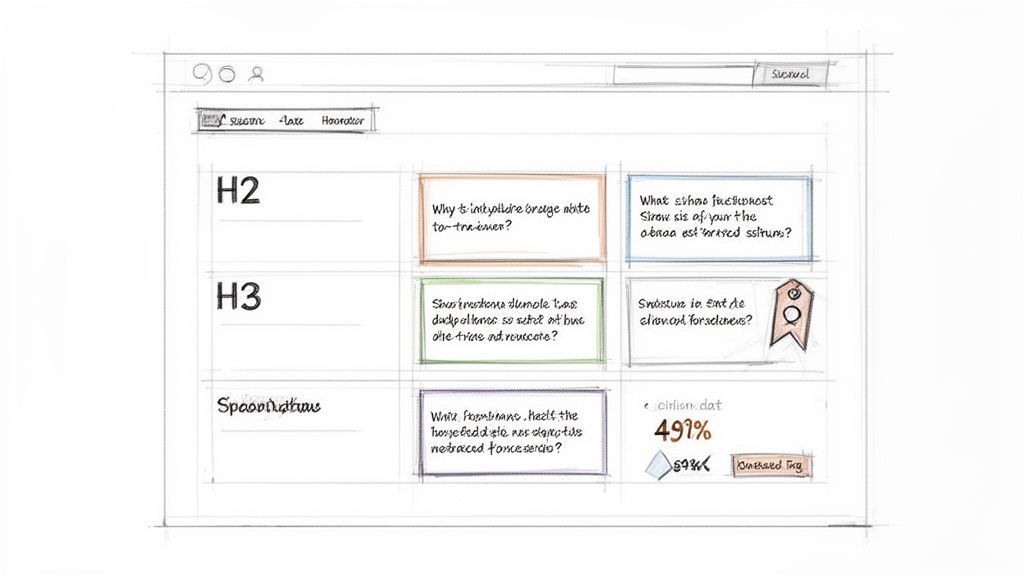
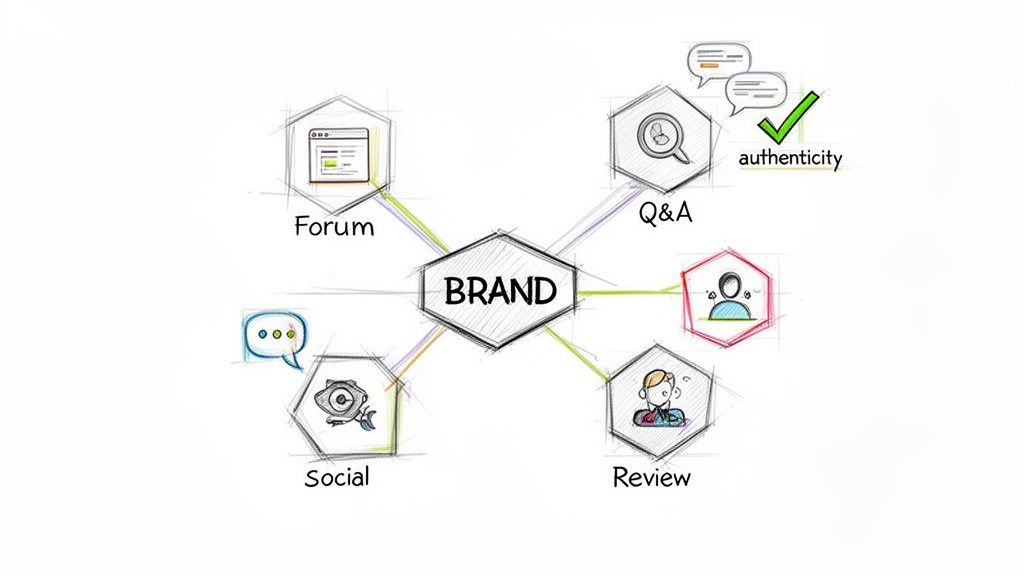
What people say about your brand on other websites is a massive signal for AI models. These systems learn from platforms like Reddit and Quora to understand what real people think. They look for authentic user experiences.
To optimize content for AI search, you must look beyond your own blog. The game is about creating external validation that influences future AI answers.
Find the High-Impact Conversations
First, find where your expertise will make a difference. Pinpoint active, relevant threads where your target audience is asking for advice. A focused approach works better than just searching for your brand name.
Use specific search queries on these platforms to find recent and relevant discussions. Look for questions that are not fully answered or have weak replies. Those are your golden opportunities to provide real value.
You can also use tools to monitor keywords across these communities. This automates the discovery process and lets you be one of the first to contribute.
Add Value, Not a Sales Pitch
Once you’ve found the right conversation, your mission is to help, not sell. Overtly promotional comments get ignored or deleted. Your goal is to become a trusted expert in that community.
Provide genuine, detailed answers that solve the original poster’s problem. If it makes sense, mention your product as part of a complete answer. Your comment should be valuable on its own, even without a click.
The best off-site contributions feel like they’re from a helpful peer, not a marketing department. Authenticity builds trust that AI models reward.
A Real-World Example
Imagine you work for a project management software company. A team member finds a Reddit thread asking for a tool to handle dependencies simply.
Instead of just dropping a link, they write a detailed comment.
- They validate the user’s struggle as a common challenge.
- They explain the key features a tool would need to solve this.
- They mention their product as one option with these features, briefly explaining how it works.
This approach offers immediate value and positions the brand as an expert. As AI models crawl this thread, they will associate your brand with solving this problem. Our guide on how to rank in Google AI Overviews explains how these signals impact visibility.
Scale Your Community Presence
Engaging in off-site discussions requires a consistent effort. With 36% of U.S. adults expected to use generative AI for searches by 2028, third-party validation is key.
To scale this effectively, create a simple system for your team.
- Assign ownership: Pick one or two people to monitor key platforms.
- Develop templates: Create flexible response outlines that can be easily customized.
- Track your impact: Keep an eye on brand mentions and referral traffic.
Consistently adding value builds a powerful network of external signals. These signals reinforce your expertise and make your brand a more reliable source for AI models.
Monitor, Measure, and Iterate Your Strategy
Optimizing for AI is not a one-time project; it’s a continuous loop. You need a solid feedback system built on real data. This allows you to see what’s working and stay ahead of changes.
Forget vanity metrics like raw traffic. It’s about tracking your influence inside AI-generated answers. Focus on mentions, not rankings.
Measuring Your Share of Voice in AI
The most important metric is AI Share of Voice. This shows how often your brand appears in AI answers for target prompts compared to competitors. A steady climb here is the clearest sign of success.
Systematically track your most important prompts across major AI models. Log every mention—yours, your competitors’, and the sources cited. This process shows who is winning the conversation.
Tracking Share of Voice turns a vague goal into a measurable KPI. It provides the data to justify your strategy and shows you where to double down.
This data also highlights which prompts you’re winning and which you’re losing. If a competitor owns the answer for a high-value prompt, that’s your cue to fill a content gap.
Connecting Visibility to Business Outcomes
Getting mentioned must lead to business results. Connect gains in AI visibility to qualified traffic, leads, and revenue. This is how you show the real ROI of your work.
Start looking for patterns. Did a jump in brand mentions from Reddit-sourced AI answers cause a spike in referral traffic? Did a citation for a “best software” prompt align with more demo requests?
This analysis creates a powerful feedback loop. Our guide on tracking your visibility in AI Overviews lays out a framework for connecting AI visibility to business growth. This data-first process lets you iterate with confidence and build a real advantage.
FAQ: Optimizing for AI Search
What’s the difference between SEO and AI search optimization?
Traditional SEO aims to rank your webpage in a list of links. AI search optimization focuses on getting a snippet of your content featured directly inside an AI-generated answer. It’s about becoming the source of truth, not just earning a click.
How do I find the prompts my audience uses?
Start with your own customer data from sales calls and support tickets. Then, monitor public communities like Reddit and Quora. Look for discussions where people are asking for solutions or recommendations related to your industry.
Does technical SEO still matter for AI?
Yes, absolutely. Fundamentals like site speed, mobile-friendliness, and crawlability are crucial. Structured data (Schema markup) is also more important than ever because it gives AI models explicit context about your content.
How long does it take to see results?
Off-site engagement on platforms like Reddit can influence AI responses in a matter of weeks. Building on-site authority is a longer game, but consistently creating well-structured content will build momentum and establish you as a trusted source over a few months.
Ready to stop guessing and start measuring your visibility in AI answers? Airefs shows you exactly where you stand and uncovers the opportunities you need to become the go-to source in your category. See how you can optimize content for AI search and win your market.