

As buyers increasingly turn to ChatGPT, Google AI Overviews, and other answer engines, tracking your brand’s visibility in AI-generated responses has shifted from a niche tactic to a core marketing function. While Profound has been a notable player in this space, the Generative Engine Optimization (GEO) landscape is evolving rapidly, with a host of powerful and specialized tools emerging. Whether you’re a B2B SaaS startup, a fast-growing scaleup, or an established enterprise, relying on a single solution might mean missing out on critical features, better pricing, or a more actionable workflow.
This guide explores 7 profound alternatives, each offering a unique approach to measuring, influencing, and winning in the new era of AI search. We’ll move beyond surface-level feature lists to provide a practical, in-depth analysis of what makes each tool stand out. You’ll find direct comparisons, screenshots, and links to help you evaluate which platform best fits your specific needs. Understanding how these tools operate is the first step; to truly grasp their full potential, it’s also essential to understand the core concept of AI automation and how it handles complex business processes at scale.
Our goal is to help you find the right tool to turn AI visibility from a black box into a predictable growth channel. For each option, we’ll cover best-fit use cases, pricing signals, and migration guidance, ensuring you can make a confident, informed decision for your brand.
1. Airefs
Airefs distinguishes itself as a premier execution-focused platform and a formidable profound alternative for teams aiming to master their visibility in generative AI answers. It moves beyond theoretical metrics by directly engaging with Large Language Models (LLMs) like ChatGPT, running the actual prompts your customers use to discover solutions. This approach provides an unparalleled, source-level view into why an AI recommends a specific brand, article, or community post.
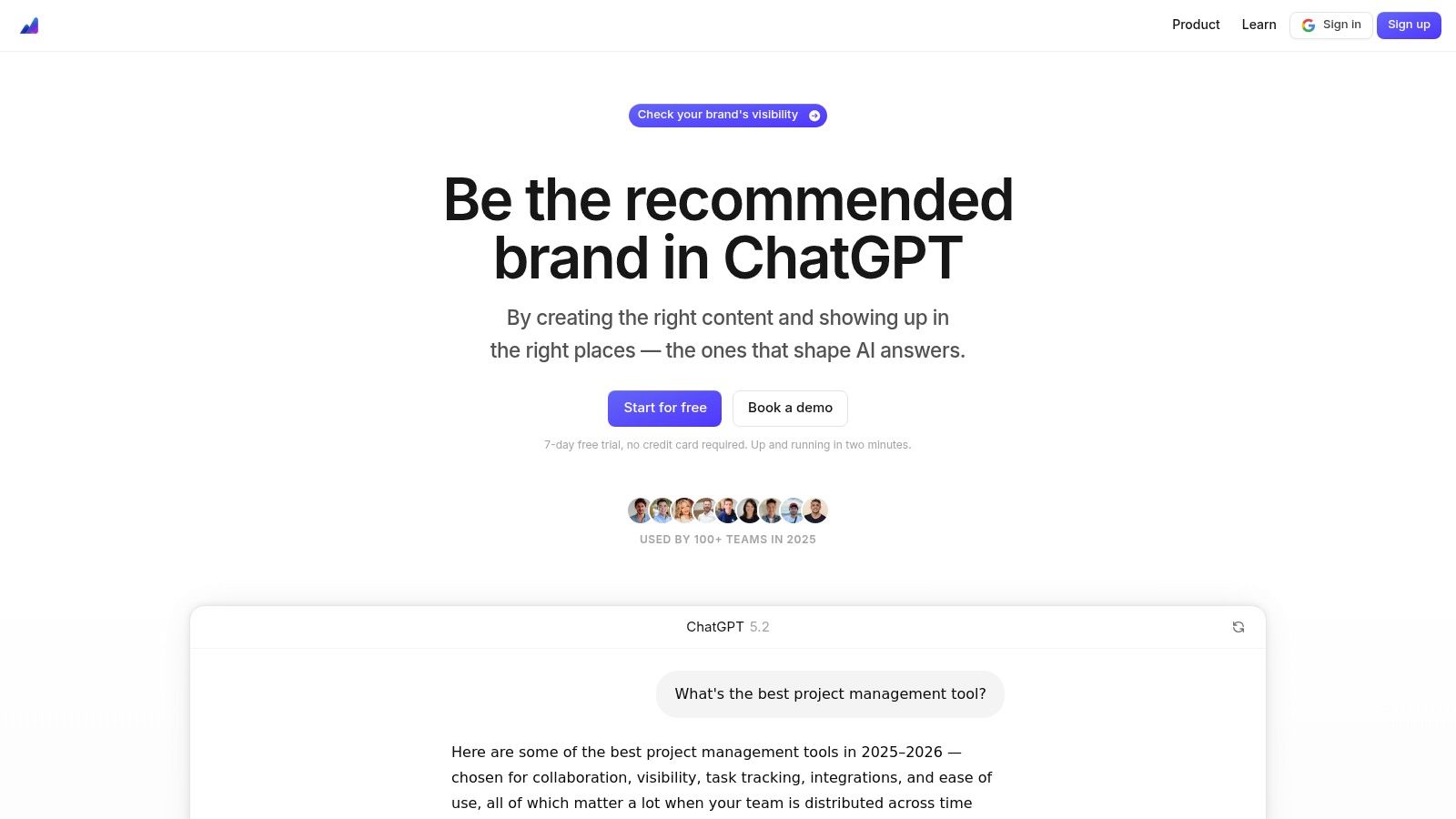
This granular insight transforms the “black box” of AI search into a set of concrete, actionable tasks. Instead of guessing, marketing teams can pinpoint the exact URLs influencing their AI visibility, whether it’s a blog post, a documentation page, or a specific Reddit thread. This clarity allows for a surgically precise content strategy, where efforts are focused on creating or updating the assets that directly impact AI-driven recommendations.
Key Strengths and Use Cases
Airefs excels by integrating AI Engine Optimization (AEO) and traditional SEO into a single, cohesive workflow. This unique synergy helps teams not only improve their standing in AI-generated answers but also enhance their organic search performance simultaneously.
- Best For: B2B SaaS marketers, in-house SEO teams, and digital agencies who need to translate AI visibility into measurable inbound demand.
- Practical Use Case: An in-house content team can use Airefs to track 50 high-intent customer prompts. The platform might reveal that a competitor is frequently cited due to a comprehensive guide on their blog. Armed with this knowledge, the team can create a superior resource, track its influence on AI answers over time, and measure the resulting increase in AI-driven impressions and clicks.
- Standout Feature: The platform’s ability to monitor community discussions and send alerts is a significant advantage. It allows teams to engage in relevant conversations on platforms like Reddit at the crucial early stages, shaping the discourse that LLMs later use as source material. This proactive approach is a core component of a modern AI search engine optimization strategy.
Platform Details
| Feature | Details |
|---|---|
| Primary Focus | Source-level analysis of AI-generated answers, linking LLM visibility to specific content and community actions. |
| Core Capabilities | Continuous prompt tracking, source URL identification, competitor benchmarking, AI impression/click analytics, community monitoring with alerts, and workflow integrations. |
| Pricing | Starts with a Lite plan at $24/month. Higher-tier Pro ($49/mo) and Expert ($83/mo) plans are available, along with a Done-For-You agency service from $249/mo. |
| Access & Onboarding | Offers a 7-day free trial with no credit card required. Setup is designed to be completed in minutes for immediate use. |
Pros and Cons
Pros:
- Action-Oriented: Reveals the exact source URLs influencing AI, enabling precise content and community engagement strategies.
- Integrated Workflow: Effectively bridges the gap between AEO and SEO, ensuring efforts contribute to both channels.
- Flexible Offerings: Provides a range of affordable self-serve plans and a comprehensive agency option for hands-off execution.
Cons:
- Plan Limitations: Lower-tier plans have restrictions on the number of prompts, competitors, and user seats, which may require an upgrade for larger teams.
- ChatGPT-Centric: While other LLMs are supported, the primary focus is on ChatGPT; extensive multi-LLM monitoring might require higher-tier plans or custom configuration.
**[Visit Airefs Website](https://getairefs.com)**
2. AthenaHQ
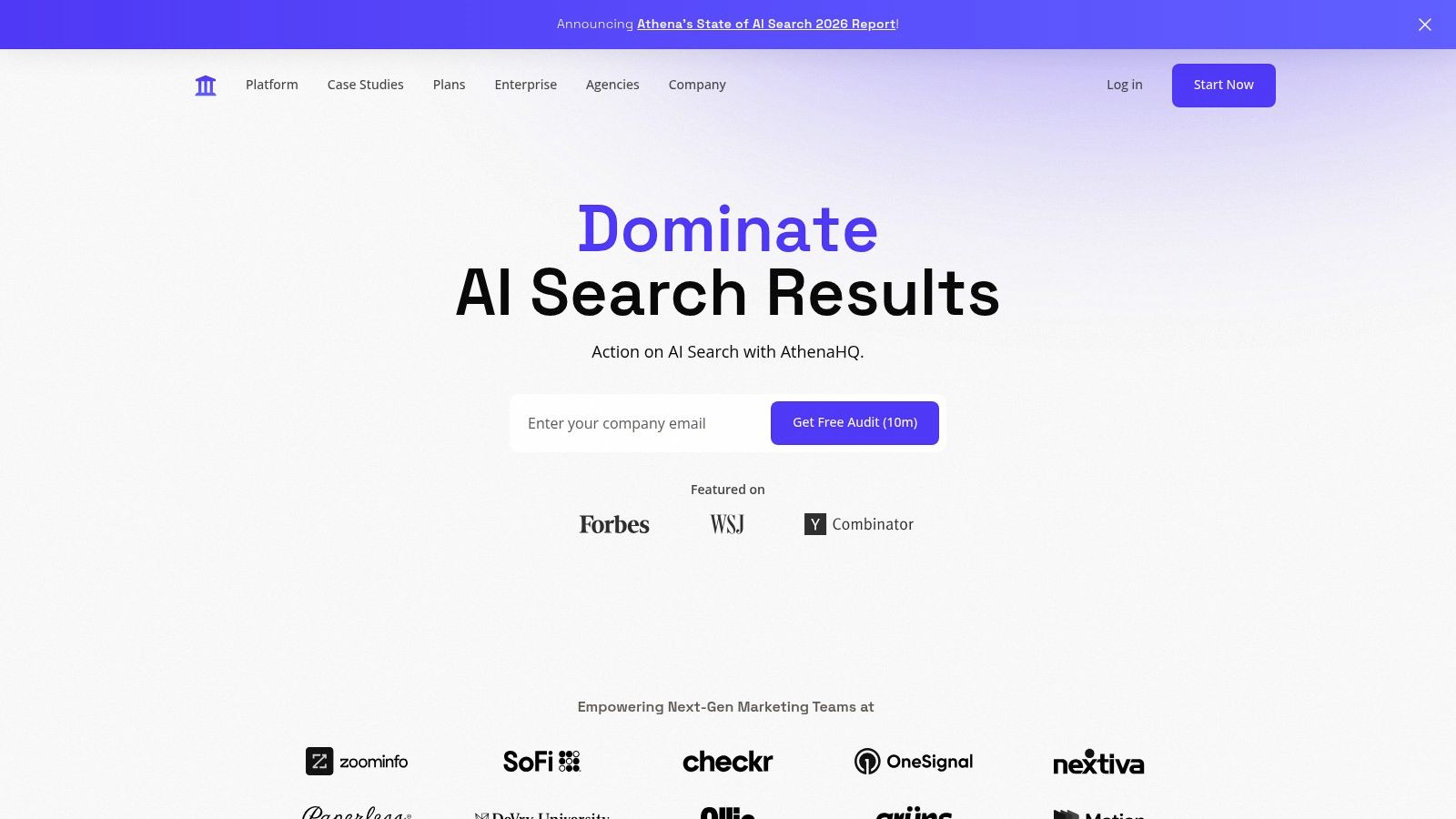
AthenaHQ distinguishes itself as a purpose-built AI Answer Engine Optimization (AEO) platform, making it a compelling alternative to Profound for teams laser-focused on brand visibility within generative AI. Unlike traditional SEO tools that add AI tracking as an afterthought, AthenaHQ’s entire infrastructure is designed to monitor how your brand is represented across major large language models (LLMs). It tracks mentions, citations, and share-of-voice in responses from ChatGPT, Google’s AI Overviews, Gemini, Perplexity, and others.
This singular focus allows for deeper, more relevant insights. The platform’s strength lies in its ability to provide citation-level intelligence, flagging not just when your brand is mentioned, but which specific sources the AI used. This is crucial for content strategy, digital PR, and link-building efforts aimed at influencing AI-generated answers.
Key Features & Use Cases
- Best For: Marketing teams at B2B SaaS companies, SEO agencies, and growth marketers who need to measure and improve their brand’s footprint in AI search. It’s ideal for those who see AEO as a distinct discipline, not just an extension of SEO.
- Multi-Model Monitoring: Track your brand across up to eight different LLMs, with GEO-specific analysis to understand how answers vary by location.
- Citation Intelligence: Pinpoint the exact URLs and sources that LLMs cite when mentioning your brand or competitors, providing a clear roadmap for content and backlink strategy.
- Impersonation Checks: Get alerted if an AI is misrepresenting your brand’s features, pricing, or core value proposition, allowing you to take corrective action.
Pricing & Implementation
AthenaHQ uses a credits-based model for its multi-model tracking, which requires some planning to manage usage effectively, especially for high-volume analysis. While it offers a free plan to get started, the best value and more advanced features like SSO and role-based access controls are found in its higher-tier paid plans.
- Website: https://www.athenahq.ai/
- Pro Tip: Use the prompt volume estimation feature to understand which user questions are driving visibility in your sector. This helps you align your content creation with actual AI user behavior.
3. Peec AI
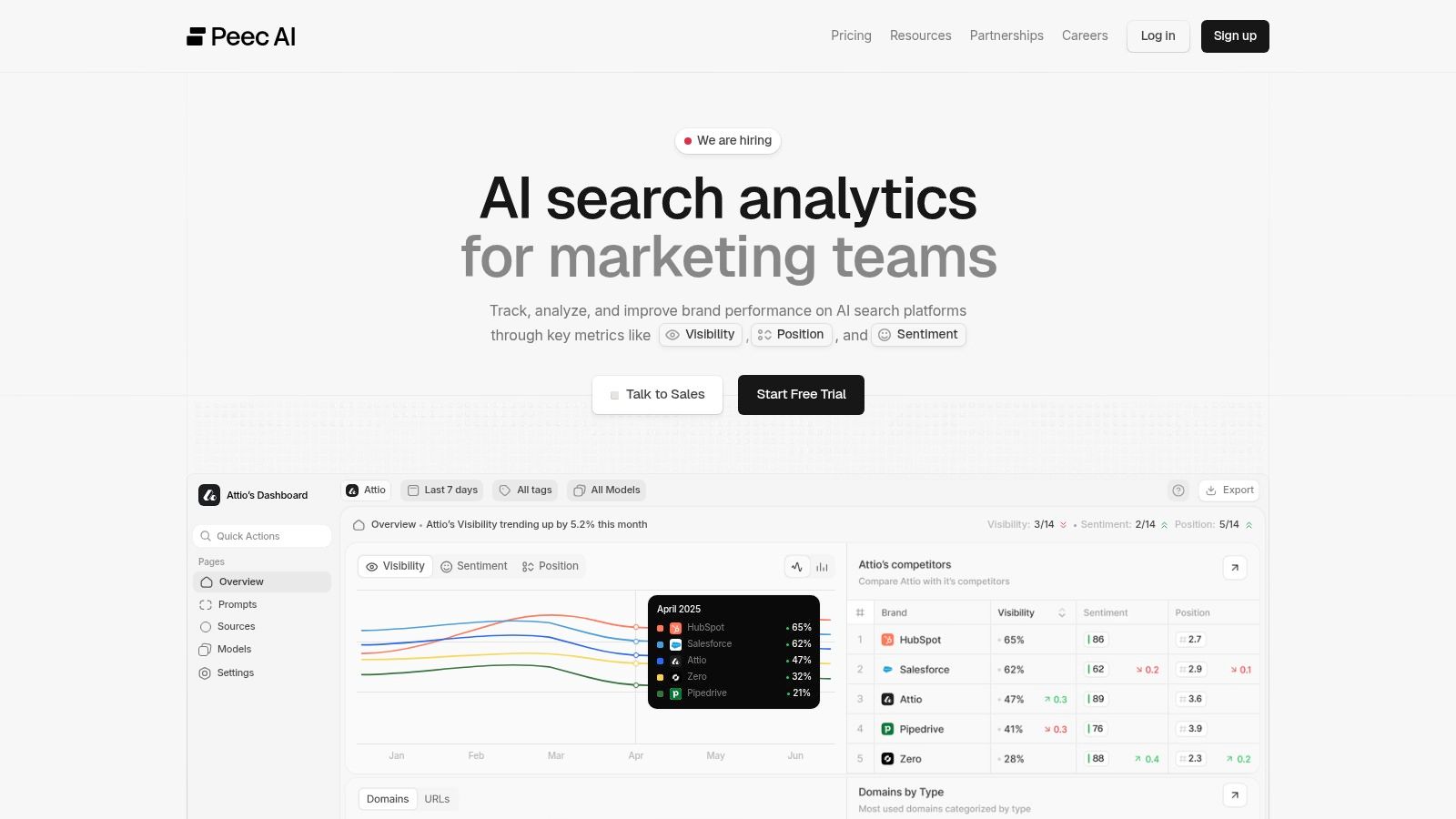
Peec AI offers a lightweight and accessible approach to AI visibility tracking, positioning itself as a strong Profound alternative for small to medium-sized businesses (SMBs) and agencies. Its core value proposition lies in simplicity and approachable pricing, focusing on core LLMs like ChatGPT, Perplexity, and Google AI Overviews in its base plans. The platform is designed for quick setup and clear reporting, stripping away the complexity found in enterprise-grade suites.
This focus makes it particularly effective for teams who need actionable data without a steep learning curve or significant budget commitment. The platform’s agency-oriented features, such as “pitch workspaces,” are a key differentiator, allowing marketing agencies to easily create and share reports with prospective and current clients.
Key Features & Use Cases
- Best For: SEO agencies, consultants, and in-house marketing teams at SMBs who require a straightforward, budget-friendly tool for monitoring brand presence in key generative AI models.
- Agency Pitch Workspaces: Create dedicated, shareable dashboards for client pitches, showcasing the need for AEO services and demonstrating potential ROI without granting full account access.
- Core Model Tracking: The base plans include daily tracking across ChatGPT, Perplexity, and Google AI Overviews, with the flexibility to add other models like Gemini and Claude as needed via add-ons.
- Generous User Access: Unlike many competitors, Peec AI offers unlimited seats and country tracking even on its lower-tier plans, making it highly collaborative for growing teams. A deeper analysis in this Peec AI review highlights its collaborative strengths.
Pricing & Implementation
Peec AI’s pricing is transparent and designed for accessibility, with a free demo available. The Starter and Pro plans are competitively priced, and the use of optional add-ons for additional LLMs allows users to control costs by paying only for what they need. While this model is cost-effective, teams requiring comprehensive, multi-model tracking out of the box may find the feature depth lighter than enterprise-focused platforms.
- Website: https://peec.ai/
- Pro Tip: Use the unlimited country tracking to analyze how your brand’s visibility differs in key international markets, even if you are on a starter plan. This can reveal surprising geographic content gaps.
4. Promptmonitor
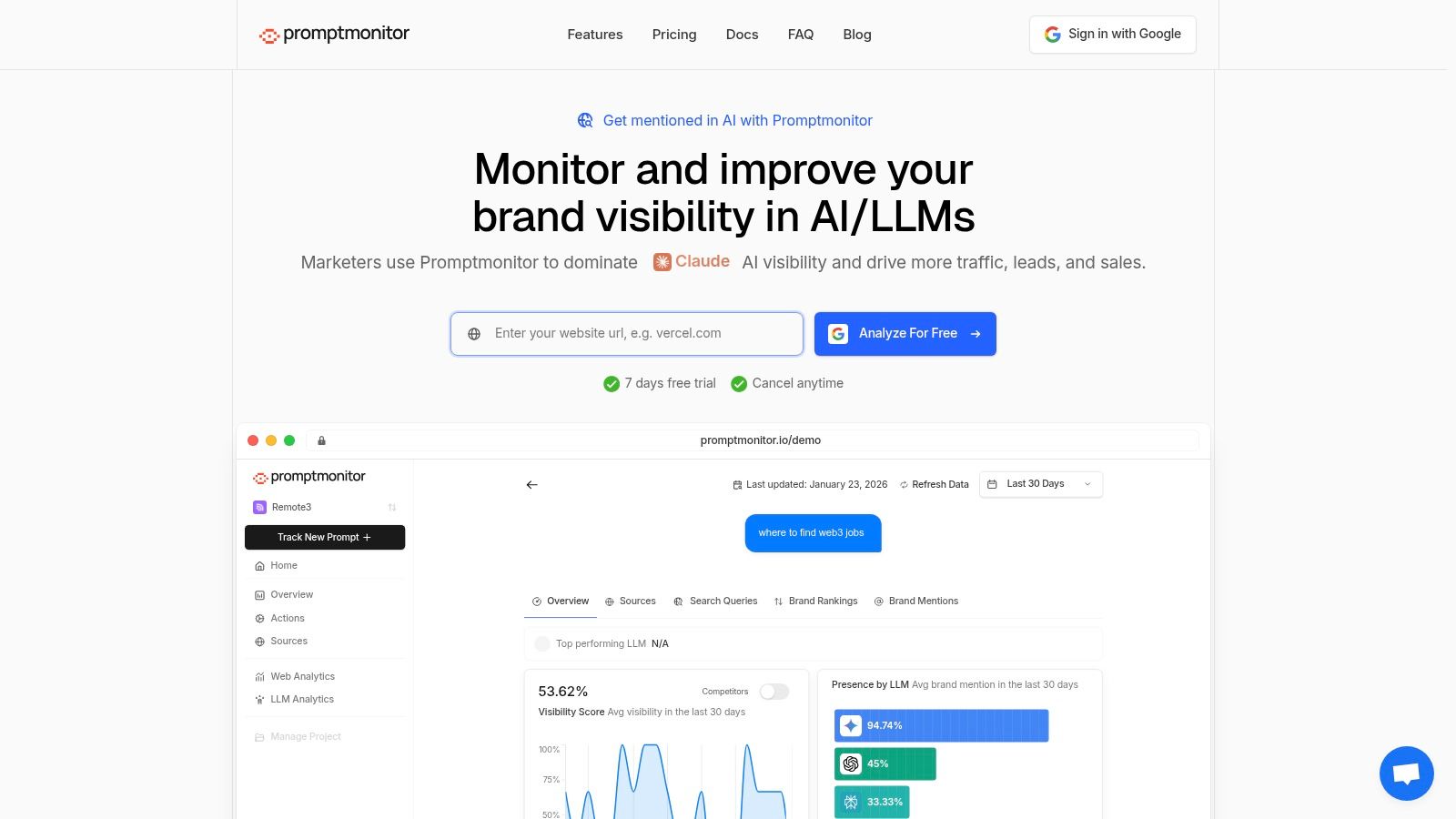
Promptmonitor positions itself as a highly accessible and budget-friendly AEO platform, making it an excellent profound alternative for small to mid-sized businesses (SMBs) and agencies. It focuses on tracking brand presence across a wide array of AI models, including ChatGPT, Claude, Gemini, Perplexity, and Google AI Overviews. The platform’s core value is its direct link between brand monitoring and actionable outreach.
Its standout feature is the workflow that not only discovers the sources and citations an AI uses but also helps extract contact information for those sources. This turns monitoring into a direct pipeline for digital PR and link-building, empowering teams to influence AI responses at the source. The user interface is designed for non-technical marketers, ensuring a quick ramp-up from setup to actionable reports.
Key Features & Use Cases
- Best For: SMBs, SEO agencies, and marketing teams that need a cost-effective, easy-to-use tool to monitor AI visibility and act on the insights without needing deep technical expertise.
- Actionable Outreach Workflow: Integrates source discovery with contact extraction, creating a clear path to engage with the websites and authors that LLMs cite. This is a crucial first step if you want to understand how to rank in ChatGPT and other models.
- Geo-Targeted Tracking: Monitor brand mentions and AI responses across more than 200 countries to understand how your visibility changes in different international markets.
- Multi-Assistant Monitoring: Tracks brand presence across up to eight major assistants, including ChatGPT, Gemini, Perplexity, and Grok, with daily data refreshes.
Pricing & Implementation
Promptmonitor is known for its very low entry price compared to enterprise-grade AEO suites, making it one of the most approachable profound alternatives on the market. It offers a 7-day free trial and live demos to get started. While its base limits are generous for smaller teams, high-volume users or those needing extensive integrations may find they outgrow the initial plans.
- Website: https://www.promptmonitor.io/
- Pro Tip: Use the source discovery feature to build a prioritized list of high-authority domains to target for guest posts and collaborations. These are the sources already trusted by AI.
5. Nightwatch
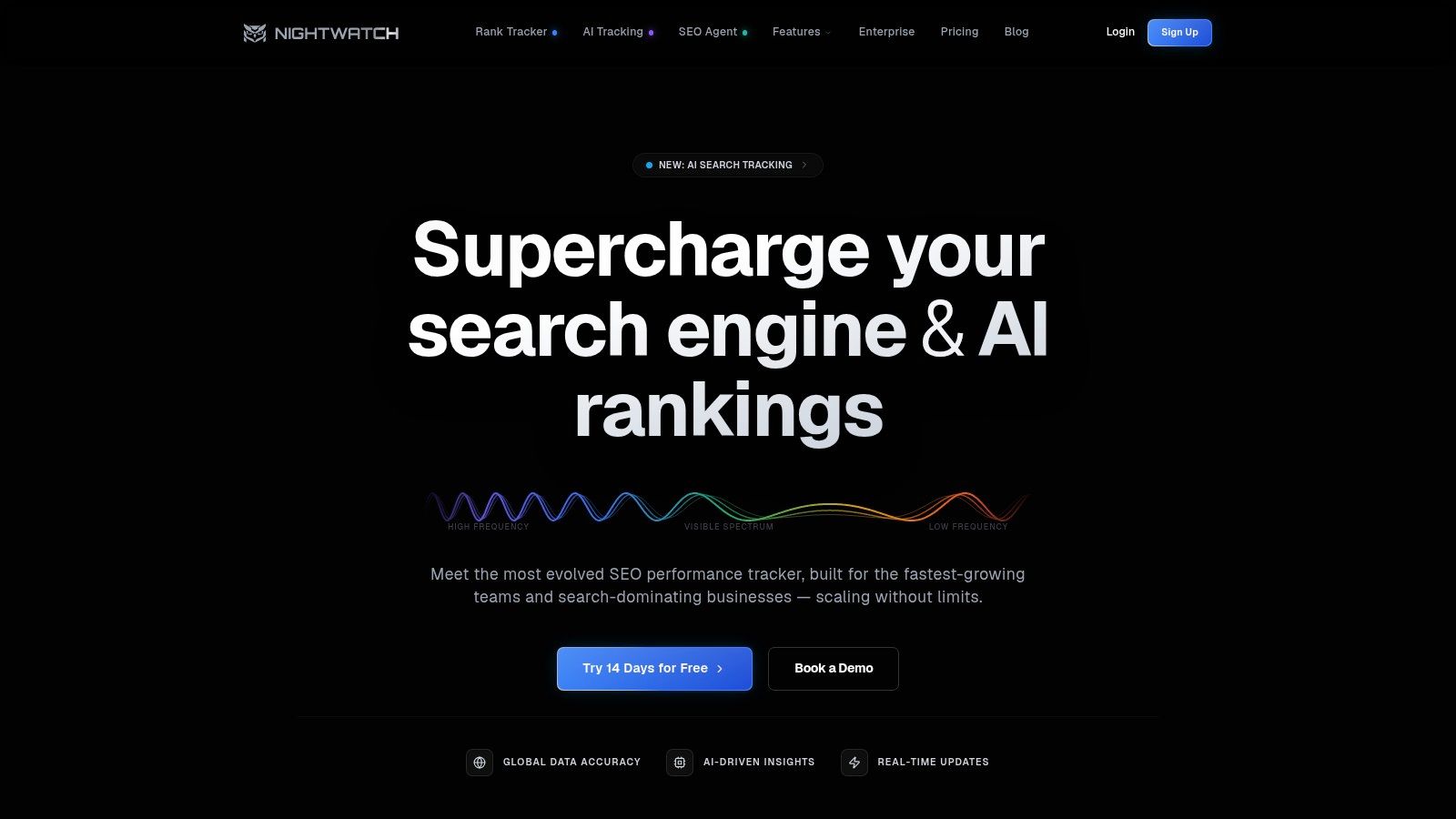
Nightwatch positions itself as a powerful, all-in-one SEO platform that has expanded into AI tracking, making it a strong Profound alternative for teams wanting to unify traditional and generative search monitoring. Rather than being a pure-play AEO tool, Nightwatch integrates AI visibility as an add-on to its established rank tracking infrastructure. This allows users to monitor generative rankings, share-of-voice, and citation sentiment alongside their core organic keyword performance.
The platform’s value lies in this consolidated view. For agencies and marketing teams that already manage a broad SEO strategy, Nightwatch prevents the need for another siloed tool. It provides a bridge between classic search engine results and emerging AI-driven answers, showing how web lookups influence generative outputs within a familiar interface.
Key Features & Use Cases
- Best For: SEO agencies and in-house marketing teams who need to manage both traditional SEO and AEO without adding another specialized platform to their tech stack. It’s ideal for those seeking a cost-effective, unified dashboard.
- AI Tracking Add-On: Monitor generative rankings, share-of-voice, and the sentiment of citations. The integration connects AI performance directly to underlying SEO efforts.
- Broad SEO Toolset: Leverage a full suite of features including local and global rank tracking, site auditing, and comprehensive reporting with Looker Studio integration. For a deeper look at its capabilities, see this comparison of the best SEO ranking reporting software.
- Flexible Data Refreshes: Offers both real-time and manual data updates, giving users control over when they pull the latest AI and search ranking information.
Pricing & Implementation
Nightwatch is known for its affordable core plans, with the AI Tracking feature available as a usage-based add-on. This model can be very cost-effective for teams just starting with AEO, though costs can scale as monitoring intensity increases. A 14-day free trial is available to test the full platform. While the core features are robust, the AI module is still in beta and may not have the same geographical depth as some dedicated AEO tools.
- Website: https://nightwatch.io/
- Pro Tip: Start by tracking your most important branded and high-intent commercial keywords in the AI module to assess the immediate impact of generative search on your bottom-funnel traffic.
6. Semrush (AI Visibility Toolkit)
For teams already embedded in the Semrush ecosystem, its AI Visibility Toolkit emerges as a practical and integrated profound alternative. Rather than being a standalone AEO platform, Semrush treats AI tracking as a powerful extension of its existing, full-stack SEO and marketing suite. This approach is ideal for organizations that want to consolidate their tools and view AI-driven visibility as a component of their broader organic strategy, not a completely separate discipline.
The toolkit allows you to monitor your brand’s presence and sentiment across prominent AI platforms, including Google’s AI Overviews. Its strength lies in its ability to layer AI insights on top of a massive dataset of traditional SEO metrics. You can analyze how your visibility in AI-generated answers correlates with your keyword rankings, backlink profile, and content performance, all within a familiar interface. This provides a holistic view that standalone tools might miss.
Key Features & Use Cases
- Best For: In-house marketing teams and SEO agencies already using Semrush who want to add AI monitoring without onboarding a new platform. It’s perfect for those who prioritize workflow integration over specialized, deep AEO features.
- Integrated SEO Workflow: Connect AI visibility and sentiment data directly to your core SEO campaigns, including rank tracking, competitor analysis, and content marketing efforts.
- Competitor Positioning: Benchmark your AI presence against key competitors to identify opportunities and threats directly within the Semrush environment you already use for competitive intelligence.
- Sentiment Analysis: Go beyond simple mentions to understand if AI models are representing your brand positively, neutrally, or negatively, providing crucial feedback for brand reputation management.
Pricing & Implementation
The AI Visibility Toolkit is available as a paid add-on to existing Semrush subscriptions, making it a cost-effective choice for current users but potentially pricey for those only needing AI tracking. The platform is mature and well-documented, ensuring a smooth implementation.
- Website: https://www.semrush.com/
- Pro Tip: Use the sentiment analysis feature to identify negative brand portrayals. For a deeper understanding, this guide to monitoring brand visibility in LLMs offers strategies for diagnosing and addressing the root causes.
7. SiteSignal
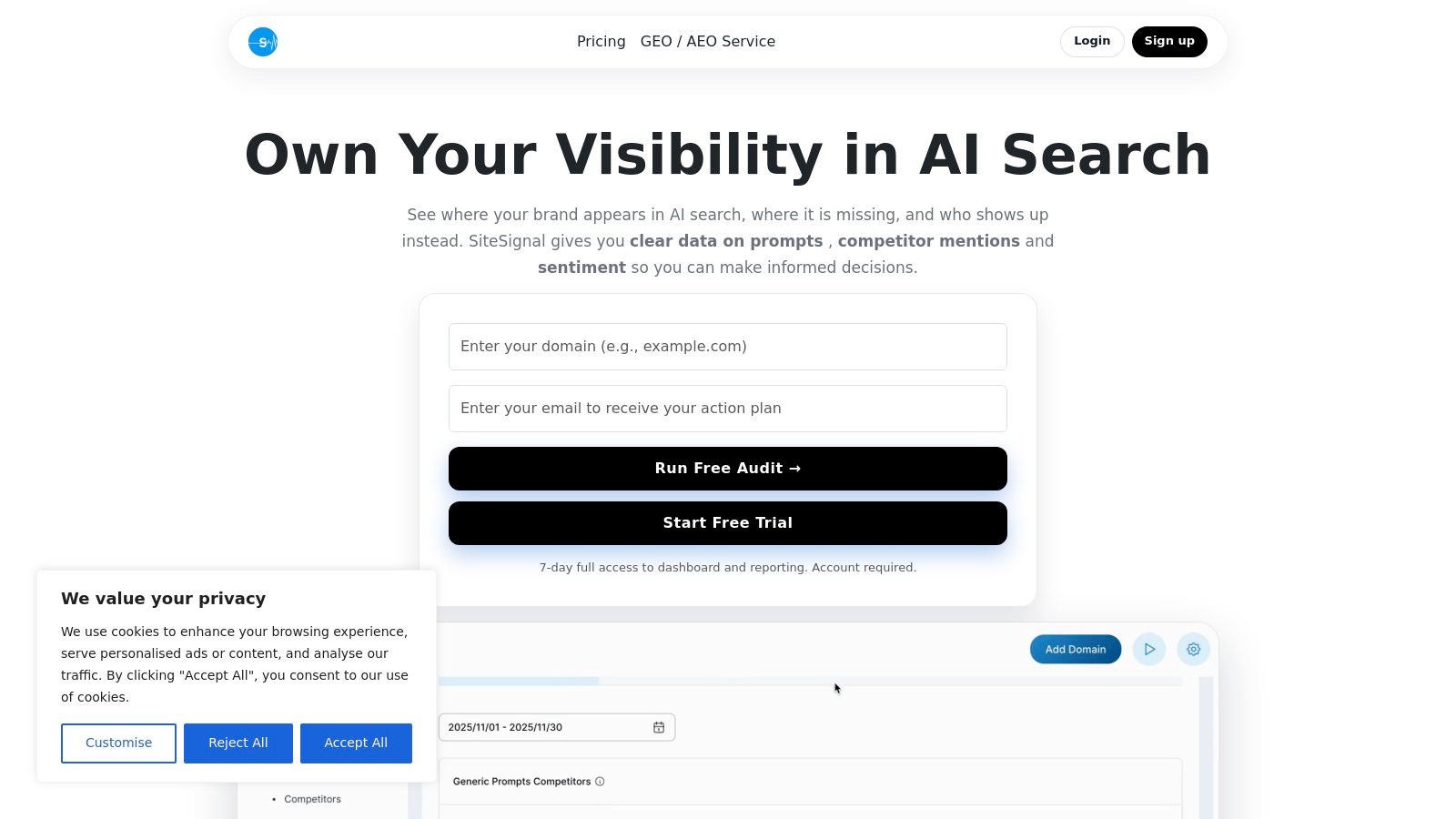
SiteSignal is a streamlined website health and AI visibility platform, making it an excellent alternative to Profound for agencies and fast-moving teams. Its core strength is the BrandRadar feature, which automates daily prompt checks across major models like ChatGPT, Gemini, Perplexity, and Claude. It quickly identifies who appears for key terms, how often, and alerts you to changes in your AI-driven visibility.
The platform’s true differentiator is its focus on actionable outcomes. Instead of just presenting data, SiteSignal provides prescriptive tasks to improve your AI search footprint. It directly connects visibility gaps with specific content, schema, or technical SEO fixes, removing guesswork from the AEO process. This makes it particularly valuable for users who need clear, step-by-step guidance.
Key Features & Use Cases
- Best For: SEO and digital marketing agencies requiring white-label AEO reports, as well as in-house marketing teams that need quick audits and actionable guidance without deep analytical overhead.
- Automated Daily Checks: Monitor your brand and competitor presence across top LLMs with automated daily scans, providing timely alerts on visibility shifts.
- Prescriptive Task Generation: Receive concrete, “what to fix” recommendations that link directly from identified visibility gaps to specific content and schema tasks.
- Agency-Ready Reporting: Generate white-label PDF and dashboard exports to share AI visibility progress and insights directly with clients.
Pricing & Implementation
SiteSignal offers a tiered subscription model, with plans designed to accommodate freelancers, growing agencies, and larger teams. The platform is known for its quick setup and user-friendly interface, allowing users to start running audits and generating reports within minutes. Its focus on providing clear tasks simplifies implementation for teams less familiar with AEO.
- Website: https://sitesignal.app/
- Pro Tip: Use the competitor presence alerts to react quickly when a rival brand starts appearing for your target prompts. This allows you to analyze their cited sources and adjust your content strategy in near real-time.
Choosing the Right AI Visibility Tool for Your Goals
Navigating the landscape of Profound alternatives reveals a market that has matured well beyond its infancy. The question is no longer if you can track your AI visibility, but how you can do it most effectively to meet your specific business objectives. This comprehensive review of platforms like Airefs, AthenaHQ, and Peec AI demonstrates a clear divergence in strategy and focus across the available solutions.
The core takeaway is that your choice must be driven by your operational reality. For agile startups and in-house marketing teams, a dedicated, source-driven platform like Airefs or SiteSignal provides the most direct path from insight to action. These tools cut through the noise to show you exactly which web pages influence AI responses, offering a clear, tactical roadmap for content creation and optimization. They are built for teams that need to execute quickly and see a tangible impact on their generative engine visibility.
For larger enterprises or agencies already embedded in comprehensive SEO ecosystems, the decision-making process is different. Integrated solutions from established players like Semrush, BrightEdge, and Conductor offer the significant advantage of consolidating AI visibility data within existing workflows. This approach streamlines reporting, aligns with established governance protocols, and allows teams to view generative engine optimization (GEO) as a natural extension of their current SEO efforts, rather than a separate, siloed discipline. The trade-off may be less specialized features, but the benefit is a unified, holistic view of search performance.
Key Factors for Your Decision Matrix
When selecting from the options available, understanding comprehensive AI brand visibility tracking tools is a vital first step. Beyond feature lists, consider these critical factors to guide your selection:
- Actionability of Data: Does the tool simply report on your mentions, or does it provide a direct link to the source documents influencing those mentions? The ability to connect an AI-generated answer to a specific URL is the most critical feature for any team serious about improving its visibility.
- Workflow Integration: How easily does the platform fit into your team’s current processes? A powerful tool that requires a complete overhaul of your marketing operations is less valuable than a slightly less feature-rich one that your team will actually use every day.
- Scalability and Pricing: Consider not just your current needs but where you’ll be in 12-24 months. A tool with a low entry price might become prohibitively expensive as you scale your tracking efforts. Evaluate the pricing tiers and ensure they align with your anticipated growth in tracked prompts and user seats.
- Focus vs. Breadth: Decide whether you need a specialized, best-in-class tool for GEO or an all-in-one suite that covers all aspects of digital marketing. There is no right answer, but this strategic decision will significantly narrow your list of viable profound alternatives.
Ultimately, the goal is to move from passive monitoring to active influence. The best tools empower you to understand why AI models say what they do and give you the precise intelligence needed to shape that narrative. By choosing a platform that aligns with your team’s size, budget, and strategic goals, you can secure a durable competitive advantage in the new landscape of AI-driven search.
Frequently Asked Questions (FAQ)
1. What is the main difference between a dedicated GEO platform and an SEO suite with an AI add-on? A dedicated GEO (Generative Engine Optimization) platform is built from the ground up to track and analyze brand visibility within AI answer engines like ChatGPT, Perplexity, and Google AI Overviews. They focus on prompt tracking, source analysis, and share-of-voice in generative answers. In contrast, an SEO suite (like Semrush or Nightwatch) adds AI tracking as a feature to its core offering of keyword ranking, backlink analysis, and site audits. The best choice depends on your focus: if AI visibility is your primary goal, a dedicated tool offers deeper, more specialized features. If you want to integrate AI data into a broader, existing SEO strategy, an all-in-one suite can be more efficient.
2. How do I know which prompts to track for my brand? Start with your buyer’s journey. Identify the high-intent questions potential customers ask when researching solutions in your category. These often include comparative prompts (e.g., “best alternative to [competitor]”), problem-based prompts (e.g., “how to solve [pain point]”), and definitional prompts (e.g., “what is [your product category]”). Many tools, including Airefs, are designed to help you identify these key prompts and monitor how you and your competitors appear in the answers.
3. Is it better to choose a tool that tracks more AI models? Not necessarily. While broad coverage seems appealing, it’s more effective to focus on the AI models your target audience actually uses. For most B2B and B2C brands, ChatGPT and Google AI Overviews are the highest priority. Choose a tool that provides deep, actionable insights for these key platforms first. A platform that tracks 10 models with surface-level data is often less valuable than one that provides source-level analysis and actionable recommendations for the two or three models that matter most to your business.
4. Can I really influence what AI models say about my brand? Yes, absolutely. AI models like ChatGPT build their answers by synthesizing information from a vast index of web pages, articles, forum discussions (like Reddit), and product reviews. By identifying the specific sources an AI relies on for a given topic, GEO platforms allow you to take concrete actions. This could involve publishing a new blog post that directly answers a common question, updating an existing article with better information, or participating in a relevant community discussion. Over time, these targeted efforts can directly influence the content of future AI-generated answers.
Ready to move from monitoring to influencing your AI visibility? Airefs provides the source-level intelligence you need to take action. As a leading Profound alternative, it helps you pinpoint the exact URLs shaping AI answers so you can build a targeted content strategy that gets results.