

Ever wonder how much noise your brand is really making in your industry? That’s what Share of Voice (SOV) is all about. It’s a straight-up measure of your brand’s visibility and relevance.
Think of your market as a packed concert hall. SOV tells you how loud your band is playing compared to everyone else on stage.
Understanding Share of Voice In Modern Marketing

Share of Voice is a core metric that stacks your brand’s presence up against the competition. Historically, it only measured your slice of the total ad spend. Today, its meaning has expanded to cover the entire digital world.
Understanding SOV is crucial in the chaotic modern marketing landscape. It’s a competitive benchmark that shows you exactly where you stand. A higher SOV usually translates to more brand awareness and authority.
The math behind it is simple: (your brand mentions ÷ total mentions in the category) × 100. This gives you a clean percentage representing your visibility.
Share of Voice At a Glance
Here’s a quick breakdown to put the key pieces of SOV into perspective.
| Concept | What It Measures | Why It Is Important |
|---|---|---|
| Visibility Benchmark | Your brand’s percentage of the total conversation in your industry. | It shows how you stack up against competitors in real-time. |
| Leading Indicator | Future market share potential, not just past sales. | SOV growth often predicts future revenue and market dominance. |
| Holistic Presence | Your influence across all channels—paid, organic, social, and earned media. | It provides a complete picture of brand health, not just ad spend. |
This table shows that SOV isn’t just a number. It’s a strategic tool for gauging and predicting your brand’s impact.
Why SOV Is More Than a Vanity Metric
Many marketers dismiss SOV as just an awareness number, which is a mistake. It is a powerful leading indicator of future growth. Sales data tells you what happened, while SOV helps you predict what’s next.
A famous study found a direct link between SOV and market share growth. It showed that for every 10% of “excess” share of voice (ESOV), your market share tends to grow by about 0.5%. ESOV is when your SOV is higher than your market share.
This connection turns SOV into an essential KPI for any team building sustainable growth. It proves that being part of the conversation directly drives business results.
Share of Voice is the ultimate measure of brand relevance. It answers a simple question: When your audience talks about your industry, are you even in the conversation? If not, you’re invisible.
The Components of Modern SOV
Today, you cannot just look at one channel and call it a day. That provides a skewed, incomplete picture. You need to track SOV everywhere your audience spends their time.
Our guide on search marketing intelligence connects some of these dots. Here are the key channels to monitor:
- Organic Search: How often do you appear in search results for your most important keywords?
- Social Media: What is the volume of your mentions, hashtags, and engagement on platforms like X, LinkedIn, and Instagram?
- Paid Media: What is your impression share compared to the total available impressions in your ad campaigns?
- Earned Media: Are you getting coverage in news articles, blog posts, and other third-party content?
Tracking these areas gives you a 360-degree view of your brand’s influence. You can pinpoint which channels drive conversations and where competitors are winning.
The Evolution of SOV: From Ad Spend to AI Answers
Share of Voice wasn’t always this complex. It began as a simple advertising metric, born in the era of TV and print.
The formula was straightforward: your brand’s ad spend compared to everyone else’s. If you outspent them, you owned the conversation. It was a direct reflection of your budget.
This traditional approach offered a clear, if narrow, picture of brand presence. It was really a measure of ‘share of wallet’ in the advertising space. The math was easy but missed organic influence and public sentiment.
Then the internet arrived, transforming the concept of SOV. The conversation exploded from a few controlled channels into countless digital platforms. Visibility was no longer just about who could buy the most ad space.
From Share of Wallet to Share of Attention
The digital shift forced marketers to rethink how they measured influence. SOV expanded to include organic search rankings, social media mentions, and earned media coverage. This began to paint a more complete picture of a brand’s true visibility.
The focus pivoted from ‘share of wallet’ to ‘share of attention.’ A brand with a smaller budget could now outmaneuver a larger competitor. Smart content, savvy SEO, and real community engagement changed the rules.
The classic formula for SOV was (your ad spend ÷ total category spend) × 100. While ad-spend SOV once accounted for over 90% of tracking in the 1990s, today it’s less than 30%. You can explore the history of Share of Voice on Wikipedia.
This evolution meant new skills became essential. Success was no longer just about media buying. It was about earning attention by being genuinely useful.
- Content Marketing: Creating articles, videos, and guides that rank in search and solve problems.
- Community Management: Joining conversations on social media and forums to build relationships.
- Public Relations: Getting mentioned in online publications and blogs to build third-party credibility.
These strategies let brands build SOV organically. This created a presence that felt more authentic and sustainable.
The New Frontier: AI Share of Voice
We are now entering the next major phase of SOV’s evolution, driven by artificial intelligence. More people are turning to AI models like ChatGPT for answers. This has created a new kind of visibility we call AI Share of Voice.
AI Share of Voice measures how often your brand is cited in AI-generated answers. This is not about ranking #1 on a search results page. It’s about becoming the answer itself—the ultimate signal of authority.
This shift is a big deal because AI models synthesize information from all over the web. To win here, your brand needs to be woven into the internet’s knowledge base. Optimizing for this is the core of AI search engine optimization.
Adapting your SOV strategy for this new channel is no longer optional. It’s the future of brand discovery.
How to Calculate Share of Voice Across Key Channels
Measuring your Share of Voice isn’t a one-size-fits-all process. The right metrics and methods depend on the channel, whether it’s organic search, paid ads, or social media.
You must isolate the right metrics for each channel to get a clear picture. Skipping this step leads to a pile of data with no real competitive benchmark.
The concept of Share of Voice has morphed over time. It started as an ad spend comparison and has expanded to track our digital footprint and our presence in AI answers.
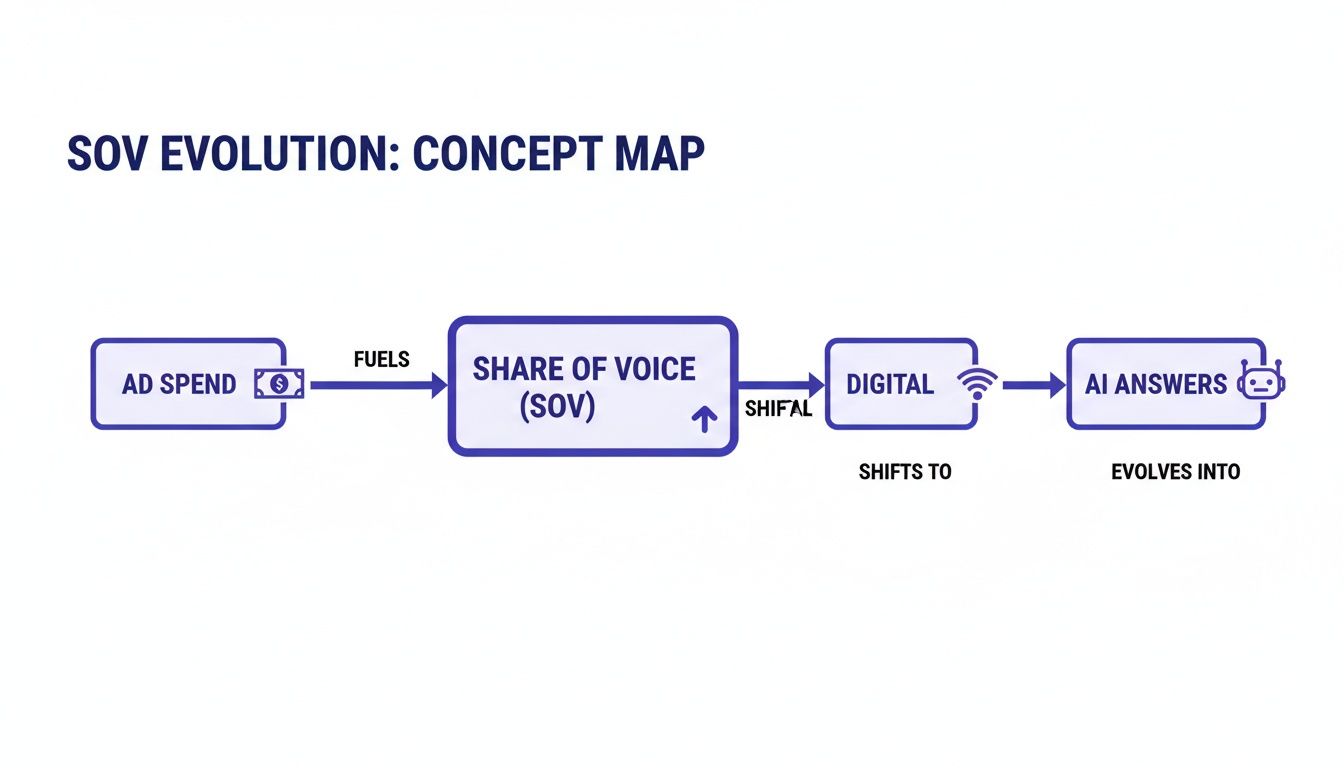
As attention shifts, our measurement must keep up. We’ve moved from tracking dollars to tracking digital authority.
Calculating Organic Search SOV
For SEO, Share of Voice is about your visibility on search engine results pages (SERPs). This applies to the keywords that matter to your business. It’s about your overall presence across a wide set of relevant queries.
A solid way to calculate this is by tracking your share of clicks or impressions for a target keyword list. Most modern SEO tools can automate this, giving you a clear percentage of search traffic you own. Our guide on Ahrefs’ Share of Voice feature shows how this works.
The basic formula is straightforward:
Organic SOV (%) = (Your Brand’s Total Clicks or Impressions / Total Clicks or Impressions for Tracked Keywords) x 100
This number tells you exactly how much of the available search audience you’re capturing.
Measuring Social Media SOV
On social media, Share of Voice is about who’s winning the conversation. It measures how often people talk about your brand compared to your competitors. This includes @mentions, hashtags, and untagged mentions.
First, you need to define your scope, like mentions on X or hashtags on Instagram. Once you’ve chosen your channels, social listening tools can pull the data.
- Step 1: Track Mentions: Count every mention of your brand, products, or unique hashtags over a set period.
- Step 2: Track Competitor Mentions: Do the same for a list of your top competitors.
- Step 3: Calculate the Total: Add your mentions and your competitors’ mentions to get the total conversation volume.
Then, use the formula:
Social SOV (%) = (Your Brand Mentions / Total Industry Mentions) x 100
This metric quickly reveals who’s dominating the social chatter in your niche.
Tracking Paid Media SOV
In paid advertising, Share of Voice is more direct. It’s measured by a metric called Impression Share, available in platforms like Google Ads. It tells you the percentage of time your ads were shown out of the total possible times.
An impression share of 70% means your ads appeared for 7 out of every 10 eligible searches. The other 30% went to a competitor or was lost due to low ad rank or budget.
Keeping an eye on impression share helps you understand market penetration and competitive pressure. It also reveals growth opportunities where you can increase your budget or bids.
A systematic approach, informed by modern content analysis methods, ensures your data is clean and your conclusions are reliable.
Calculating SOV by Marketing Channel
Here’s a quick look at how the core metrics and formulas change from one channel to the next.
| Channel | Key Metric to Track | Calculation Formula |
|---|---|---|
| Organic Search | Keyword Impressions or Clicks | (Your Impressions / Total Market Impressions) x 100 |
| Paid Media | Impression Share | (Your Impressions / Total Available Impressions) x 100 |
| Social Media | Brand Mentions or Hashtags | (Your Mentions / Total Industry Mentions) x 100 |
| Public Relations (PR) | Media Mentions | (Your Media Mentions / Total Industry Mentions) x 100 |
While the metric changes, the goal is the same: to figure out how much of the conversation you own.
Measuring Your Share of Voice in the Age of AI
Traditional share of voice metrics are missing a huge piece of the puzzle. A critical new channel exists where the modern battle for brand visibility is won: AI-generated answers. Old-school methods just can’t track it.
This new frontier is called AI Share of Voice. It measures how often your brand gets mentioned in responses from LLMs like ChatGPT. As more people turn to AI for recommendations, becoming the answer is more valuable than ranking on a page.

This shift requires a new set of tools and a different way of thinking about brand presence. The game is now about influence and authority, not just clicks.
The Shift to Measuring AI Visibility
Measuring your presence in AI answers is not like tracking keywords. AI models pull information from a massive web of sources. They read articles, forums, and discussions to synthesize the most credible response.
To win here, you must understand which sources are shaping the AI’s “opinion” in your industry. This means identifying the specific blog posts, Reddit threads, and review sites that LLMs consistently reference. Visibility into these sources is key to influencing the conversation.
This is why new platforms are being built. Tools like Airefs analyze outputs from major AI models to see which brands are cited as authoritative sources.
How to Approach AI Share of Voice
Getting started with AI SOV requires a methodical approach. You need a clear process for tracking, analyzing, and acting on the data.
Here’s a practical framework to get you started:
- Identify Key Prompts: Figure out the core questions your potential customers are asking AI assistants.
- Track Brand Mentions: Monitor how often your brand and competitors appear in the answers to these prompts.
- Analyze the Sources: Dig deeper to see which articles, forum discussions, or reviews the AI is using.
- Find Opportunities: Use source analysis to spot content gaps you can fill or conversations you can join.
This process turns AI visibility from a black box into a measurable, manageable marketing channel. It gives you a clear roadmap for securing your brand’s place in the future of search. Our guide on AI Overviews tracking offers a deeper dive.
Why Source Analysis Is Critical
Understanding the sources AI models rely on is the single most important part of this discipline. If you don’t know why an AI recommends a competitor, you can’t change the outcome. Source analysis gives you that “why.”
AI models are like tireless research assistants. They read everything—product reviews, forum debates, expert articles—and form a consensus. Winning AI Share of Voice means ensuring your brand is a trusted, frequently-cited source in the material they study.
For instance, an AI might consistently recommend a competitor’s product because it’s mentioned in a dozen Reddit threads. Without a tool that surfaces those specific threads, you’d never know where to focus your efforts.
This level of insight allows you to be surgical with your marketing. You can prioritize creating content that mirrors what AI already trusts.
Why Share of Voice Is a Powerful Growth Lever
Most marketing metrics tell you what already happened. Sales reports and revenue figures are all lagging indicators.
Share of Voice (SOV) is different. Think of it as a crystal ball for your market share. It’s a leading indicator, giving you a peek into where your business is headed.
There’s a well-established rule in the industry called Excess Share of Voice (ESOV). The idea is surprisingly simple but incredibly powerful. When your brand’s SOV is higher than its market share, you’re on track to grow.
The Predictive Power of Excess Share of Voice
ESOV creates a clear link between how much you’re talked about and your bottom line. More organic search SOV funnels high-intent traffic your way. More social media mentions build brand trust.
SOV’s track record as a predictor of growth is its most powerful attribute. A landmark study found that a 10% ESOV typically leads to a 0.5% gain in market share. You can read more about these SOV findings on Sprout Social.
This relationship shifts SOV from a vanity metric into a must-track strategic tool. It proves that building your brand’s presence is a direct investment in long-term growth.
A brand that consistently maintains an SOV greater than its market share is creating a growth deficit for its competitors. Every percentage point of ESOV you gain makes it harder for others to keep up, creating a powerful competitive moat over time.
This makes SOV a critical lever for your entire business strategy. It justifies brand-building efforts by tying them to tangible financial outcomes.
How SOV Translates to Tangible Business Value
Thinking of SOV as just “mentions” completely misses the point. Each piece of your Share of Voice contributes to different business goals.
Here’s how the different components of SOV deliver real value:
- Higher Search SOV: Drives more organic traffic, directly lowering your customer acquisition costs.
- Greater Social SOV: Builds a loyal community and sparks user-generated content, which is powerful social proof.
- Stronger Media SOV: Boosts your credibility, making it easier to attract top talent and partnerships.
None of these exist in a vacuum. A feature in a major publication (media SOV) gets more people searching for you (search SOV). This creates a self-fuelling cycle of growth.
Actionable Strategies to Increase Your Share of Voice
Knowing your share of voice is one thing. Actually growing it is another.
Boosting your SOV isn’t about shouting louder. It’s about being the one everyone wants to listen to. It requires a shift from pure promotion to becoming an indispensable resource.
The goal is to earn attention, not just buy it. The best strategies focus on sparking genuine conversations and establishing your brand as a credible voice.
Build Authority with Data-Driven Content
One of the surest ways to grow your SOV is to publish data-driven content. Original research, industry surveys, and deep-dive case studies are valuable to both humans and AI models. They offer unique insights backed by proof.
AI models constantly scan the web for credible sources to cite in their answers. When your brand is the origin of that data, you increase your chances of being featured. This directly lifts your AI Share of Voice.
Your goal is not just to create content, but to create source material. When your blog posts and reports become the data that others cite, your share of voice grows exponentially without any additional effort.
For a closer look, check out our guide on how to optimize content for AI search.
Dominate Niche Community Discussions
Another effective strategy is to get active in niche communities. Think platforms like Reddit, Quora, and specialized industry forums. These are the places where people have authentic conversations.
Your presence here can directly shape future AI-generated answers. But you have to add real value, not just drop links. Answer questions thoughtfully and become a trusted community member.
How to make it work:
- Find the Right Hangouts: Identify the subreddits, Quora spaces, or forums where your audience is already asking questions.
- Listen First: Get a feel for the community’s culture, rules, and hot topics before you jump in.
- Offer Real Help: Provide detailed, helpful advice without the hard sell.
Analyze and Exploit Competitor Gaps
You don’t have to build your SOV strategy in a bubble. A smart analysis of your competitors’ share of voice can point you to their weaknesses. This reveals your biggest opportunities.
Look at the channels they own and, more importantly, the ones they ignore. Are they all over social media but invisible in organic search? Do they get PR mentions but never show up in community forums?
Every gap is an invitation to establish a beachhead. Use SOV monitoring tools to pinpoint these content and channel gaps. Then, move in to fill them with your own authoritative voice.
FAQ: Your Share of Voice Questions Answered
What’s the difference between Share of Voice and Market Share?
Market share is your percentage of total sales, a look at past performance (a lagging indicator). Share of Voice is your percentage of the total conversation, a predictor of future performance (a leading indicator). A high SOV today often leads to a larger market share tomorrow.
What is a good Share of Voice percentage?
There is no single “good” number. The goal is to achieve “Excess Share of Voice” (ESOV), where your SOV is higher than your market share. For example, if you have a 5% market share, an SOV above 5% indicates you are positioned for growth.
How does Share of Voice impact customer acquisition cost (CAC)?
A higher organic SOV from channels like search and social can dramatically lower your CAC. As more people discover your brand for free, you become less dependent on expensive advertising. This makes your customer acquisition more efficient and profitable.
How is AI Share of Voice different from SEO Share of Voice?
SEO SOV measures your visibility in a ranked list of search results. AI SOV measures your brand’s presence inside the single, synthesized answer provided by an AI model. SEO gets you on the list of options, while AI SOV makes you the definitive answer.
Why is Share of Voice a leading indicator of growth?
Conversation comes before conversion. When more people talk about your brand and find you organically, you build “mental availability.” This increased visibility and relevance create momentum that translates into future sales and market share growth.
Ready to measure and grow the most important new metric in marketing? Airefs is the only platform that tracks your brand’s visibility inside AI-generated answers. See where you stand against competitors and uncover actionable opportunities to become the go-to answer in your industry. Learn more at Airefs.