
Search marketing intelligence is a new way of thinking about brand visibility now that AI is everywhere. It goes way beyond old-school SEO metrics. The focus is now on how, when, and why your brand shows up in AI-generated answers from tools like ChatGPT and Google’s AI Overviews.
It’s about influencing recommendations, not just ranking pages.
The New Reality of Search Intelligence
The ground is shifting beneath our feet. For two decades, marketing was a game of keywords and clicks. Success meant climbing to the top of a search engine results page. That era is quickly fading.
The new customer journey often bypasses websites completely. It starts and ends with a conversation with an AI.
This isn’t some far-off trend; it’s happening right now. The move from traditional search to AI-powered discovery is changing how buyers find information and make decisions. According to Gartner, AI assistants are on track to handle roughly 25% of global search queries by 2026. At the same time, they predict traditional search engine volume is expected to drop by 25%.
This is a massive shift. A recent study by HubSpot found that 75% of consumers say they use AI search tools more often than they did a year ago. To win, we need a completely different playbook.
From Keywords to Prompts
Yesterday’s goal was to rank for “best project management software.” Today, the challenge is to be the top-cited brand when a user asks an AI, “What are the best project management tools for a small, remote team that needs integrations with Slack and Figma?”
This is what search marketing intelligence is all about: understanding and winning these moments. Thriving here means getting really good at the synergy between knowledge management and artificial intelligence.
Search Marketing Intelligence isn’t about tricking an algorithm. It’s about becoming such an authoritative and trusted source in your niche that AI models have no choice but to recommend you.
This dashboard gives you a feel for how platforms track brand visibility inside AI answers.
Instead of just tracking keyword positions, this view shows how often a brand gets mentioned for key user prompts over time. It gives you a clear picture of your actual influence.
Understanding the Four Pillars of Search Marketing Intelligence
Search marketing intelligence isn’t just a new buzzword; it’s a whole new way of looking at your performance in an AI-first world. Think of it like a four-legged stool. If one leg is missing, the whole thing gets wobbly. These four pillars give you a complete picture of your brand’s health, moving way beyond old-school metrics like keyword rankings.
The path from a person typing a question to getting an AI answer has fundamentally changed how we find information.
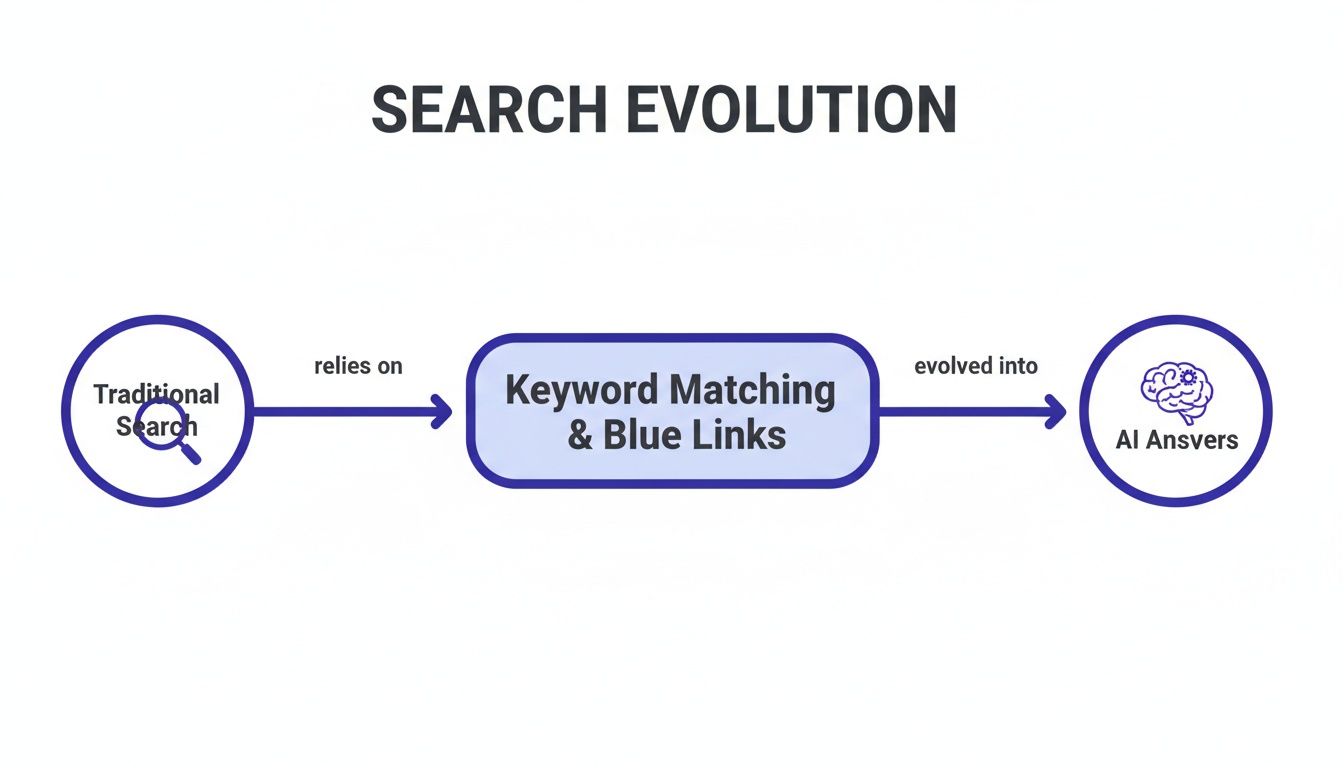
This shift from the classic search magnifying glass to the AI brain means winning is no longer about just showing up in a list of blue links. It’s about becoming part of the answer itself.
Let’s break down the four pillars that make this possible. Each pillar helps you answer a critical question about your performance in this new landscape.
| Pillar | What It Measures | Key Question It Answers |
|---|---|---|
| Prompt Tracking | The full, conversational questions your audience asks AI. | ”What are my customers really asking?” |
| AI Answer Visibility | How often your brand is mentioned in AI-generated answers. | ”Is my brand part of the conversation?” |
| Source Attribution | The specific content (articles, forums, etc.) an AI uses to form its answers. | ”Why is the AI saying what it’s saying?” |
| Competitor Benchmarking | Your visibility and source performance compared to your rivals. | ”How am I doing against the competition?” |
These components work together to turn the black box of AI search into a clear, actionable strategy for growth.
Pillar 1: Prompt Tracking
First up is prompt tracking, which is basically the new keyword research. Instead of zeroing in on short, choppy keywords, this pillar focuses on the full, conversational questions people are actually asking AI models. These detailed “prompts” tell you what your audience truly wants to know.
Let’s say you sell project management software. A classic keyword is “project management tool.” A modern prompt is something like, “What are the best project management tools for a small marketing agency that needs to track time and integrate with Slack?” See the difference?
Tracking these prompts shows you the exact problems your customers are trying to solve. It’s about listening to their real language and aligning your content to match. You’re no longer guessing what people want; you’re seeing exactly what they’re asking for.
Pillar 2: AI Answer Visibility
Once you know the prompts that matter, you need to measure your AI Answer Visibility. This is your brand’s report card in a world where clicks are becoming less important. It answers a simple question: “When someone asks about my industry, is my brand getting mentioned?”
But it’s not just about getting a mention. It’s about the quality of that mention. Are you the top recommendation? Are you just listed among a sea of competitors? Or worse, are you nowhere to be found?
This metric completely replaces the old vanity metric of keyword ranking. It’s a direct measure of your brand’s influence right at the moment a buying decision is being made.
Pillar 3: Source Attribution
Source attribution is the detective work. After you see your brand mentioned (or not mentioned) in an AI answer, this pillar helps you figure out why by tracing the response back to the original content it pulled from.
AI models don’t just invent information. They synthesize it from a massive library of articles, Reddit threads, reviews, and blog posts. Source attribution pinpoints exactly which pieces of content are influencing the AI.
- Content Opportunities: You might find the AI keeps citing a competitor’s annual report. That’s a huge signal to create your own, better version.
- Comment Opportunities: Maybe a specific forum discussion is repeatedly sourced for a key prompt. By joining that conversation, you can directly influence future AI answers.
Understanding the sources turns the AI from a mysterious black box into a roadmap of opportunities. It shows you exactly where to focus your efforts. A good place to start is making sure your own site is ready; you can learn the basics with these 10 technical SEO tips for AI search.
Pillar 4: Competitor Benchmarking
The final pillar is competitor benchmarking. This is what gives all your other data context. It’s great to know how often you’re mentioned, but you also need to know how that stacks up against your rivals.
This pillar helps you answer critical strategic questions:
- Which competitors own the conversation for high-value prompts?
- What specific sources are giving them that visibility?
- Are there any prompts where a competitor is weak, creating an opening for you?
By tracking competitor performance, you can spot threats before they become problems and find strategic weaknesses to exploit. This turns your intelligence from a simple monitoring tool into a real competitive weapon, giving you a proactive plan to win market share.
Why Traditional SEO Metrics No Longer Tell the Full Story
For years, the SEO dashboard was our North Star. We lived and died by metrics like keyword rank, organic traffic, and click-through rates. Those numbers told us if we were winning or losing the search game.
But the game has changed, and our old scorecard is now dangerously incomplete.
Relying solely on those traditional KPIs is like trying to navigate a new city with an old paper map. It shows you the main roads but misses all the new highways and shortcuts that determine how people actually get around today. In the world of AI search, those new highways are AI answers, and they often bypass your website completely.
The Rise of the Zero-Click Answer
The core problem is simple: when an AI like ChatGPT or a Google AI Overview gives someone a direct, satisfying answer, there is no click. The user’s journey starts and ends right there in the AI interface. Your brand could be the star of that answer, the top recommendation that solves the user’s problem, yet your Google Analytics will show… nothing.
This creates a massive blind spot. If your strategy is only optimized for driving traffic, you’re invisible in the growing number of conversations that happen before a click ever occurs.
An AI-generated answer is the new top of the funnel. If you aren’t visible there, you don’t exist for a significant and growing portion of your audience, regardless of how well your pages are ranked.
This isn’t just a theory; the consumer behavior is already here. A striking report from Capgemini found that 62% of global consumers now trust AI tools to guide their brand decisions. That trust is so strong that research from BrightLocal shows 68% of consumers have used ChatGPT specifically to research local products or services, proving AI is now a key advisor in the buying process.
The Volatility of AI Models
Adding to the complexity is how volatile these AI models are. Unlike Google’s relatively predictable algorithm updates, the information and sources powering Large Language Models (LLMs) can change in a flash. One day, your brand might be the top recommendation for a key prompt. The next, a model update could make you disappear entirely.
Traditional rank tracking just can’t capture this instability. It’s no longer enough to monitor your position on a search results page. You need a more advanced framework. For a deeper dive, check out our guide on how to monitor your brand visibility in LLMs.
This volatility means you need a system for continuous monitoring that answers a whole new set of questions:
- AI Visibility: How often is my brand mentioned in answers for my target prompts?
- Citation Frequency: Are my articles and data being used as sources by the AI?
- Share of Voice: How does my visibility stack up against my competitors within these answers?
These metrics provide a true measure of influence in an AI-first world. They shift the focus from getting a click to winning the recommendation—the ultimate goal of modern search marketing intelligence.
Your Workflow for Turning AI Insights into Action
Gathering data is the easy part. The real work starts when you turn that intelligence into a repeatable process that actually moves the needle. A solid search marketing intelligence workflow isn’t about random acts of content; it’s a deliberate system for influencing AI conversations.
It’s a simple loop: monitor what AI models are saying, analyze the sources they’re pulling from, and execute plays to get your brand into those sources. Follow these steps, and you’ll build a consistent strategy to show up where it counts.
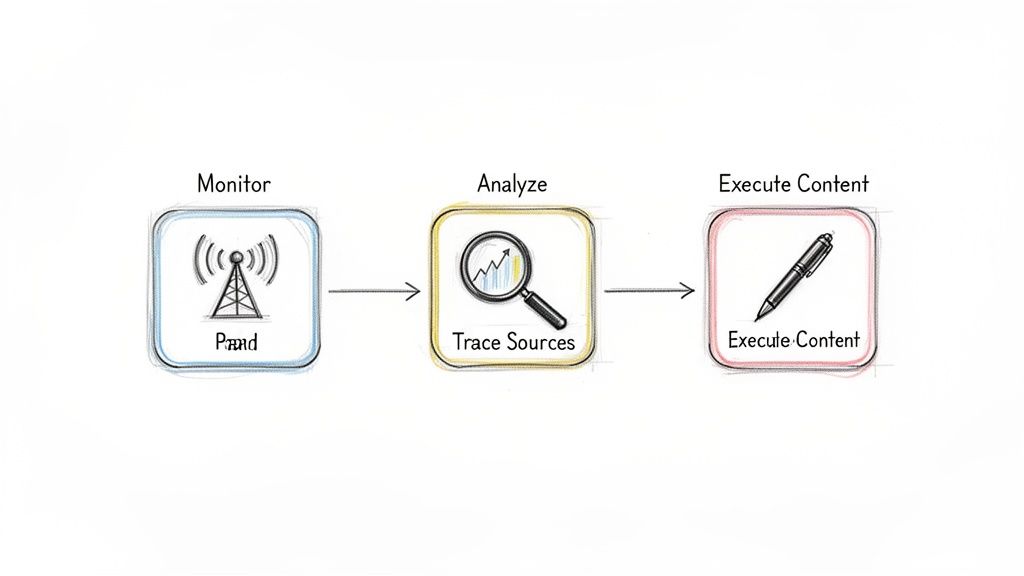
Step 1: Set Up Your Monitoring System
You can’t fix what you can’t see. The bedrock of any SMI workflow is a system that constantly tracks how your brand shows up for the high-intent prompts your customers use. One-off manual searches just give you a snapshot in time; you need continuous monitoring.
Your system should be set up to track:
- Priority Prompts: Start with 10-20 essential questions your audience asks when they’re looking for solutions like yours.
- Your Brand and Products: Track your company and product names to catch direct mentions.
- Key Competitors: Keep an eye on your top three to five competitors to see where they’re winning and why.
A steady monitoring cadence is everything. The 2024 State of Marketing AI Report from Marketing AI Institute highlights that a lack of strategy is a huge roadblock for teams. A structured monitoring process gives you the hard data to build that strategy. It turns fuzzy goals into concrete numbers, showing you exactly where you stand.
Step 2: Analyze Visibility and Trace the Sources
Once the data is flowing, it’s time to play detective. The goal is to answer two questions: “Where are we losing?” and “Why?” This is where source attribution becomes your superpower.
Look for the prompts where you have zero visibility, but your competitors are all over the place. Dig into the AI-generated answers for those queries and find out what sources they’re citing. This isn’t magic—it’s just tracing the breadcrumbs back to the specific articles, forum threads, and reviews that are shaping the AI’s opinion.
This turns a vague problem like “we need more visibility” into a precise one, like “we need to get our product mentioned in that ‘best of’ list on TechCrunch that the AI keeps referencing.”
Step 3: Execute Content and Comment Plays
Now for the fun part: taking action. Based on your analysis, you’ll find opportunities that usually fall into two buckets, each with its own playbook.
1. Content Opportunities
These are gaps you can fill by creating or updating content on your own website. Maybe you discover an AI model loves citing a competitor’s two-year-old research report.
- Action: Create a newer, better, more in-depth report on the same topic.
- Why it works: You’re giving the AI a more authoritative and current source to pull from next time. This is a core part of modern AI search engine optimization—your content quality directly influences its chances of being sourced.
2. Comment Opportunities
These are chances to get your voice into third-party platforms that AI models already trust, like Reddit, Quora, or niche industry forums.
- Action: If an AI answer cites a specific Reddit thread, have someone from your team jump into the conversation. Add a genuinely helpful comment that mentions your solution in context, without being spammy.
- Why it works: You’re literally inserting your brand into a trusted source document. It’s a high-leverage move that makes it much more likely future AI answers will include your input.
By systematically finding and running these plays, you create a powerful feedback loop. Your actions influence the sources, which improves your visibility in AI answers. Your monitoring system picks up the improvement, and the cycle begins again. This is the engine that drives a winning search marketing intelligence strategy.
How Real Companies Win with Search Marketing Intelligence
Theory is great, but seeing a strategy actually work is what really matters. Search marketing intelligence isn’t some abstract idea; it’s a real-world playbook that gets tangible results. Let’s walk through two stories of B2B SaaS companies that used it to carve out a serious advantage.
These examples show what happens when you look beyond classic SEO metrics and start focusing on the actual conversations happening in AI. It’s all about turning intelligence into targeted action—and winning the moments that count.
Case Study 1: The Startup That Owned a Critical Buyer Question
A small, ambitious B2B SaaS startup in the data visualization market was stuck. They were trying to break through the noise made by bigger, better-funded competitors, but their traditional SEO efforts felt like pushing a boulder uphill. They just couldn’t rank for the big, competitive keywords.
So, they switched gears and started using a search marketing intelligence platform to track prompts. They quickly zeroed in on a high-intent question that their ideal customers were asking AI models: “What is the best way to visualize customer journey data for a mobile app?”
Their analysis uncovered two huge opportunities:
- The Content Gap: Nobody had written a single, killer guide that answered this question well. AI models were just stitching together answers from a bunch of old blog posts and random forum threads.
- The Source Opportunity: A few marketing analytics blogs were getting cited over and over, but none of them had gone deep on this specific, nuanced topic.
With this insight, the startup’s marketing team knew exactly what to do. They built an exhaustive, expert-led guide packed with templates, case studies, and tool comparisons. Once it was live, they did targeted outreach to the blogs that AI models already trusted, which landed them a few key backlinks.
The result? Within three months, their guide became the #1 cited source for that critical buyer prompt across multiple AI models. That single piece of content, born from smart intelligence, brought in more qualified leads than their last six months of SEO work combined.
Case Study 2: The Established Player That Conquered Reddit
An established project management software company was watching its market share slowly get chipped away by a scrappy rival. Their competitor kept popping up in AI-generated answers for comparison prompts like, “Compare [Established Brand] vs. [Rival Brand] for enterprise teams.”
Using competitive benchmarking tools, they dug into the source attribution. The data all pointed to one place: Reddit. Their rival was building a genuine presence in subreddits like r/projectmanagement and r/SaaS, where real users were sharing positive stories. AI models were picking up on these conversations and treating them as trusted, third-party proof.
Instead of just throwing more money at ads, the company got smart and launched a targeted “comment opportunity” strategy.
- First, they identified the exact threads and user comments that AI models were sourcing from.
- Next, they got their product experts to jump into these conversations authentically—offering helpful advice and clearing up misconceptions without any hard selling.
- Finally, they started monitoring Reddit for new mentions so they could engage in relevant discussions within hours.
The results were impressive. Over the next quarter, they saw a 40% increase in positive mentions in key Reddit threads. Even better, their visibility in AI answers for those crucial comparison prompts started to climb, effectively neutralizing their competitor’s biggest advantage. If you’re looking to do something similar, our guide on how to rank in ChatGPT is a great place to start.
Building Your Answer Engine Optimization Tech Stack
If you want to win in an era of AI-driven search, your old SEO toolkit just won’t cut it. The platforms we’ve relied on for years—the ones built to track keyword rankings and backlinks—are completely blind to the new battleground of AI conversations. To stay relevant, you need a modern search marketing intelligence stack built for what’s next: Answer Engine Optimization (AEO).
This isn’t about throwing out your existing tools. It’s about augmenting them with new capabilities that measure what actually matters now. The goal is to shift from tracking page ranks to tracking your brand’s influence inside AI-generated answers. A solid AEO platform is your command center for seeing, measuring, and shaping these conversations.
Core Capabilities of a Modern AEO Platform
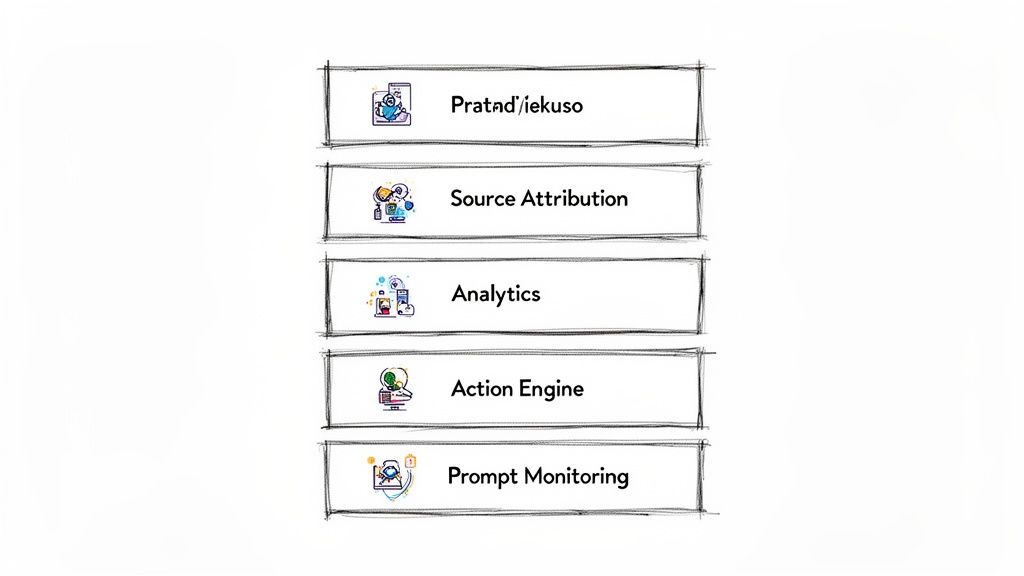
A true search marketing intelligence platform is defined by a few key features that legacy SEO software simply doesn’t have. When you’re looking at different solutions, make sure they have these non-negotiable capabilities. They’re essential for getting a complete picture of your AI search performance.
- Continuous Prompt Monitoring: Forget static keywords. An AEO platform needs to monitor the full, conversational prompts your customers are actually using. This gives you a live look at how AI models are answering the questions that matter most to your business.
- AI Answer Visibility Tracking: The platform has to quantify how often your brand gets mentioned or cited in AI answers. This creates a brand new “share of voice” metric for the AI era.
- Source Attribution: This is the detective work. The tool has to trace AI answers back to the specific articles, forum threads, and web pages the model used. This tells you exactly what content is shaping its opinion.
- Actionable Opportunity Engine: Intelligence without action is just data. A good system should automatically point out “content opportunities” (gaps you can fill on your own site) and “comment opportunities” (conversations you can join on third-party sites).
As you think about your AEO tech stack, it’s worth looking into related concepts like Generative Engine Optimization (GEO). This really drives home how tightly your content strategy is tied to influencing AI.
Your AEO stack isn’t just another dashboard; it’s a strategic weapon. It should tell you where you stand today and prescribe the exact moves you need to make to win tomorrow.
Connecting AI Visibility to Business Outcomes
At the end of the day, the most critical piece is analytics that tie all this effort back to real results. A modern platform connects the dots between your visibility in AI answers and the business metrics that matter. It should help you answer questions like, “Did our improved visibility in ChatGPT for this prompt actually lead to more demo requests?”
This is the key difference. Traditional tools report on traffic; a search marketing intelligence platform reports on influence. According to the 2024 State of Marketing AI Report from Marketing AI Institute, the biggest hurdle for marketers is the lack of a clear strategy. The right tech stack gives you the data to build that strategy, making sure your efforts to learn how to rank in Google AI Overviews are actually driving business growth.
Frequently Asked Questions About Search Marketing Intelligence
Got questions about putting Search Marketing Intelligence into practice? Here are some straight answers to the most common ones we hear.
How is SMI different from traditional SEO?
Think of it this way: SEO has always been about winning the click. You optimize pages, target keywords, and try to get users to your site from a list of blue links. Search Marketing Intelligence (SMI) is about winning the recommendation inside the AI’s answer. Instead of keywords, we track prompts. Instead of rankings, we measure how often our brand is mentioned, cited, and positioned as the solution right within the AI chat. SEO gets you on the list; SMI makes you the answer.
I’m a small business. How can I get started?
You don’t need a huge budget. Start small and focused. First, identify 5-10 critical questions your customers would ask an AI when they’re looking for what you sell. Run those prompts through ChatGPT or Google’s AI Overviews and see what comes back. Who gets mentioned? What sources are cited? That’s your battlefield. Now, pick just one or two of those cited sources—maybe a specific Reddit thread or a “best of” list—and focus all your energy there. A small, targeted effort is far more powerful than spreading yourself too thin.
Is Search Marketing Intelligence going to replace SEO?
Not at all. Think of SMI as the next evolution of SEO. The two work hand-in-hand. All the SEO fundamentals—creating high-quality, authoritative content—are more important than ever. Why? Because that great content is exactly what AI models use as source material. Your strong SEO foundation is what fuels the AI. SMI is the strategic layer you add on top. It’s the work you do to make sure your great content and brand authority actually show up in AI answers, which is where more and more customer journeys are starting. They’re two sides of the same coin.
How long does it take to see results from an SMI strategy?
It can be much faster than traditional SEO, especially with “comment opportunities.” Getting involved in a trusted Reddit thread can shift AI answers in just a few weeks. Bigger “content opportunity” plays, like creating the definitive guide, usually take about 2-4 months to become an authoritative source.
Is keyword ranking completely irrelevant now?
Not completely, but its importance has definitely diminished. A high-ranking page is still a great asset, since it’s more likely to be used as a source by AI models. But ranking alone doesn’t guarantee you’ll be featured in an AI answer, so it’s just one piece of a much larger puzzle.
What is the difference between an AEO platform and a standard SEO tool?
A standard SEO tool is all about keyword rankings, backlinks, and website traffic. An Answer Engine Optimization (AEO) platform is built for the new world: it focuses on prompt monitoring, brand visibility inside AI answers, and source attribution to help you measure and influence your presence in conversational AI.
Ready to stop guessing and start shaping how AI talks about your brand? Airefs is the action platform for winning in an AI-first world. See your AI search visibility, pinpoint your opportunities, and execute a winning strategy.