
Profound and Peec AI are two of the best-funded platforms in the AEO (Answer Engine Optimization) category—Profound at $155M+, Peec AI at about $29M—and they’ve made different bets on what the category actually needs. Profound is building a full-stack platform: track, analyze, generate content, and surface specific actions. Peec AI is building a monitoring tool around accuracy and clean reporting: simulate real user interactions, benchmark regionally, and report across many languages.
Neither is wrong. They target different teams with different problems.
If you’re deciding between them, the choice usually comes down to two questions: do you need content creation built into the platform, and how many AI platforms do you need to track without getting charged per-platform add-ons?
This comparison covers how each platform works—features, screenshots, user feedback, and pricing—and where each one stops.
Profound vs Peec AI at a glance
| Profound | Peec AI | |
|---|---|---|
| Founded | 2024 | 2025 |
| Funding | $155M+ (Khosla, Kleiner Perkins, NVIDIA, Sequoia, Lightspeed) | ~$29M (20VC, Singular) |
| HQ | New York City | Berlin, Germany |
| G2 | G2 Winter 2026 Leader, 4.5/5 (1,130 reviews) | 4.7/5 (21 reviews) |
| AI Platforms | Up to 9 (Enterprise) | 3 models + add-ons (+$35–$165/mo per extra model, monthly billing) |
| Tracking Method | Browser-captured answer-engine data + prompt-based; AI crawler analytics | UI scraping (simulates real user interactions) |
| Content Creation | Yes — Agents (briefs, articles, opportunities) | No |
| Prompt Volume Data | Yes (few others offer it) | No |
| Starting Price | Free trial, then custom | $95/mo |
| Free Tier | 7-day free trial + free AEO report | Free trial (length not stated) |
| Update Frequency | Daily | Daily |
| Compliance | SOC 2 Type II, SSO (SAML/OIDC) | Pursuing SOC 2 (not yet certified) |
| Languages | Not disclosed | Many (countries per project) |
| Customers | Target, Walmart, MongoDB, Indeed, Ramp, Figma, US Bank, Chime, and others | Zalando, Attio, Squarespace, Glide, Merge, and others |
What is Profound?
Profound is an AI search visibility and content optimization platform built for enterprise marketing teams. It tracks your brand’s presence across up to 9 AI platforms and generates AEO-optimized content to improve it—so it spans both measurement and execution in a single platform.
One capability few others have is prompt volume data: Profound shows actual AI search demand for topics in your category, not just your brand’s position within existing queries. For a topic like “best CRM for startups,” you can see total monthly query volume across ChatGPT, Perplexity, and Gemini, filtered by demographics. This turns Profound from a brand monitoring tool into a content strategy tool—you’re not just measuring where you stand, you’re identifying which topics have AI search demand before you invest in them.
Funding timeline:
- Seed — Khosla Ventures
- Series A — Kleiner Perkins + NVIDIA
- Series B — Sequoia
- Series C — Lightspeed
- Total raised: $155M+
The enterprise customer list reflects where Profound has found product-market fit: Target, Walmart, Figma, MongoDB, Ramp, U.S. Bank, Chime, Docusign, Indeed, Plaid, Deel, and Statsig. Ramp’s 7x AI visibility increase—moving from 19th to 8th among Accounts Payable fintech brands within a month—is the most-cited case study in the category.
What is Peec AI?
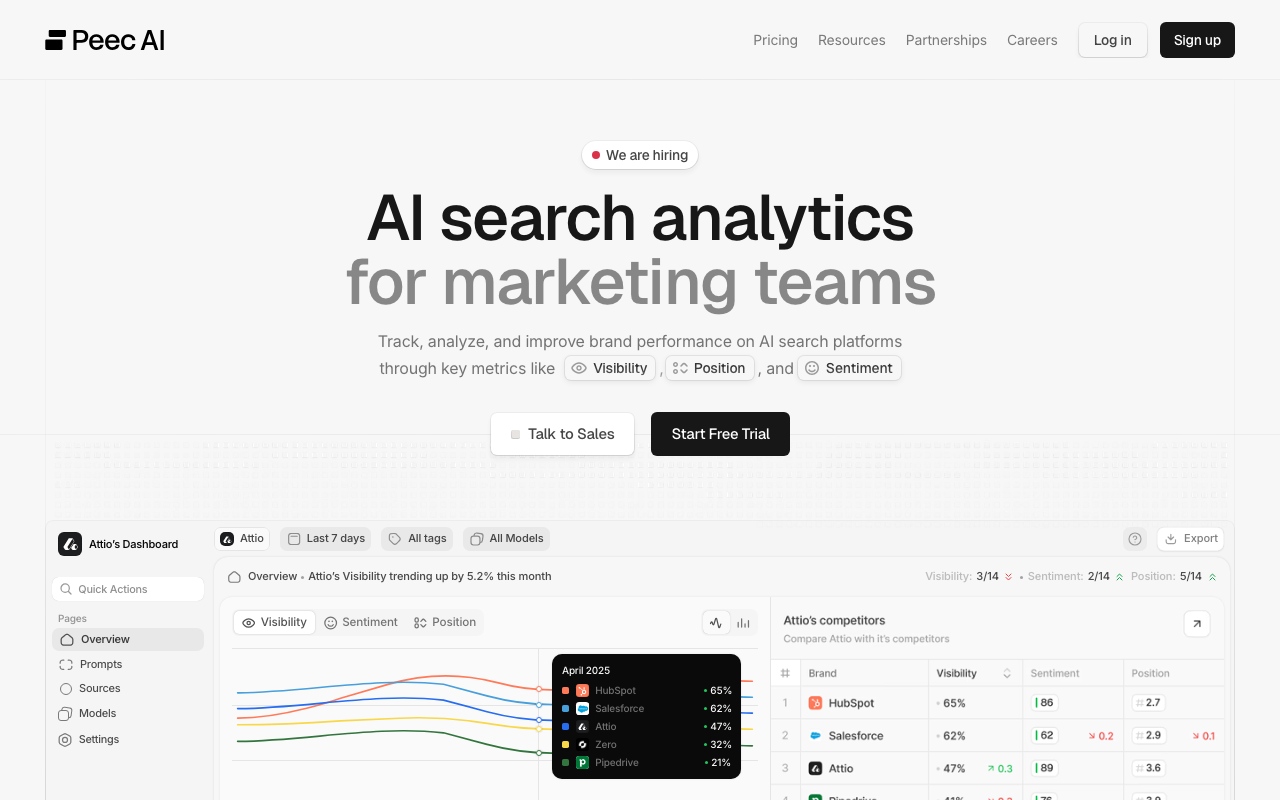
Peec AI is an AI search analytics platform built for marketing teams who need to know exactly how AI portrays their brand—and how that compares to competitors across regions and languages. Founded in 2025 in Berlin, it reported $4M+ ARR within its first ten months and counts 3,000+ marketing teams, brands, and agencies as customers. Press in June 2026 reported a further ~$10M raise at about a $200M pre-money valuation (not confirmed as closed).
Peec AI’s core differentiation is methodology. Rather than querying AI APIs directly (which returns approximated or sampled data), Peec uses UI scraping—it simulates real browser sessions on ChatGPT, Perplexity, and Google AI Overviews, and captures exactly what a user would see. This is a meaningful accuracy advantage in a category where the whole point is knowing what AI is actually saying.
The tradeoff is scope. Each plan includes three AI models of your choice; every extra model is a paid add-on (+$35/mo on Starter, +$85/mo on Pro, +$165/mo on Advanced on monthly billing). Stacking several add-ons raises the monthly total quickly compared with all-in-one tiers on other platforms. And Peec AI stops at monitoring: it doesn’t write content, generate opportunities, or surface specific Reddit threads forming AI preferences in your category.
Funding timeline:
- July 2025 — Seed led by 20VC
- November 2025 — $21M (EUR 18M) Series A led by Singular, with Antler, Combination VC, identity.vc and S20
- Total raised: about $29M
Feature breakdown
Prompt volume and AI search demand
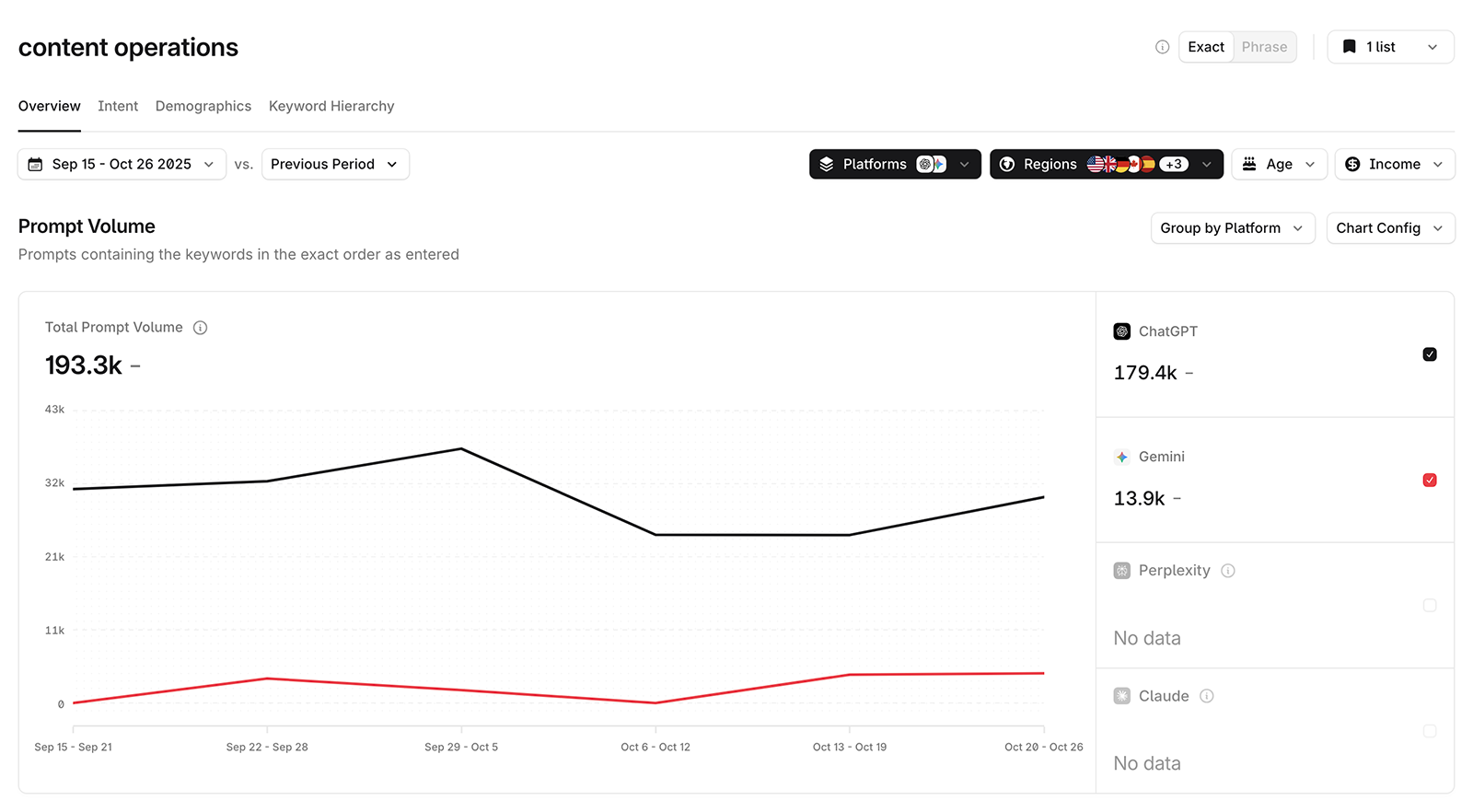
Profound is one of the few platforms in the category that show prompt volume data—the actual number of times users are querying AI platforms about topics in your category. For a topic like “content operations,” the dashboard shows total monthly prompt volume broken down by platform, filtered by region, age, and income demographics.
This is the signal that separates content strategy from brand monitoring. The equivalent in traditional SEO is keyword volume—knowing how many people are searching before you decide whether to write the article. Few other AEO tools have it.
Peec AI does not offer prompt volume data (G2 reviewers say they still rely on Semrush for prompt-volume research). It tracks how visible you are within existing queries—it doesn’t tell you whether those queries have meaningful volume in the first place.
Edge: Profound, significantly.
Prompt tracking and visibility scoring
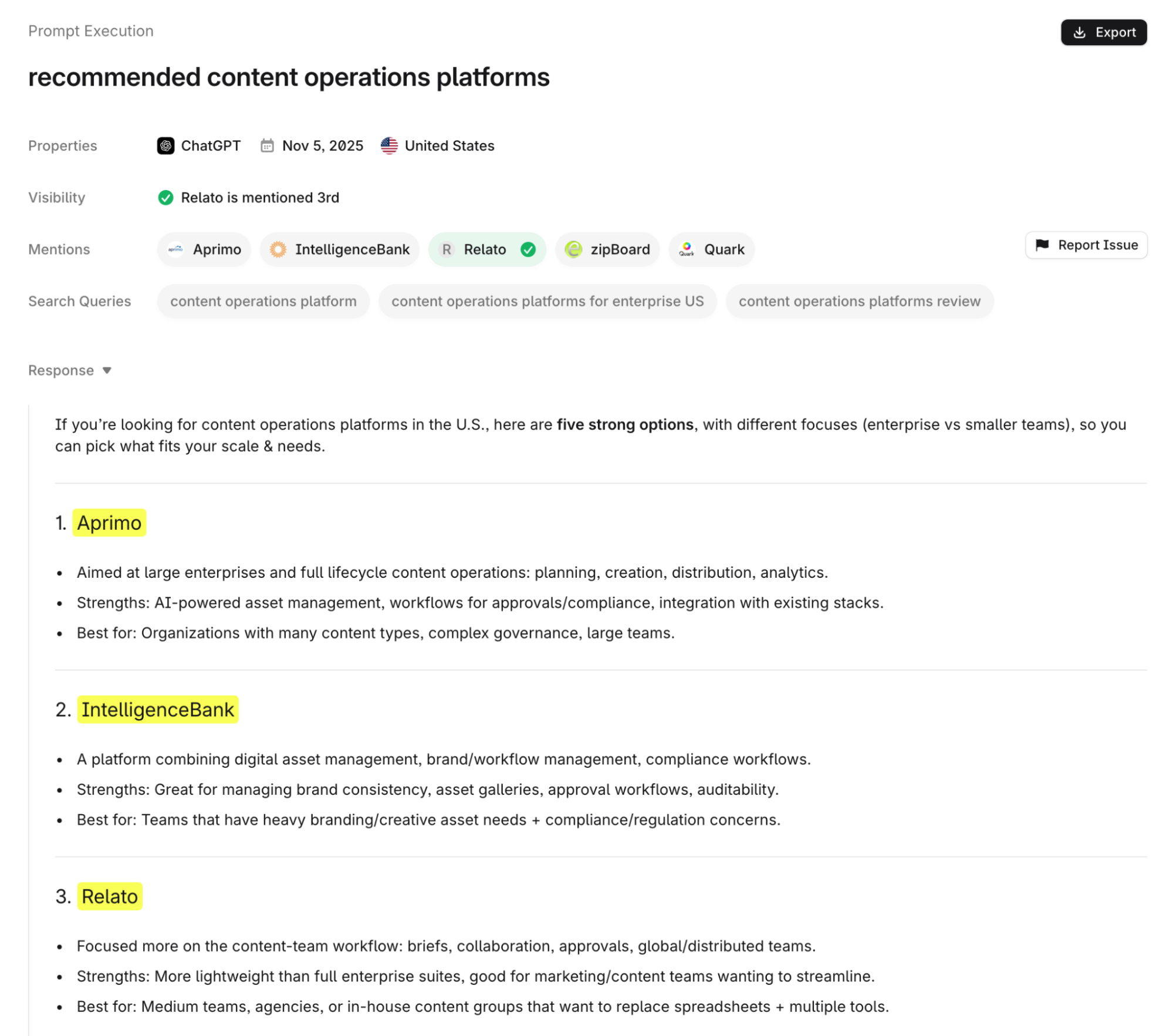
Profound — Each tracked prompt shows a full execution log: which platforms mentioned you, at what position, alongside which competitors. A prompt like “recommended content operations platforms” shows whether you’re mentioned on ChatGPT (mentioned 3rd) but completely invisible on Perplexity, Gemini, and Google AI Overviews. Visibility score, average position, and citation share are tracked over time.
Peec AI — Setup is faster: Peec AI scans your website and suggests relevant prompts to track, saving meaningful time for teams new to AEO. The active prompts view shows position, sentiment, and visibility percentage per prompt alongside competitor logos. Timeline filters let you analyze 7, 14, or 30-day windows, and data can be exported to CSV.
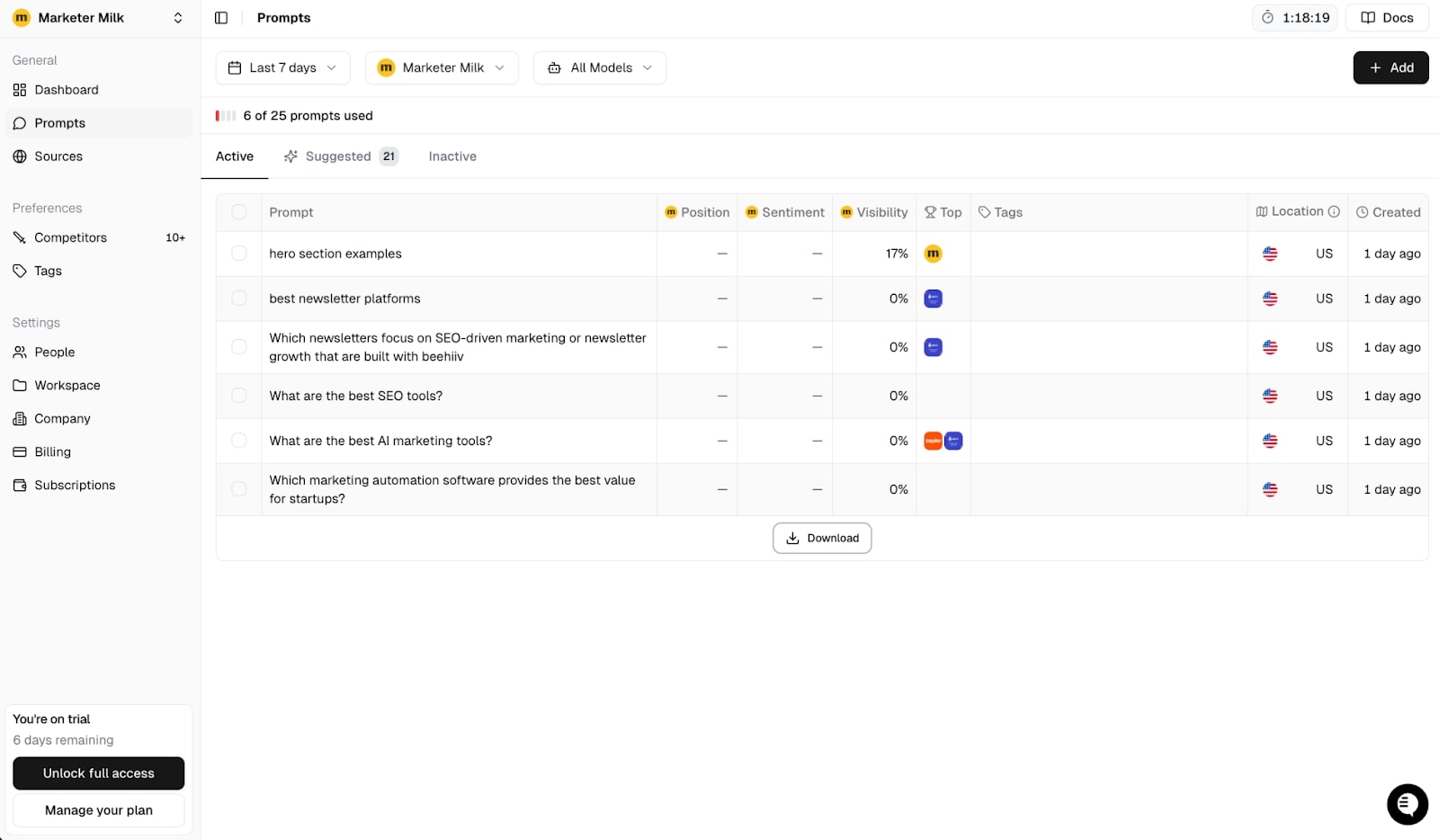
Edge: Tie on core tracking data. Profound leads on execution depth; Peec AI leads on setup speed.
Dashboard and at-a-glance visibility
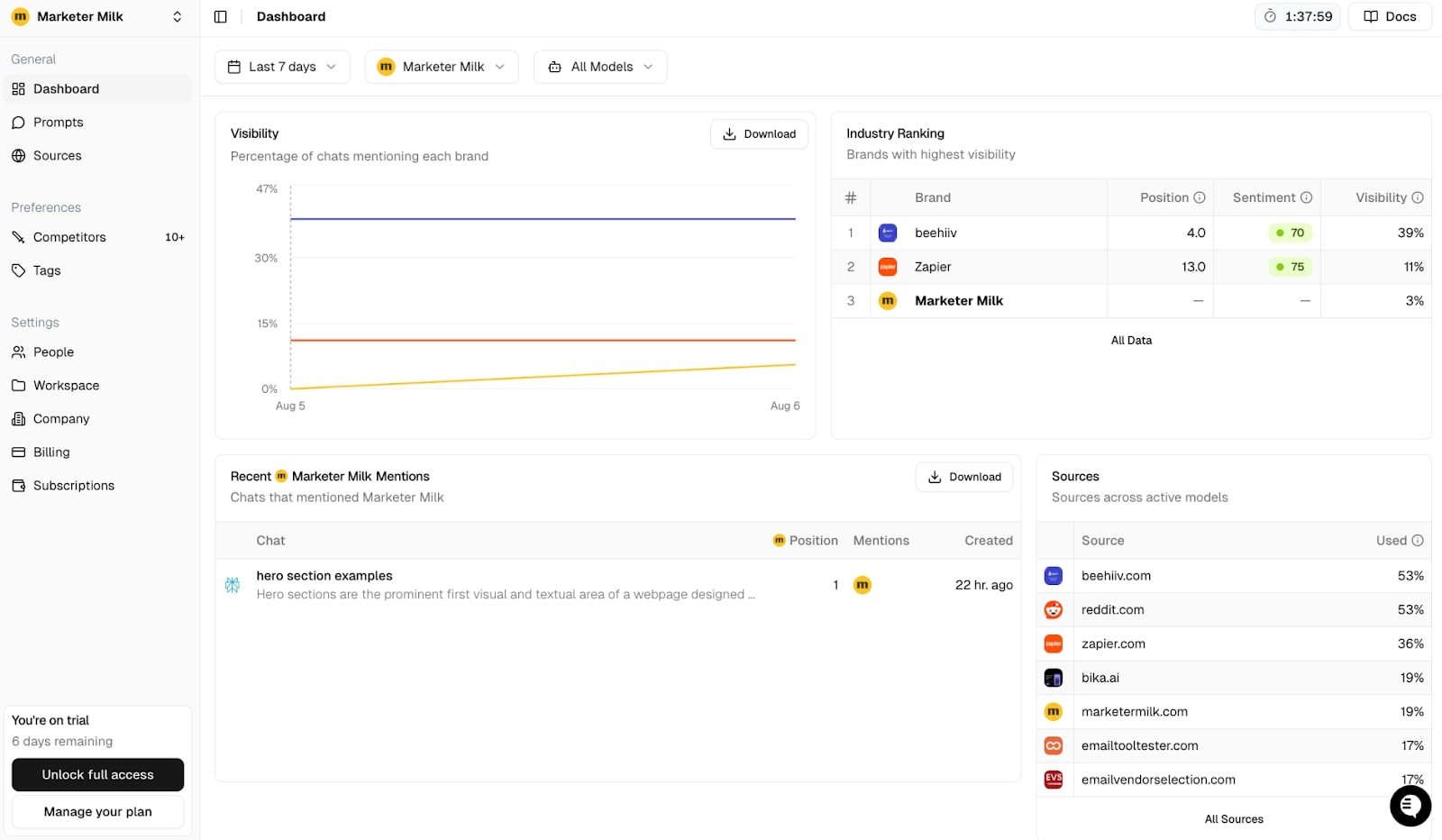
Peec AI’s main dashboard shows your brand’s visibility percentage across tracked AI platforms, an industry ranking table, recent brand mentions with full chat context, and a sources summary—all on one screen. A countdown timer shows when the next data refresh is due, which gives a clear sense of data freshness.
Profound’s dashboard is organized around prompt tracking and volume analytics, citation and share of voice data, the Opportunities panel, and Agents. It’s more data-dense and requires more orientation time, but surfaces more signal once you’re set up.
Citation and source tracking
Both platforms show which domains AI models are citing in your category.
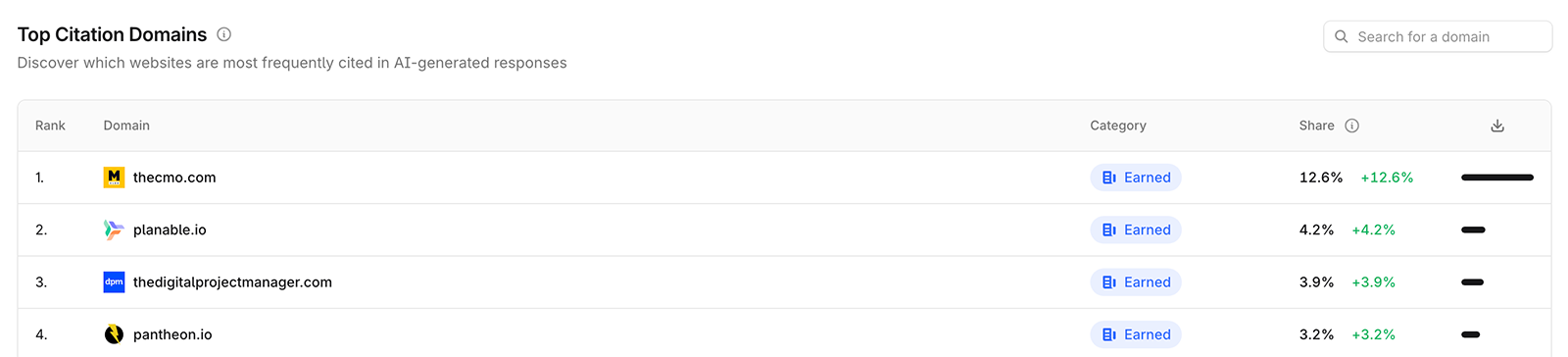
Profound — The citation panel shows domain-level citation share ranked against the full competitive set. Your citation rank is shown in context so you can see exactly how far you are from the leading sources.
Peec AI — The sources panel categorizes each URL by type: competitor, brand, citation, UGC, and editorial. Each URL shows a yes/no indicator for whether your brand is mentioned in that source—a clean gap list for PR targeting. Trend charts show citation frequency over time.
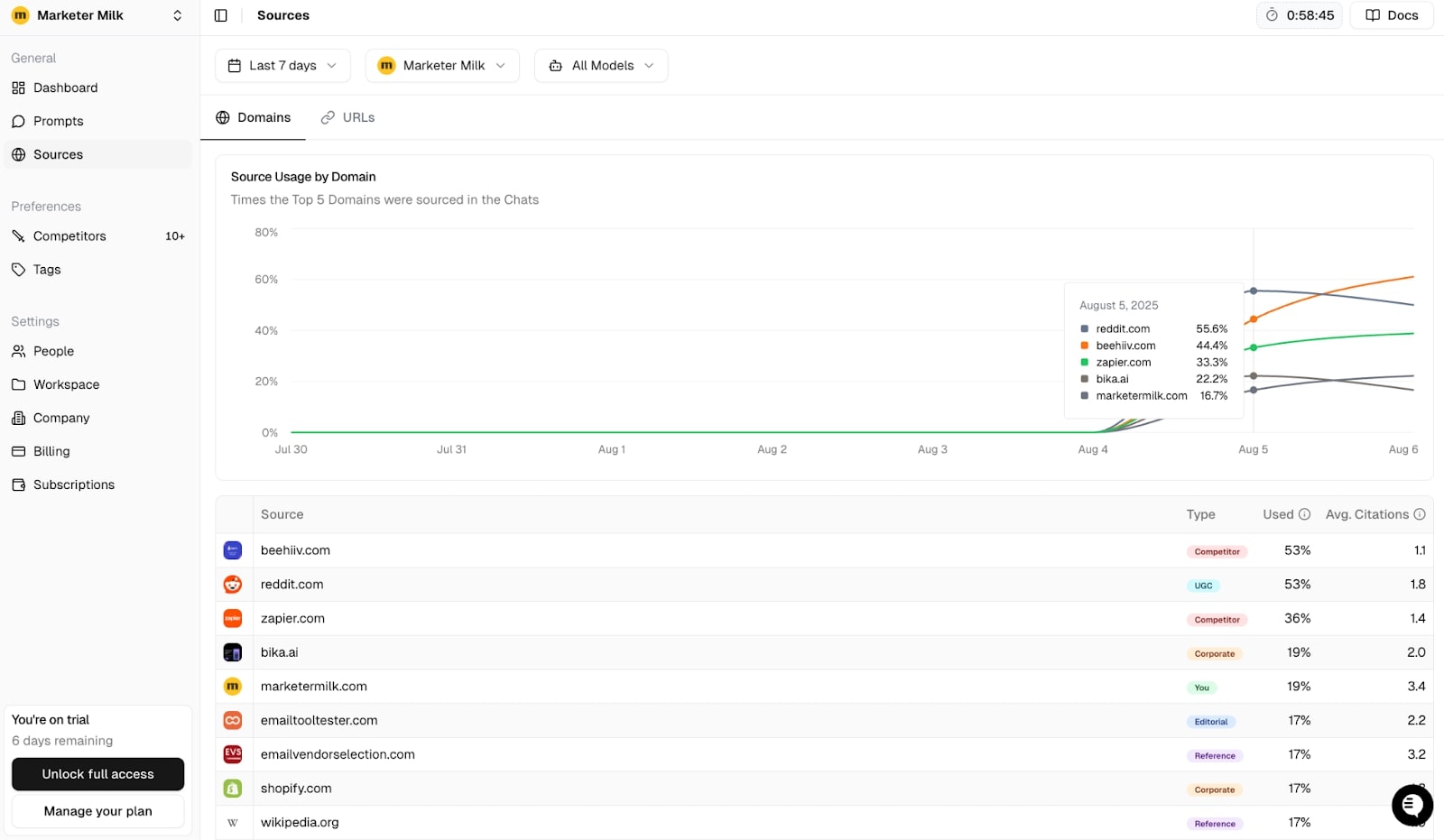
Edge: Peec AI for source categorization clarity. Profound for what to do with that data next (Opportunities panel).
Share of voice and competitor benchmarking
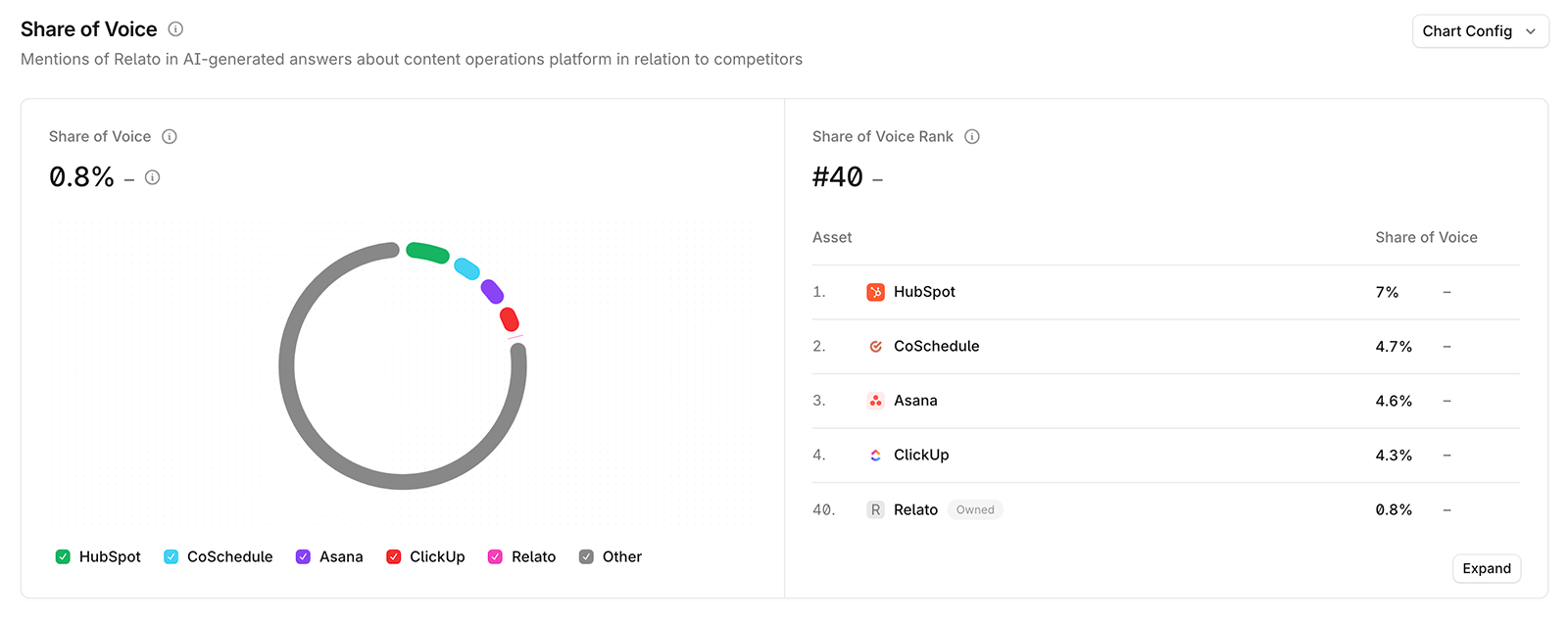
Profound — Tracks your brand’s share of voice versus named competitors across all tracked prompts. The donut chart and rank table show how your mentions compare to category leaders, with your exact rank shown against the full field.
Peec AI — The competitors panel suggests competitors based on your category, shows mention counts, and lets you add any brand by name. Competitor tracking is regional: share of voice can be compared across geographies and many languages. This is the clearest differentiator for multi-market brands where regional AI visibility varies meaningfully.
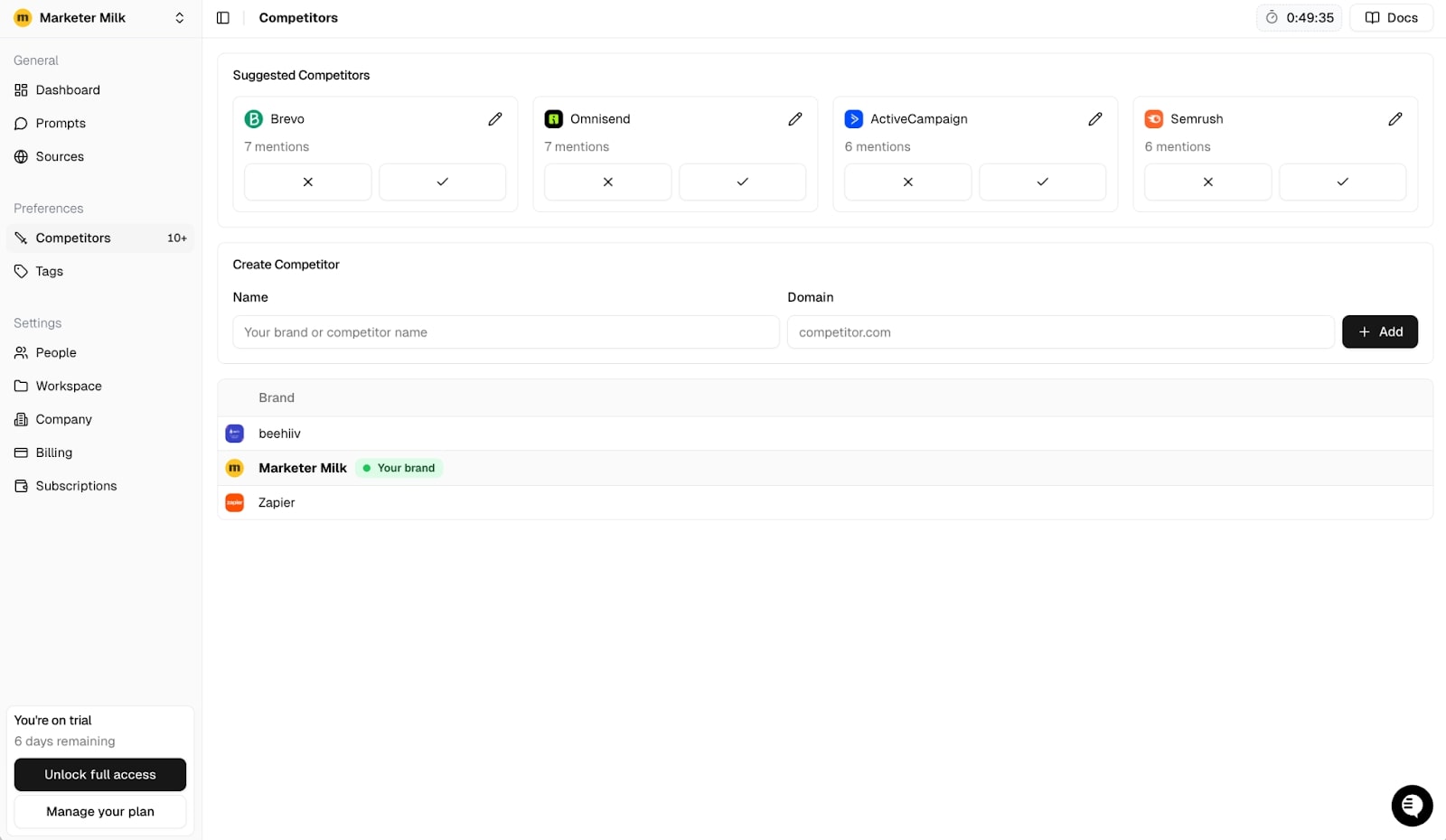
Edge: Profound for depth on a single market. Peec AI for multi-market and multilingual programs.
Opportunities: what to do next
This is the most important feature gap in the comparison.
Profound’s Opportunities panel generates specific, prioritized actions rather than leaving teams to interpret data: create a particular piece of content for a gap in AI citations, contact a named journalist at a named publication with a specific pitch rationale, or engage in a specific subreddit thread. Each opportunity includes current performance data so you can prioritize by impact. The specificity—naming an individual journalist at a specific outlet rather than “do outreach”—is what separates it from generic recommendations.
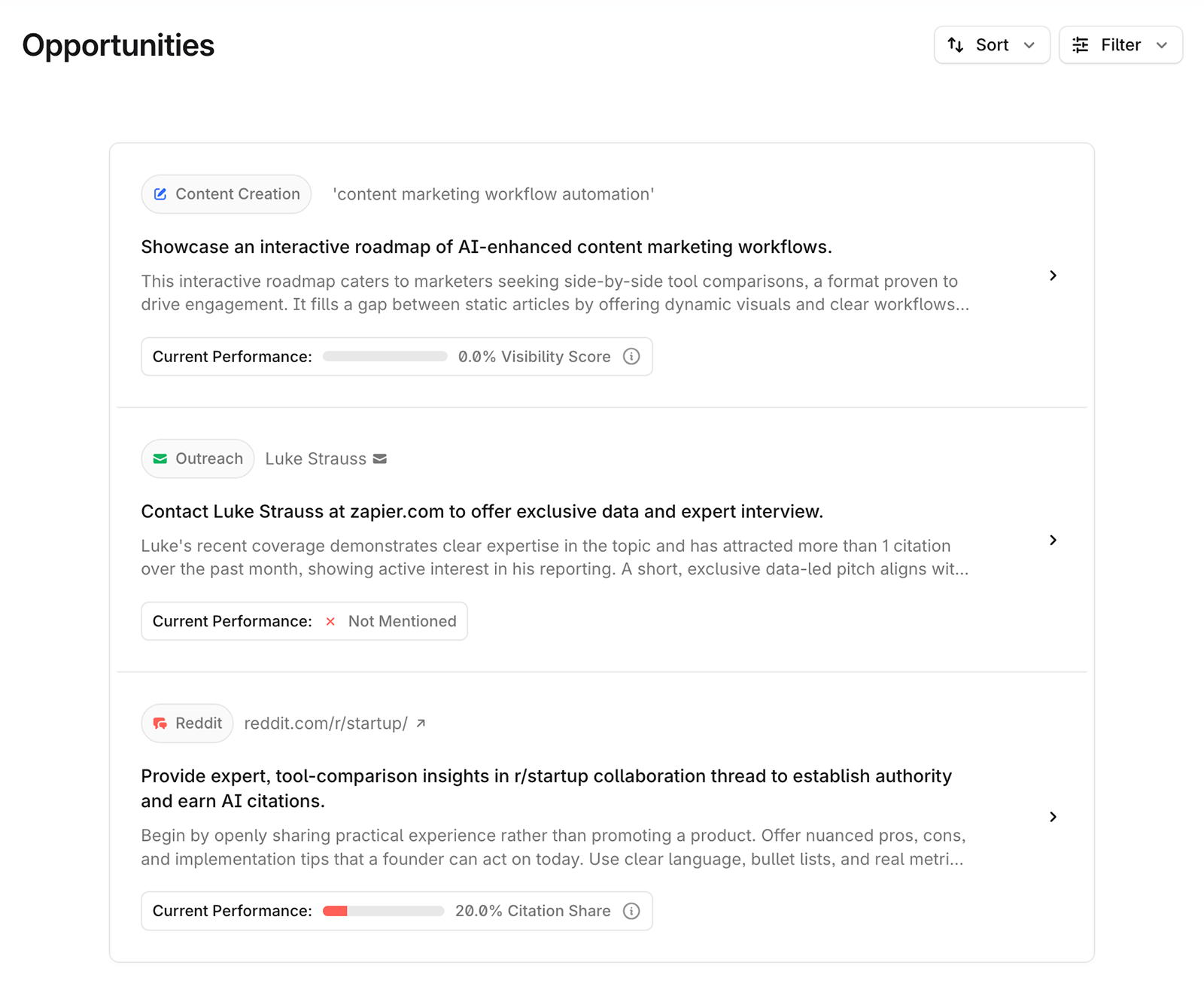
Peec AI does not have an opportunities panel. It surfaces which sources are being cited and where you rank, and its Actions recommendations are lighter than Profound’s; G2 reviewers say it doesn’t give clear recommendations on how to improve AI search performance.
Edge: Profound, significantly.
Content creation: Agents
Profound’s Agents feature generates AEO-optimized content briefs and full article drafts based on what AI models are actually citing in your category. A brief includes the title, target topic, target prompts, target platforms, and top-cited pages to reference.
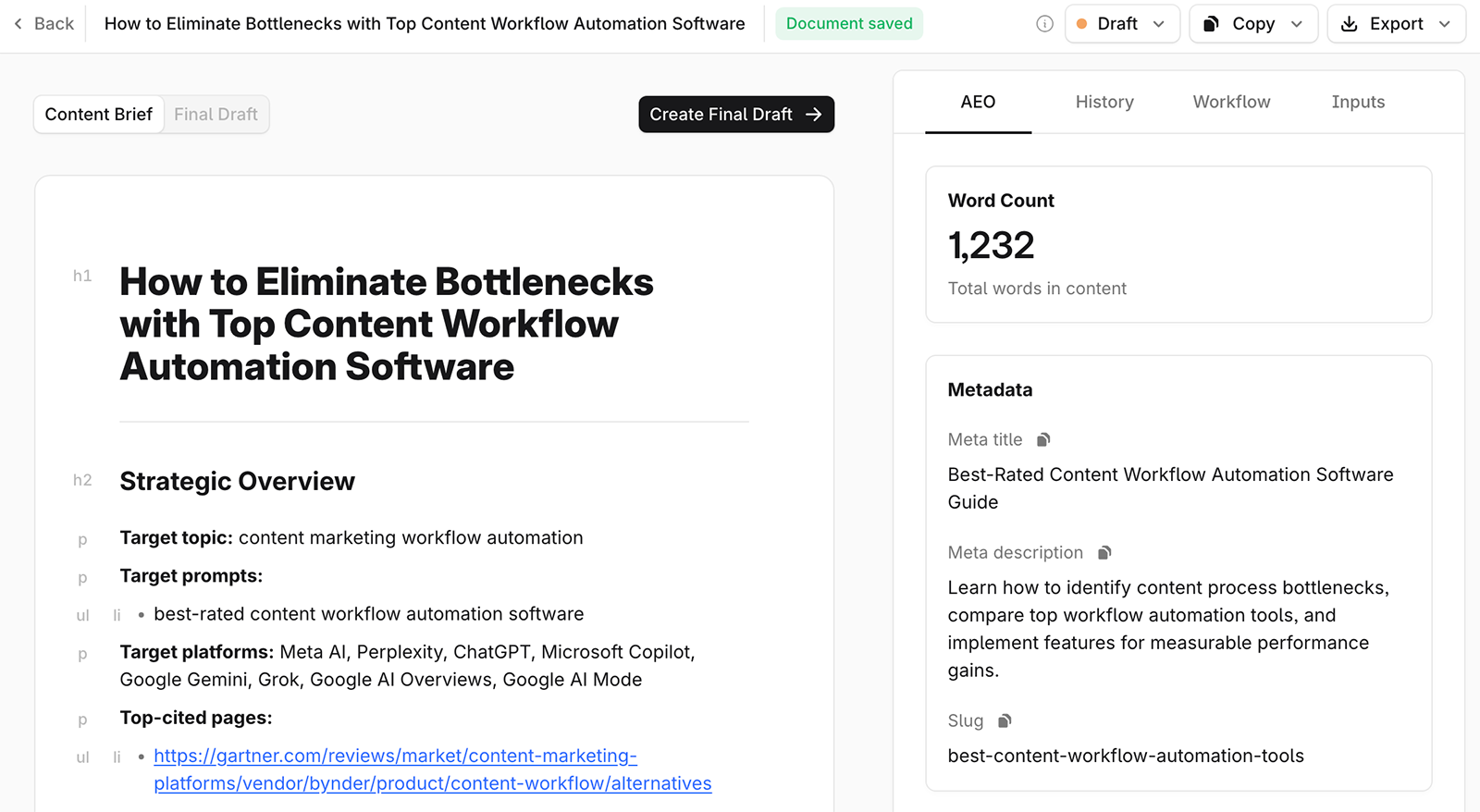
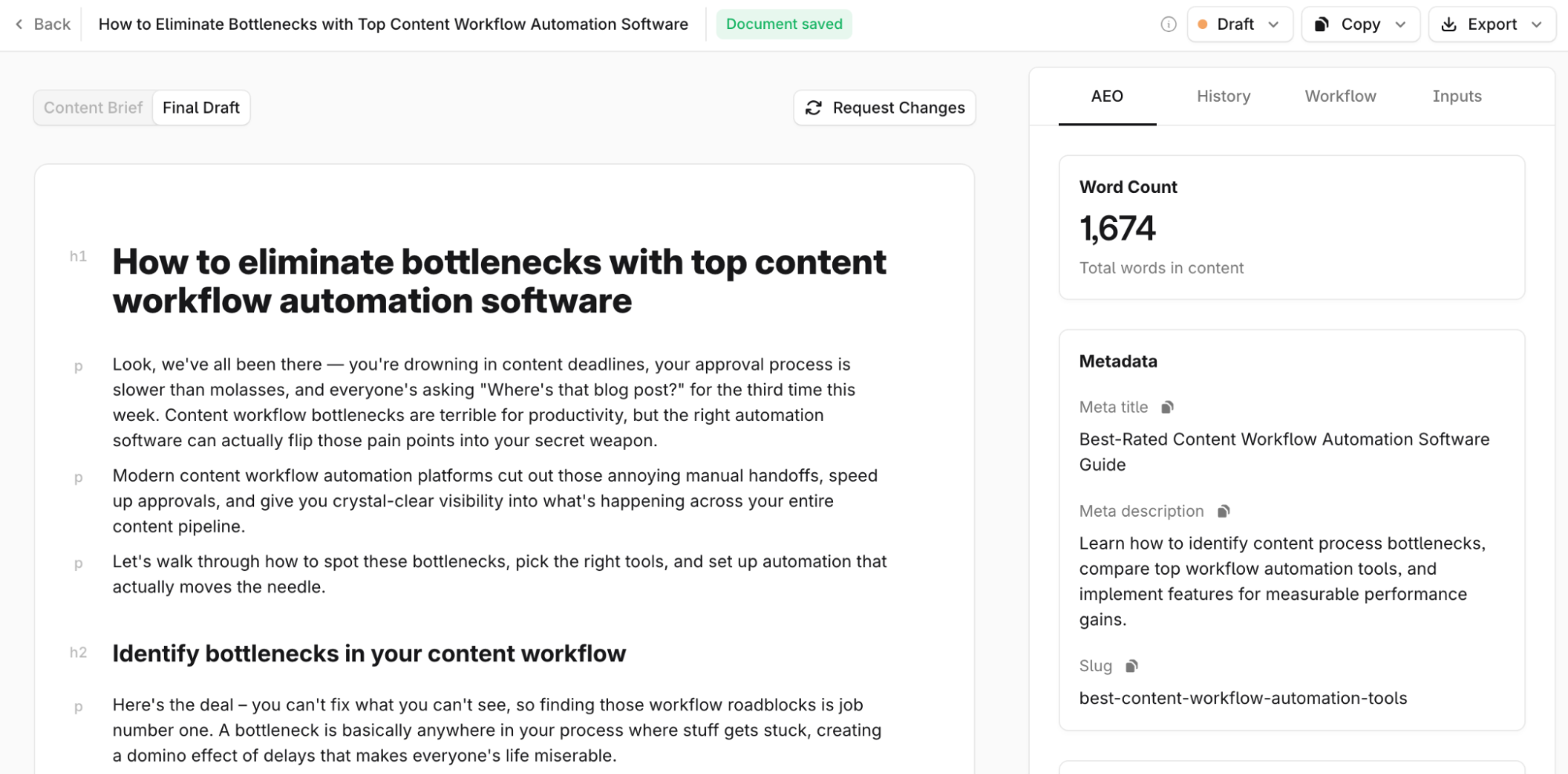
The final draft is generated from the brief and can be exported or revised. This is the feature that justifies the platform—it turns citation data into production-ready content without a separate writing tool.
Peec AI has no content creation capability. Monitoring-only.
Edge: Profound, significantly.
Tracking methodology
Profound combines browser-captured answer-engine data with prompt-based tracking across up to 9 platforms on Enterprise, plus proprietary AI crawler analytics.
Peec AI uses UI scraping—it opens the actual ChatGPT, Perplexity, and AI Overviews interface in a real browser session and captures responses the way a real user would see them. Since API responses can vary from live product responses, Peec’s methodology arguably captures what users actually see with higher fidelity.
Edge: Peec AI for per-response accuracy. Profound for breadth (up to 9 platforms vs 3 included).
Integrations and compliance
Profound offers SOC 2 Type II, SSO (SAML/OIDC), API access at Enterprise, Google Analytics integration for AI crawler tracking and human visitor attribution, and integrations with Vercel, Cloudflare, AWS, Netlify, Fastly, and Akamai. These are table stakes for enterprise procurement processes.
Peec AI is pursuing SOC 2 (not yet certified) and offers Looker Studio (from the $495 Advanced plan), an API (Enterprise), and an MCP server. All plans include unlimited user seats, which is a practical advantage for team collaboration.
Edge: Profound for enterprise requirements.
Pricing
Profound
| Plan | Price | Prompts | AI Platforms |
|---|---|---|---|
| Trial | Free (7 days) | 50 prompts run daily (recommended set) | ChatGPT, Gemini, Google AI Overviews |
| Enterprise | Custom | Custom | Up to 9 platforms |
| Agency Growth | $99/mo + add-ons | n/a | Agency pitch workspaces (client workspaces are a $399/mo add-on) |
Free AEO report (no credit card). Profound’s former $99 Starter and $399 Growth tiers are retired, though G2 and many review blogs still quote them. Agency Growth is aimed at agencies running audits for prospects, not at brands tracking themselves.
The pricing structure is the most important thing to understand before signing up. The free 7-day trial is enough to see what Profound does, but it uses a recommended prompt set that cannot be customized, with no history, exports, or API. After the trial there is no self-serve paid tier: continuing means a sales conversation and custom Enterprise pricing.
Peec AI
| Plan | Price | Prompts | Projects |
|---|---|---|---|
| Starter | $95/mo | 50 | 1 |
| Pro | $245/mo | 150 | 2 |
| Advanced | $495/mo | 350 | 5 |
| Enterprise | Custom | Custom | Unlimited |
Free trial (length not stated on the pricing page). Annual billing is about 15% off ($80/mo on Starter). Agencies have separate credit-based plans ($245 to $795/mo). All plans include unlimited user seats, daily tracking, and three AI models of your choice (additional models are add-ons: +$35/mo on Starter, +$85/mo on Pro, +$165/mo on Advanced on monthly billing).
The add-on model matters if you need more than three models: stacking extra platforms increases monthly cost quickly compared to all-in-one tiers on other tools.
Pros and cons
Profound
Pros:
- Prompt volume data from real conversations shows AI search demand by topic and demographics—few other AEO platforms offer it
- Opportunities panel generates specific named actions: journalist contacts, subreddit threads, content gaps
- Agents creates AEO-optimized content briefs and full article drafts
- Up to 9 AI platforms on Enterprise, including ChatGPT Shopping and DeepSeek
- Google Analytics integration for AI crawler tracking and human visitor attribution
- SOC 2 Type II, SSO (SAML/OIDC)—enterprise procurement ready
- G2 Winter 2026 Leader with 1,130 G2 reviews at 4.5/5, the deepest review base among AEO-specific tools
- Backed by Khosla, Kleiner Perkins + NVIDIA, Sequoia, Lightspeed
Cons:
- The free trial is deliberately limited—a recommended prompt set only, 50 prompts daily, no history or exports
- No self-serve paid tier is published; after the 7-day trial buyers must talk to sales
- Full engine coverage (up to 9 platforms) requires Enterprise; the trial covers only ChatGPT, Gemini, and Google AI Overviews
- No proactive Reddit monitoring—surfaces Reddit opportunities but doesn’t alert on new threads
- No done-for-you execution tier—all content creation is self-serve through Agents
- Opaque, credit-based pricing makes cost hard to forecast
Peec AI
Pros:
- UI scraping captures real user responses, not API approximations
- Many languages with regional competitor benchmarking
- Daily tracking on all plans with unlimited seats
- Sentiment analysis included
- 7x demo requests for Merge (per Peec’s case study); blog posts ranking in AI in 24 hours for Glide
- Cleanest reporting in the category, fast to hand to an executive
- Free trial
- About $29M in funding and 3,000+ customers
Cons:
- Monitoring-focused: no content creation and no done-for-you option (Actions recommendations are included)
- Three AI models included per plan; each extra model is a paid add-on (+$35–$165/mo depending on tier, monthly billing)
- No prompt volume data—can’t assess AI search demand before investing in topics
- No opportunities panel—Actions recommendations are limited, so action planning mostly falls to the team
- No retroactive data—tracking starts from setup date only
- Pursuing SOC 2 but not yet certified
- API access is Enterprise-only (an MCP server is available)
- Less useful for new brands with minimal AI mentions—measures existing visibility, so established brands get more signal from day one
What users say
Profound
Profound holds G2 Winter 2026 Leader status with more than 50x the G2 reviews of Peec AI (1,130 vs 21). The platform appears in dozens of Reddit threads in the AEO and AI search space—unusual for a B2B SaaS tool—reflecting genuine practitioner adoption.
Consistent praise: prompt volume data and the specificity of the Opportunities panel. Teams that have tried multiple AEO tools often cite prompt volume as a capability they can’t find elsewhere. Consistent criticism: price. G2 reviewers repeatedly call it expensive (“rather expensive in comparison to other tools we’ve vetted”), and it no longer publishes self-serve tiers.
Ramp boosted AI visibility 7x within one month and moved from 19th to 8th among Accounts Payable fintech brands.
Peec AI
Peec AI holds a 4.7/5 G2 rating (21 reviews). The most consistent praise is its clean, executive-ready reporting. G2 reviewers also say the interface can feel noisy and that it “doesn’t give clear recommendations on how to actually improve your AI search performance,” and one questioned the Earned/Owned Actions suggestions.
Jon Gitlin, SEO Strategist, Merge: “Peec allows us to pinpoint the exact types of content that are surfaced in specific LLMs.”
Case studies (from Peec’s customer stories): Merge — 7x increase in demo requests from AI search. Momentum — doubled AI search visibility within a month. Glide — blog posts ranking in ChatGPT and Perplexity within 24 hours.
Consistent criticism: Peec AI monitors but doesn’t optimize. Users who want to act on the data need to bring their own content strategy, writers, and distribution.
Who Profound is best for
- Enterprise teams that need SOC 2 compliance, SSO, API access, and multi-platform coverage across up to 9 AI models
- Content teams who want AEO content generation (briefs, full drafts) built into the same platform as their tracking
- Teams running content programs at scale who need the Agents feature to turn citation data into production-ready articles
- Brands that need prompt volume data to prioritize which topics have real AI search demand before investing in content
Who Peec AI is best for
- Multi-market brands that need regional benchmarking across many languages
- Teams that prioritize tracking accuracy and prefer UI-scraping over API-based methodology
- Established brands with enough existing AI visibility to benchmark against—newer brands with minimal AI mentions will have less signal from day one
- Teams that want monitoring only and plan to handle content creation and distribution separately
The monitoring-only ceiling
The most important thing to understand about this comparison is what Peec AI explicitly doesn’t do. Knowing which content to create, which Reddit threads are forming AI model preferences in your category, and how to close the gap between your current citation footprint and the category leaders—that’s where actual visibility growth happens.
Profound closes this loop with Agents and Opportunities. Peec AI leaves it to you.
For teams with dedicated content and SEO resources who can turn monitoring data into action independently, this gap may not matter. For teams who want a platform that moves from insight to execution without switching tools, Peec AI’s monitoring boundary is a ceiling.
The Airefs alternative
If you’re evaluating Profound and Peec AI, it’s worth knowing what the category looks like at a different price point.
Airefs is an AI search visibility and content execution platform starting at $24/mo. Like Profound, it combines monitoring with action—tracking where your brand appears in ChatGPT alongside identifying opportunities (relevant discussions to join, content to create) that improve that visibility. Like Peec AI, it’s designed to be quick to set up without an enterprise procurement process.
The practical difference: Airefs is built for startups, growth-stage companies, and agencies who want results without a sales-led Enterprise contract. The platform tracks AI visibility, surfaces Reddit and content opportunities, and includes a done-for-you option where the Airefs team handles execution (content creation, discussion participation) on your behalf.
| Profound | Peec AI | Airefs | |
|---|---|---|---|
| Starting price | Free trial, then custom | $95/mo + add-ons | $24/mo (billed yearly) |
| AI platforms | Up to 9 (Enterprise) | 3 models + paid add-ons | ChatGPT default |
| Prompt volume data | Yes | No | No |
| Reddit monitoring | Opportunities only | No | Yes (up to 30 keywords) |
| Content creation | Yes (Agents) | No | Done-for-you at $349/mo |
| Free trial | 7 days + free AEO report | Yes (length not stated) | 7 days |
| Regional benchmarking | — | Many languages | — |
| SOC 2 | Yes (Enterprise) | Pursuing, not yet certified | — |
Try Airefs free for 7 days, up and running in two minutes.
Verdict
Choose Profound if you’re an enterprise team that needs prompt volume data, multi-platform coverage across up to 9 AI models, content generation built into the platform, and SOC 2 compliance. Expect custom Enterprise pricing after the free trial. The $155M+ in funding, G2 Leader status, and customers like Ramp, MongoDB, and Indeed reflect genuine enterprise maturity.
Choose Peec AI if you’re a multi-market brand that needs regional benchmarking across many languages and you prefer the accuracy of UI-scraping methodology. Budget for platform add-ons if you need coverage beyond the three included platforms. Accept that content strategy and execution are separate from the tool, and that Peec is not yet SOC 2 certified.
Neither is the right fit if you’re an early-stage startup or growth company that doesn’t need enterprise infrastructure and wants a platform that combines monitoring with execution at a price that doesn’t require procurement sign-off. That’s where Airefs fits.
Want to compare further? See Profound alternatives (or the budget-friendly shortlist) or Peec AI alternatives.