
SEO management is not a one-time project. It’s the ongoing process of improving, monitoring, and adapting a website’s search visibility.
Most teams treat SEO as a to-do list. Set it up, publish content, check back in six months. That’s not management — that’s neglect. Real SEO management is a live discipline with weekly decisions and monthly strategy reviews.
This guide covers what SEO management actually involves in 2026 — including how AI search has changed the job.
Whether you’re building a programme from scratch, inheriting one that’s drifted, or trying to add AI search to an existing workflow, the principles here apply.
What is SEO management?
SEO management is the systematic process of improving a website’s visibility in search engines. It includes technical audits, content strategy, keyword research, link building, and performance tracking.
The “management” part is what separates it from one-off optimisation. A well-managed SEO programme has owners, workflows, and accountability. Rankings are monitored. Drops are investigated. Content is updated as queries evolve.
In 2026, SEO management also means managing visibility in AI search engines — ChatGPT, Perplexity, Google AI Overviews, and Gemini. These platforms now surface answers before users ever click a link. Managing your presence there is no longer optional.
Why SEO management matters in 2026
Google AI Overviews now trigger on 48% of all searches. B2B tech queries trigger AI answers 82% of the time. ChatGPT processes 2.5 billion prompts per day.
Search has split into two channels. Traditional search returns links. AI search returns a direct answer — often without a click. Both require active management.
Brands that only manage traditional SEO are invisible in the AI channel. Brands that only track AI citations miss the 70%+ of traffic that still flows through Google.
The core components of SEO management
1. Technical SEO
Technical SEO ensures search engines and AI crawlers can find, read, and index your site. It covers site speed, mobile performance, crawl budget, structured data, canonical tags, and JavaScript rendering.
AI crawlers (GPTBot, PerplexityBot, ClaudeBot) behave differently from Googlebot. They prioritise clean HTML, structured content, and fast page loads. A site that ranks well on Google can still be invisible to AI systems if the technical foundation is wrong.
Technical SEO is not a setup task. It requires regular audits — especially after site migrations, redesigns, or CMS changes. Most ranking drops that look like algorithm penalties are actually technical regressions introduced by site updates.
2. Keyword research and intent mapping
Keyword research identifies the queries your audience uses. Intent mapping connects those queries to the right content — informational, navigational, or transactional.
In 2026, intent mapping extends to AI prompts. Buyers search Google with keywords like “seo management tool”. They ask ChatGPT: “What’s the best way to manage SEO for a small team?” or “How do I improve my brand’s visibility in AI search?”. Both require content — but the content formats differ.
High-volume head terms drive Google traffic. Conversational, problem-framed queries drive AI citations. A well-managed SEO programme covers both.
3. On-page optimisation
On-page optimisation aligns each page with its target query. It includes title tags, meta descriptions, heading structure, internal linking, and content depth.
AI search adds a layer. AI systems prefer content that answers questions directly, uses structured formatting, and cites specific evidence. Page-one Google rankings don’t guarantee ChatGPT citations — the requirements overlap but aren’t identical.
4. Content strategy
Content strategy decides what to publish, in what format, and for which audience. A managed content programme has a publishing cadence, topic clusters, and clear KPIs per piece.
In 2026, content strategy must account for AI sources. ChatGPT doesn’t only cite your website — it cites Reddit threads, review sites, industry blogs, and forum discussions. A content strategy that only publishes to your own domain is missing most of the AI citation opportunity.
The sources AI relies on vary by category. For software, G2 and Reddit threads are disproportionately cited. For professional services, industry publications and LinkedIn posts carry weight.
Knowing which sources drive AI citations in your market is a prerequisite for content strategy.
5. Link building and off-page SEO
Link building earns mentions and backlinks from external sites. Domain authority, backlink quality, and brand mention frequency all influence rankings. A single high-authority mention in a relevant publication can move rankings faster than ten low-quality links.
AI search adds a related signal: citation authority. Brands cited often across credible third-party sources — media, industry reports, review platforms — appear more in AI answers. The overlap with traditional link building is high, but citation-focused outreach differs from pure link acquisition.
6. Performance tracking and reporting
SEO management requires measurement. Core metrics include organic traffic, keyword rankings, click-through rate, impressions, and conversions from search.
AI search requires additional tracking. GA4 under-reports AI-driven traffic — a user who finds you via ChatGPT but Googles you afterward shows up as organic search. Purpose-built tools measure share of voice, citation rate, and AI mention frequency — the metrics GA4 can’t capture.
Who manages SEO?
SEO management sits in different places depending on team size and growth stage.
In-house SEO managers own the entire programme. They coordinate content, technical fixes, and reporting internally. This works well when SEO is a primary acquisition channel and the team has the bandwidth to execute.
SEO agencies take ownership of strategy and execution. They bring specialist expertise and established processes. The trade-off is less context about the specific business and a layer of communication between decisions and output.
Fractional SEOs operate as part-time strategic leads. They define the programme and manage execution but aren’t full-time employees. Common in early-stage startups and growing SMBs.
Software-only approaches use tools like Ahrefs or SEMrush to guide internal teams. This works if the team has SEO knowledge but needs data infrastructure. It fails when the team lacks the expertise to act on what the tools surface.
There’s no universally right answer. The best SEO management model is the one where someone is genuinely accountable for outcomes — not just activity. An agency that produces reports without moving rankings is worse than a scrappy in-house hire who owns the numbers.
SEO management tools
A well-equipped SEO management stack covers five areas.
Keyword research: Ahrefs, SEMrush, and Google Keyword Planner for search volume and difficulty data.
Technical auditing: Screaming Frog, Ahrefs Site Audit, or Google Search Console for crawl errors, indexation, and Core Web Vitals.
Rank tracking: Daily keyword position monitoring — SE Ranking, SerpWatcher, or the rank tracking modules in Ahrefs and SEMrush.
Content management: A CMS with SEO-friendly architecture. Paired with a brief and workflow tool to manage the publishing process.
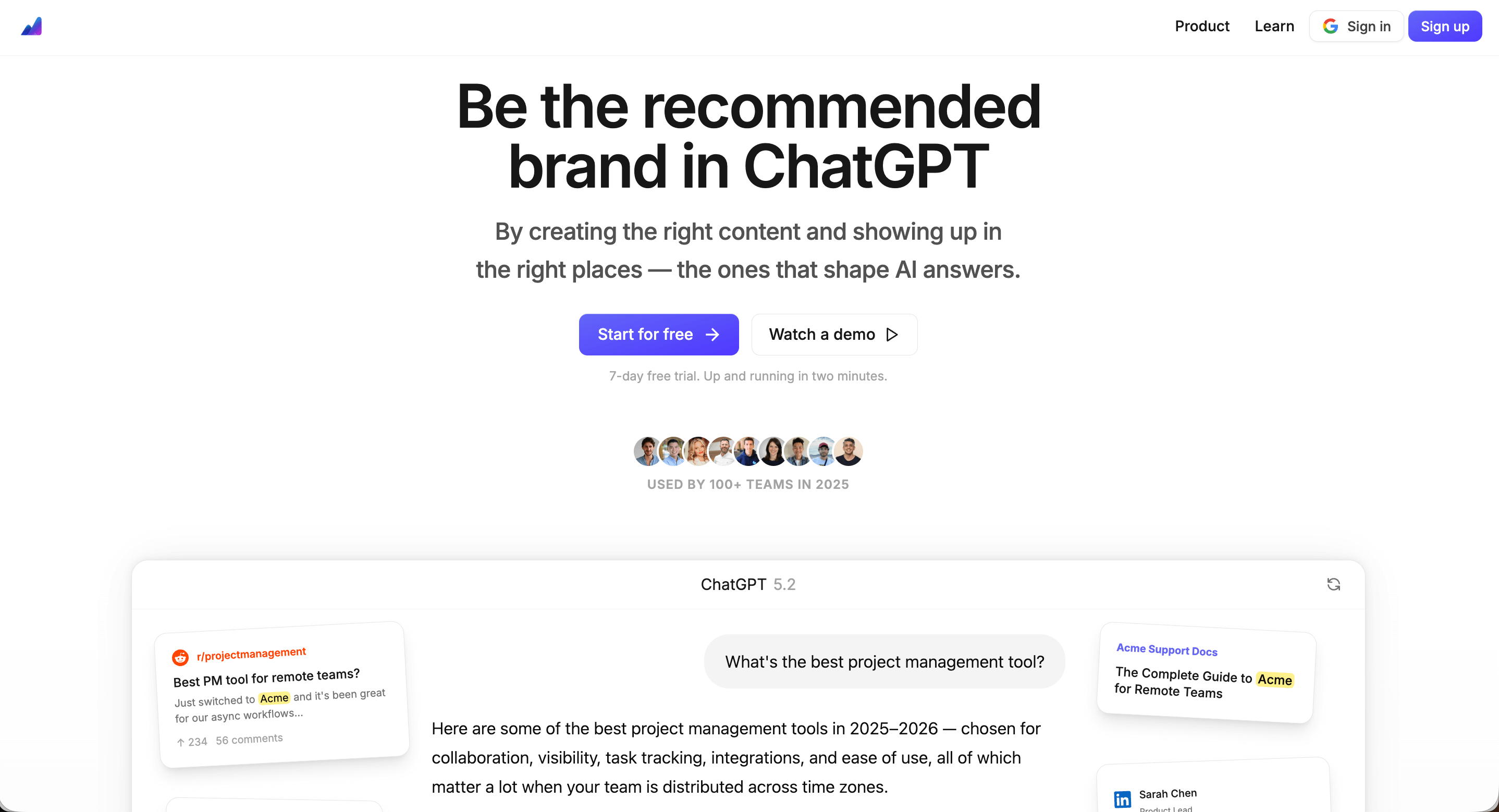
AI search visibility: GA4 doesn’t show AI-driven traffic accurately. Airefs tracks brand mentions, citation rates, and share of voice across ChatGPT and Google AI Overview (add-on), and its crawler analytics recognize Perplexity, Claude, and Gemini bots. It also surfaces the exact sources AI cites in your category.
How AI search changes SEO management in 2026
Three things have shifted.
First, the measurement gap. Traditional analytics under-report AI-driven visits. When ChatGPT mentions a brand without a link, users Google it or type the URL directly — both show up as organic or direct in GA4. At Airefs, GA4 shows ~2% of traffic from ChatGPT, but 20%+ of new sign-ups say they found us through AI.
Second, the source map. AI systems don’t generate answers from scratch — they cite sources. Managing which sources get cited is now part of SEO management. Reddit threads, G2 pages, industry blogs, and YouTube videos all influence AI answers. Your domain is one input among many.
Third, the prompt layer. Buyers research in two modes: keyword searches on Google and recommendation prompts in AI. “What’s the best SEO management tool for a 10-person team?” is an AI prompt, not a search query. It surfaces different results through a different mechanism. Managing both requires tracking both.
What good SEO management looks like in practice
A well-run SEO programme in 2026 has a few consistent characteristics.
It has a weekly cadence. Rankings are reviewed, drops are flagged, and new content opportunities are captured. Nothing sits unnoticed for months.
It tracks AI search separately. Citation rate and share of voice in AI answers are tracked alongside keyword rankings. When a competitor gains ground in AI answers, the team knows why.
It connects SEO to revenue. Traffic is a proxy — trials, demos, and sign-ups are the real metric. Every content investment maps to a measurable outcome.
It updates existing content. Publishing new content gets more attention, but refreshing existing pages drives more compounding returns. A managed programme has a content refresh schedule, not just a publishing calendar.
It has clear ownership. SEO without a named owner drifts. Someone needs to be accountable for rankings, someone for content output, and someone for technical health. These can be the same person on a small team — but the accountability has to exist.
It treats competitors as a signal, not a threat. When a competitor gains ground in Google or AI answers, the managed response is to understand why — which content they published, which sources they earned — and use that as intelligence. Ignoring competitor movements is how programmes fall behind quietly.
Step-by-step: the SEO management process
Most teams know SEO matters. Fewer have a repeatable process for managing it. Here’s how a structured SEO management cycle works in practice.
Step 1: Audit your current state
Before changing anything, understand where you stand. Run a technical audit using Screaming Frog or Ahrefs Site Audit. Check for crawl errors, broken links, missing meta tags, slow page loads, and indexation issues.
Alongside the technical audit, pull your Google Search Console data. Identify which pages drive impressions but not clicks (title/meta issues), which pages have dropped in the last 90 days (algorithm shifts or cannibalisations), and which queries you rank for on page two or three (quick-win candidates).
Run your AI visibility baseline too. Check which prompts in your category mention your brand, which competitors appear instead of you, and which third-party sources AI is pulling from. This is the starting map — everything else is measured against it.
Step 2: Define your keyword and prompt targets
Prioritise keywords by a combination of volume, difficulty, and business relevance. A keyword with 2,000 monthly searches that directly maps to your product is worth more than a 20,000-search keyword with no conversion path.
Group keywords into topic clusters. Each cluster has a pillar page (broad, high-authority) and supporting content (specific, long-tail). Internal links flow from supporting pages to the pillar. This structure signals topical authority to Google.
Map AI prompts separately. Identify the questions your buyers ask ChatGPT at the awareness and consideration stages. These are typically longer, more conversational, and more specific than search keywords. Each prompt is a targeting opportunity.
Step 3: Fix the technical foundation
Address technical issues in priority order. Crawl errors and broken pages first — these actively harm rankings. Core Web Vitals second, particularly Largest Contentful Paint (LCP) and Cumulative Layout Shift (CLS). Structured data third — schema markup helps both Google and AI crawlers parse your content correctly.
For AI crawlers specifically, check that GPTBot and PerplexityBot aren’t blocked in your robots.txt. Many sites block these unintentionally. Confirm your pages render cleanly as HTML — AI crawlers struggle with heavy JavaScript rendering.
This step is never fully complete. Technical debt accumulates. Build a monthly check into your workflow, not a quarterly one.
Step 4: Build and execute the content plan
Assign each keyword cluster a content owner, a target publish date, and a success metric. Ambiguity here kills execution. If no one owns a piece, it doesn’t get written.
Prioritise content that serves both Google and AI. Well-structured articles with clear headings, specific evidence, and direct answers to common questions rank on Google and get cited by AI. These are your highest-leverage pieces.
Don’t only publish to your own domain. Identify the third-party sources AI cites most in your category — Reddit communities, G2 profiles, industry publications. Contributing to these platforms extends your AI citation surface beyond your website.
Step 5: Build authority and citations
Link building for traditional SEO focuses on domain authority and anchor text. Citation building for AI search focuses on mention frequency across credible sources.
The overlap is high. A mention in a respected industry publication earns a backlink and increases your AI citation surface. Guest posts, analyst reports, podcast appearances, and PR placements all serve both goals.
Reddit is underestimated here. ChatGPT and Perplexity cite Reddit threads heavily for product and category questions. Genuine participation in relevant subreddits — answering questions honestly, not self-promoting — builds the kind of citation-worthy presence that pure content marketing can’t replicate.
Step 6: Track, measure, and adjust
Set a weekly review cadence. Check keyword ranking movements, organic traffic trends, and any new crawl errors flagged in Google Search Console.
Monthly, review AI visibility metrics. Has your citation rate in tracked prompts improved? Are competitors gaining share of voice? Have new third-party sources started influencing AI answers in your category? These shifts don’t always align with Google ranking changes — they need separate attention.
Quarterly, do a full programme review. Assess which content is driving conversions (not just traffic), which technical issues have resurfaced, and whether your keyword targets still reflect the business priorities. SEO strategy that isn’t revisited becomes misaligned within six months.
Step 7: Iterate based on what’s working
Double down on the content formats and topic clusters that are converting. Cut or redirect content that gets traffic but no engagement. Update pieces that are ranking on page two — often a targeted refresh is faster than publishing a new page.
For AI search, iterate on which sources you contribute to. If Reddit threads in a specific subreddit are regularly cited in ChatGPT answers about your category, increase your presence there. If a competitor’s blog posts are being cited over yours, analyse the structural differences — length, specificity, formatting — and close the gap.
The process is cyclical, not linear. A well-managed SEO programme never “finishes” — it compounds.
One practical note: most teams over-invest in Step 4 (content creation) and under-invest in Steps 1 and 6 (auditing and measurement). Publishing without a clear baseline is guessing. Measuring without acting on findings is reporting theatre. The programme only compounds when all seven steps run in sequence.
Frequently asked questions
What’s the difference between SEO and SEO management?
SEO is the discipline. SEO management is the ongoing practice of applying it. Management means owning the results — monitoring, iterating, and adapting over time.
How much does SEO management cost?
It varies significantly. In-house SEO managers in the US cost $70,000–$120,000/year. Agencies charge $2,000–$15,000/month; fractional SEOs $3,000–$8,000/month. Software-only approaches run $100–$500/month in tools, plus internal time.
How long does SEO management take to show results?
New domains typically see initial ranking movement in 3–6 months. Established domains with existing authority can see results faster from targeted optimisation. AI search visibility can move faster — citation rates respond to content changes within weeks, not months.
The more useful question is: how long until SEO drives revenue? That depends on your conversion rate from organic traffic, not just your rankings. Teams that optimise for conversions alongside rankings see ROI faster than teams that track rankings alone.
Do I need a separate strategy for AI search?
Yes and no. Strong traditional SEO — authoritative content, good technical health, credible backlinks — also improves AI visibility. But AI search requires additional work. You need to track which sources AI cites in your category, participate in the right third-party platforms, and structure content to answer questions directly.
What metrics should I track in SEO management?
At minimum: organic traffic, keyword rankings, click-through rate, and conversions from organic. In 2026, add AI visibility metrics — brand citation rate, share of voice, and mention frequency across tracked prompts. Airefs covers the AI metrics GA4 misses.
Can small teams manage SEO effectively?
Yes. Small teams with focused programmes — 3–5 pieces per month, weekly rank checks, quarterly audits — consistently outperform large teams with unfocused output. Discipline matters more than headcount. Software tools cut the time cost of monitoring significantly.
The constraint for small teams is usually bandwidth, not knowledge. Prioritise ruthlessly: fix the highest-impact technical issues first, publish content for the highest-conversion keywords first, and track the metrics that connect to revenue — not every metric available.
The bottom line
SEO management in 2026 means managing two channels: traditional search and AI search. The fundamentals overlap — content quality, technical health, and credibility signals matter in both. But the measurement, the source map, and the prompt layer are new.
Teams that treat AI search as a separate concern from SEO are creating unnecessary complexity. A unified programme that tracks keyword rankings alongside AI citation rates is more efficient and more complete.
The seven-step process above is a repeatable framework, not a one-time project. Start with the audit. Define your targets. Fix the technical foundation. Then build, measure, and iterate. Each cycle compounds on the last.
The teams winning in organic search right now — both Google and AI — are the ones who treat SEO management as a continuous discipline rather than a periodic campaign. They review weekly, adjust monthly, and compound quarterly.
Start by knowing where you stand. Airefs shows your AI search visibility across ChatGPT and Google AI Overview — including the exact sources AI cites when answering questions about your category. The Pro plan starts at $49/mo (billed yearly) with a 7-day free trial.