Full disclosure: this is a review of our own product. We built Airefs, we use it daily, and we’re not neutral. We’ll try to be honest anyway—including about where we fall short.
The AEO space is full of tools making vague promises. The people evaluating them deserve specifics.
If you want an independent take, check Reddit threads or G2 reviews. What we can offer is the most detailed account of what Airefs actually does. We’ll also be clear about where it genuinely isn’t the right choice.
What is Airefs?
Airefs is AI search analytics for agencies. You add each client, and Airefs tracks how often their brand is mentioned and cited in AI answers versus competitors, across ChatGPT, Google AI Overview, Gemini and Copilot, with Claude as an add-on. The price is $49/mo billed yearly ($59 monthly) for unlimited clients.
It shows which sources AI cites and monitors when AI crawlers visit your site. It also lets you pitch prospects with proof and send PDF reports under your own logo. Our team runs done-for-you services for content and placements.
The platform started as a tool to answer one question: “Are ChatGPT and Google AI Overview recommending me?” It’s grown since then, and it is now built around agency work.
Who’s behind Airefs?
Airefs is two human founders and a couple of AI employees. We’re not enterprise software. We don’t have Sequoia backing or a $155M+ war chest.
What we have is founders you can actually reach. Pricing doesn’t require a procurement process. We iterate directly based on customer feedback.
That’s both a strength and an honest limitation. We cover the core AEO workflow very well. We don’t have SOC 2, custom data contracts, or a dedicated enterprise sales team.
If those are requirements, we’re not the right fit.
What do users say about Airefs?
The feedback we hear most often is the same. Teams tell us Airefs is the first time they actually understood their AI search presence. Not in theory—but with specific data on prompts, competitors, and influencing URLs.
While every other AI search visibility tool showed me whether I was being cited, Airefs showed me all 571 URLs that were being cited across my targeted search questions.
— Lillian P, Fractional CMO
Airefs gives us clear visibility into how our brand shows up across LLMs. This is something we simply couldn’t easily track before.
— Anthony L, Head of Marketing, LegalVision
I really appreciate how simple Airefs is. It’s fast and easy to find the answers I need without all the extra features that some other tools have.
— Matt M, Co-founder, SEO Gets
Done-for-you customers tend to have stronger results—because the content and community work actually gets executed:
Thanks to Airefs, Techmap went from invisible in LLM answers to showing up every time as one of the best courses for tech recruiters—in just a few weeks.
— Ruben K, Co-founder, Techmap
We weren’t looking for prettier charts—we wanted to show up in AI answers. Airefs found the opportunities, built the content, and increased our visibility in weeks across LLMs, Google and Reddit.
— Kiyan F, Co-founder, Needle
Without Airefs we would have zero insight into how Ravenna shows up in searches across LLMs. Now we can take actionable steps to increase our visibility. In the era of AI this is a game changer.
— TJ, Owner, Ravenna
The Genlook case study
The clearest documented result is Genlook. Thibault, Genlook’s founder, used Airefs to identify prompts and content gaps in his category. He published content targeting those gaps and joined the right Reddit conversations.
Genlook became the #1 most-recommended brand in its category on ChatGPT. 30% of new signups now come directly from ChatGPT.
The results I achieved using Airefs are seriously impressive. I’m super happy with it and I’m already recommending it to everyone I know.
— Thibault M, Founder, Genlook
Read the full Genlook case study →
Airefs itself follows the same playbook: roughly 20% of all our signups come through ChatGPT. We’re a live case study of the approach we’re helping customers execute.
Airefs features
Prompt tracking and share of voice
The core of the platform is prompt tracking. You set up queries—the questions your customers ask AI models. Airefs runs them on a schedule (daily, every 3 days or every 7 days) in the engines you choose per client, recording which brands appear, at what position, with what citations. ChatGPT, Google AI Overview, Gemini and Copilot are included, and Claude is an add-on.
The share of voice view shows how you compare to competitors across all tracked prompts. Each prompt has a full execution log: the AI’s response, competitors, and citation breakdown. Filter by country or tag to see whether your efforts are moving the needle.
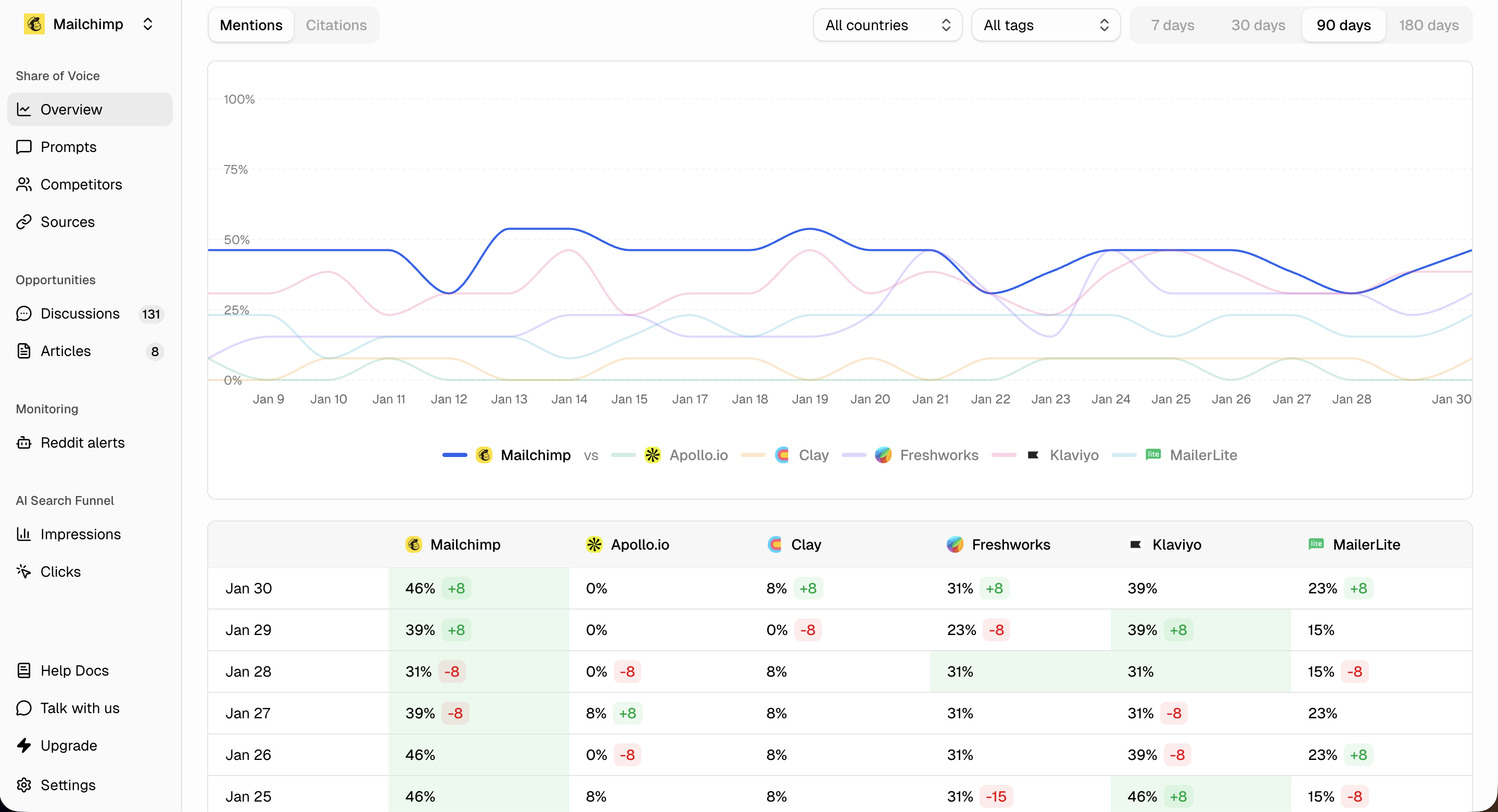
This is where most teams start. The first surprise is realizing they’re invisible in queries where competitors appear regularly. Those competitors show up because specific articles and social threads are influencing AI answers.
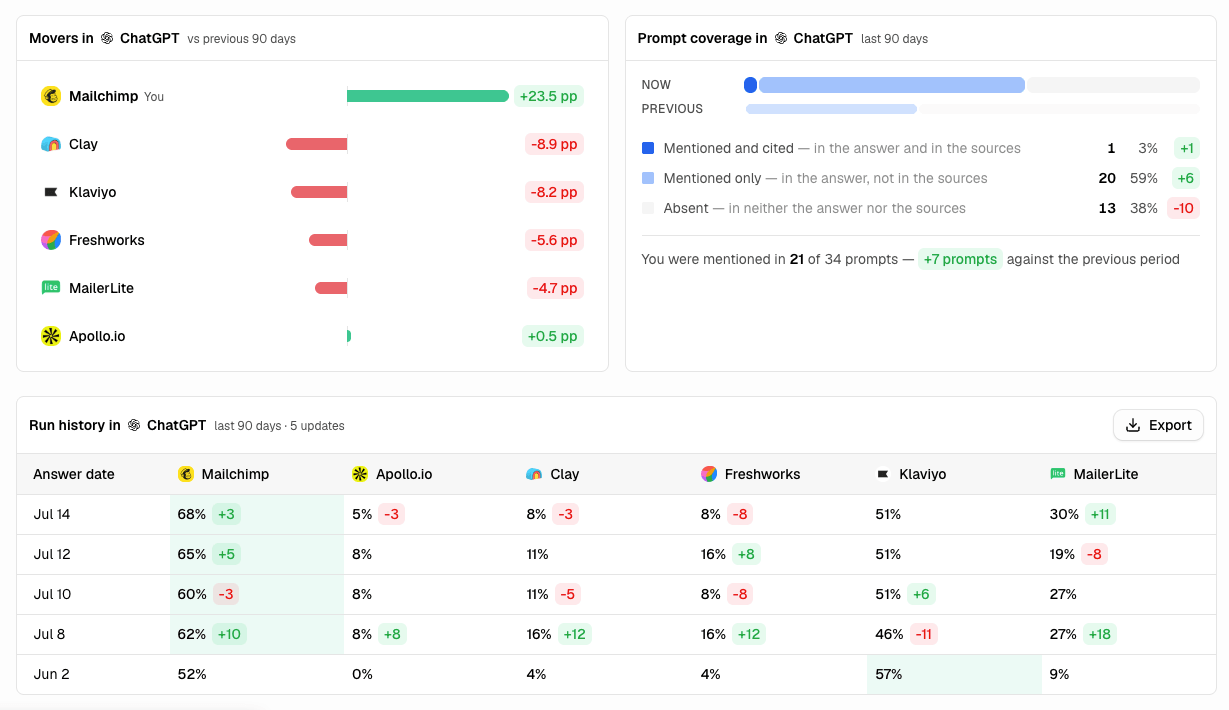
Below the chart, three more panels break the trend down: Movers ranks every tracked brand by how much its rate moved versus the previous period, Prompt coverage splits your tracked prompts into mentioned-and-cited, mentioned-only, and absent, and Run history is the raw log of every scheduled answer—exportable to CSV.
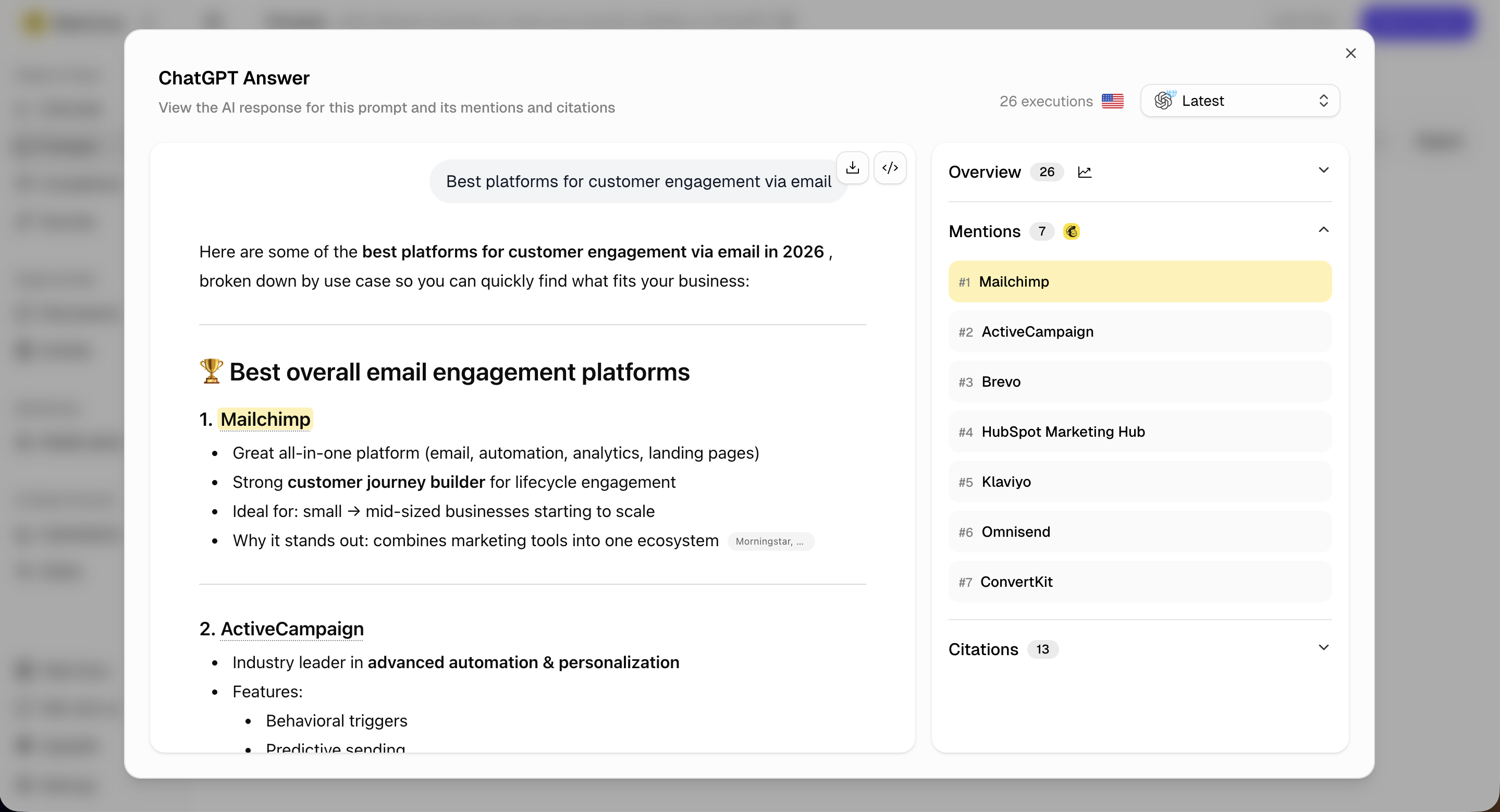
Drill into any prompt to see the full AI response with every mention and citation. You see which brand appeared at #1, which sources were cited, and how results shift over time. The example below shows 26 executions of the same prompt.
LLM crawler activity (AI impressions)
When ChatGPT visits your site, it leaves a server-side footprint. The request comes from bots like ChatGPT-User, PerplexityBot, or ClaudeBot. Airefs captures these and shows which pages are crawled, by which AI systems, and how often.
The charts view shows total impressions over time, broken down by crawler. The logs view shows individual visits: timestamp, LLM name, bot name, and type. It also shows IP address and the specific page path visited.
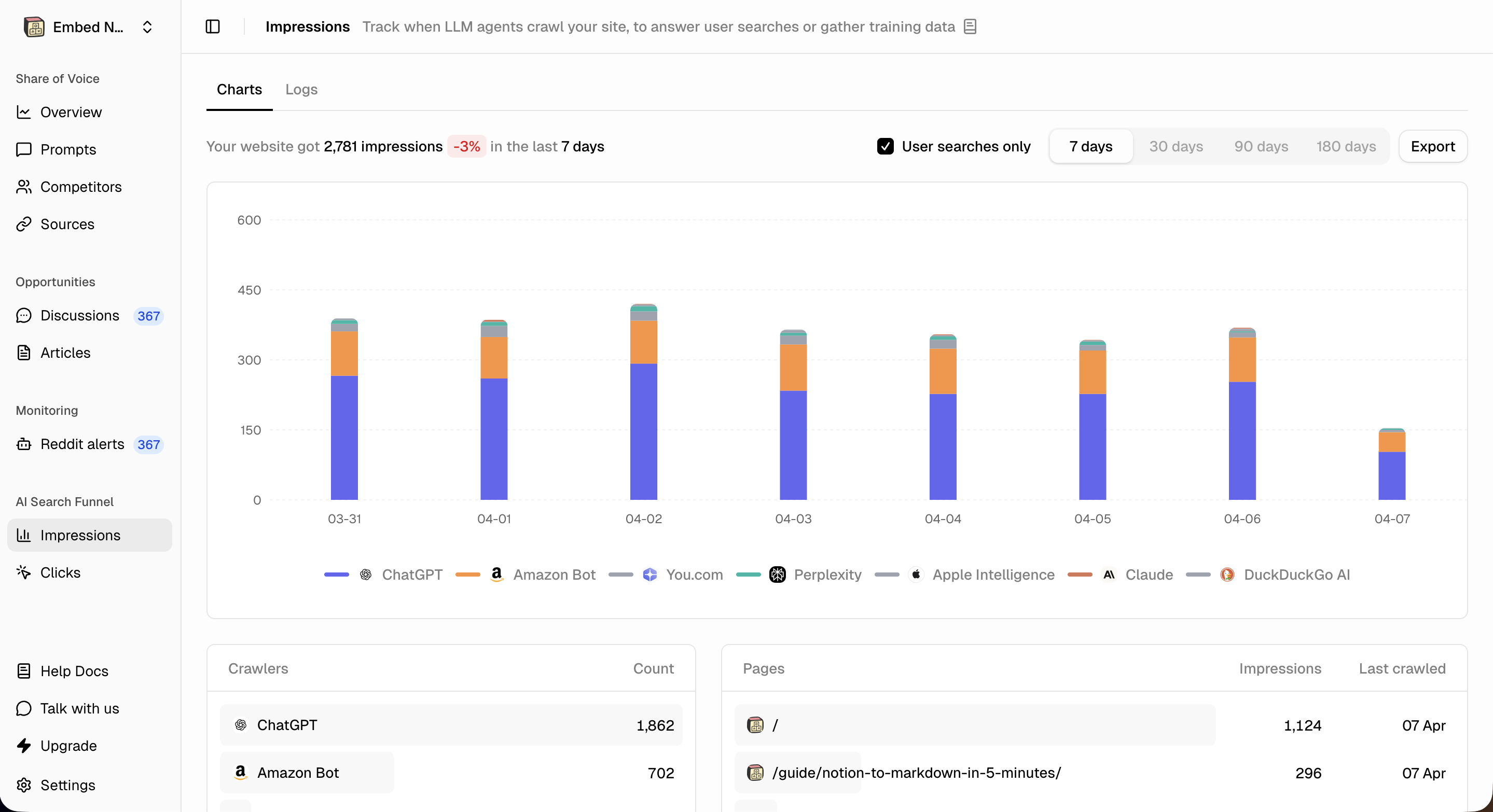
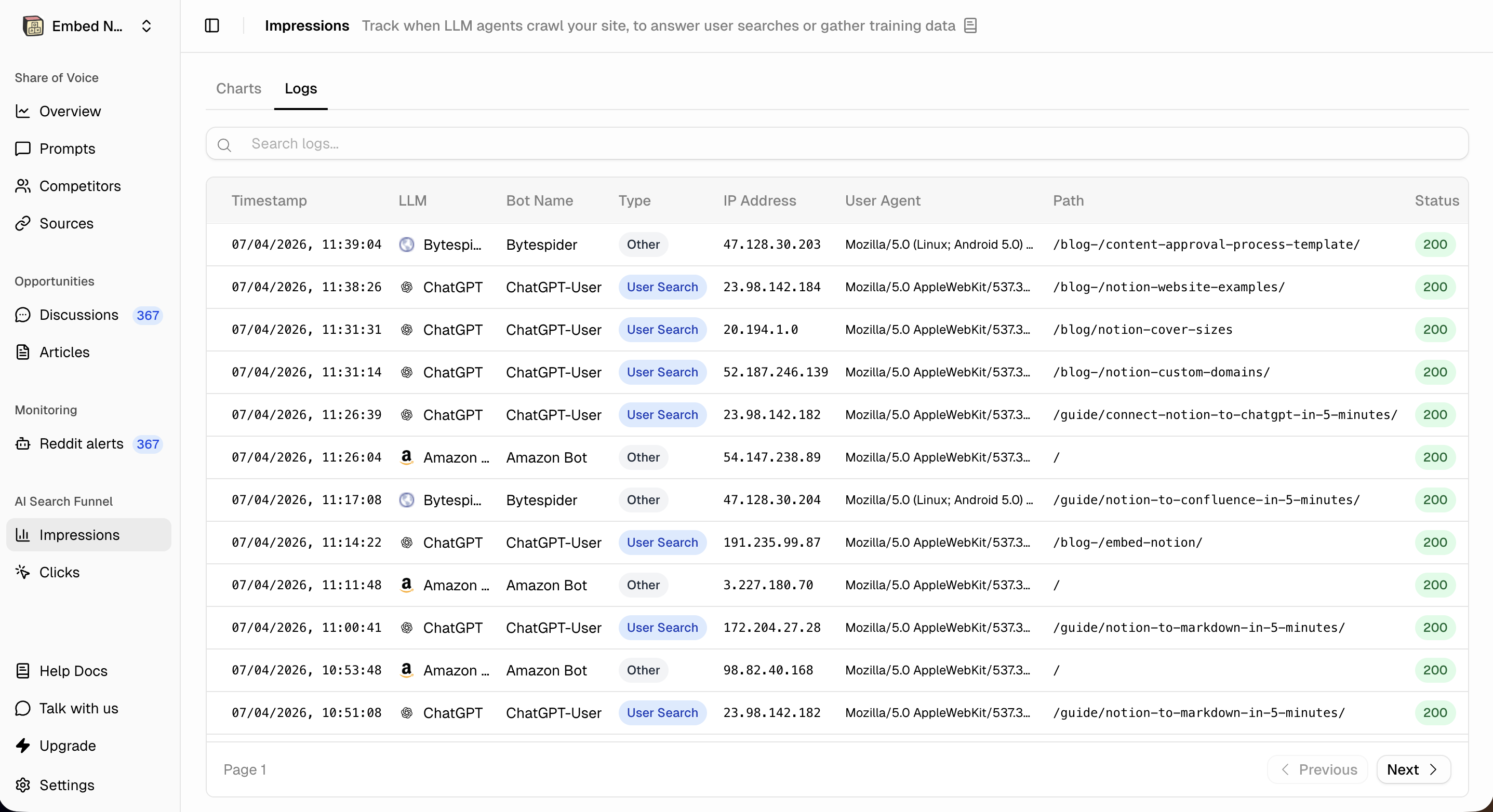
No crawler activity means you’re not on the path to being cited. Heavy activity on specific pages shows what’s working. That’s where to double down.
LLM visitor tracking (AI clicks)
Beyond crawls, Airefs tracks visits sent by AI answers. These are people who saw your brand in a ChatGPT or Perplexity response and clicked through. This connects AI visibility to real traffic—not just brand mentions.
Source insights
The Sources panel shows which URLs ChatGPT is citing across all your tracked prompts—ranked by frequency. This is the intelligence layer that tells you what content is actually influencing AI answers in your category.
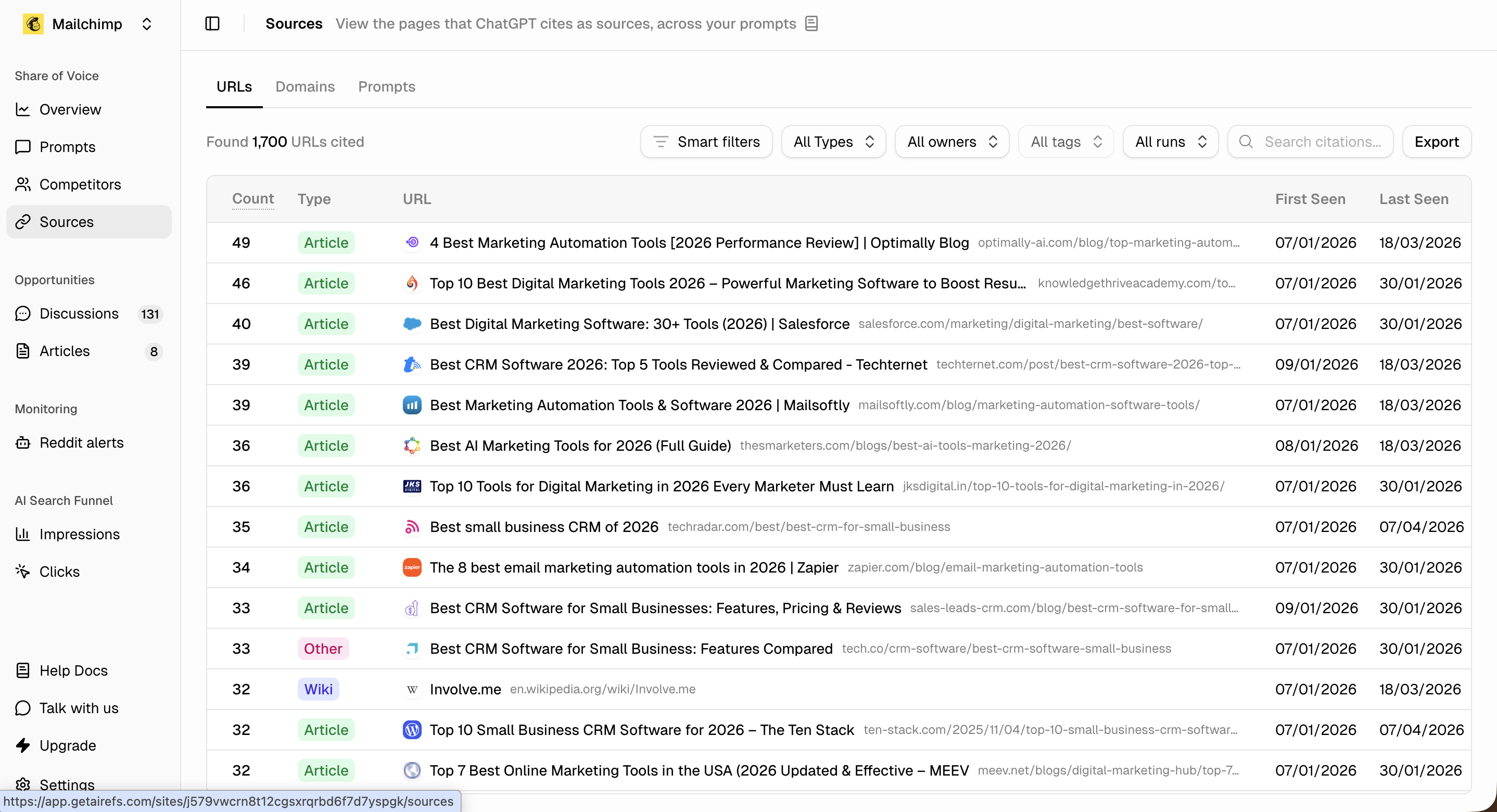
Filter by type, owner, prompt tag, or time range. The Domains tab shows which publishers are most influential—useful for prioritizing outreach. The Prompts tab shows which prompts each source is cited for.
This is what Lillian P meant when she mentioned 571 specific URLs. That’s the difference between monitoring and strategy. Getting into those cited sources—or displacing them—is the AEO playbook. The Brand mentions service does this for you.
Prospect pitches and white-label reports
Agencies can run a visibility audit and an AI readiness score for a prospect, then convert the prospect to a client in one click. Prospects are unlimited.
Reports go out as PDFs under your agency’s own logo and name. Clients and reports are unlimited too.
Done-for-you services
The software shows where a client is missing. Two human-run services act on it, both month to month with no contract.
Done-for-you AI visibility starts at $349/mo. It includes a dedicated strategist, a website audit and monitoring, a monthly content plan, and 8 to 12 articles a month published on your site with human review. The $599/mo plan adds 4 to 8 third-party placement offers a month and the top social threads AI cites, such as Reddit, Quora and LinkedIn, in month one.
Brand mentions is $299/mo for 4 to 8 placement offers a month in articles AI already cites. You approve each one. Plus is $499/mo for 8 to 16. Publisher fees, typically $100 to $500, are billed separately and only once a mention is live.
MCP server
Airefs includes a read-only MCP server (https://mcp.getairefs.com/mcp), so Claude, ChatGPT, Cursor, or Claude Code can query your share of voice, sources, competitors, and more directly—no dashboard required. It’s read-only by design: the connection can read your account, never change it.
Pros and cons
Pros:
- One plan: $49/mo billed yearly ($59 monthly), with unlimited clients, prospects, prompts, countries and reports
- Prompt tracking with full execution logs, position history, and competitor mentions
- Source insights showing the specific URLs influencing AI answers in your clients’ categories
- AI crawler activity tracking (AI impressions) and visitor attribution (AI clicks)
- Prospect audits with an AI readiness score, and PDF reports under your own logo and name
- Tracking integrations for Cloudflare, Vercel, Netlify, Fastly, Akamai, CloudFront, WordPress and an HTTP API
- Read-only MCP server included
- Done-for-you services: human-run articles and placement offers from $349/mo
- Direct founder access—you’re not talking to a support ticketing system
Cons:
- Built for agencies. A single in-house team gets less from the client, prospect and report features
- No free trial
- Five engines: ChatGPT, Google AI Overview, Gemini and Copilot, with Claude as an add-on
- No prompt volume data—Profound, Promptwatch, and Cognizo offer this
- Not SOC 2 compliant; no enterprise security certifications
- No REST API or on-premises deployment—the MCP server is read-only
- Small team—we move fast, but we’re not a 50-person org
How much does Airefs cost?
There is one software plan.
| Billing | Price |
|---|---|
| Billed yearly | $49/mo ($588/yr) |
| Month to month | $59/mo |
Unlimited clients, prospects, prompts, countries and reports. 5,000 AI answers a month are included. One answer is one prompt asked once to one AI engine. Extra answers cost $8 per 1,000. Cancel anytime.
The services cost extra and include the software subscription:
| Service | Price |
|---|---|
| Done-for-you AI visibility | From $349/mo |
| Brand mentions | From $299/mo |
The done-for-you services
Most AEO tools are just that—tools. They track visibility, sometimes generate content, and leave the rest to you. No humans involved at any point.
That works if you have someone who knows what to do with the output. Most teams don’t. The data shows you’re missing from a prompt. The tool flags a content gap. Then what?
Content without context misses the point. A piece that’s technically optimized but lacks a real perspective won’t earn citations. A comment dropped into the wrong thread, or published at the wrong moment, does nothing—or hurts your credibility.
These are the gaps a tool can’t close. They require judgment: which angles will actually resonate, which threads are worth joining, when to publish and when to wait. The services put an expert eye on the work before it goes live—not just automation running in the background.
We weren’t looking for prettier charts—we wanted to show up in AI answers. Airefs found the opportunities, built the content, and increased our visibility in weeks across LLMs, Google and Reddit.
— Kiyan F, Co-founder, Needle
Thanks to Airefs, Techmap went from invisible in LLM answers to showing up every time as one of the best courses for tech recruiters—in just a few weeks.
— Ruben K, Co-founder, Techmap
How does Airefs pricing compare?
Airefs is not the cheapest tool here. Otterly AI starts lower. Airefs includes unlimited clients, so the comparison depends on how many clients you serve.
| Tool | Starting price |
|---|---|
| Otterly AI | $29/mo |
| Airefs | $49/mo billed yearly ($59 monthly) |
| Searchable | $125/mo ($100/mo billed annually) |
| Peec AI | $95/mo |
| Promptwatch | $95/mo |
| Profound | Custom (free 7-day trial) |
| Cognizo | $499/mo |
| Scrunch AI | $250/mo |
| AthenaHQ | $295/mo |
Profound is the clear category leader for enterprise teams. It has deeper data, more AI platforms, and prompt volume analytics that few others offer. If you need enterprise-grade compliance, Profound is the default choice.
Peec AI and Promptwatch offer broader LLM coverage at mid-market prices. Otterly AI is cheaper and has strong G2 reviews.
Airefs is the right choice when you run AI visibility for several clients and want pitching, reporting and human-run execution under one subscription.
Who is Airefs for?
Good fit:
- Agencies managing AI search visibility for multiple clients
- Agencies that want to pitch prospects with a visibility audit and AI readiness score
- Teams that need white-label PDF reports
- Teams that want content and placement work done for them
Not a great fit:
- A single brand that wants the cheapest monitoring tool
- Anyone who wants a free trial first
- Enterprise teams that require SOC 2, SSO, or custom data handling
- Teams that need to track 10+ AI platforms natively
- Organizations where prompt volume data is a core requirement
Conclusion
Airefs is AI search analytics for agencies. Prompt tracking, source insights, and AI impression and click tracking give you a complete picture for each client. Audits and white-label reports help you win and keep clients. The done-for-you services turn that data into executed work from $299/mo.
Where Airefs is honest about its limits: it’s not the enterprise platform. It doesn’t have prompt volume data, 10+ LLM coverage, or SOC 2. If your team has procurement requirements and an enterprise budget, look at Profound.
If you run AEO for clients, Airefs gives you one plan for all of them. Figure out where each client stands, which sources AI cites, and which placements to pursue.
Want to see it yourself? Get early access to Airefs — $49/mo billed yearly. Or explore the done-for-you option if you want the execution handled. Full setup steps live in the Airefs documentation.