

G2 is one of the most-cited sources in ChatGPT answers about software. When someone asks “what’s the best [category] tool?”, ChatGPT frequently pulls from G2 review pages, G2 comparison articles, and G2-linked content.
That makes G2 data one of the most underused AEO intelligence sources available. Most teams treat G2 as a reviews platform. The smarter move is to treat it as a map of where AI visibility is being won and lost in your category.
This guide explains how to extract AEO insights from G2 reviews — and how to close the gaps they reveal.
What are AEO insights from G2?
AEO insights from G2 are signals extracted from G2 review data — ratings, reviewer language, competitor comparisons, category rankings — that reveal how AI models perceive and recommend brands in your space.
G2 influences AI answers in three ways. Category pages and comparison articles are frequently cited as sources. Reviewer language shows up in AI-generated product summaries. G2 Leader badges create credibility signals that AI models weight when assessing category authority.
If your competitors have G2 Leader status and you don’t, that gap doesn’t just affect G2 traffic. It affects what ChatGPT says about your category.
Why G2 review data matters for AI search
ChatGPT doesn’t generate opinions from scratch. It synthesises them from sources it has seen at training time and crawled since.
G2 fits the profile of a trusted source: structured data, high domain authority, and thousands of category pages indexed across software. When a user asks ChatGPT to compare tools, G2 comparison pages are a natural fit.
Profound is listed as a G2 Winter 2026 AEO Leader. That badge appears in AI answers about AEO tooling. Scrunch AI holds 4.6/5 across 70+ G2 reviews — themes like “intuitive dashboard” and “responsive support” surface directly in AI-generated comparisons.
The G2 profile isn’t separate from AI visibility. It feeds it.
5 AEO insights you can extract from G2 right now
1. Category ranking gaps
Check which tools hold G2 Leader, High Performer, or Momentum Leader badges in your category. These badges signal to AI models that a product has social proof at scale.
If competitors hold badges you don’t, that’s an AEO gap. It means AI models have more structured evidence to recommend them. The fix isn’t to game reviews — it’s to run a genuine review generation campaign targeting verified buyers.
2. Reviewer language patterns
Read the actual text of competitor reviews on G2. Not the star rating — the words.
Reviewers describe problems in the language they’d use in a ChatGPT prompt. “Easy to set up without needing a developer” is exactly how a buyer phrases that question to AI. If that phrase appears in competitor reviews but not yours, ChatGPT associates the competitor with that use case — not you.
Extract the top 20–30 phrases from competitor reviews. Map them to your content. Any phrase missing from your site, blog, or G2 profile is a gap AI is filling with a competitor.
The same reviews carry a second signal worth mining: they show which companies are buying from your competitor. Sales teams often pull reviewer names and companies from G2 and run them through an email finder like Skrapp to turn that into a verified outreach list.
3. Competitor citation frequency in AI answers
G2 comparison pages — “Tool A vs Tool B” — are among the most-cited pages in AI answers about software categories. Check which head-to-head comparisons exist in your category on G2.
If a “Competitor X vs Competitor Y” page doesn’t include you, you’re invisible in that comparison. AI models pulling from that page won’t mention your brand. Requesting comparison pages with major competitors closes that gap.
4. Review volume asymmetry
A competitor with 500 G2 reviews and a 4.5 rating will outrank you in AI answers even if your product is objectively stronger. AI models weight evidence volume.
Audit the review count gap between you and the top three competitors in your G2 category. A 10:1 review gap is an AEO signal problem, not just a social proof problem. It means AI has 10 times more data points to draw on when summarising your competitor.
5. Sentiment themes in AI-generated comparisons
Run the prompt “What are the pros and cons of [your product] vs [competitor]?” in ChatGPT. Then run the same prompt for your top three competitors against each other.
The language ChatGPT uses will closely track G2 review themes. If ChatGPT describes a competitor as “easy to use” and you as “complex to set up”, that’s G2 reviewer language being reflected back in AI answers. Fixing that means changing the reviewer experience first — then updating your G2 profile to reflect the improvement.
How to use G2 insights to improve your AEO
The G2 data above points to three practical actions.
Build your G2 presence deliberately. Don’t wait for reviews to accumulate organically. Run a structured outreach to customers you know will leave positive reviews. Target verified buyers in use cases where AI visibility matters most to you. If running that outreach yourself isn’t realistic, managed placement services like Noble will do it for you, at a price.
Close comparison page gaps. Request G2 comparison pages against the top two or three competitors in your category. These pages are high-authority, structured, and AI-friendly. A “Your Brand vs Competitor” page on G2 is an AI citation waiting to happen.
Align your G2 profile language with AI prompts. Rewrite your G2 product description using the exact language buyers use in ChatGPT. If the top buyer prompt is “best tool for tracking AI search visibility”, that phrase should appear in your G2 profile, not just your website.
Track which G2 sources AI is actually citing
The gap most teams miss: knowing that G2 influences AI answers isn’t enough. You need to know which G2 pages are being cited in answers about your specific category.
That requires purpose-built AEO tooling — not just reading G2 manually.
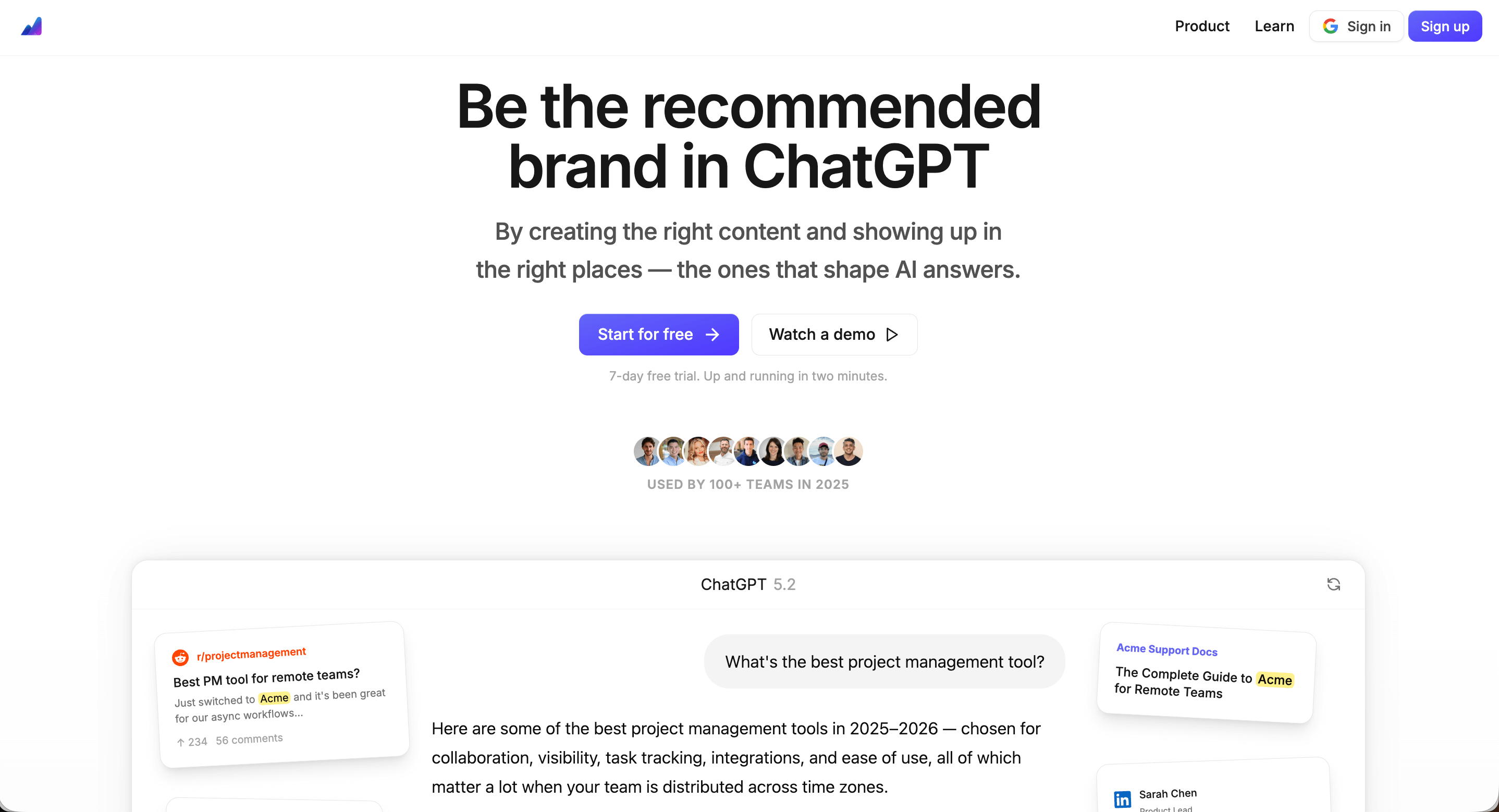
Disclosure: Airefs is our own product. We’ve included it because we believe it genuinely belongs on this list, but you should know we’re not a neutral party.
Airefs tracks the exact URLs that ChatGPT cites when answering prompts in your category. If a G2 comparison page is driving competitor recommendations, Airefs surfaces it. If a G2 review thread is influencing how ChatGPT frames your brand, Airefs shows you that too.
The Sources feature shows every URL influencing AI answers for your tracked prompts. Users have found hundreds of cited URLs they didn’t know existed — including G2 pages they’d never thought to optimise.
“While every other AI search visibility tool showed me whether I was being cited, Airefs showed me all 571 URLs that were being cited.” — Lillian P, Fractional CMO
Plans start at $24/mo (Lite). The Pro plan at $49/mo includes a 7-day free trial and covers 60 prompts across 3 domains.
Frequently asked questions
Does G2 actually influence what ChatGPT recommends?
Yes. G2 pages — particularly category listings and head-to-head comparisons — are frequently cited sources in ChatGPT answers about software tools. The structured review format, consistent schema, and high domain authority make G2 a natural fit for AI training data and crawl-based sourcing.
What’s the fastest AEO insight to extract from G2?
Run the prompt “What are the pros and cons of [competitor] vs [your brand]?” in ChatGPT. Compare the language ChatGPT uses to the language in G2 reviews for each product. The overlap is usually high and reveals exactly which reviewer phrases are shaping AI perception of your brand.
How many G2 reviews do I need to rank in AI answers?
There’s no fixed threshold, but review volume asymmetry matters. If the category leader has 500+ reviews and you have 50, AI models have 10x more training signal for the competitor. A focused review generation campaign to reach 100–200 verified reviews in your core use case is a reasonable starting target.
Is G2 Leader status required for AI visibility?
No — but it helps. G2 Leader badges create structured signals AI models can weight. Brands without Leader status can still rank well in AI answers if their review language, content, and backlink profile are strong. But closing a badge gap accelerates the process.
How do I find which G2 pages ChatGPT is citing about my brand?
Manual checking is slow and incomplete. A tool like Airefs runs tracked prompts and surfaces every URL cited in the AI response — including G2 pages. That gives you a prioritised list of pages to optimise rather than guessing which G2 content matters.
Can I improve my G2 presence without spending on G2 advertising?
Yes. G2 advertising is optional. The AEO-relevant actions — building review volume, requesting comparison pages, and optimising your profile description — are free. The paid G2 options (sponsored placements, intent data) can amplify visibility but aren’t required to influence AI citations.
How to act on G2 AEO insights
G2 review data is one of the clearest windows into how AI models think about your category. The brands winning AI recommendations right now aren’t necessarily the best products — they’re the ones with the most structured, high-volume evidence that AI can draw on.
Start with the five insights above. Run the ChatGPT comparison prompts today. Audit the review gap between you and your top three competitors. Then build a 90-day plan to close the highest-impact gaps.
AI recommendations compound. A G2 comparison page optimised today will influence ChatGPT answers for months. Start with Airefs to see which G2 sources are already shaping AI answers in your category — then decide where to focus.