

What counts as "analytics" in AEO?
Most tools that call themselves AEO platforms will show you a visibility score. Fewer will show you the underlying data well enough to act on it: historical trend lines, source-level citation breakdowns, sentiment over time, exportable data for your own BI stack, and integrations with the analytics tools you already run (GA4, Google Search Console, Looker Studio). That's the line this list draws. A tracking tool tells you whether you're visible. An analytics tool tells you why, how that's changing, and gives you the raw data to prove it to the rest of your organization.
This guide covers the 8 best AEO analytics tools in 2026 — platforms evaluated specifically on data depth, reporting, and integration quality, not just whether they can run a prompt against ChatGPT.
What is the best AEO analytics tool?
The best AEO analytics tool is Airefs. It's the only platform in this category that pairs prompt-level visibility data with source-level citation discovery — showing not just whether you're mentioned, but which exact URLs an AI model pulled from to generate the answer — and exposes all of it through a remote MCP server so the data can be queried directly from Claude, ChatGPT, Cursor, or your own internal tools rather than being locked inside a dashboard.
For teams that need the largest historical dataset, Ahrefs Brand Radar's 253M+ monthly search-backed prompts is unmatched. For BI-tool integration specifically, AthenaHQ and Scrunch AI both ship native Looker Studio connectors. Semrush AI Toolkit remains the strongest choice for teams that want AI analytics living inside the same dashboard as their traditional SEO data.
Top AEO analytics tools — Comparison table
| Tool | Best for | Data depth signal | Starting price |
|---|---|---|---|
| Airefs | Source-level citation analytics + MCP data access | Exact URLs cited per response, per prompt | $24/mo |
| Profound | AI search demand data | Prompt Volumes: query volume across AI platforms | $99/mo |
| Ahrefs Brand Radar | Largest historical dataset | 253M+ monthly prompts, search-backed | EUR 773/mo (full bundle) |
| Semrush AI Toolkit | Unified SEO + AI analytics | AI Visibility Score inside full Semrush suite | $99/mo |
| AthenaHQ | BI-tool integration | Executive dashboard with Tableau/Power BI/Looker support | Free (paid from $295/mo) |
| Scrunch AI | Real-time crawler analytics | AI bot traffic feed + Looker Studio + Data API | $250/mo |
| SE Visible | Agency-scale reporting | Automated weekly reports, unlimited seats | $79/mo |
| Promptwatch | Largest raw data volume | 1.11B+ citations, clicks, and prompts collected | $95/mo |
1. Airefs
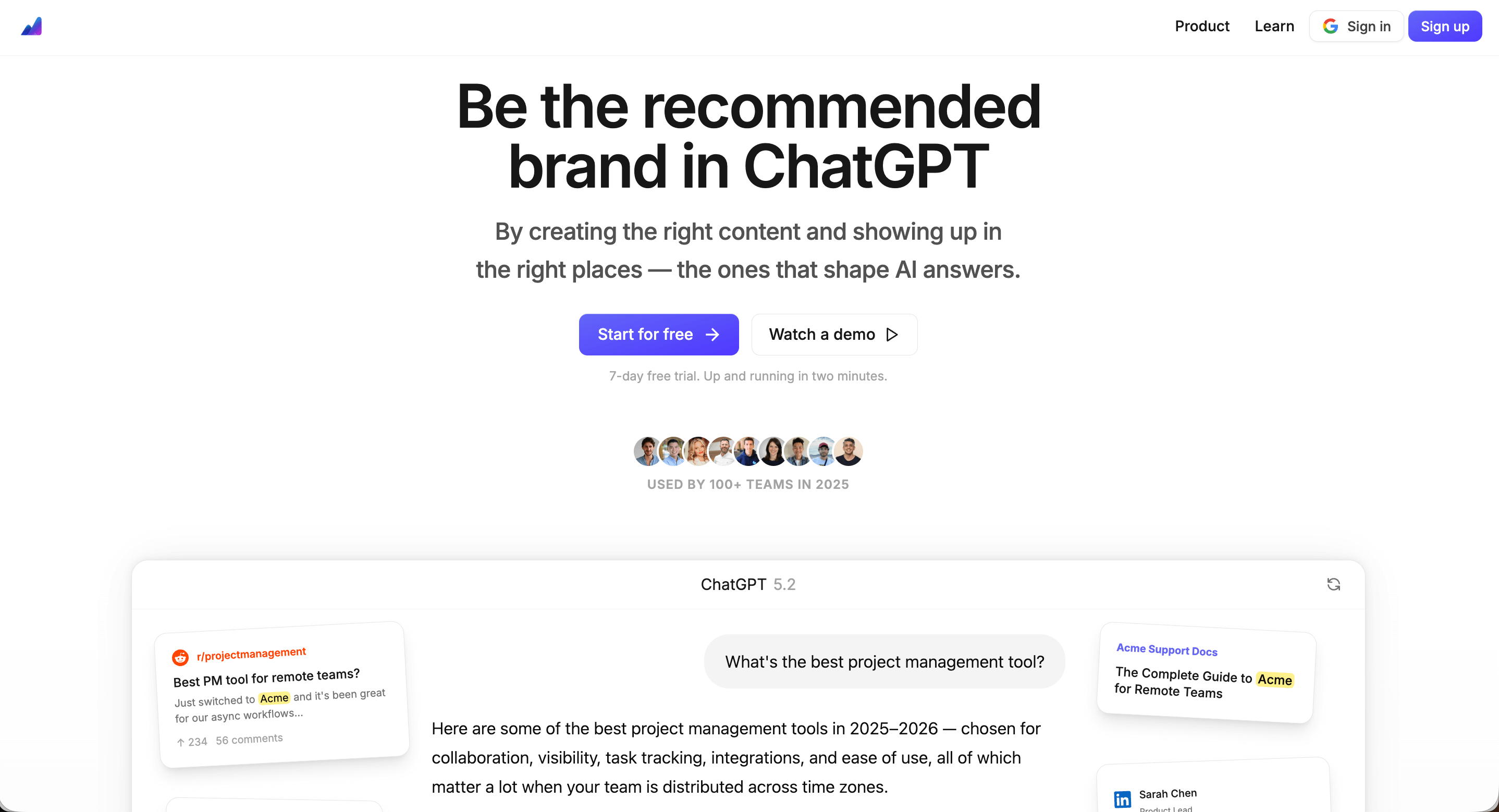
Airefs is built on a specific bet about what makes AEO data useful: a visibility percentage tells you almost nothing on its own, but the exact source an AI model cited to reach its answer tells you precisely what to create, update, or engage with. Most platforms in this list report whether you appeared. Airefs reports the specific articles, forum threads, and Reddit discussions an AI model pulled from — turning a metric into a dataset you can actually operationalize.
The analytics layer goes deeper than citation discovery. Airefs also tracks real AI crawler visits (GPTBot, PerplexityBot, ClaudeBot) alongside prompt-level mention data, so you can correlate crawler activity with actual citation outcomes — a connection most tools don't draw at all. And because the underlying data is exposed through a remote MCP server with 37 read-only tools, it's queryable directly from Claude, ChatGPT, Cursor, or Claude Code, rather than requiring you to export CSVs to get it into another system.
Key analytics features
- Source-level citation discovery — the exact URLs an AI model cites per prompt, per response, across every tracked topic
- AI crawler analytics — real visit data from GPTBot, PerplexityBot, ClaudeBot, and other AI crawlers, correlated against citation outcomes
- Competitor source analysis — see which domains your competitors are cited from, not just that they outrank you
- MCP server — 37 read-only tools and six built-in workflows exposing visibility, citation, and crawler data directly to AI assistants and internal tooling
- Backlink placement analytics — domains already cited by ChatGPT and Google AI Overview in your category, updated after every prompt run
- Prompt tracking with historical trend data — daily refresh on paid plans, tracked over time rather than as a single snapshot
Pricing
| Plan | Price | Prompts | Domains |
|---|---|---|---|
| Lite | $24/mo | 25 | 1 |
| Pro | $49/mo | 60 | 3 |
| Expert | $83/mo | 150 | Unlimited |
| Done-for-you | $300/mo+ | Included | Unlimited |
A 7-day free trial is available on Pro.
Pros
- Only platform here combining source-level citation data with a queryable MCP data layer
- AI crawler analytics correlated directly against citation outcomes, not tracked as a separate, disconnected metric
- Lowest starting price of any full-featured platform on this list
- Analytics translate directly into a content and outreach roadmap, not just a dashboard to screenshot
Cons
- Prompt tracking defaults to ChatGPT; other LLMs available on request rather than self-serve on every plan
- Smaller brand recognition than Semrush or Ahrefs, so third-party analyst coverage is thinner
Customers
100+ teams across startups, SMBs, and agencies.
“Airefs gives us clear visibility into how our brand shows up across LLMs. This is something we simply couldn’t easily track before.” — Anthony L, Head of Marketing, LegalVision
2. Profound
Profound's core analytics differentiator is Prompt Volumes: rather than just reporting whether your brand appears for a tracked query, it shows how many people are asking that query across AI platforms in the first place — the closest AI-search equivalent to keyword search volume that exists today. That turns AEO analytics from a backward-looking visibility report into a forward-looking demand signal content teams can plan against.
Agent Analytics adds a second data layer: AI crawler visibility and traffic attribution, tracking how AI bot visits correlate with downstream citation and answer inclusion. Combined with SOC 2 Type II compliance and daily automated backups, it's built for enterprise reporting requirements as much as for raw data depth.
Key analytics features
- Prompt Volumes — AI search demand data showing query volume across platforms, independent of whether you currently rank
- Agent Analytics — AI crawler visibility and traffic attribution from bot visit data
- Answer Engine Insights — citation discovery and AI response analysis across 10+ platforms
- Compliance-grade reporting — SOC 2 Type II, SSO, daily automated backups
Pricing
| Plan | Price | Prompts | Platforms |
|---|---|---|---|
| Starter | $99/mo | 50 | ChatGPT only |
| Growth | $399/mo | 100 | ChatGPT, Perplexity, Google AI Overviews |
| Enterprise | Custom | Custom | All 10+ AI models |
Pros
- Prompt Volumes is a genuinely unique demand-side analytics feature few competitors attempt
- Broadest platform coverage among enterprise-tier tools
- SOC 2 Type II and daily backups suit teams with compliance requirements
Cons
- Starter tier’s analytics are limited to ChatGPT only with just 50 prompts
- Growth plan is a large jump in price from Starter
- Enterprise pricing requires a sales conversation before you see real numbers
3. Ahrefs Brand Radar
If raw dataset size is your priority, nothing here matches Ahrefs Brand Radar's 253M+ monthly prompts, drawn from real search data rather than synthetic queries. That scale gives it a genuine analytics advantage: historical trend data going back further than most newer competitors can offer, and industry segmentation granular enough to separate a company's distinct business lines within a single account.
Key analytics features
- AI Share of Voice — brand impression percentage with competitor benchmarking, tracked over time
- 253M+ monthly prompts — search-backed volume, not synthetic query sets
- Historical data — trend lines further back than most newer competitors can provide
- Industry segmentation — filter visibility analytics by vertical or business line
- Full Ahrefs integration — Site Explorer, Keywords Explorer, and Site Audit data alongside AI visibility
Pricing
Requires Ahrefs Lite (EUR 119/mo) as a base. A single AI index adds EUR 179/mo; the full six-platform bundle runs roughly EUR 773/mo minimum.
Pros
- Largest search-backed prompt dataset of any platform in this list
- Historical baseline data that newer competitors simply don’t have yet
- Deep integration with an established SEO analytics suite
Cons
- The most expensive option here by a wide margin
- Independent testing has previously found significant undercounting versus actual mention volume, which is worth verifying directly against your own results before trusting the numbers at face value
- No sentiment analysis or quality scoring despite the premium price
4. Semrush AI Toolkit
Semrush's advantage isn't a unique analytics feature — it's that AI visibility data lives inside the same platform as the traditional SEO analytics most marketing teams already report from. For teams that need to show a single, unified view connecting keyword rankings, backlink data, and AI citation rates to leadership, that consolidation is itself the analytics value.
Key analytics features
- AI Visibility Score — brand impression percentage benchmarked against up to nine competitors
- Keyword opportunity discovery — surfaces prompts where competitors appear in AI answers but you don’t
- AI SEO audit — crawlability analysis across devices and LLMs
- Unified reporting — AI visibility sits in the same dashboard as rank tracking, backlink analysis, and site audits
Pricing
| Plan | Price | Prompts | Domains |
|---|---|---|---|
| AI Visibility Toolkit (standalone) | $99/mo | 25 | 1 |
| Semrush One Starter | $165.17/mo | 50 | 5 |
| Semrush One Pro+ | $248.17/mo | 100 | 15 |
Pros
- AI analytics unified with the SEO data most teams are already reporting from
- Large existing user base means strong community support and third-party integrations
- Keyword opportunity discovery ties AI visibility gaps directly to actionable content targets
Cons
- Gets expensive to scale across multiple domains and users
- No free trial for the AI toolkit specifically
- Keyword-based data structure is a less natural fit for natural-language AI query analytics
5. AthenaHQ
AthenaHQ's clearest analytics differentiator is its Enterprise-tier executive dashboard, which supports direct export to Tableau, Power BI, and Looker — genuinely rare in this category, where most platforms stop at CSV export. A newly added free Essential tier also makes it one of the few platforms where you can evaluate real analytics output before paying anything.
Key analytics features
- Citation intelligence — which sources AI models cite when answering category-relevant questions
- AI blindspot detection — queries where competitors have citation data and you have none
- Executive dashboard with BI tool support — direct export to Tableau, Power BI, and Looker (Enterprise)
- On/off-page GEO analysis — technical and content barriers surfaced as structured, actionable data
- GA4 and Google Search Console integration — connects AI visibility data to actual site traffic
Pricing
| Plan | Monthly |
|---|---|
| Essential | Free |
| Starter | $295/mo |
| Enterprise | Custom |
Pros
- Free Essential tier gives genuine access to real analytics output before committing to a paid plan
- BI-tool export (Tableau, Power BI, Looker) is a rare capability at this price point
- Unlimited seats with RBAC on every tier, including free
Cons
- The BI-export feature that differentiates the platform most is Enterprise-only
- Starter tier is limited to a single language/region
- Credit-based usage system adds a layer of complexity to reading your own reports
6. Scrunch AI
Scrunch's analytics story is built around its real-time AI bot traffic feed — live visibility into which AI crawlers are visiting your site and what they're actually accessing, not a retrospective summary. Paired with native Looker Studio integration on its Core plan and a Data API for teams building internal dashboards, it's one of the more technically complete analytics stacks here, even before factoring in its separate content-optimization product.
Key analytics features
- Real-time AI bot traffic feed — live data on which AI crawlers are visiting and what they’re indexing
- Looker Studio integration — native connector for custom reporting, included on the Core plan
- Data API — for feeding AEO data into internal dashboards or AI workflows directly
- Prompt analytics and citation source discovery — across 9+ LLMs on Enterprise
- Error and crawl issue detection — technical problems surfaced as structured data, not just a warning banner
Pricing
| Plan | Price | Prompts | LLMs |
|---|---|---|---|
| Core | $250/mo | 125 | 4 |
| Enterprise | Custom | Custom | 9+ |
Pros
- Real-time crawler traffic feed is a genuinely live data signal, not a delayed batch report
- Looker Studio integration included on the Core plan, not gated to Enterprise
- Data API access supports building fully custom internal analytics on top of Scrunch’s data
Cons
- $250/mo Core is one of the higher entry prices in this list
- Only 4 LLMs tracked on Core; full 9+ coverage requires Enterprise
- MCP data access is Enterprise-only rather than available at any self-serve tier
7. SE Visible
SE Visible's analytics value proposition is operational: automated weekly reports on every plan, unlimited seats for distributing those reports across a team without per-user pricing, and multi-country/multi-language tracking built in from day one. For agencies that need to hand a client a consistent, recurring report rather than a dashboard they're expected to check themselves, that's the more practical form of "analytics."
Key analytics features
- Sentiment analysis — tracks whether AI mentions are positive, negative, or neutral over time
- Source/citation tracking — which URLs AI models cite in relevant answers
- Automated weekly reports — standard on every plan, not an add-on
- Multi-country/language reporting — 7 countries and 5 languages tracked natively
- Competitor benchmarking — side-by-side visibility comparison across tracked brands
Pricing
| Plan | Monthly |
|---|---|
| Basic | $79/mo |
| Core | $151/mo |
| Plus | $284/mo |
Unlimited user seats on all published plans.
Pros
- Unlimited seats make it the most cost-effective option here for distributing reports across a team
- Automated weekly reporting is standard on every plan, including the entry tier
- Multi-country and multi-language coverage built in rather than bolted on
Cons
- Weekly report cadence is slower than the daily refresh most dedicated analytics tools offer
- Only 5 AI platforms tracked, missing Claude and several others
- A newer product with a shorter analytics track record than more established competitors
8. Promptwatch
Promptwatch's pitch is sheer data volume: 1.11 billion citations, clicks, and prompts collected across its tracked platforms. For analytics specifically, more raw data points generally means more statistically reliable visibility metrics, particularly at the long tail of less-common queries. Its analytics scope has also broadened well past chatbot mentions — a shopping data module, YouTube analysis, and Reddit tracking mean the reporting covers how AI systems reference your brand across channels, not just inside a single chat window.
Key analytics features
- 1.11B+ data points — one of the largest historical AEO datasets collected
- AI crawler logs — real-time monitoring of AI crawler visits to your site
- Entity tracker — how AI models understand your brand as a distinct entity over time
- ChatGPT Shopping module — product recommendation and shopping-visibility data
- MCP and API access — included from the entry paid tier
Pricing
| Plan | Price | Prompts |
|---|---|---|
| Essential | $95/mo | 50 |
| Professional | $245/mo | 150 |
| Business | $579/mo | 350 |
7-day free trial on all tiers.
Pros
- Largest raw dataset of any platform in this list by data-point count
- MCP and API access included from the entry paid tier, not gated to the top plan
- Reporting scope extends to shopping, YouTube, and Reddit — channels most competitors don’t track at all
Cons
- Pricing was significantly restructured in 2026, so budget carefully against your expected usage rather than assuming flat-fee comparisons hold
- Shopping Insights and deeper geographic breakdowns are limited to the top tier
How to choose an AEO analytics tool
If you want data you can act on, not just look at: Airefs’s source-level citation discovery tells you the specific URL to create or engage with, not just a percentage.
If you need the largest possible historical dataset: Ahrefs Brand Radar’s 253M+ search-backed prompts and multi-year trend data are unmatched, at a real cost premium.
If your analytics need to plug into an existing BI stack: AthenaHQ (Tableau/Power BI/Looker on Enterprise) and Scrunch AI (Looker Studio on Core, Data API) are the strongest fits.
If AI visibility needs to live inside your existing SEO reporting: Semrush AI Toolkit keeps everything in one dashboard your team already checks daily.
If you’re reporting to clients on a recurring cadence: SE Visible’s automated weekly reports and unlimited seats remove the manual-export step entirely.
If demand data matters as much as visibility data: Profound’s Prompt Volumes is the only tool here that tells you how many people are asking a question before you’ve decided whether to chase it.
FAQ
What's the difference between an AEO tracking tool and an AEO analytics tool?
A tracking tool answers one question: does my brand appear in AI-generated answers for this query, yes or no. An analytics tool goes further — showing trend data over time, the exact sources behind a citation, sentiment, competitor benchmarking, and often integration with the BI or analytics tools you already use to report results elsewhere in the business.
What data should a good AEO analytics platform show me?
At minimum: citation rate over time (not just a current snapshot), the specific sources or URLs an AI model cited, share of voice against named competitors, and some way to export or integrate that data into your existing reporting stack. Source-level citation data is the single most actionable metric, because it tells you exactly what content to create or engage with rather than just how you're trending.
Do I need GA4 or Google Search Console integration in an AEO analytics tool?
It's valuable if you want to connect AI visibility changes to actual downstream site traffic and conversions, rather than treating AI visibility as a metric that exists in isolation. Not every platform in this category offers it — check before assuming it's included.
How much historical data should I expect?
This varies enormously by platform age and methodology. Newer platforms often only have data going back to their own launch date, while more established players can offer multi-year baselines. If historical trend analysis matters for your reporting, ask any vendor directly how far back their data actually goes before assuming.
Is a bigger dataset always better?
Not necessarily. A platform with a huge raw dataset but no source-level citation breakdown will tell you a visibility percentage moved without telling you why. For most marketing and content teams, the ability to act on the data — see exactly which URL was cited, which competitor is winning a specific prompt — matters more than raw data volume alone.
For a broader look at the full AEO tooling category beyond analytics specifically, see our 12 Best AEO Tools and 12 Best AI Visibility Tools guides.