Stop chasing citation counts like backlinks. A citation can make an answer look sourced, raise trust, and still send you no visit and no proof. Score the sentence, not the footnote.
Table of Contents
- Why AI Citations Rarely Send the Click
- How Each AI Search Tool Shows Sources
- Mentions Sources and Real Claim Support
- Outrank Handles Keyword Research Before the First Draft
- What Studies Found About Citation Accuracy
- Examples of Citations That Miss the Claim
- How Brands Earn Citations That Hold Up
- Common Questions About AI Citations
Why AI Citations Rarely Send the Click
The popular advice says get cited and traffic follows. That’s the wrong expectation for AI citations.
A citation often works as provenance. It tells the reader the answer came from somewhere, even if they never open it.
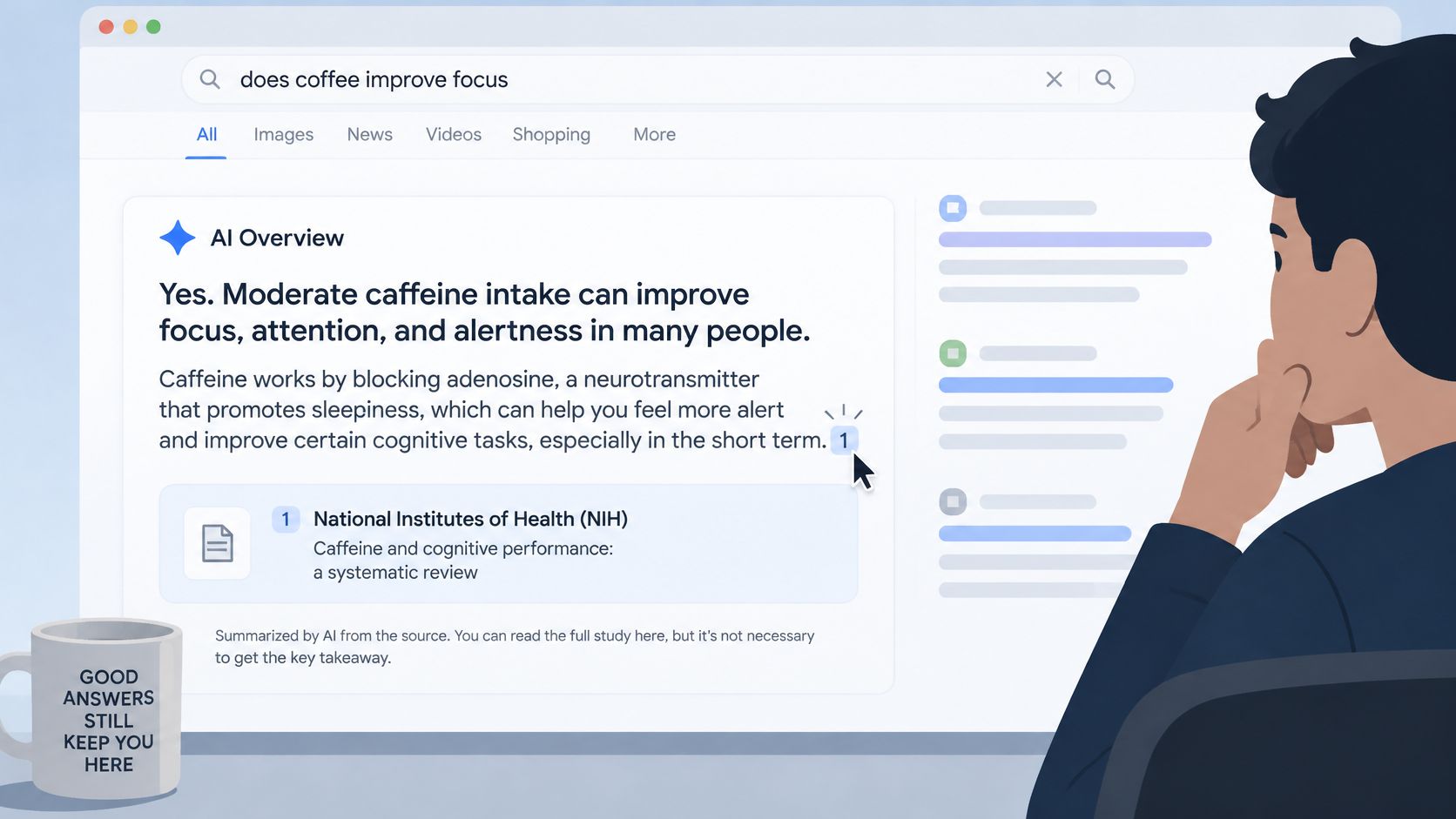
In the Pew Research Center analysis of browsing data from 900 U.S. adults, 58% conducted at least one Google search in March 2025 that produced an AI-generated summary. That’s not a niche interface anymore. It’s a normal search experience.
Users who saw an AI summary clicked a traditional search-result link in 8% of visits, compared with 15% of visits when no summary appeared. They clicked a link inside the AI summary itself in only 1% of visits.
The session often ends inside the answer
Pages with an AI summary ended the browsing session 26% of the time, versus 16% for pages containing only traditional results. The reader got enough to stop, or thought they did.
That’s why referral reports look thin even when visibility improves. It’s also why teams misread the gap if they only check sessions, a problem covered in why GA4 under-reports ChatGPT traffic.
An AI citation is a visible pointer from a generated answer to a page, thread, video, or document. One sentence, one definition. Don’t add traffic promises to it.
A brand mention is different. Your name can appear in the answer with no link, no source card, and no page of yours attached.
A citation shows where an answer points. It doesn’t prove the reader clicked, or that the sentence is true.
By the end, you’ll be able to read each tool’s citation UI. You’ll also score whether a source supports the sentence it’s attached to.
You’ll know which pages and discussions are worth earning. And you’ll stop treating every footnote as a win.
How Each AI Search Tool Shows Sources
Start with what the user can see and click. The interface tells you what to log.
| Tool | What the user sees | How sources are chosen | First check |
|---|---|---|---|
| ChatGPT Search | Inline citations and a Sources area with cited and related links | May run targeted web queries, then retrieve pages and write the answer | Open the page; citations are not guaranteed complete, current, or correct |
| Google AI Overviews and AI Mode | An answer plus supporting links, often a wider set than classic results | Models identify additional supporting pages while generating the response | Check whether the page is the one that would rank first, or an extra doc, article, or forum |
| Perplexity | Numbered inline citations tied to a visible source list | Retrieves web pages for the query, then attaches numbered references to generated sentences | Match the number to the specific sentence, not just the topic |
ChatGPT Search
OpenAI’s ChatGPT Search help page explains that ChatGPT may decide current web information would improve the response, generate one or more targeted search queries, and retrieve relevant results. The answer can then include inline citations. A Sources area may provide cited sources and additional relevant links.
That distinction matters in your log. A page in Sources isn’t always tied to a specific sentence. An inline citation is closer to a claim, but still needs checking.
OpenAI also gives a blunt warning. On its ChatGPT Search guidance page, OpenAI warns that citations are not guaranteed to be complete, current, or correct.
Open the source yourself. Check when it was published or updated, especially when accuracy matters.
Google AI Overviews and AI Mode
Google doesn’t describe these features as link-free answers. The Google Search documentation on AI features says AI Overviews and AI Mode surface relevant links while answering questions.
Google says its advanced models identify additional supporting web pages while generating responses. They can display a wider and more diverse set of helpful links than classic web search.
That wider set changes your target list. The cited page may be documentation, a forum thread, or a niche article, not the page ranking first.
Track the exact URLs, not just your domain. That’s the practical core of AI Overview tracking, because one answer can expose several supporting pages at once.
Perplexity
Perplexity makes the mapping easier to inspect. Numbers sit next to sentences, with a visible source list behind them.
Don’t stop at topical relevance. Click the number and find the passage that supposedly supports that sentence.
A pricing page about the right product can still fail. If it doesn’t state the price in the answer, the citation doesn’t support the claim.
The shared log for every tool
Use the same fields across ChatGPT, Google, and Perplexity. Consistency makes gaps visible.
- Exact URL: Record the page, thread, or document cited, not just the domain.
- Attached sentence: Copy the sentence the citation sits beside, word for word.
- Publish or update date: Note the date shown on the source, or mark it missing.
- Brand location: Mark whether your brand is named in the answer, in the source, in both, or in neither.
Don’t score accuracy yet. First capture what the user saw, in a form you can audit later.
Mentions Sources and Real Claim Support
Think of a citation like a footnote. A footnote shows where a sentence points, not that the sentence is true.
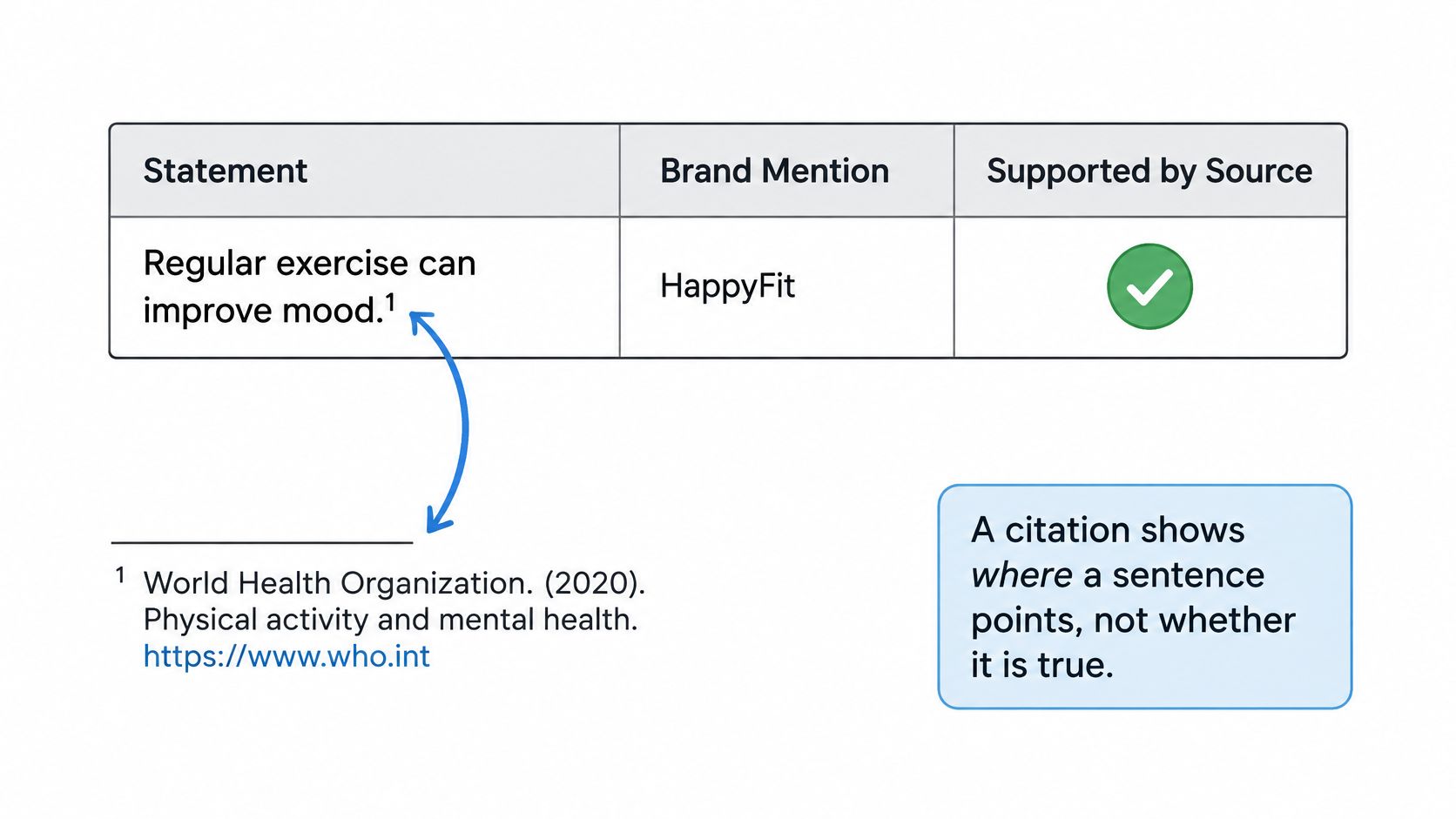
That’s why I would split every answer into three signals. Mixing them inflates your score.
| Signal | Question it answers | How it fails |
|---|---|---|
| Brand mention | Does the name appear in the answer? | Visibility with no source at all |
| Source inclusion | Is a URL attached to the answer? | The page is real but does not entail the sentence |
| Claim support | Does the cited passage support that specific claim? | The text is outdated, out of scope, or contradicts the answer |
A mention gives you presence. It doesn’t give the reader a path to your page, and it doesn’t prove your content shaped the answer.
Source inclusion gives you a pointer. The URL can be real, current, and authoritative, yet still pinned to the wrong sentence.
Claim support is the strict test. The cited passage must entail the specific statement in the answer.
Microsoft Research adds a human problem on top. Its Microsoft Research report on appropriate reliance reports that users often rely on AI summaries instead of fact-checking, and that citations can exacerbate overreliance by making users overestimate accuracy.
Readers treat formatting as proof. A neat link, a familiar domain, or several references can raise trust even when a link is wrong.
That creates brand risk. Your name can sit inside a confident summary that your own page wouldn’t support.
Citation presence is not citation reliability.
Recall and precision keep the score honest
The Springer article on evaluating AI citations defines citation recall as whether each factual claim has at least one supporting citation. It defines citation precision as whether the cited passage is relevant and necessary for that claim.
A related page can pass a traffic check and fail precision. If it doesn’t entail the generated statement, it’s decorative evidence.
Counting citations alone overstates influence. Claim-level scoring shows whether a source is grounding the answer, which is also why building website authority needs more than collecting mentions.
A four step claim audit
- Split the answer into atomic claims, one factual statement at a time.
- Map each claim to the cited passage, not just the cited URL.
- Score existence, entailment, currency, and contradiction separately.
- Flag unsupported claims instead of averaging them into a citation count.
Keep failures visible. One unsupported pricing, safety, or compatibility claim matters more than five harmless supported sentences.
That’s the score I trust. Mention, inclusion, and support each answer a different question.
Outrank Handles Keyword Research Before the First Draft
Citation-ready content starts before drafting. A clear buyer question, a bounded claim, and a structured page give retrieval systems specific passages to work with. A citation can still look authoritative without sending a click or proving the answer, so the useful check is whether a passage supports the sentence.
Outrank is an AI-powered SEO platform for content creation and management. It can generate SEO-focused articles and custom on-brand images, with tools to help teams publish their content.
Its keyword research happens before the first draft. That sequence matters: a broad topic can lead to vague claims, while a focused brief gives writers a clearer scope to develop and verify.
What it handles in practice
Outrank supports long-form drafting and direct publishing. Brand voice customization helps teams shape the output, while multi-user access lets writers and reviewers work on the same piece.
For teams exploring AI citations, faster production is only useful if the brief makes claims specific enough to check. A polished draft can earn a mention and raise trust without making its answer true. Compare the generated sentence with the source passage, and check whether the passage entails the claim rather than merely discussing the same topic.
Where it fits and where it doesn’t
Outrank can suit teams whose bottleneck is research, drafting, and publishing volume. A defined topic list gives the workflow a clear starting point and helps carry a keyword through to a draft.
It is not a citation audit. Check sources, dates, and claim support yourself: generated prose can sound precise while overstating what a source says.
Treat the draft as raw material. Give each section one main claim, make its scope clear, and remove sentences you cannot support with a source. Then compare each cited passage with the exact sentence it is meant to support.
The trade-off is practical. Faster drafting can get a page ready sooner, but speed does not establish accuracy. Keep separate checks for whether the brand is mentioned, whether its page is included as a source, and whether that source supports the claim.
What Studies Found About Citation Accuracy
Progress is real. The gap between knowing a fact and citing it properly is also real.
| Evaluation | What was tested | Answer or claim result | Citation result |
|---|---|---|---|
| GPT-4 scientific sourcing, 2024 | 1,326 scientific facts | 96% of facts correctly identified | 78% of citations relevant and existent |
| Google AI Overviews claim check | 98,020 verifiable claims against cited page text | About 89% clearly or broadly supported by the cited text | 7% absent from the cited text, 4% contradicted it; only 41.9% of full overviews had every verifiable claim supported |
GPT-4 knew more than it sourced
In the 2024 GPT-4 scientific sourcing study, GPT-4 correctly identified 96% of 1,326 scientific facts. It generated citations that were both relevant and existent with 78% accuracy.
That spread is the lesson. A model can reproduce a fact and still attach a weak, irrelevant, or nonexistent source.
Don’t collapse those scores. Answer correctness, citation existence, and citation relevance fail for different reasons.
Google AI Overviews at claim level
The Washington University report on Google AI Overview citations assessed 98,020 verifiable claims against the text of cited webpages. Approximately 89% were clearly or broadly supported, while 7% were absent from the cited text and 4% contradicted it.
The stricter result is more useful for brands. Only 41.9% of complete overviews had every verifiable claim supported by the available cited material.
A mostly supported answer can still contain a bad sentence. If that sentence names your product, the average doesn’t protect you.
Retrieval and synthesis fail separately
Retrieving a credible page is one job. Synthesizing it without stretching the claim is another.
A system can pick a good URL, then combine it with another source. It can also extrapolate past a scoped statement or drop a condition that changed the meaning.
That’s why domain-level citation counts are too blunt. Large citation sets need claim checks, a point that also shapes analysis of 14 million AI search results.
Track entailment and contradiction rate separately. Also note where the supporting passage sits on the page, because buried caveats get lost.
Practical rule: Make the quotable sentence carry its own scope, date, and limits.
Concise, explicitly scoped pages are easier to audit. They’re also harder to cite accurately for a conclusion they never made.
Examples of Citations That Miss the Claim
Failure types repeat. Label the type first, then decide whether the problem is existence, entailment, or currency.
Case A the fabricated source
Say a buyer asks for the best virtual try-on tool. The answer gives a confident comparison and cites a paper or URL that doesn’t resolve.
That pattern showed up early and at scale. In the 2023 ACM SIGIR Asia Pacific study of ChatGPT references, ChatGPT produced correct or partially correct answers in approximately 50.6% of cases, but only 14% of the references it generated existed.
Among 160 evaluated answers, 9% contained no references even though the system had been explicitly instructed to include them. The remaining answers averaged 3.08 references each, and 385 references, 86% of the total, were nonexistent.
Wikipedia accounted for approximately 85% of the valid references identified. Even existing references often failed to support the claims attributed to them.
Log it in one line. Exists, no. Entails, no. Current, not applicable. Brand mentioned, cited, or both, record which.
Case B the real page pinned to the wrong sentence
Say an answer claims your tool includes a feature on the starter plan. It cites your docs, but the docs page describes the feature without tying it to that plan.
The URL works. The domain is yours. The sentence still isn’t supported.
This is the most deceptive failure for a growth team. Your dashboard shows a citation win while the buyer reads a pricing or feature claim you never made.
Log it precisely. Exists, yes. Entails, no. Current, check the update date. Brand status, cited and possibly mentioned, but misrepresented.
Don’t average this into a positive count. Mark it as a correction risk, especially if sales or support will inherit the expectation.
Case C the citation that holds
Say an answer says a tool supports a specific workflow with a stated limit. It cites a current docs section or a discussion thread whose wording matches that sentence.
The brand is named in that context. The passage says the same thing, with the same scope.
Log why it passed. Exists, yes. Entails, yes. Current, yes. Brand mentioned and cited in the same claim.
That last case is your template. Not because it has a link, but because a skeptical reader can open it and land on the proof.
How Brands Earn Citations That Hold Up
A citation can make an answer look credible without making its claim true, and it may not send a click. Build for accurate source inclusion, then check whether the cited passage supports the sentence.
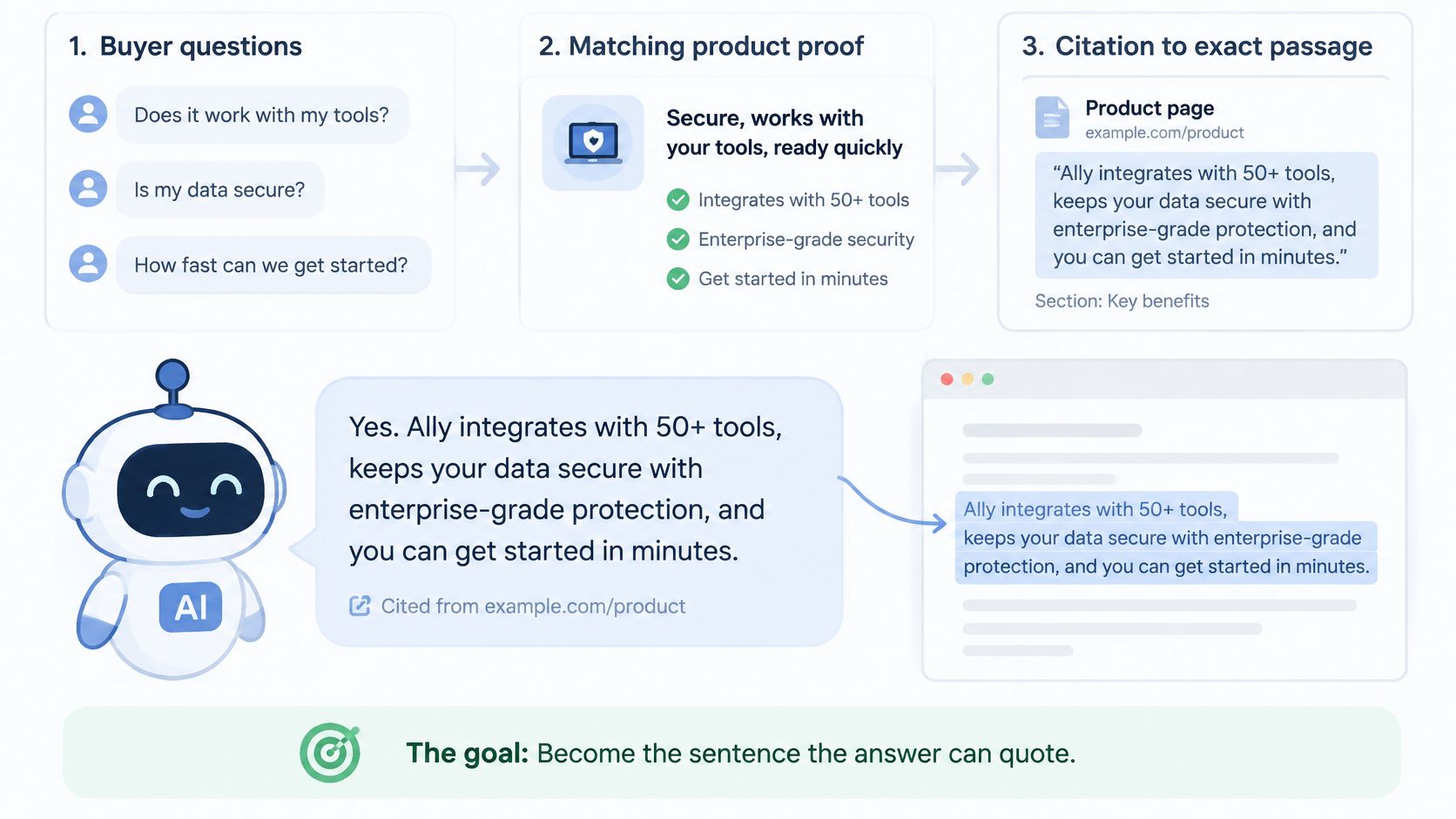
The seven moves
- List real buyer prompts. Start with questions buyers already ask, such as which tool to use, what it costs, and what it integrates with.
- Save every cited URL. For the same prompt set, capture your pages, competitor pages, documentation, reviews, videos, Quora answers, and Reddit threads.
- Prioritize recurring sources. Rank URLs that appear across multiple prompts ahead of one-off appearances. Repeated use shows which pages AI systems draw on across answers, though it does not prove their claims are accurate.
- Publish around one verifiable claim. State its scope and relevant date, then support it directly below so a passage can be quoted without extrapolation.
- Join cited discussions early. Answer in a natural user voice, add the missing fact or experience, and avoid disguising promotion as help.
- Re-read the same prompts after changes. Score brand mentions, source inclusion, and claim support separately. A new link is not a win if the attached sentence remains wrong.
- Judge value beyond the click. Track branded search, direct visits, qualified signups, and assisted conversions alongside citation exposure. A citation can build recognition without producing an immediate session.
Interpret those measures cautiously. If citation exposure rises while sessions stay flat, one chart cannot show whether the citation failed or influenced a later visit. A buyer may see your name in an answer, search for the brand later, and convert through a direct visit.
Make the page easy to quote correctly
Put each answer near the heading it belongs under. Keep numbers beside the population, date, and condition they describe, so a retrieved passage does not turn a qualified fact into a broad claim.
Avoid burying the point under paragraphs of setup. Retrieval systems can pull a passage without its surrounding context, leaving readers or AI with room to infer more than the source says. For comparisons that vary by plan or use case, use a table with clear conditions in each row.
This is the practical logic behind structuring content for AI search. Formatting should make claims easier to check, not just easier to scan.
Work the sources you don’t own
Third-party reviews, documentation, forums, and comparison threads can shape the sentence attached to your brand. Find the recurring sources in your prompt set. Correct outdated facts where possible, contribute where participation is welcome, and create the missing page when no good source exists.
Airefs can serve as the working log for those prompts, cited URLs, and competitors across models, and its content and discussion opportunities show where to act first. Use that view to focus effort on sources already shaping answers in your category, rather than trying to address every thread.
Fix an unsupported high-intent claim before publishing several new posts. A bad cited sentence about pricing or capability can cost more trust than a missing blog post. Check the claim, not just the presence of a link.
Common Questions About AI Citations
Are AI citations the same as backlinks
No. A backlink is a link a site publishes on a page it controls.
An AI citation is attached at answer time. It often produces no visit, and the same prompt can produce a different citation set later.
Should citation count be the goal
No. A higher count can raise trust while linked pages are irrelevant, outdated, or wrong.
That becomes a reputation risk when your brand sits beside a bad summary. Score claim support before you celebrate volume.
Do ChatGPT Google AI Overviews and Perplexity need separate tracking
Yes. The same prompt can cite different pages in each tool, with different sentences attached.
Log each tool on its own. Keep the prompt wording, date, URL, and attached sentence so comparisons stay clean.
What should a team do first
Pick about ten buyer prompts. Log mention, source inclusion, and claim support for each answer.
Then fix the page or discussion that fails. Re-check on a schedule rather than after a single publish, because citation sets shift over time.
Can a brand mention help without a citation
Yes, but don’t overvalue it. A mention can build category recognition inside answers even when no page is cited.
It just doesn’t prove your content was used. Treat it as visibility, then check whether a citable source supports the claim being made about you.
Start this week with ten buyer prompts your sales team hears most, log mention, source inclusion, and claim support for every answer, and fix the first unsupported sentence you find. That small audit will tell you more about your real AI visibility than another month of counting citations.