

AI answers now have an audience of their own. Buyers ask ChatGPT, Perplexity, and Google AI Overviews which B2B SaaS products they should trust, then use reviews, discussions, documentation, and customer stories to validate the recommendation. Traditional website proof still matters, but it no longer matters only on your pricing page.
Nielsen’s global research found that 83% of consumers trusted recommendations from friends and family, while 66% trusted consumer opinions posted online across the surveyed markets. Nielsen’s 2015 Global Trust in Advertising study also found that 83% said they acted on personal recommendations at least some of the time. That makes social proof more than a conversion ornament. It’s evidence that can influence both human decisions and the sources AI systems use when forming answers.
The strongest social proof examples for B2B SaaS follow a sequence. Start with assets you control, such as testimonial libraries and documentation. Then build proof you earn through customer stories, reviews, communities, experts, and media. Finally, measure whether AI systems mention your brand, cite your sources, and position you against competitors.
Each example below names the mechanism, explains the trade-off, gives a practical implementation path, and shows how to check whether the proof appears in AI answers.
Table of Contents
- 1. Bragly
- 2. Documentation and Knowledge Base Authority
- 3. User-Generated Content and Case Studies
- 4. Review and Rating Aggregation as AI Training Data
- 5. Data-Backed Benchmarks and Industry Reports
- 6. Community Validation Through Discussion Participation
- 7. Expert and Creator Endorsements
- 8. Media Coverage and Press Mentions
- 9. Source-Level Authority in AI Training Data
- 10. AI Model Mentions and Citations
- 11. Competitive Share of Voice in AI Answers
- 11-Point Social Proof Comparison
- Where to Start Build the Proof, Then Measure It
1. Bragly
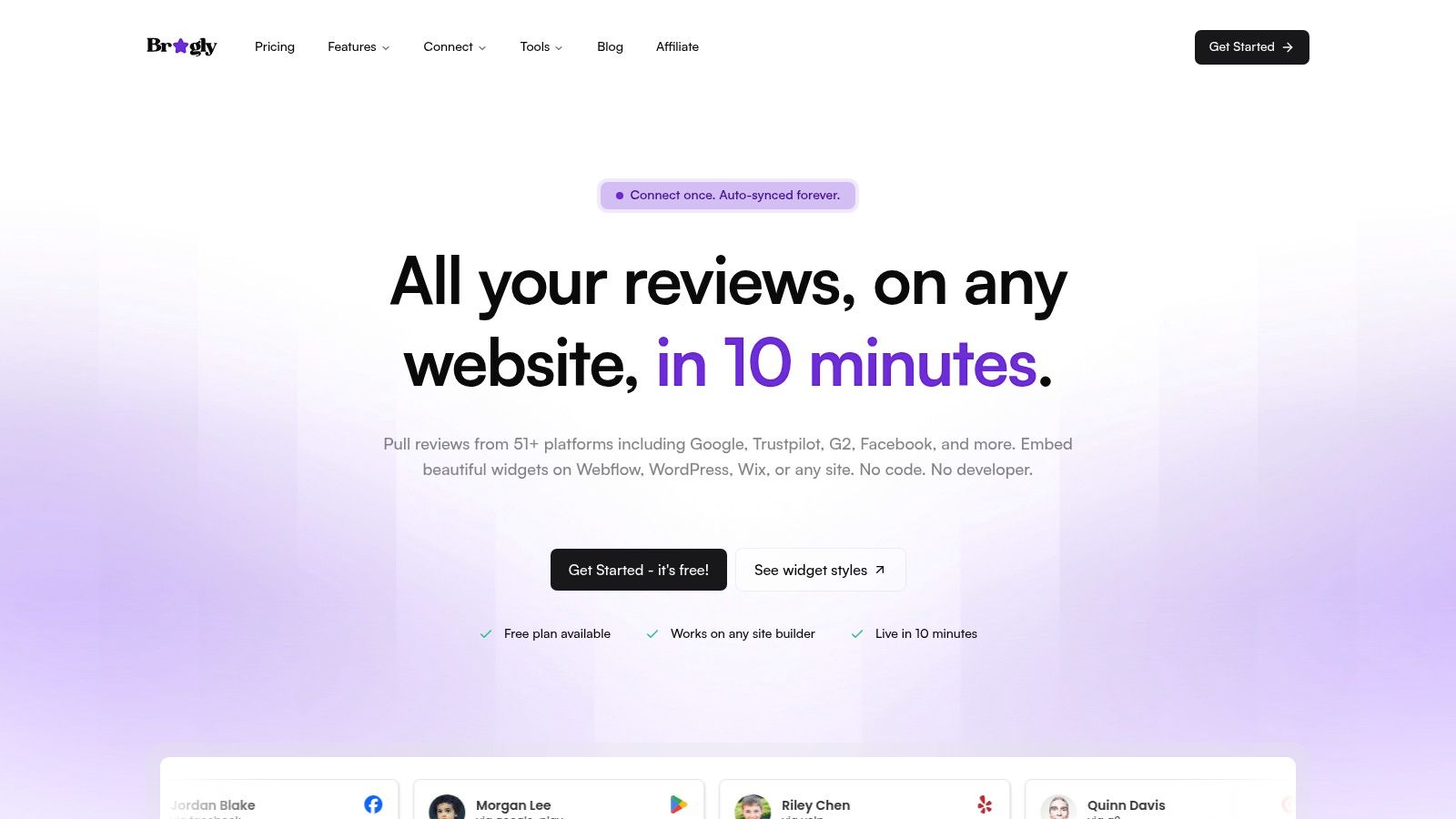
Bragly is useful when customer proof is scattered across Google, Trustpilot, G2, Facebook, Yelp, Product Hunt, TripAdvisor, Capterra, app stores, and other public platforms. It aggregates reviews from 50+ sources, then lets teams publish them through no-code widgets on Webflow, WordPress, Wix, or a custom site using copy and paste. You can explore the product through Bragly Wall of Love.
The mechanism is distribution with consistency. A review that sits unused on a third-party profile can’t support a pricing-page decision, a comparison page, or an AI-readable customer story. Bragly’s carousels, grids, sliders, mosaics, ribbons, badges, and video highlights let you place relevant proof beside the claim it supports, while automatic syncing reduces the risk of displaying outdated feedback.
Where Bragly fits
The platform supports first-party collection forms, manual review additions, tagging, basic analytics, webhooks, and AI-based review analysis with limits determined by plan. Its listed plans include a free tier, Pro at $14 per month, and Business at $67 per month, as shown in Bragly’s plan information. Use those prices as current product details to verify before purchase, because software plans can change.
Bragly is a good choice for a SaaS team that needs one operational layer for review collection, curation, and display. It’s less suitable if the team expects a widget alone to create independent authority. AI systems can read your site, but a branded wall of praise is stronger when it points back to identifiable, independently hosted reviews and detailed customer experiences.
Practical rule: Use Bragly to connect third-party proof to a specific buying question, not to create a generic praise wall.
How to test AI impact
Tag reviews by use case, customer type, objection, and outcome. Publish the most relevant selections on pages that answer prompts such as “best tool for agency reporting” or “which platform helps SaaS teams monitor AI visibility.”
Then track those prompts in Airefs. Look for changes in brand mentions, cited review pages, and the external sources that AI systems use when describing your category. The useful signal isn’t whether a carousel looks polished. It’s whether detailed customer evidence becomes discoverable and quotable outside your own domain.
2. Documentation and Knowledge Base Authority
Documentation is social proof for technical buyers because it demonstrates that a company can explain, support, and maintain its product. Detailed product documentation, API references, implementation guides, code examples, and help-center articles give AI systems useful answers to questions that promotional pages usually avoid.
The mechanism is reference utility. When documentation explains setup requirements, integrations, limits, workflows, and failure conditions clearly, it becomes a practical source for users and answer engines. A page that resolves a specific question can support prompts such as “which API supports this integration?” or “how does this SaaS product handle onboarding?”
Build authority through maintenance
The trade-off is ongoing maintenance. Documentation that no longer matches the product doesn’t merely fail to help. It can undermine trust when customers and AI systems encounter obsolete instructions.
- Organize by task: Group pages around jobs users need to complete, not only internal product modules.
- Expose limitations: Document permissions, prerequisites, unsupported workflows, and common errors.
- Update visibly: Keep revision dates and change notes where they help users judge freshness.
- Connect evidence: Link technical guidance to customer examples without replacing the technical detail with marketing copy.
A well-maintained knowledge base can support customers, reduce repetitive support work, improve organic discovery, and strengthen website authority through content and trust signals. It won’t become authoritative immediately. Teams need consistent coverage and accurate updates before external sources begin treating it as a reference.
Check AI retrieval
Create prompts around implementation, compatibility, troubleshooting, and product comparisons. In Airefs, inspect whether AI answers cite your documentation, mention your product accurately, or rely on competitor pages instead. A useful next step is to update the pages that answer high-value prompts but are absent from cited sources, then monitor whether those pages enter the source set.
3. User-Generated Content and Case Studies
Customer evidence can change how both buyers and AI systems describe a product. A case study published by a customer, industry publication, or recognizable practitioner supplies third-party context around the problem, implementation, and outcome.
The mechanism is independent validation. A useful story identifies the customer’s situation, the obstacle before adoption, the workflow used, and the result. “Easy to use” gives an AI system little to work with. A detailed account of how a growth team prioritized content opportunities, handled adoption friction, and evaluated results creates language that can influence prompts about implementation, use cases, and product comparisons.
Build the asset around specifics:
- A defined starting point: Describe what was difficult before implementation.
- A named use case: Connect the product to a concrete job, such as AI-answer monitoring or multi-market content planning.
- A measured outcome: Use a verified result when one exists, with its measurement period and baseline.
- A limitation or objection: State where the product was not the right fit or what required extra work.
Ask customers for permission to publish these details rather than requesting general praise. A single reported story can become a customer article, company page, podcast discussion, sales asset, and source for external citations. Airefs uses customer case studies to show how named customer experiences support its positioning.
The trade-off is editorial control. Customers may describe a failed implementation, qualify the result, or focus on a product feature you would not put on a homepage. That risk improves the evidence. Balanced accounts give AI systems more precise material than frictionless testimonials, while also helping prospects judge fit.
Distribution determines the proof’s reach. Keep the original case study on the customer’s site where possible, then pursue an industry publication, relevant interview, or podcast. A story that exists only on your domain may influence branded prompts, but it has less chance of becoming an independent source in broader answers.
Test the source footprint
Track prompts covering the customer’s industry, use case, and alternative solutions. Check whether AI answers cite the customer’s article, represent the outcome accurately, or mention your brand only through its own case-study page. Record which source appears, what wording is retained, and where the account is missing. Then prioritize distribution for stories that address valuable prompts but remain absent from cited answers.
4. Review and Rating Aggregation as AI Training Data
A strong review profile gives AI systems a distributed record of customer experience. G2, Capterra, Trustpilot, app stores, and specialist communities expose buyers to different accounts, while recommendation prompts can draw on those public evaluations.
The mechanism is corroboration. Repeated descriptions of strengths, weaknesses, customer types, and implementation experience create a clearer entity signal than one testimonial on your own site. BrightLocal’s review survey found that 50% of consumers trusted reviews as much as personal recommendations from friends and family. It also reported that 89% said local-branch reviews would affect their decision, while 91% said local reviews of chains and franchises would affect their overall perception. The local-business context limits how directly SaaS teams can apply those figures, but the mechanism remains relevant: review evidence can shape both buyer choice and AI-generated recommendations.
Review count supports credibility, yet detail gives AI systems material to repeat. BrightLocal reported that 59% of consumers wanted a business to have between 20 and 99 reviews before trusting its average star rating. Treat that as a surveyed local-business reference point, not a universal SaaS target.
Ask for evidence-rich feedback:
- Start with the original problem: Buyers and AI systems can connect the review to a specific use case.
- Request product detail: Invite comments about workflows, features, onboarding, or support.
- Allow balanced feedback: Unscripted criticism makes positive claims more credible.
- Answer complaints publicly: The response shows how the company handles failure and accountability.
The trade-off is exposure. Negative reviews become public counter-evidence, while uniform praise can look manufactured. Review management software guidance can help structure response workflows and source monitoring, rather than treating collection as the whole task.
Check what AI repeats
Run prompts such as “best alternatives to [category]” and “which SaaS tool has strong customer support.” In Airefs, compare the platforms cited in answers with the sites where customers discuss your brand. If AI repeatedly uses one neglected source, improve its completeness and response history before creating another testimonial page. Record which review source appears, what claims AI retains, and whether the answer reflects both strengths and limitations.
5. Data-Backed Benchmarks and Industry Reports
Original research can become the evidence AI systems cite when buyers ask about market trends, adoption, performance, or accepted practice. A benchmark, survey, or industry report gives writers and answer engines a concrete source to quote, especially when comparable public data is limited.
The mechanism is information scarcity. Publish a focused question, transparent methodology, and findings competitors cannot easily reproduce. The report can then serve people researching the topic, even before they consider your product. The trade-off is scrutiny: a branded chart with unclear sampling may attract attention, but it also gives critics a reason to dismiss the entire source.
Build the report around defensible choices:
- Define a narrow question: A specific benchmark is easier for journalists, analysts, and AI systems to understand and cite.
- Document the evidence: State how data was collected, who participated, what the sample represents, and where it falls short.
- Clarify the vocabulary: Publish definitions, categories, exclusions, and calculation rules so others can interpret the findings consistently.
- Separate evidence from advice: Mark the point where measured results end and your recommendations begin.
- Support different citation formats: Provide the full report, concise findings, charts, and an accessible HTML page.
The AI search citation sources and statistics research shows why discoverability matters. A credible study may earn links, media coverage, expert commentary, and repeated citations in AI answers, while weak methodology can spread criticism just as widely.
Test the report against real prompts
Create prompt groups based on the questions your study answers. Check whether AI systems find the original report, cite it by name, summarize its findings accurately, and preserve the limits around the data. Compare those answers with competitor sources. If another report appears more often, improve your page structure, definitions, and quotable passages without removing necessary context. Record which prompts trigger citations and which claims AI misstates.
6. Community Validation Through Discussion Participation
A public answer can become proof before a buyer reaches your website. What makes a forum comment count is that it appears where the uncertainty already exists, and other members can challenge the claim.
A Reddit comment, forum answer, or Q&A response shows how your team handles difficult questions. Explain a technical limitation, compare implementation paths, or acknowledge when another workflow fits better. Members can add their own experience, correct the response, or confirm it. That visible exchange gives AI systems context they rarely get from a polished product page.
Earn participation instead of broadcasting
Promotion-heavy accounts create negative proof. A company profile that appears only to paste links signals self-interest, while a representative who gives accurate answers and admits limitations can build trust. Choose discussions where the team has genuine expertise, then contribute before mentioning the product. If the product solves the stated problem, explain why. Show the trade-offs behind the recommendation, correct errors in public, and record recurring objections as input for documentation or product work.
The practical cost is time and exposure. Public answers remain searchable, and an inaccurate claim can spread through later summaries. Review posts before publication, identify the account clearly, and avoid presenting a sales opinion as independent user experience.
The principles behind Reddit for SEO apply here, with an added AI visibility benefit. A detailed discussion may become a source for prompts about implementation, alternatives, limitations, or real-world use. Its value depends on whether the thread contains specific language that an answer engine can retrieve and represent accurately.
Measure discussion influence
Use Airefs to identify Reddit threads, forums, and Q&A pages appearing in source analysis for relevant prompts. Check whether AI answers mention your brand, preserve the discussion’s qualifications, and connect it with the right use case. Track referral clicks, but also record which prompts surface the thread and whether competitor discussions appear more often. A thread that sends little traffic can still shape future recommendations if it becomes an AI source.
7. Expert and Creator Endorsements
A respected practitioner can connect your product with a specific job, audience, and decision. In B2B SaaS, the strongest endorsement explains where the tool fits, what it replaces, and which teams should choose another approach.
Specificity creates the signal. “This is the best tool” gives an AI system little usable context. A creator who describes using the product for competitor benchmarking, source analysis, or content prioritization supplies language that can influence prompts about those workflows, alternatives, and tool recommendations.
Give the expert something worth evaluating before asking for a mention. Provide access, answer product questions, and accept an independent assessment. Paid promotion can extend reach, yet unclear sponsorship or a poor audience match can reduce credibility. Ask for the person’s actual experience, including limitations, rather than a fixed script.
Endorsements can appear as:
- Expert-written guides: The product is included in a category explanation or documented workflow.
- Independent comparisons: The author explains which tool suits a defined use case and why.
- Podcasts and interviews: Spoken commentary can be transcribed, republished, and summarized.
- Practitioner quotations: A precise observation can support a landing page or an industry article.
The trade-off is ongoing maintenance. Audiences notice sponsorships, expert reputations change, and a recommendation may become inaccurate after the product evolves. Keep the original page specific, disclose the relationship, and revisit claims when workflows or features change.
Check whether the endorsement travels
Use Airefs to track prompts asking for practitioner recommendations, tools for a defined workflow, or alternatives in your category. Record which expert pages appear as citations, whether the answer names your product, and whether it assigns the endorsement to the correct use case. Check the source page itself for clear authorship, experience, sponsorship disclosure, and limitations.
A published endorsement that never appears in relevant AI answers may lack detail, authority, or distribution. Improve the page and its supporting references before asking the expert to repeat the same claim. Track referral visits separately, because an endorsement can influence AI recommendations without sending many direct clicks.
8. Media Coverage and Press Mentions
Earned media can influence AI answers only when an article provides usable, independent context. A publication that quotes your founder, reviews the product, or reports a company development creates evidence outside your editorial control. That evidence may affect prompts about category definitions, emerging vendors, or market leaders, especially when a specialist outlet explains the problem and competing options.
The mechanism is editorial selection. Reported coverage can carry more weight than a company announcement when it adds context, competing views, or details the brand did not supply. The trade-off is control. Journalists may expose weaknesses, use an unexpected category label, or place competitors beside you. That risk contributes to credibility. Press releases can support discovery, but they do not replace independent reporting.
Build the pitch around a durable angle. A new category problem explains why existing workflows no longer answer a buyer’s question. Original evidence, such as research, customer experience, or product data, gives reporters something they can verify. A useful expert makes company leaders available for precise, non-promotional commentary. A clear audience matches the story to the publication’s actual readers.
A feature does not automatically make AI systems recommend you. Article quality, relevance, persistence, and references from other sources determine whether the mention appears in answers. A niche technical article may influence a narrow prompt more effectively than a prominent general outlet.
Inspect how coverage appears in answers
Use Airefs to track prompts about your category, emerging vendors, and market leaders. Check whether answers cite the publication, mention your brand without attribution, or rely on secondary summaries. Read the article and answer together. If the piece presents your product as a niche solution, do not treat it as evidence of broad category leadership. Improve the story’s specificity or distribution, then measure referral visits separately from AI mentions.
9. Source-Level Authority in AI Training Data
What matters here is page-level reuse. A domain can rank well while a specific article, documentation page, review, Reddit thread, or video supplies the evidence an AI system uses in an answer. Repeated citation of one page can shape how a model explains a problem, defines a category, or compares vendors.
A stale pricing comparison shows the risk. It may keep circulating in summaries and retrieved answers after plans, limits, or competitors have changed. The problem is not merely lower rankings. Buyers may receive an outdated recommendation, then question the brand when the cited information no longer matches the product.
Find the pages that shape answers
Start with prompt-level source review. Record which URLs appear for category questions, vendor comparisons, implementation requests, and prompts about pricing or integrations. A page that recurs across different phrasings has more practical influence than a high-authority domain that appears once without relevant detail.
Assess each recurring page for:
- Decision coverage: Which buyer question does it answer?
- Evidence quality: Does it show examples, definitions, limitations, or observable product details?
- Scope: Does the page support a narrow use case, or does the answer extend it beyond what the page proves?
- Current fit: Do pricing, capabilities, screenshots, integrations, and competitor claims still match reality?
The trade-off is concentration. A single page may influence several answers, but an error on that page can spread through every prompt that retrieves it. Prioritize corrections by answer exposure, then compare AI responses before and after the update.
Airefs can connect recurring citations with concrete actions, such as revising a page, adding missing evidence, or checking third-party sources that models already use. Run the same prompts across relevant models and markets. Check whether systems cite the page, paraphrase it accurately, and apply its evidence only to the use case it covers. This page-level review shows whether visibility reflects useful authority or merely repeated exposure.
10. AI Model Mentions and Citations
A direct brand mention in an AI answer places social proof at the moment of discovery. The user receives a synthesized recommendation from an intermediary they selected for research, rather than encountering your page among a list of alternatives.
A mention inside an AI answer functions as an endorsement when the model connects your brand to a specific need. “Best tool” carries limited value. “A suitable option for teams that need source-level visibility into AI answers” gives the recommendation useful context and a prompt you can monitor.
Measure the recommendation, not just the mention
Test recurring prompts across ChatGPT, Perplexity, Google AI Overviews, and other relevant systems. Capture:
- Mention status: Whether your brand appears.
- Position and context: Whether the answer recommends, compares, or defines you.
- Source support: Which pages, reviews, discussions, or articles support the claim.
- Accuracy: Whether the description matches your product and audience.
- Competitor framing: Which alternatives appear alongside you.
The trade-off is volatility. Model changes, retrieval behavior, source availability, geography, language, and prompt wording can all alter an answer. A favorable response today does not establish a durable channel, while inconsistent manual checks make trends difficult to interpret.
A prompt-monitoring tool such as Airefs can automate this baseline and track changes over time.
Use the results to improve the evidence behind each recommendation. If a model cites a weak or outdated source, update the page or strengthen the relevant third-party proof. If it names a competitor for a use case you serve, create or revise content that addresses that exact decision. Check whether later answers describe your capability accurately, cite defensible sources, and connect the brand with the prompts that matter to buyers.
The objective is a mention that remains accurate under scrutiny, not visibility for its own sake.
11. Competitive Share of Voice in AI Answers
Share of voice turns AI visibility into a competitive metric. It measures how often your brand appears beside named competitors across a defined set of prompts, revealing which companies AI systems repeatedly associate with a category, use case, or buying problem.
Repetition across related questions creates a perception of category leadership. It also affects the research path: an AI answer may place a recommendation directly in front of a buyer, while a conventional result can remain buried among many links. Track where the proof comes from, not just whether your name appears.
Build a useful benchmark
Start with prompts that represent real buying situations. Cover alternatives, use cases, industries, pain points, and competitor comparisons, then segment findings by AI model, country, language, prompt type, and source category. Tools like Airefs make this benchmark practical by tracking competitor appearances across models and markets.
Interpret the metric carefully. Share of voice does not equal qualified pipeline, revenue, or customer fit. It can also change when an AI provider modifies retrieval or model behavior, even if your content remains unchanged. The figure is most useful when paired with business and evidence signals:
- Visibility trend: Does your brand appear consistently across repeated prompts?
- Prompt coverage: Which use cases produce mentions, and which remain absent?
- Source ownership: Do your pages support the mention, or do third parties?
- Competitive gaps: Where does a competitor appear with stronger supporting evidence?
- Downstream behavior: Do AI-referred visitors sign up, request demos, or convert?
Check the answers themselves for recommendation strength and accuracy. A brand that appears briefly without a relevant source may have less practical visibility than a competitor named as the preferred option with clear supporting evidence.
Use the benchmark to prioritize work
Choose the gap connected to a valuable customer question, rather than chasing every missed mention. Identify the source supporting the competitor, then decide whether the response requires a better first-party answer, relevant third-party validation, or participation in the discussion AI systems already reference. Recheck the same prompt set after changes and compare both appearance frequency and recommendation context.
11-Point Social Proof Comparison
| Item | Implementation complexity | Resource requirements | Expected outcomes | Ideal use cases | Key advantages |
|---|---|---|---|---|---|
| Bragly | Low, no‑code embeds and widgets | Low–Medium, subscription + setup | Centralized reviews, live widgets, basic AI summaries | Websites and stores that need quick social proof displays | Wide source support (50+), auto‑sync, many widget layouts |
| Documentation & Knowledge Base Authority | High, needs structure and maintenance | High, writers, devs, continuous updates | Long‑term AI citations, reduced support load, SEO gains | API platforms, complex products, developer tools | Evergreen reference, dual benefit for users and AI visibility |
| User‑Generated Content & Case Studies | Medium, customer coordination | Medium, program management, incentives | Credible third‑party validation and measurable examples | Products with noteworthy customer outcomes | High trust signals, concrete evidence AI will cite |
| Review & Rating Aggregation | Medium, integrate review sources | Medium, review requests, management tools | Scaled social proof via star ratings and volume | Consumer/SaaS products with many customers | Objective third‑party validation and compounding visibility |
| Data‑Backed Benchmarks & Industry Reports | High, rigorous research required | High, survey/design/analysis budget | Authoritative citations and thought‑leadership signals | Companies with data to publish unique insights | Unique, hard‑to‑replicate authority; media pickup |
| Community Validation (Forums/Reddit) | Medium, ongoing authentic participation | Low–Medium, staff time for engagement | Organic trust and conversations that AI may absorb | Niche communities, developer and B2B audiences | Timely influence and direct user relationships |
| Expert & Creator Endorsements | Medium, relationship building | Medium, outreach, collaborations | Authority transfer and amplified reach | Consumer apps, tools seeking credibility boosts | High‑authority endorsements that AI weights heavily |
| Media Coverage & Press Mentions | High, PR and newsworthiness needed | Medium–High, PR resources, story generation | Strong credibility and wide citation potential | Product launches, funding announcements, growth stories | Tier‑1 publication authority and broad amplification |
| Source‑Level Authority in AI Training Data | High, consistent, original content | High, content strategy and quality investment | Persistent AI citations across relevant queries | Firms aiming for sustained topical dominance | Flywheel of trust as AI repeatedly cites your content |
| AI Model Mentions & Citations | High, content must be in training corpora | Medium–High, monitoring and targeted content | Direct AI recommendations and user trust boosts | Brands tracking AI presence and prompts | Immediate visibility in AI answers; direct credibility |
| Competitive Share of Voice in AI Answers | High, requires tracking + coordinated strategy | High, analytics, content, and monitoring tools | Measurable positioning vs competitors in AI outputs | Companies in competitive categories wanting edge | Clear competitive benchmarks and prioritized gaps |
Where to Start Build the Proof, Then Measure It
Start with an evidence audit, not a new campaign. List the proof your company already owns, including customer reviews, testimonials, documentation, case studies, research, expert mentions, media coverage, community discussions, and product pages. Record the source URL, audience, use case, date, claim, supporting evidence, and any limitation that a buyer should understand.
Then separate owned proof from earned proof. Owned proof includes your documentation, case-study pages, research, and testimonial library. Earned proof includes customer-published stories, independent reviews, Reddit threads, expert commentary, and media coverage. AI systems can use both, but they don’t carry the same credibility, and a polished owned page can’t fully replace independent validation.
Use your strongest existing assets to create an initial prompt set. Include questions about the category, alternatives, customer type, problem, implementation, pricing, and product limitations. A growth team selling to agencies might track prompts about multi-client reporting and competitive research. An in-house team might focus on source-level recommendations, content prioritization, and AI-search visibility.
Airefs gives teams a way to monitor those prompts repeatedly, compare competitors, inspect cited and influential sources, and identify practical opportunities. It can reveal that your best customer story never appears in AI answers, that a Reddit thread shapes a category recommendation, or that an outdated competitor comparison is still being reused. Those findings are more actionable than a general instruction to “publish more content.”
Prioritize one source and one discussion opportunity first. Update the page that answers a high-value prompt but lacks detail, then participate in the external conversation where buyers are already asking the question. Request reviews from customers who can describe a real use case, but don’t script their language or filter out legitimate criticism.
Social proof also needs a conversion path. Thrive Architect’s six-week test with approximately 20,000 visitors compared a page with two customer testimonials against a control. The testimonial version converted at 2.75%, compared with 2.20% for the control, an absolute difference of 0.55 percentage points and a relative lift of 25%; the company also reported 13% more sales, 19.6% higher revenue per visitor, and 98% confidence. Thrive Architect’s test report supports a practical lesson, place specific proof beside the decision point, then test the business outcome.
Placement isn’t universal. Vegetology’s product-page experiment reported a 6% conversion-rate increase and a 10.3% increase in unique purchases after moving testimonials above the fold. The experiment summary from OptiMonk treats that result as a case-specific benchmark, not a guaranteed lift for every audience or page.
For AI visibility, the decision point is broader than a CTA. The proof must also live where answer engines can find and interpret it. A testimonial on a landing page can help conversion, while a detailed customer article, review, forum discussion, or expert comparison can influence the sources behind an AI recommendation.
Measure four layers together:
- Proof creation: New reviews, stories, discussions, research, and endorsements.
- Proof distribution: External pages, platforms, publications, and communities where it appears.
- AI visibility: Mentions, citations, source reuse, accuracy, and competitive share of voice.
- Business impact: Qualified traffic, signups, demos, opportunities, and revenue influenced by AI discovery.
Don’t treat negative evidence as an automatic failure. A 2025 study of 253 participants found that 52.6% considered positive and negative reviews equally influential. The same study identified informative review content at 32.4%, star ratings at 25%, and verified-buyer badges at 22.9% as leading credibility cues. The study published through EUDL points to a useful principle: informative and verifiable proof can matter more than uniformly positive praise.
A small team should begin with one audience, one use case, and one competitor set. Audit existing proof, track the prompts that represent real demand, improve the sources AI systems already rely on, and review results on a consistent schedule. The goal isn’t to manufacture certainty. It’s to make credible customer evidence easier for both buyers and AI systems to discover, understand, and verify.
FAQ
How can I track AI mentions without checking manually?
Use a prompt-monitoring platform such as Airefs to run a consistent set of questions across relevant AI systems. Track brand mentions, competitor appearances, cited sources, model differences, and changes over time instead of relying on occasional manual searches.
Can expert endorsements be paid for?
They can be sponsored, but the relationship and commercial arrangement should be disclosed. Paid praise that hides the relationship can weaken credibility, while an independent, specific evaluation that explains fit and limitations is more useful to buyers and AI systems.
Do negative reviews hurt AI visibility?
They can influence how AI systems describe your brand, but negative evidence isn’t automatically harmful. A transparent response, clear limitation, and pattern of constructive customer feedback can make positive claims more credible than a profile containing only generic praise.
Where should a small team begin?
Start by auditing existing reviews, customer stories, documentation, and external discussions. Choose a focused prompt set, track which sources AI answers use, then improve one high-value source and request detailed feedback from customers who have a relevant experience.