Profound raised $155M+ from Khosla Ventures, Kleiner Perkins + NVIDIA, Sequoia, and Lightspeed, earned G2 Winter 2026 Leader status, and counts Target, Walmart, MongoDB, Indeed, Docusign, Ramp, Figma, US Bank, Chime, and others among its customers. Ramp’s 7x AI visibility increase is the most-cited case study in the AEO category. If you’re evaluating Profound for your team, the question isn’t whether it works at the enterprise tier—it’s what you get after the free 7-day trial, now that Profound no longer publishes self-serve plans for brands and custom Enterprise pricing requires a sales conversation.
This review covers what Profound actually does across its tiers, what users say, where the platform stops, and how it compares to Airefs, which is built for agencies and publishes its price. If custom Enterprise pricing is out of reach, see our roundup of Profound alternatives under $100/mo.
What is Profound?
Profound is an AI search visibility and content optimization platform built for enterprise marketing teams. It tracks your brand’s presence across up to 9 answer engines on Enterprise—ChatGPT, Perplexity, Claude, Gemini, Copilot, DeepSeek, Google AI Mode, Google AI Overviews, and Exa Search, plus ChatGPT Shopping—and generates AEO-optimized content to improve that presence.
Unlike monitoring-only platforms, Profound’s “Agents” feature goes beyond measurement: it generates content briefs, full article drafts, and prioritized opportunities (specific journalists to contact, Reddit threads to engage, content gaps to fill) based on what AI models are actually citing in your category.
Who’s the team behind Profound?
Profound was founded in New York City and has grown to become the most-funded platform in the AEO category. Its investor roster—Khosla Ventures at seed, Kleiner Perkins and NVIDIA at Series A, Sequoia at Series B, Lightspeed at Series C—reflects confidence from some of the most consequential technology investors in the market.
Funding timeline:
- Seed — Khosla Ventures
- Series A — Kleiner Perkins + NVIDIA
- Series B — Sequoia
- Series C — Lightspeed ($96M, at a $1B valuation)
- Total raised: $155M+
The enterprise customer list is the strongest proof point: Target, Walmart, Figma, MongoDB, Ramp, U.S. Bank, Chime, Docusign, Indeed, Charlotte Tilbury, Plaid, Deel, Coterie, and Statsig. These are logos that require SOC 2 compliance, procurement processes, and genuine platform maturity—not just a slick demo.
What do users say about Profound?
Profound holds G2 Winter 2026 Leader status and has 1,130 G2 reviews at 4.5/5, several times more than any other AEO-specific tool. The platform is mentioned in dozens of Reddit conversations in the AEO and AI search space—unusual for a B2B SaaS tool—reflecting genuine practitioner adoption rather than just marketing-driven awareness.
The most-cited positives are the depth of data and the actionability of the output. Teams that have tried multiple AEO tools consistently cite prompt volume data—showing actual AI search demand in a topic, not just your brand’s position within it—as a capability that doesn’t exist elsewhere. The Opportunities panel is specifically praised for telling teams exactly what to do next, rather than leaving them to interpret a dashboard.
The consistent criticism is pricing. Profound no longer publishes self-serve paid plans for brands: after a free 7-day trial (50 prompts on a fixed set, no history or exports), buyers must talk to sales for credit-based Enterprise pricing, which is a significant commitment compared to tools that publish their prices. G2 reviewers repeatedly call it expensive.
Profound features
Profound’s platform is organized around four areas: prompt tracking and volume analytics, citation and share of voice data, opportunities, and the Agents content creation engine.
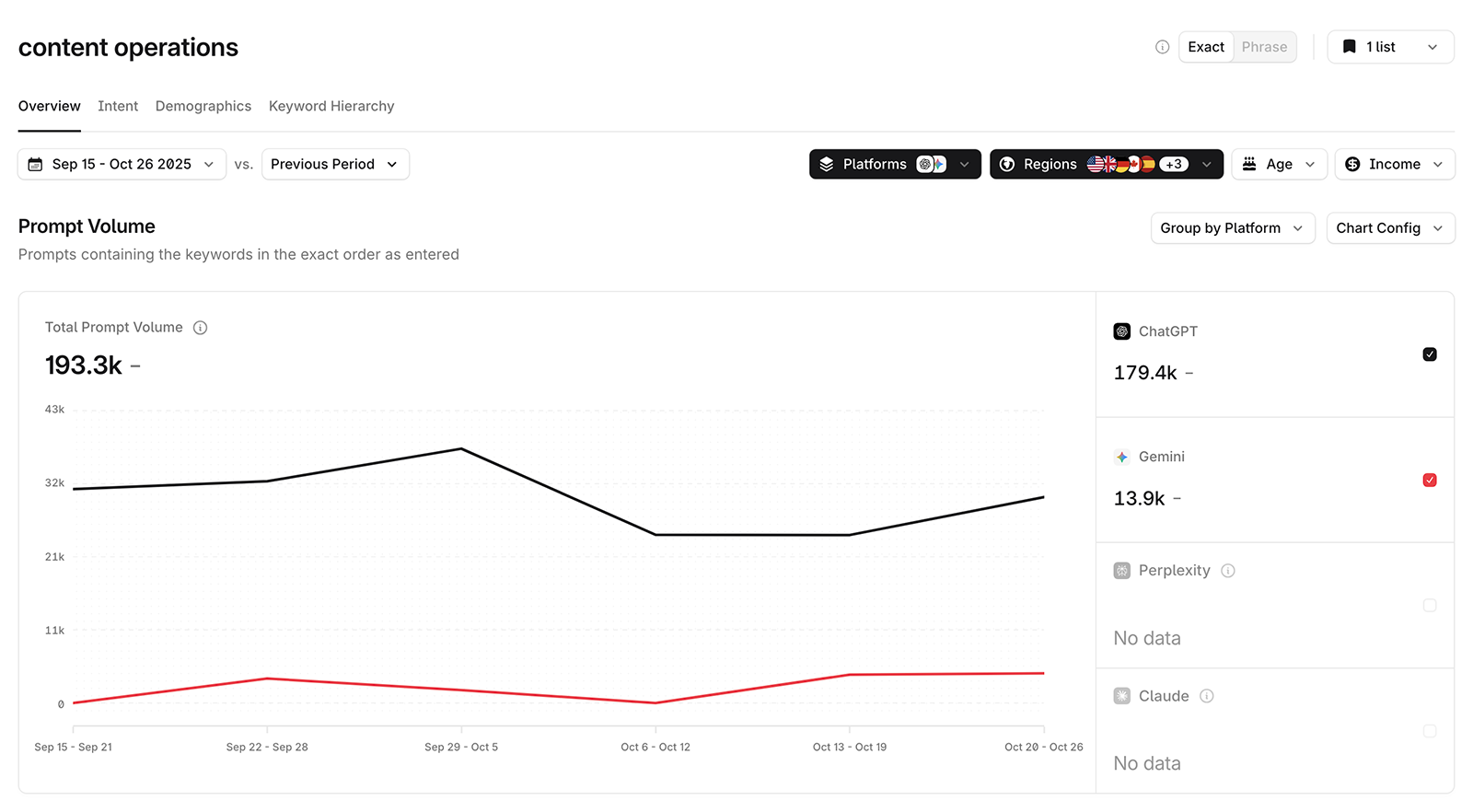
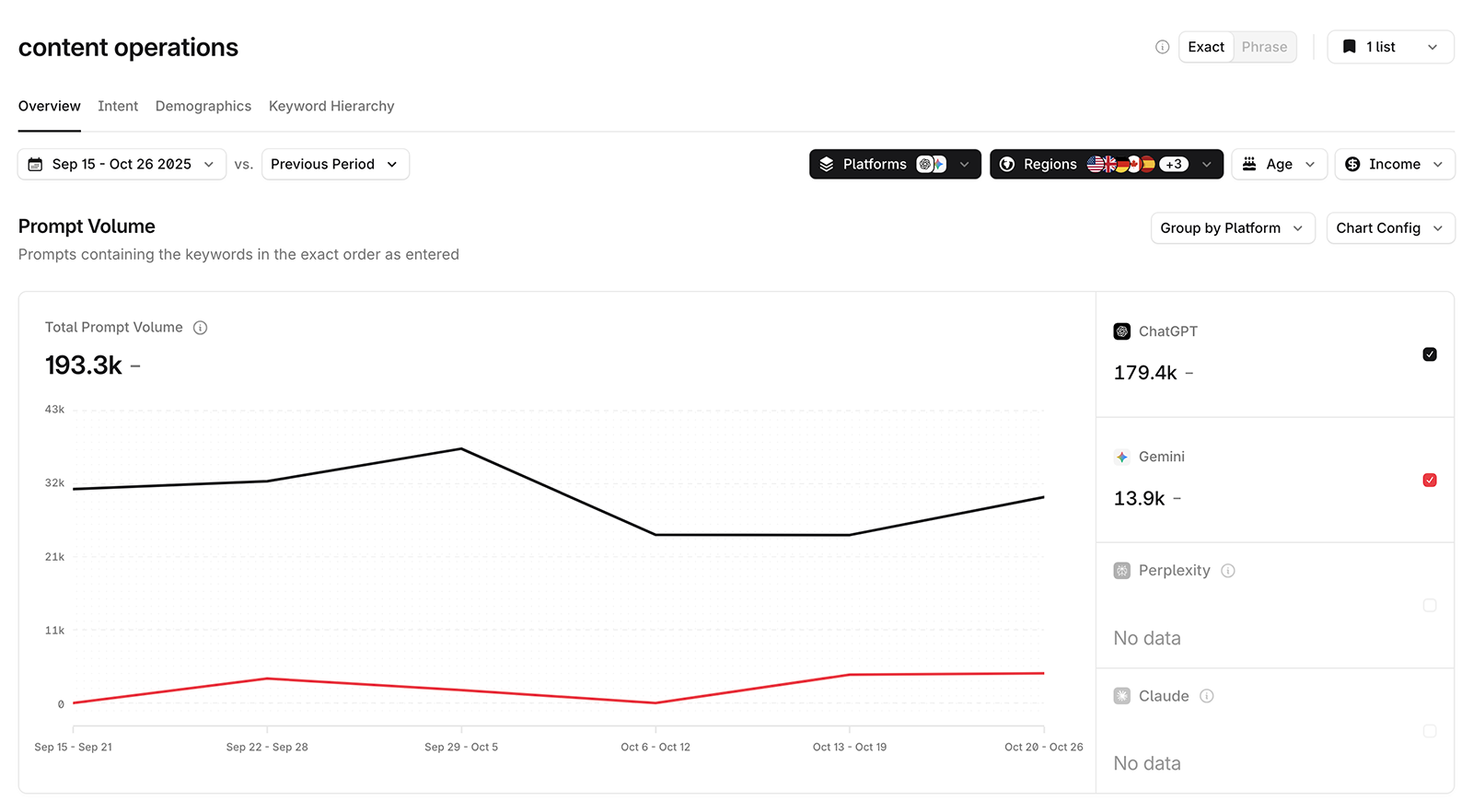
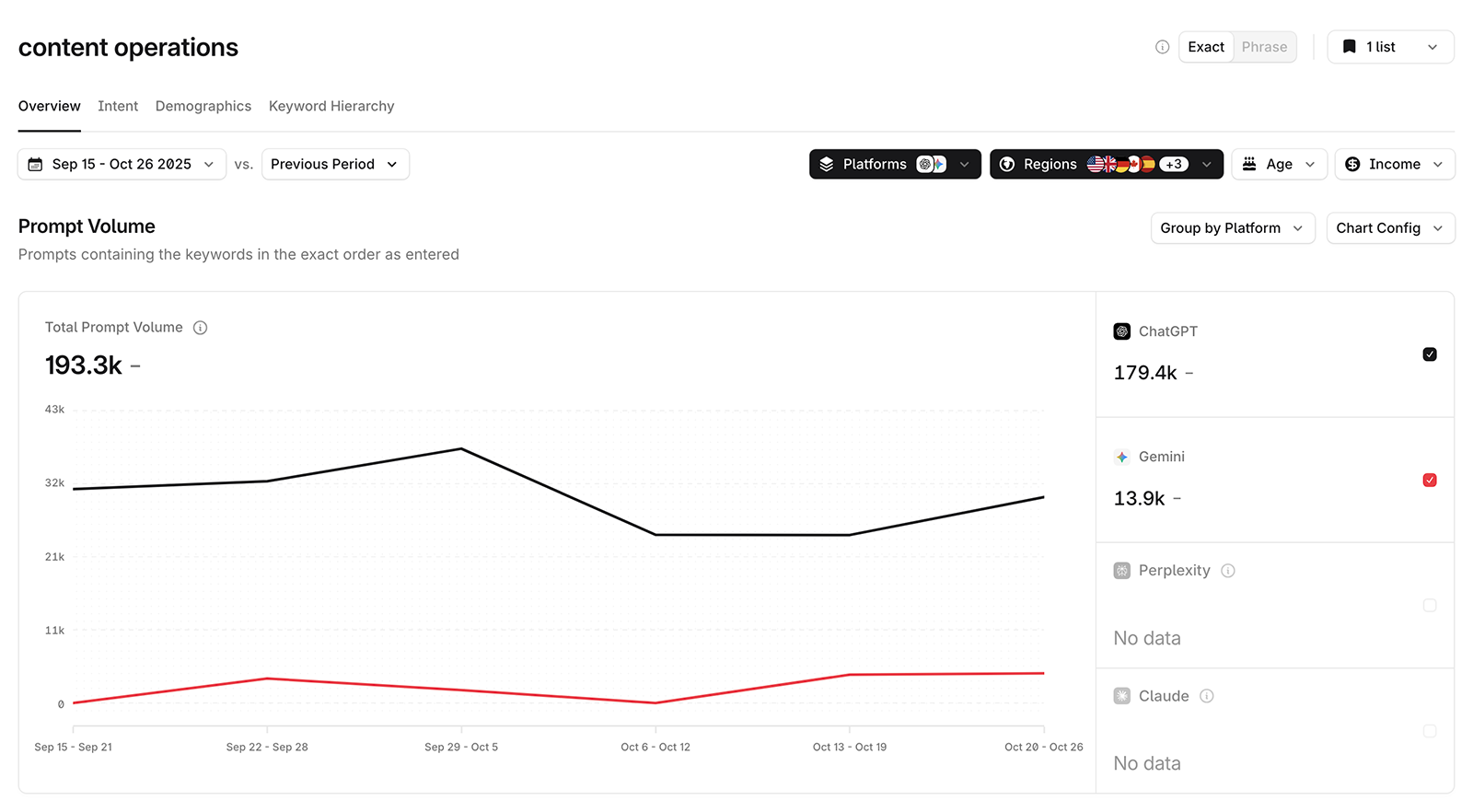
Prompt volume. Profound is one of the few AEO platforms that show prompt volume data—the actual number of times users are querying AI platforms about topics in your category. For a topic like “content operations,” the dashboard shows total monthly prompt volume broken down by platform (ChatGPT typically accounts for the large majority of volume). You can filter by platform, region, age, and income demographics, and compare performance against a previous period. This search demand signal is what makes Profound useful for content strategy, not just brand monitoring.
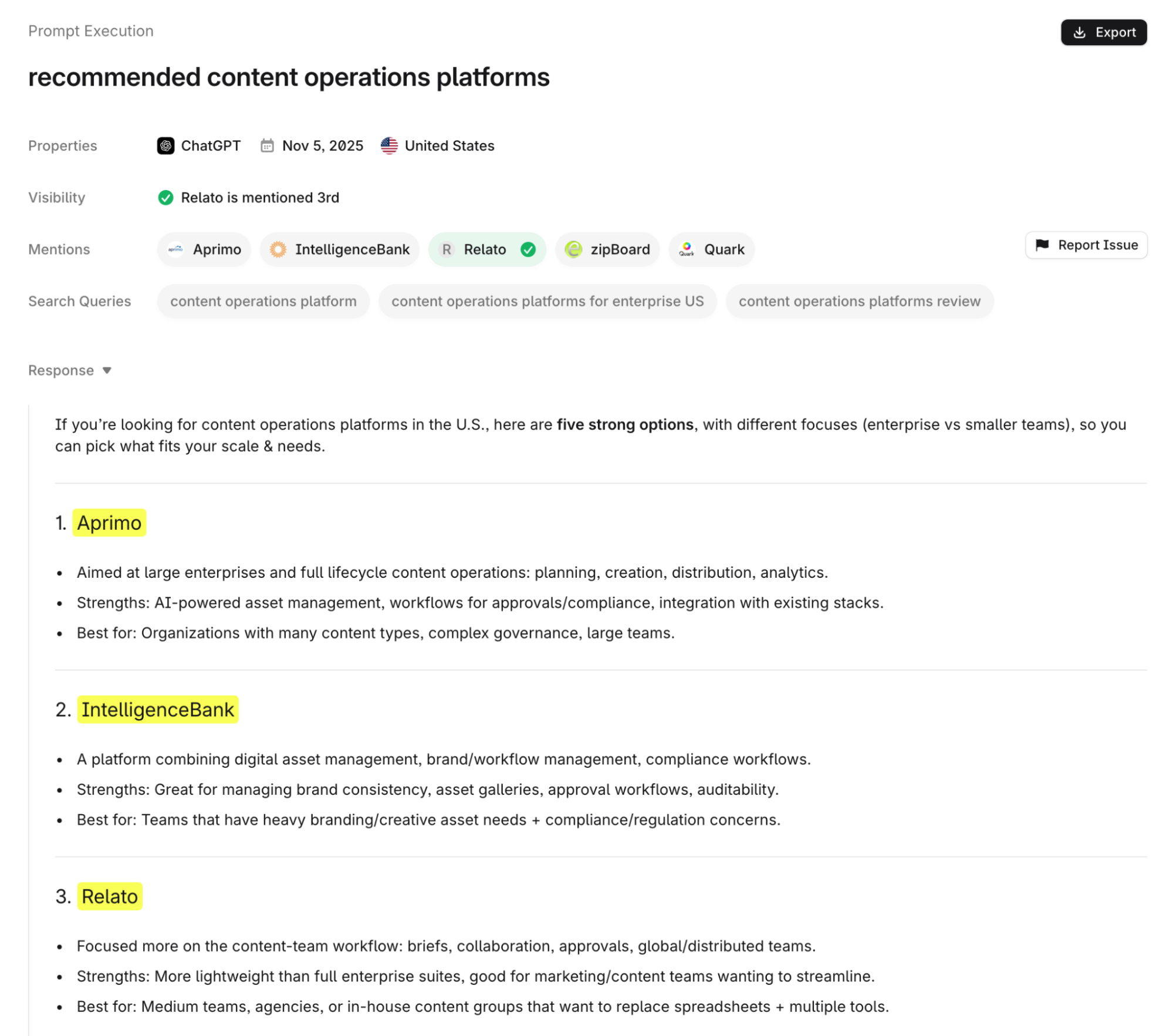
Prompt execution tracking. Each tracked prompt shows a full execution log: which platforms mentioned you, at what position, alongside which competitors. A prompt like “recommended content operations platforms” shows whether you’re mentioned on ChatGPT (mentioned 3rd) but completely invisible on Perplexity, Gemini, and Google AI Overviews. Visibility score, average position, and citation share are tracked over time so you can see whether your efforts are moving the needle.
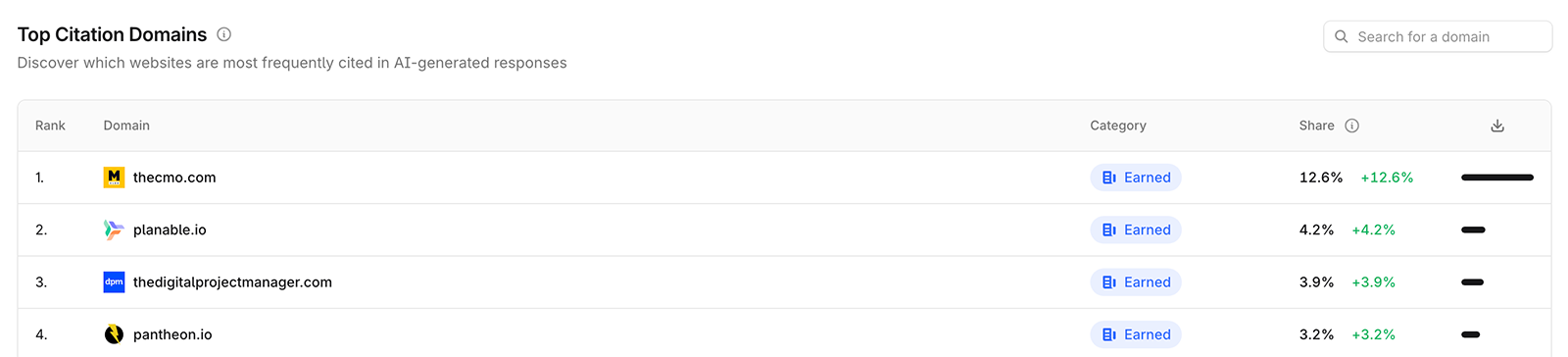
Citation share and top domains. The citation panel shows which domains AI models are citing most frequently in responses about your category, ranked by share. Your own citation rank is shown in context against the full competitive set—so you can see exactly how far you are from the leading sources and which publishers to prioritize for coverage.
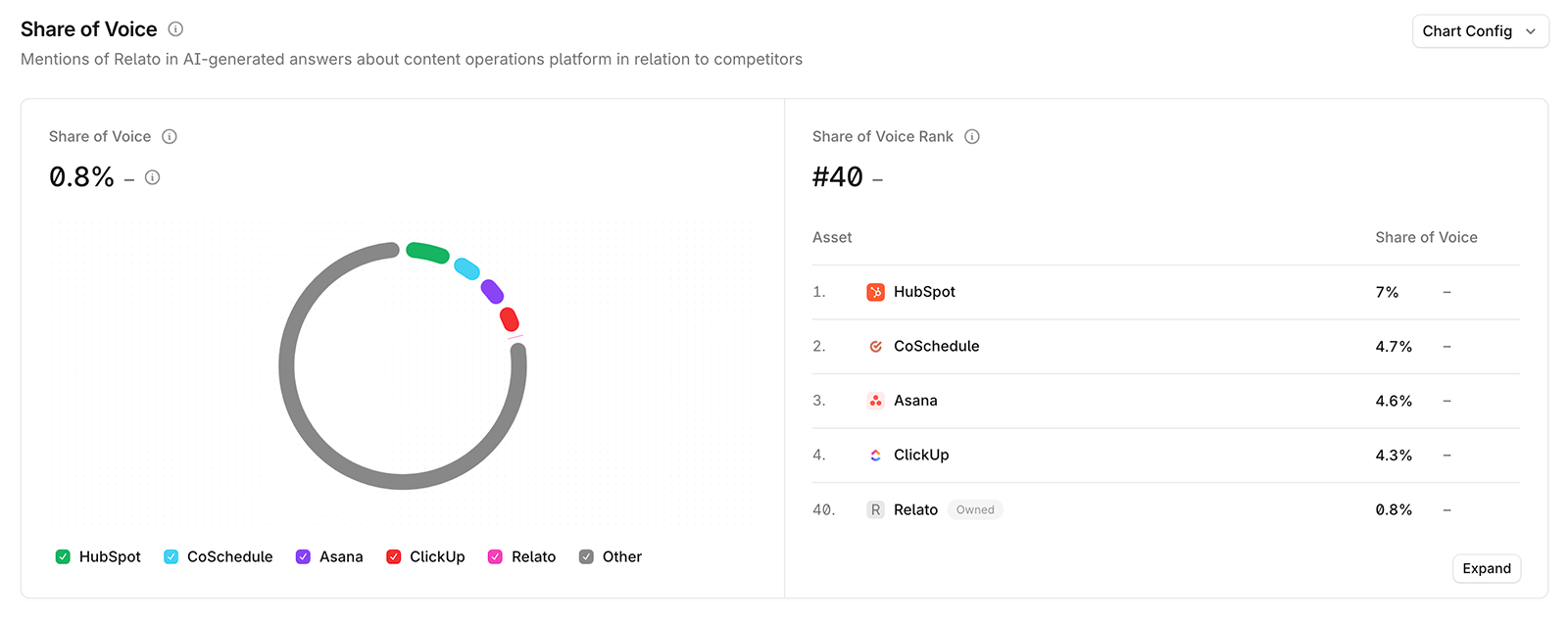
Share of voice. Profound tracks your brand’s share of voice versus named competitors across all tracked prompts in a topic. The donut chart and rank table show how your mentions compare to the category leaders, with your exact rank shown against the full field of brands being mentioned.
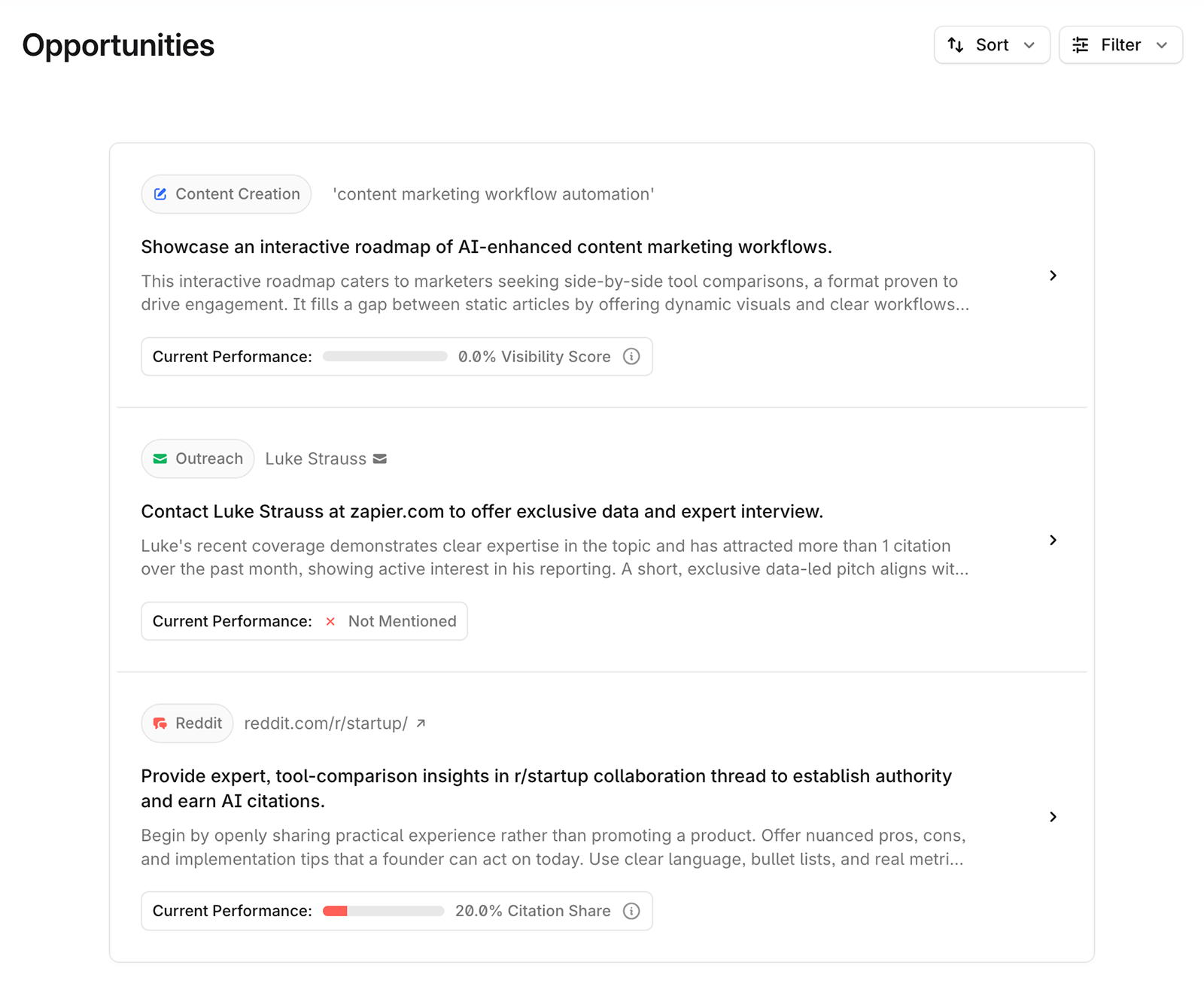
Opportunities. This is Profound’s most differentiated panel. Rather than leaving teams to interpret data, it generates specific, prioritized actions: create a particular piece of content for a gap in AI citations, contact a named journalist at a named publication with a specific pitch rationale, or engage in a specific subreddit thread. Each opportunity includes current performance data so you can prioritize by impact. The specificity—naming an individual journalist at a specific outlet rather than just “do outreach”—is what separates it from generic recommendations.
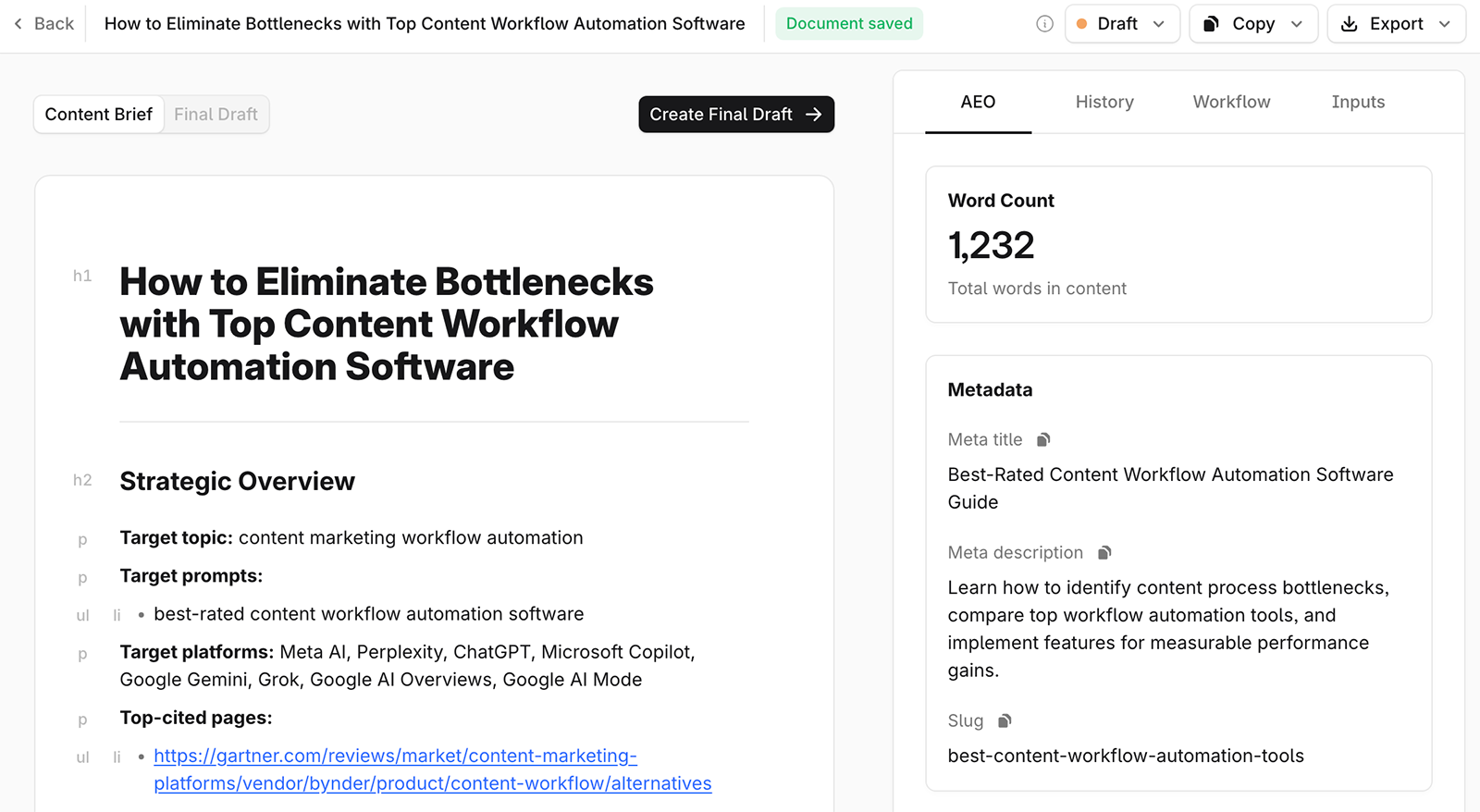
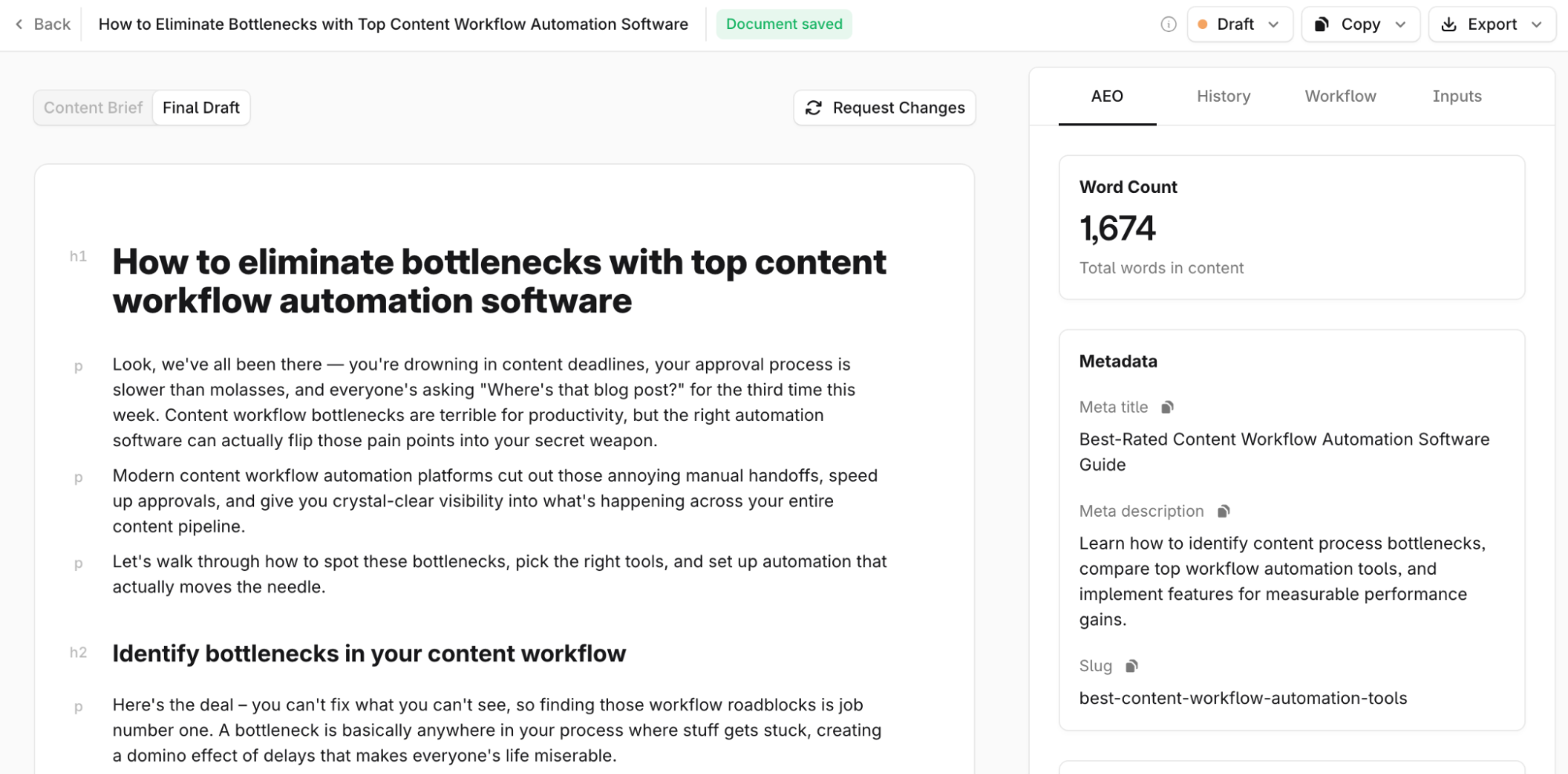
Agents (content briefs and final drafts). Profound’s Agents feature generates AEO-optimized content briefs and full article drafts based on what’s actually being cited in AI responses. A brief includes the title, target topic, target prompts, target platforms, and top-cited pages to reference. The final draft is generated from the brief and can be exported or revised. This is the feature that justifies the platform—it turns citation data into production-ready content without a separate writing tool.
Agent analytics. Profound integrates with Google Analytics to show how AI crawlers (GPTBot, PerplexityBot, ClaudeBot) are accessing your site and how human visitors arriving from AI search are converting. This closes the loop between AI visibility and business impact in a way that pure monitoring platforms can’t.
Pros and cons
Pros:
- G2 Winter 2026 Leader with the deepest G2 review base in the AEO category
- Prompt volume data shows AI search demand by topic and demographics—few other AEO platforms offer it
- Opportunities panel generates specific, named actions: journalist contacts, subreddit threads, content gaps
- Agents feature creates AEO-optimized content briefs and full article drafts
- Up to 9 answer engines on Enterprise, plus ChatGPT Shopping
- SOC 2 Type II compliance—enterprise-ready for procurement requirements
- Google Analytics integration for AI crawler tracking and human visitor attribution
- Integrations with Vercel, Cloudflare, AWS, Netlify, Fastly, and Akamai
- Backed by Khosla, Kleiner Perkins + NVIDIA, Sequoia, Lightspeed—long-term platform viability is not a concern
- Customer base (Target, Walmart, Ramp, MongoDB, Figma) validates genuine enterprise-grade maturity
Cons:
- No self-serve paid plan is published for brands: the former $99 Starter and $399 Growth tiers are retired, and buyers must talk to sales after the trial
- The free trial is limited: 50 prompts on a fixed set across ChatGPT, Gemini, and Google AI Overviews, with no history, exports, or API
- Opaque, credit-based pricing makes cost hard to forecast; full engine coverage (up to 9) requires Enterprise
- No Reddit monitoring—the platform surfaces Reddit opportunities but doesn’t proactively alert on new threads
- No done-for-you service tier—all content creation is self-serve through Agents, though Profound does route customers who want managed placement work to third parties like Noble
- Enterprise pricing is not publicly listed; requires a sales conversation
- The free trial is limited to 7 days (a free AEO report is also available)
How much does Profound cost?
| Plan | Price | Prompts | AI Platforms |
|---|---|---|---|
| Free trial | Free (7 days) | 50 | ChatGPT, Gemini, Google AI Overviews |
| Enterprise | Custom | Custom | Up to 9 platforms |
The most important thing to understand before signing up is that prices are no longer published. The free trial is enough to see what Profound does—but not enough to run a meaningful AEO program, and the features that justify the platform (Agents content generation, multi-platform tracking, the Opportunities panel) sit behind a sales conversation. Teams comparing Profound against alternatives should ask for an Enterprise quote and compare it with published prices.
Enterprise adds up to 9 answer engines, ChatGPT Shopping, daily tracking, all-time history, exports, API access, SSO (SAML/OIDC), and SOC 2 Type II compliance. Profound also sells an Agency Growth plan at $99/mo plus add-ons (client workspaces are a $399/mo add-on), which is built for agencies pitching prospects rather than for a brand tracking itself. Note that G2 and several 2026 review blogs still show the retired $99 Starter and $399 Growth tiers, so check the date on any Profound price you read.
How does it compare with Airefs?
Profound and Airefs target different buyers. Profound is built for enterprise brand teams that want measurement, content creation, and prioritized opportunities in one platform. Airefs is built for agencies that track AI visibility for many clients at a published price.
| Profound | Airefs | |
|---|---|---|
| Starting price | Custom (free 7-day trial) | $49/mo billed yearly ($59 monthly) |
| AI platforms | 3 (trial), up to 9 (Enterprise) | ChatGPT, Google AI Overview, Gemini, Copilot (Claude add-on) |
| Prompt volume data | Yes | No |
| Clients | Client workspaces are a $399/mo add-on | Unlimited, with white-label PDF reports |
| Content creation | Yes (Agents) | Done-for-you services from $349/mo (human-run) |
| SOC 2 compliance | Yes (Enterprise) | — |
| Free trial | 7 days | No |
Profound’s prompt volume data, Opportunities panel specificity, and Agents content engine are genuine advantages for enterprise teams whose budget matches their ambition. Airefs’ unlimited clients, white-label reports and done-for-you services are genuine advantages for agencies that need to build AI visibility for clients, not just measure it, at a price that doesn’t require a procurement process.
The pricing approach is different. Airefs is one published plan at $49/mo billed yearly ($59 monthly), while Profound requires a sales conversation for Enterprise pricing. Airefs has no free trial. Its done-for-you services, from $349/mo, include the content work that Profound leaves to your team to execute.
Conclusion
Profound is the category leader for enterprise AEO: the deepest platform, the most credible customer base, the best-funded team, and one of the few tools with prompt volume data. If you’re an enterprise team with budget and a procurement process, it’s the default choice in the category, and the free 7-day trial is a low-risk way to see the product before talking to sales. Ramp’s 7x visibility increase and logos like MongoDB and Indeed are the real proof points.
The real question is whether an Enterprise contract is the right investment. If you run AI visibility for several clients, Airefs tracks each one at $49/mo billed yearly, with done-for-you services from $349/mo when you want the work done.
Want to compare Profound to other options? See all Profound alternatives or get early access to Airefs — $49/mo billed yearly, with unlimited clients.