
AirOps and Profound have both moved past monitoring-only into full-stack AEO platforms—they track AI visibility and help you improve it—but they’ve done so with very different architectures.
AirOps is a content production engine. Power Agents and Grids are built to turn citation data into publishable content at scale, and CMS integrations with Webflow, WordPress, and Shopify mean teams can go from gap to published article without leaving the platform.
Profound is a strategic intelligence platform. Prompt volume data—one of the few capabilities in the category that shows actual AI search demand for topics—turns Profound from a brand monitor into a content strategy tool. Its Opportunities panel surfaces named journalists, specific subreddit threads, and content gaps with performance data attached.
Both have the case studies to back them up. If you’re deciding between them, the choice usually comes down to two questions: do you need to produce content at scale, or do you need to prioritize which topics to invest in before you write anything?
This comparison covers how each platform works—features, screenshots, customer results, and pricing—and where each one stops.
AirOps vs Profound at a glance
| AirOps | Profound | |
|---|---|---|
| HQ | San Francisco | New York City |
| Funding | $40M Series B (Nov 2025), about $60M total | $155M+ (Khosla, Kleiner Perkins, NVIDIA, Sequoia, Lightspeed) |
| SOC 2 | Type II | Type II (Enterprise) |
| AI Platforms | ChatGPT (Solo) / 7+ answer engines incl. Perplexity (Pro) | 3 (Trial) / up to 9 (Enterprise) |
| Prompt Volume Data | Popular Prompt Gaps (requires Prompt Volume to be enabled) | Yes — a core differentiator (few others offer it) |
| Content Creation | Power Agents + Grids | Agents (briefs + drafts) |
| CMS Publishing | Webflow, WordPress, Shopify | No |
| Opportunities | 9 opportunity types across Create/Refresh/Outreach/Community | Named journalist contacts, subreddit threads, content gaps |
| Google Analytics Integration | No | Yes |
| Starting Price | Start free (Insights) or talk to sales; paid prices not published | Free 7-day trial / Custom Enterprise (Agency Growth $99/mo + add-ons) |
| Free Trial | Free Insights plan (listed earlier; earlier 14 days + 50K credits) | 7 days + free AEO report |
| Customers | Webflow, HubSpot, Ramp, Carta, Chime, Brex | Target, Walmart, MongoDB, Indeed, Ramp, Figma, US Bank, Chime, and others |
What is Profound?
Profound is an AI search visibility and content optimization platform built for enterprise marketing teams. It tracks your brand’s presence across up to 9 answer engines on Enterprise—ChatGPT, Perplexity, Google AI Mode, Gemini, Copilot, DeepSeek, Claude, Google AI Overviews, and Exa Search, plus ChatGPT Shopping—and generates AEO-optimized content to improve it.
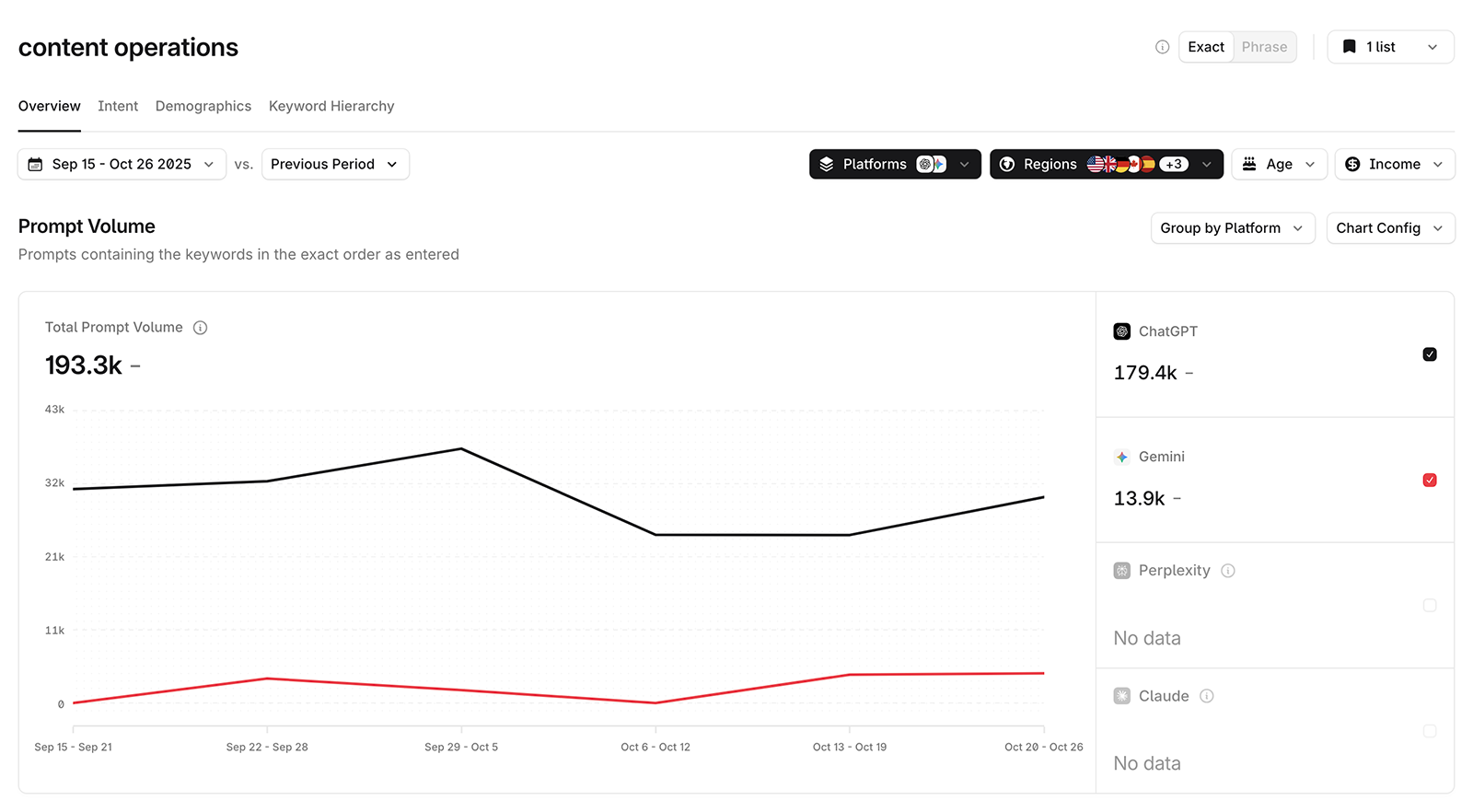
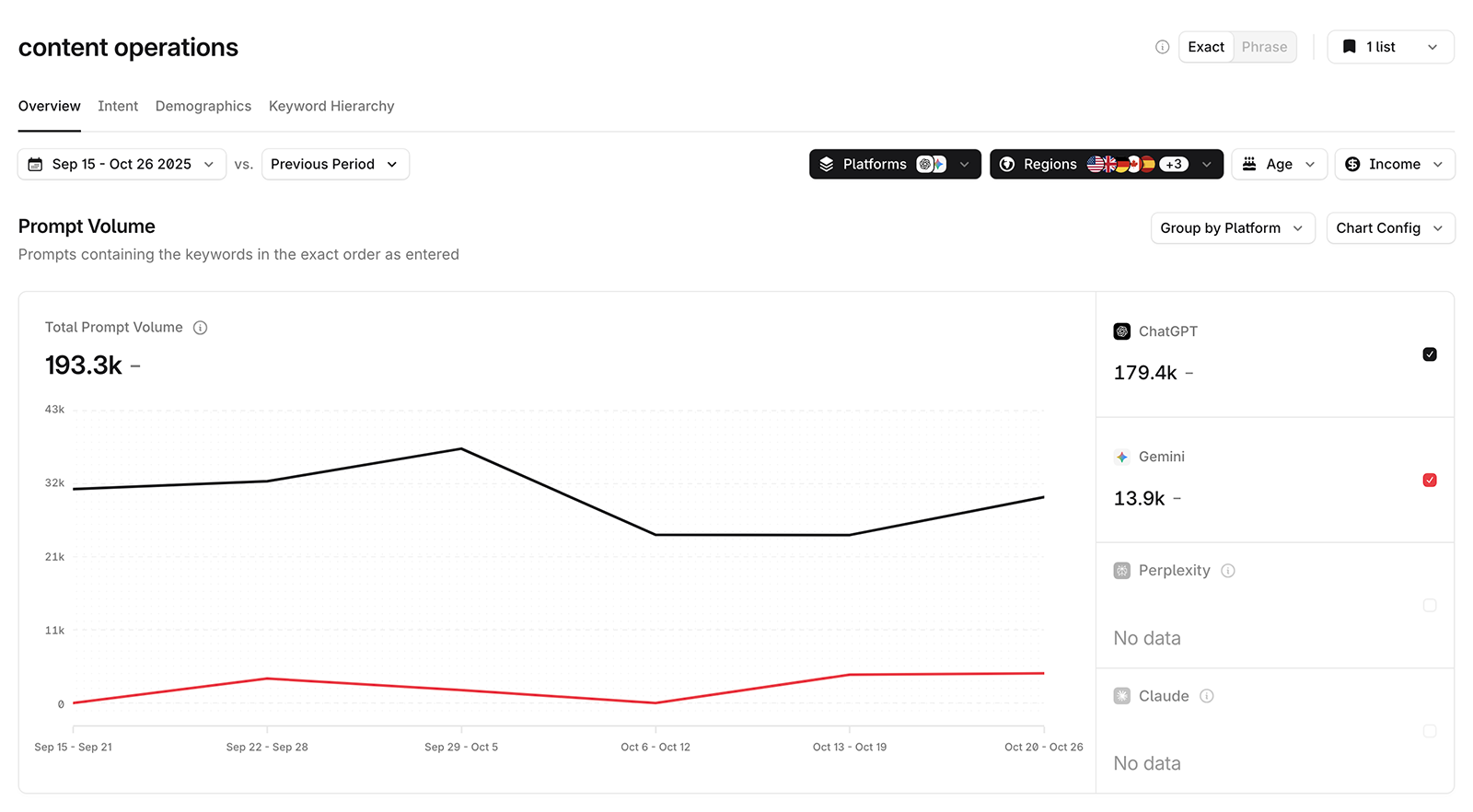
One capability few others have is prompt volume data: Profound shows actual AI search demand for topics in your category, not just your brand’s position within existing queries. For a topic like “best CRM for startups,” you can see total monthly query volume across ChatGPT, Perplexity, and Gemini, filtered by demographics. This turns Profound from a brand monitoring tool into a content strategy tool—you’re identifying which topics have AI search demand before you invest in them.
Funding timeline:
- Seed — Khosla Ventures
- Series A — Kleiner Perkins + NVIDIA
- Series B — Sequoia
- Series C — Lightspeed ($96M, Feb 2026, at a $1B valuation)
- Total raised: $155M+
The enterprise customer list reflects where Profound has found product-market fit: Target, Walmart, Figma, MongoDB, Ramp, U.S. Bank, Chime, Docusign, Indeed, Plaid, Deel, and Statsig. Ramp’s 7x AI visibility increase (3.2% to 22.2% in a month, moving from 19th to 8th among Accounts Payable fintech brands) is the most-cited case study in the AEO category.
What is AirOps?
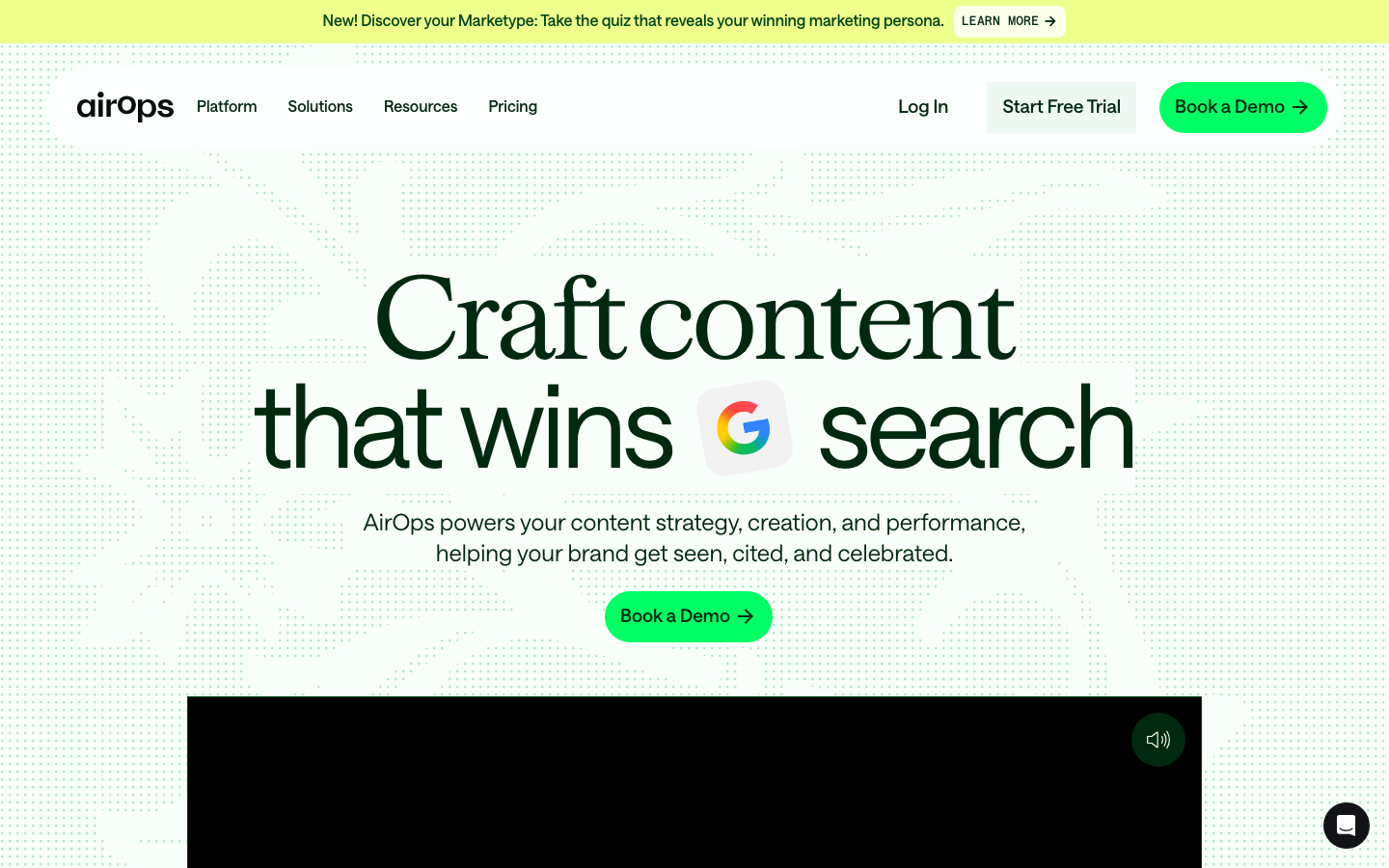
AirOps is an AI search visibility and content production platform. It tracks brand presence across AI search responses, identifies citation gaps, and then builds the content production infrastructure to close them—Power Agents, Grids, and CMS integrations in a single workflow.
The differentiation is execution speed. AirOps connects opportunity identification to content creation in one platform: a Power Agent takes a keyword, runs SERP analysis, performs deep research, generates a content brief, and produces a final article draft in a single automated run. Grids run those workflows across dozens of topics simultaneously. For teams producing large volumes of AEO content, this eliminates the repetitive setup between articles.
AirOps is SOC 2 Type II certified and headquartered in San Francisco. Its customer base—Upwork, Ramp, Webflow, Chime, HubSpot, Carta, Brex, Docebo, and monday.com among them—reflects genuine enterprise adoption.
Feature breakdown
Prompt volume and AI search demand
Profound is one of the few platforms in the category that show prompt volume data—the actual number of times users are querying AI platforms about topics in your category. For a topic like “content operations,” the dashboard shows total monthly prompt volume broken down by platform, filtered by region, age, and income demographics.
This is the signal that separates content strategy from brand monitoring. The equivalent in traditional SEO is keyword volume—knowing how many people are searching before you decide whether to write the article. Few other AEO tools have it (Promptwatch, Cognizo, and Writesonic offer their own versions).
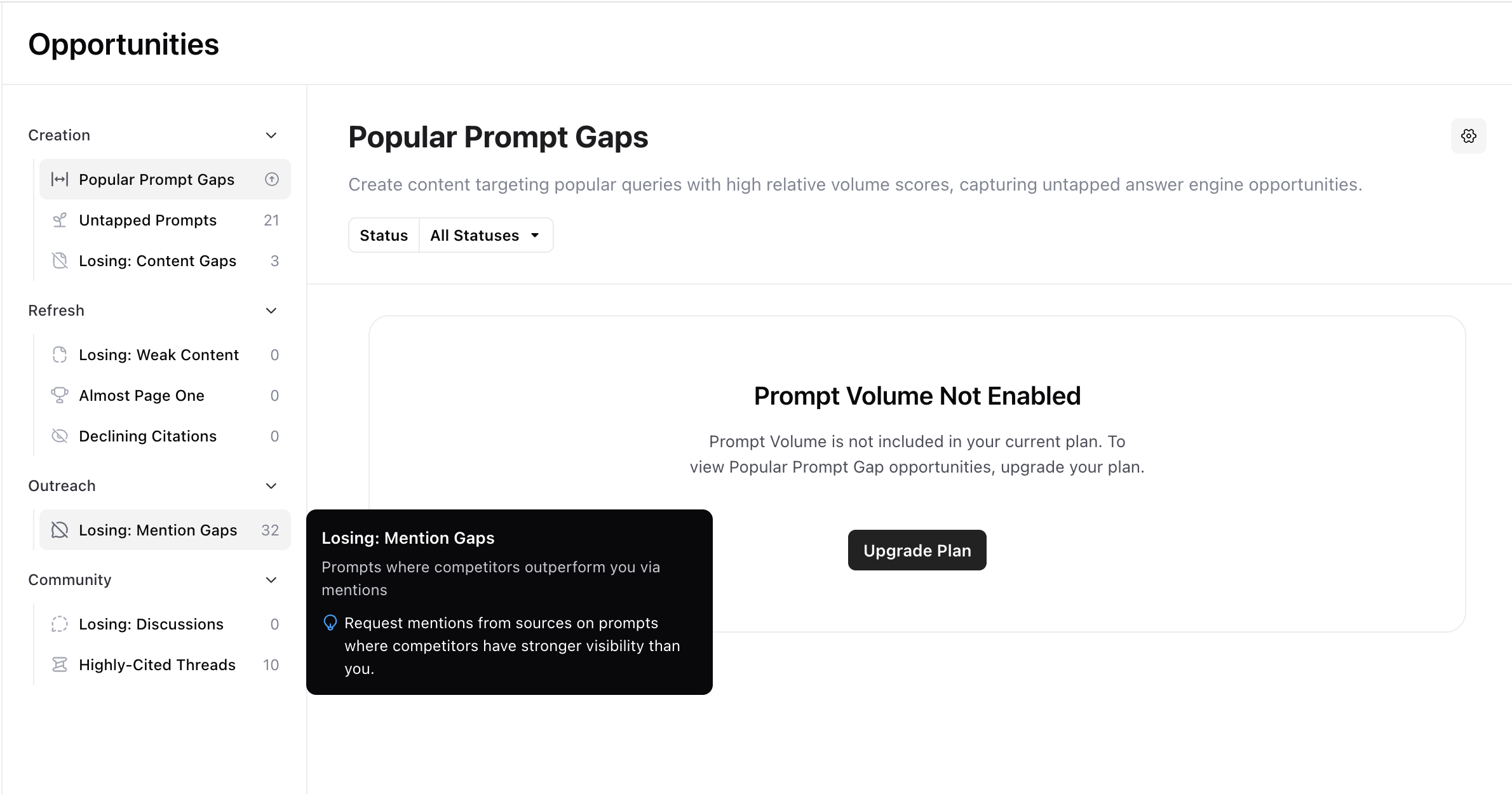
AirOps has a Popular Prompt Gaps feature in its Opportunities module, but it requires the Prompt Volume feature to be enabled—a plan-dependent gate. It shows which high-volume AI queries you’re not appearing in, but only once that data layer is active.
Edge: Profound. Its prompt volume data, built on a dataset of real user conversations, is the most developed in the category.
Content creation at scale
This is AirOps’ strongest differentiator.
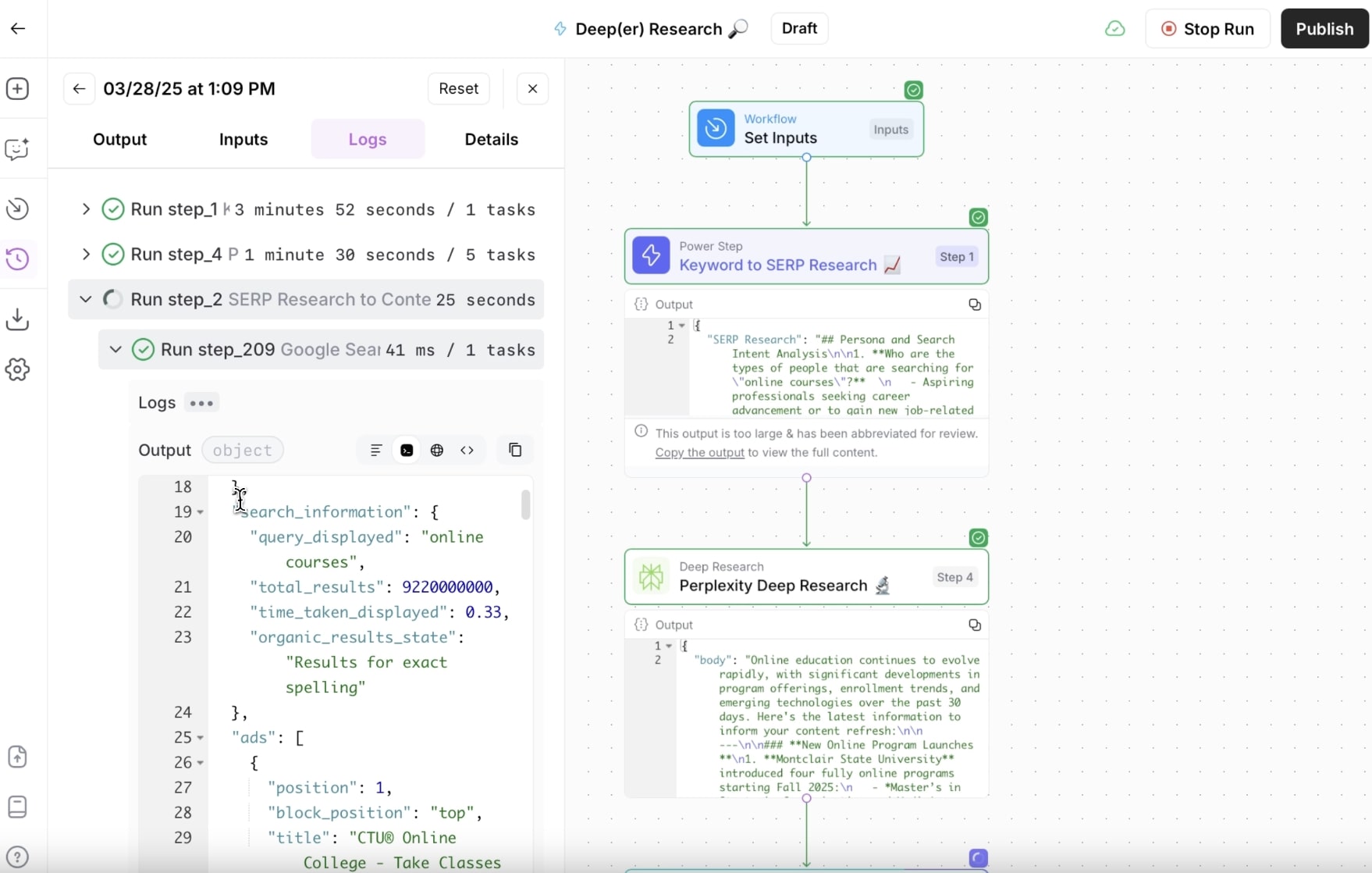
Power Agents are custom multi-step AI workflows built in a visual node editor. They chain research, writing, and enhancement steps into automated pipelines. A typical workflow takes a keyword, runs SERP analysis, performs deep research, generates a content brief, and produces a final article draft—all in a single automated run.
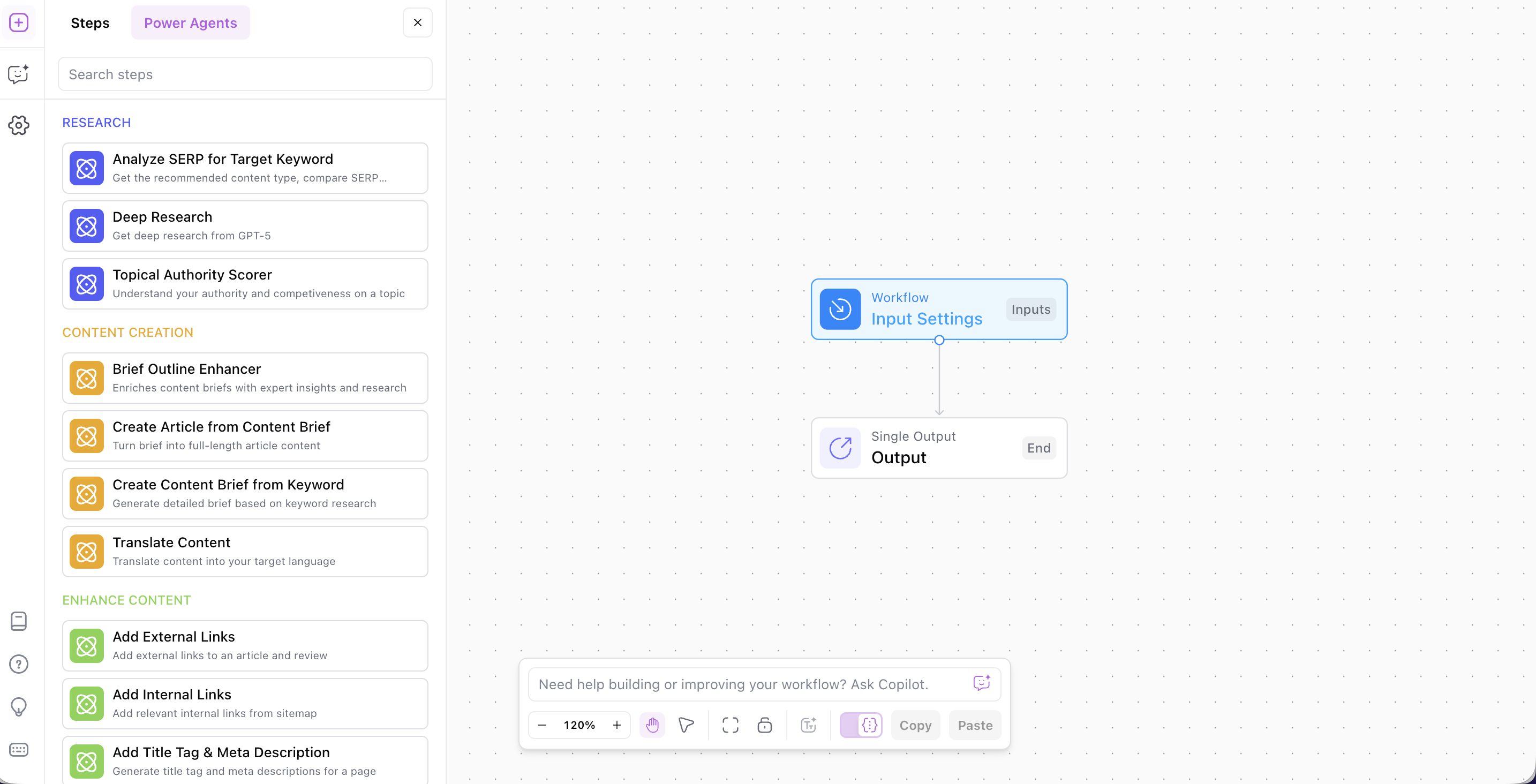
The step library covers Research (Analyze SERP, Deep Research, Topical Authority Scorer), Content Creation (Create Content Brief from Keyword, Create Article from Content Brief, Write Article Outline, Translate Content), and Enhance Content (External Links, Internal Links, Title Tag and Meta Description).
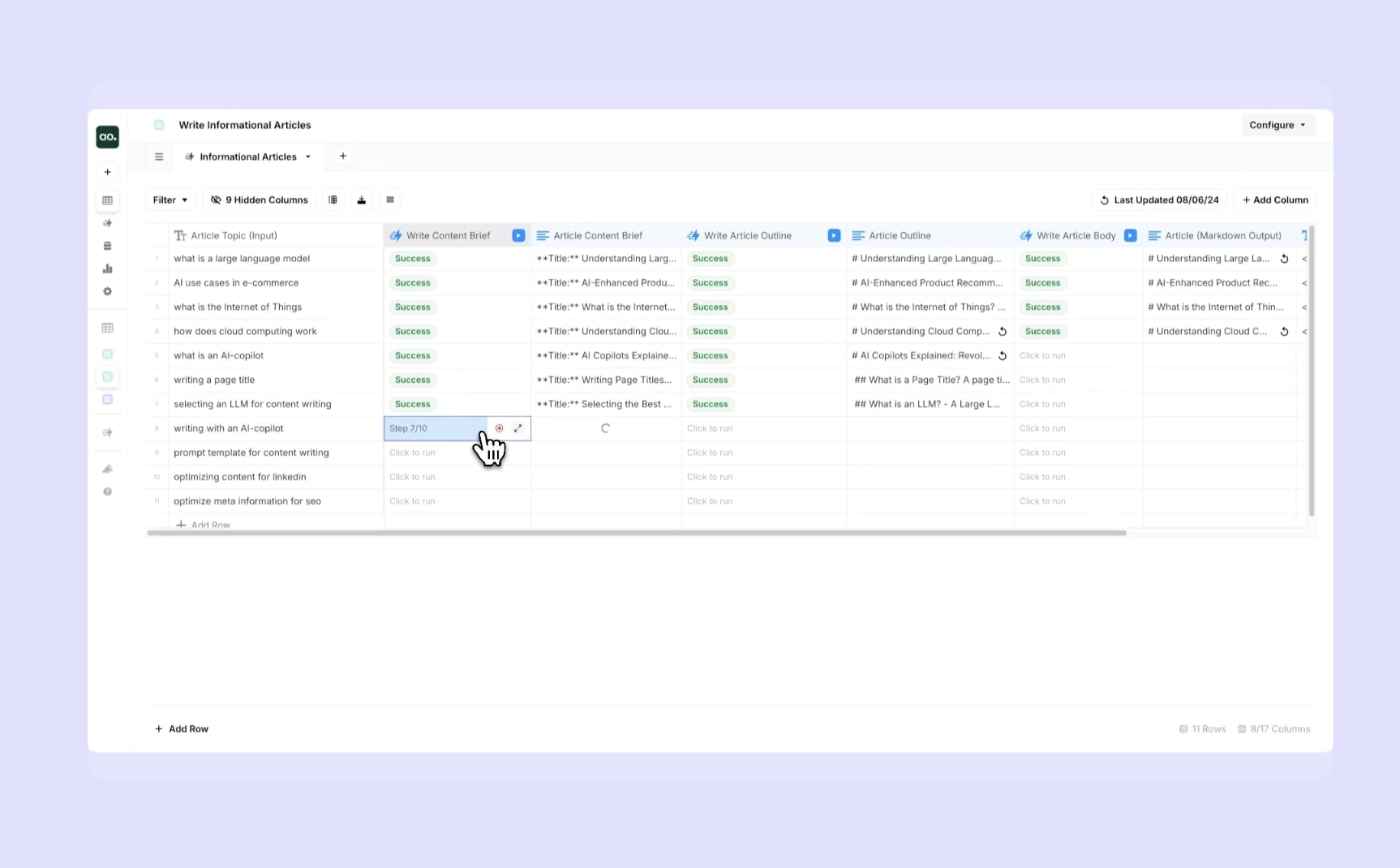
Grids run those pipelines at bulk. Where Power Agents build an individual pipeline, Grids run it across many rows simultaneously. A “Write Informational Articles” grid starts with a list of article topics—each row runs the full Content Brief → Article Outline → Article Body pipeline, producing Markdown output.
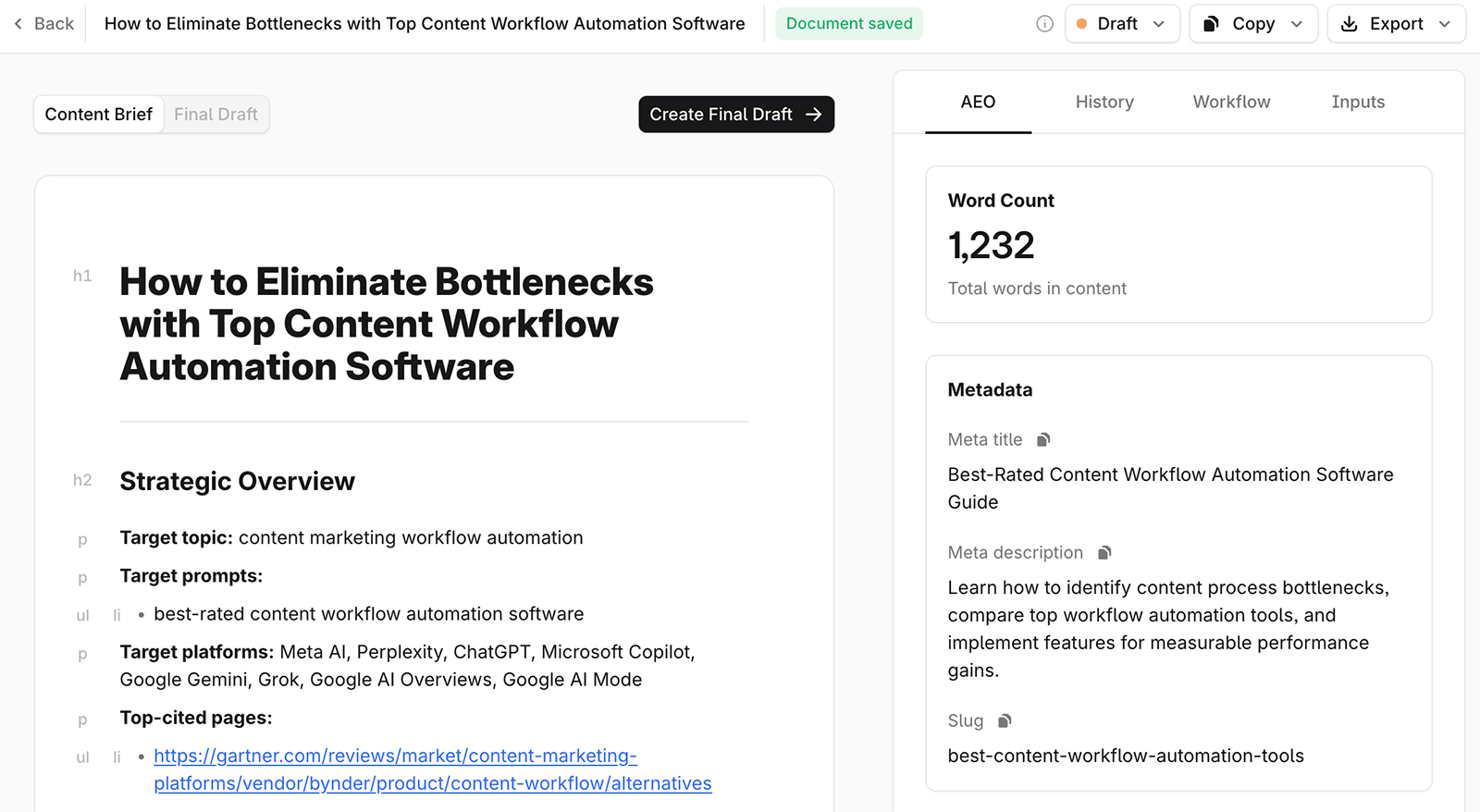
Profound’s Agents feature generates AEO-optimized content briefs and full article drafts based on what AI models are actually citing in your category. A brief includes the title, target topic, target prompts, target platforms, and top-cited pages to reference. The final draft is generated from the brief and can be exported or revised.
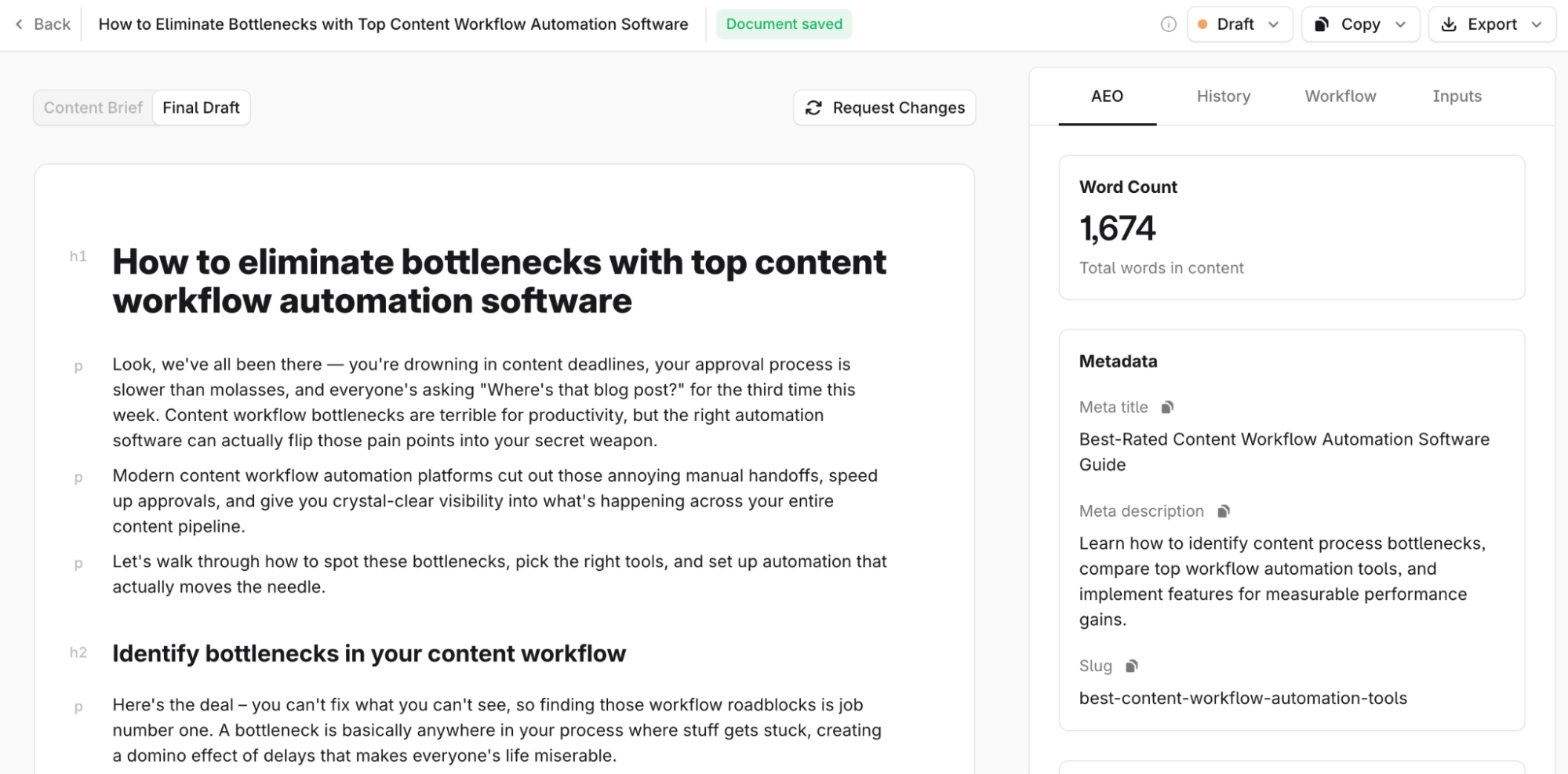
Both platforms generate content. The difference is throughput. AirOps’ Grids can run full article pipelines across dozens of topics in a single batch. Profound’s Agents run one brief and draft at a time.
Edge: AirOps for content production at scale. Profound for content that’s strategically grounded in prompt volume data and citation signal.
Opportunities: what to do next
Both platforms have an Opportunities module. The structure is different.
AirOps breaks opportunities into four workflow types: Creation (Popular Prompt Gaps, Untapped Prompts, Content Gaps), Refresh (Weak Content, Almost Page One, Declining Citations), Outreach (Mention Gaps, Discussions), and Community (Highly-Cited Threads). This taxonomy is useful for teams that need to triage across different kinds of actions—knowing whether to write new content, refresh existing pages, pursue PR coverage, or participate in communities.
Profound’s Opportunities panel generates specific, named actions: create a particular piece of content for a gap in AI citations, contact a named journalist at a named publication with a specific pitch rationale, or engage in a specific subreddit thread. Each opportunity includes current performance data so you can prioritize by impact.
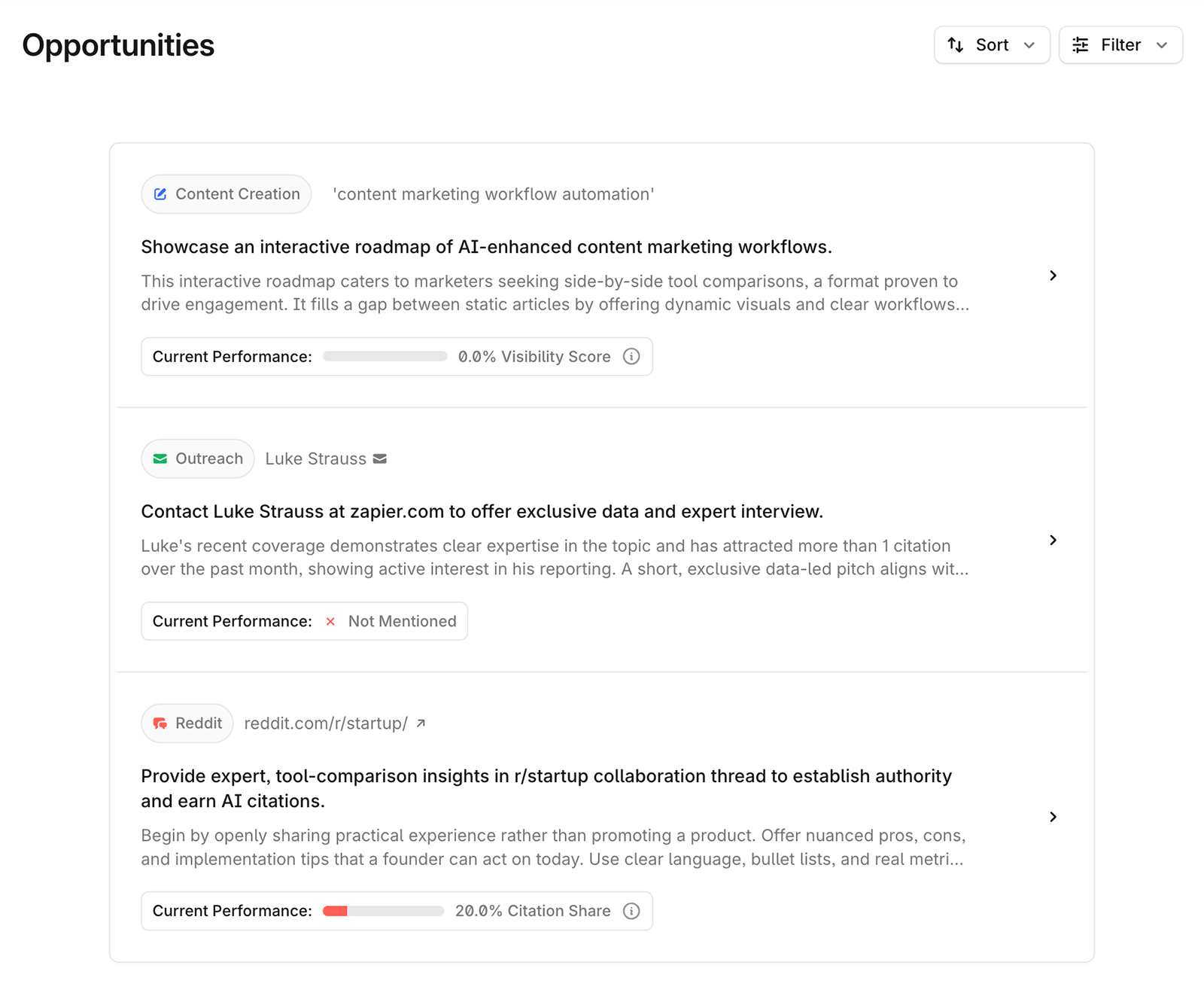
Edge: AirOps for structured opportunity taxonomy. Profound for specificity—naming an individual journalist at a specific outlet rather than “do outreach.”
CMS publishing
AirOps publishes directly to Webflow, WordPress, and Shopify. This eliminates the copy-paste step between content production and CMS publishing. For teams that publish frequently, it’s a meaningful workflow advantage: content goes from Power Agent or Grids output to live page without leaving AirOps.
Profound has no CMS publishing integration. Content created through Agents must be exported and published manually.
Edge: AirOps, clearly.
Prompt tracking and visibility scoring
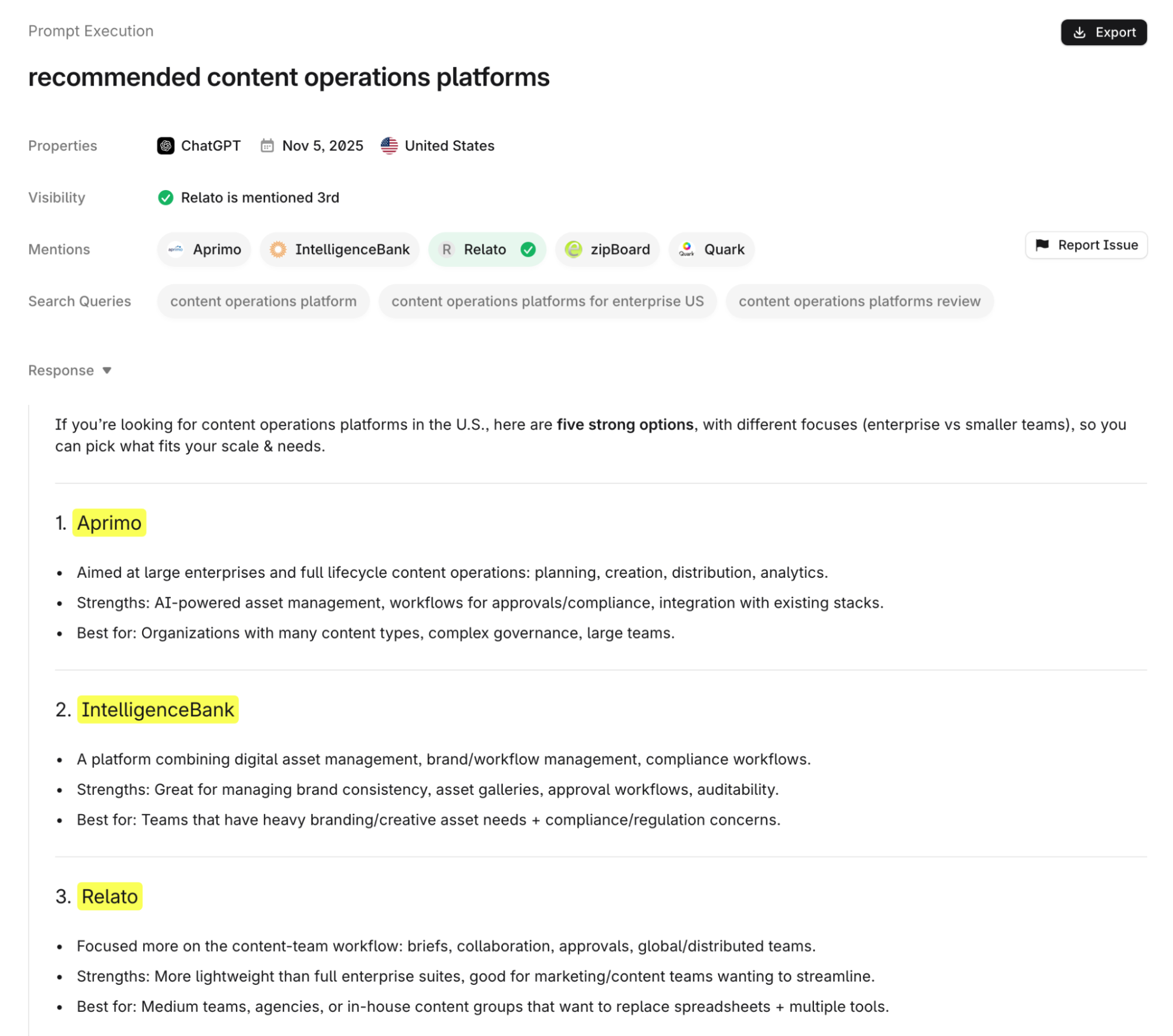
Profound — Each tracked prompt shows a full execution log: which platforms mentioned you, at what position, alongside which competitors. A prompt like “recommended content operations platforms” shows whether you’re mentioned on ChatGPT (mentioned 3rd) but completely invisible on Perplexity, Gemini, and Google AI Overviews. Visibility score, average position, and citation share are tracked over time.
AirOps — Prompts are tracked with visibility data and citation performance. The Pages section gives a unified view of existing content and its AI search performance, and Smart Filters surface the most actionable segments automatically.
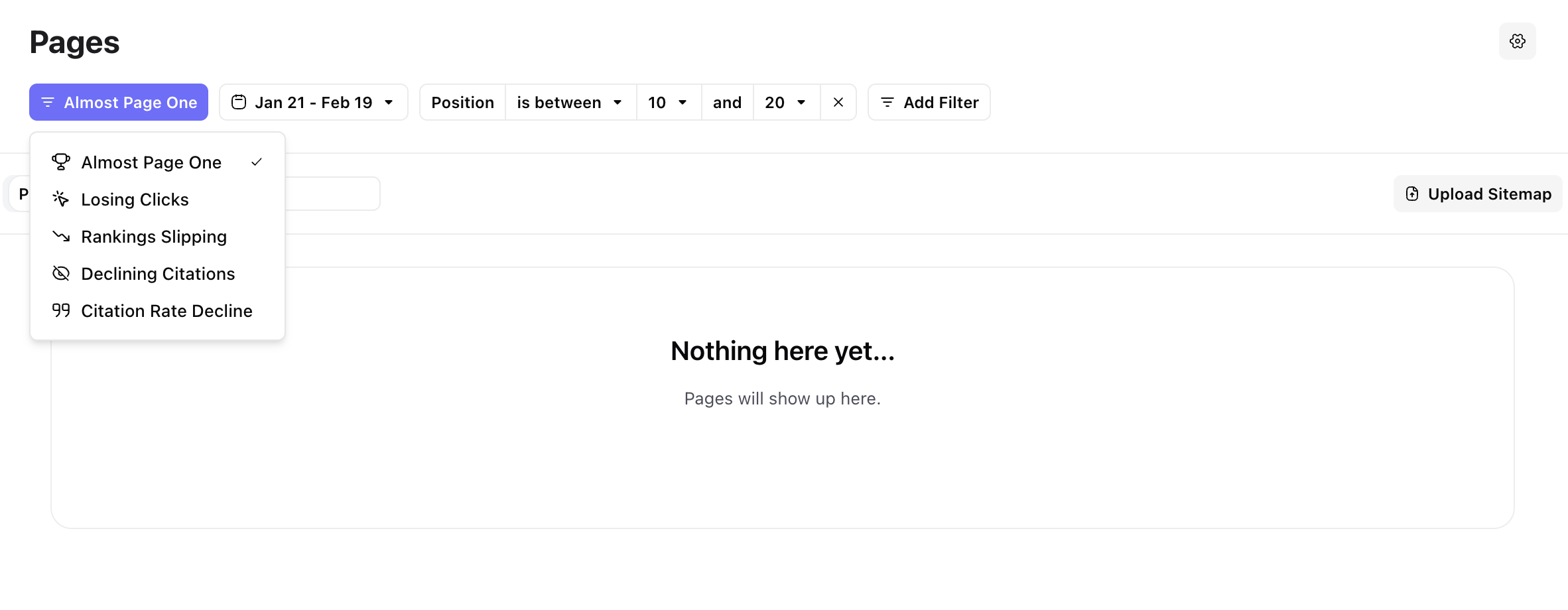
Edge: Profound for prompt execution depth and multi-platform coverage. AirOps for Pages Smart Filters on existing content inventories.
Citation and share of voice
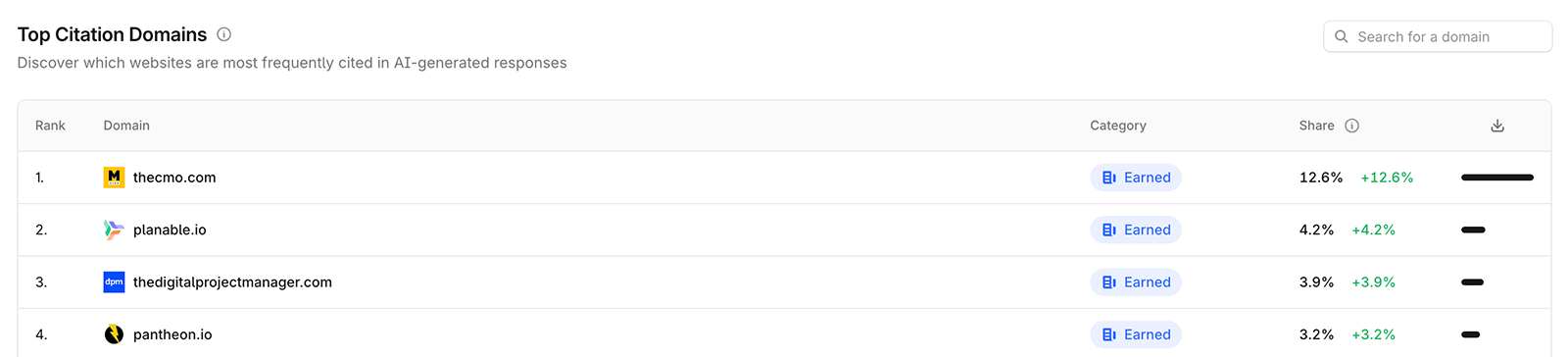
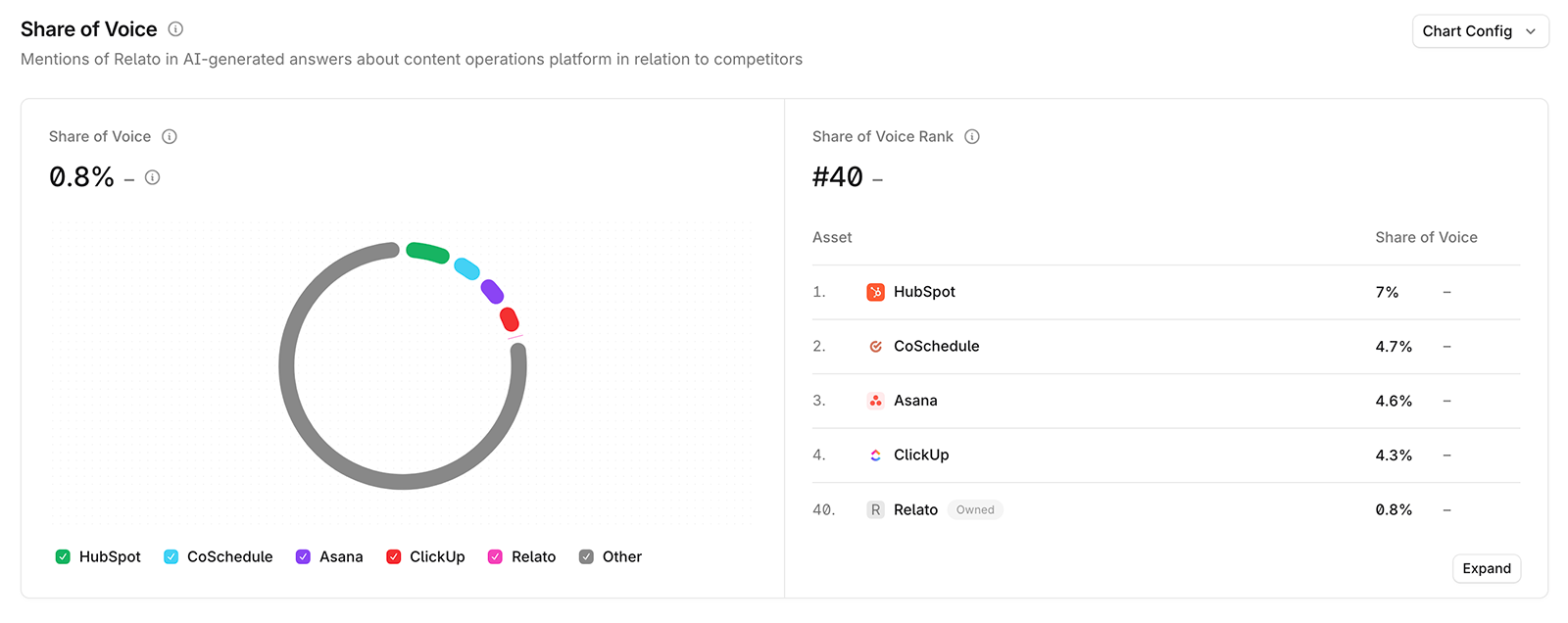
Profound — The citation panel shows domain-level citation share ranked against the full competitive set. Share of voice tracks your brand’s percentage versus named competitors across all tracked prompts, with a donut chart and rank table.
AirOps — Citation data surfaces through the Opportunities module (Declining Citations, Citation Rate Decline in Smart Filters, Mention Gaps in Outreach). The Page360 view gives per-page citation performance including AI-generated traffic and improvement recommendations.
Edge: Profound for top-level citation share and SOV tracking. AirOps for per-page citation diagnostics.
Google Analytics and business impact
Profound integrates with Google Analytics to show how AI crawlers (GPTBot, PerplexityBot, ClaudeBot) are accessing your site and how human visitors arriving from AI search are converting. This closes the loop between AI visibility and business impact—a capability that pure monitoring or content platforms can’t match.
AirOps has no Google Analytics integration. Content performance is measured within the platform’s own tracking data.
Edge: Profound, significantly.
Integrations and compliance
Both platforms are SOC 2 Type II certified (Profound lists SOC 2 and SSO under Enterprise).
Profound offers SSO (SAML/OIDC), API access at Enterprise, and infrastructure integrations with Vercel, Cloudflare, AWS, Netlify, Fastly, and Akamai. These are table stakes for enterprise procurement processes.
AirOps offers CMS publishing integrations (Webflow, WordPress, Shopify) and Brand Knowledge Bases for keeping AI-generated content on-brand. Confirm API and SSO availability with sales, as its public pages don’t detail them.
Edge: Profound for enterprise security requirements. AirOps for content workflow integrations.
Pricing transparency
Profound no longer publishes self-serve pricing for brands: its former Starter ($99/mo) and Growth ($399/mo) plans are retired. You can evaluate it through a free 7-day trial, but paid use requires a sales conversation. (Its Agency Growth plan, $99/mo plus add-ons, is for agencies pitching prospects.)
AirOps publishes no prices below Enterprise. Its pricing page says to start free or talk to sales, and the Solo and Pro plans are listed by task allowance only. You cannot budget for AirOps without talking to sales first.
Edge: Neither—both require a sales conversation for paid plans, though Profound’s free trial and AirOps’ free start let you evaluate first.
Pricing
Profound
| Plan | Price | Prompts | AI Platforms |
|---|---|---|---|
| Trial | Free (7 days) | 50 run daily (fixed set) | ChatGPT, Gemini, Google AI Overviews |
| Enterprise | Custom | Custom | Up to 9 platforms |
Free AEO report (no credit card).
The trial is enough to see what Profound does, but it uses a recommended prompt set that cannot be customized and has no history, exports, or API. The features that justify the platform (Agents, multi-platform tracking, the Opportunities panel at full scale) sit in custom Enterprise pricing. Profound’s former $99/mo Starter and $399/mo Growth tiers are no longer published, though G2 and many review sites still quote them. Agency Growth ($99/mo plus add-ons; client workspaces are a $399/mo add-on) is a separate agency offering.
AirOps
| Plan | Price | Tasks/mo | AI Platforms |
|---|---|---|---|
| Insights | Free (shown earlier; not on the current pricing page) | 1,000 | 30+ AI models |
| Solo | Not published | 35,000 (content production) | ChatGPT insights only |
| Pro | Not published | 100,000 | Insights across 7+ answer engines |
| Enterprise | Custom | Custom | All engines |
AirOps earlier offered a 14-day free trial with 50,000 credits to Scale features. Solo overages were billed at $0.025 per task.
The free Insights plan (when offered) is generous for exploration—1,000 tasks per month and 30+ AI models. But the 1,000 tasks deplete quickly under real volume, and every paid tier requires a sales conversation before you can evaluate cost. G2 reviewers cite cost (about 20 mentions) alongside a steep learning curve.
Pros and cons
AirOps
Pros:
- Strongest case studies in the AEO category—Webflow, Chime, Ramp, Carta results are publicly documented
- Power Agents enable fully configurable multi-step content workflows—not just presets
- Grids for bulk content production—run full pipelines across dozens of topics simultaneously
- CMS integrations (Webflow, WordPress, Shopify) allow publishing directly from AirOps
- Opportunities module categorizes actions by type (Create, Refresh, Outreach, Community)
- Pages Smart Filters surface highest-value existing content without manual review
- Brand Knowledge Bases keep AI-generated content on-brand at scale
- SOC 2 Type II across paid plans
- A free start (Insights) before any sales conversation
Cons:
- No published pricing for Solo, Pro, or Enterprise—cost evaluation requires a sales call
- Steep learning curve—Power Agents and Grids require meaningful setup before producing output
- Desktop-only—no mobile access
- Prompt volume depth is limited (Popular Prompt Gaps requires the Prompt Volume feature to be enabled)
- No Google Analytics integration
- 1,000 free tasks on Insights deplete quickly; earlier Solo overages were $0.025/task
- Multi-engine tracking (beyond ChatGPT) requires Pro—same limitation as many competitors
Profound
Pros:
- Prompt volume data from real conversations shows AI search demand by topic and demographics—few other AEO platforms offer it
- Opportunities panel generates specific named actions: journalist contacts, subreddit threads, content gaps
- Agents creates AEO-optimized content briefs and full article drafts
- Google Analytics integration closes the loop between AI visibility and business outcomes
- Up to 9 AI platforms including ChatGPT Shopping and DeepSeek (Enterprise)
- SOC 2 Type II, SSO (SAML/OIDC)—enterprise procurement ready
- Infrastructure integrations: Vercel, Cloudflare, AWS, Netlify, Fastly, Akamai
- G2 Winter 2026 Leader with 1,130 G2 reviews at 4.5/5, the deepest review base among AEO-specific tools
- $155M+ backed by Khosla, Kleiner Perkins + NVIDIA, Sequoia, Lightspeed
Cons:
- No self-serve paid tier is published—after the 7-day trial, buyers must talk to sales
- The trial is limited—a fixed 50-prompt set on 3 platforms, no history, exports, or API
- Claude, Grok, and other engines beyond the trial’s 3 require Enterprise
- No CMS publishing integration—content must be exported and published manually
- No bulk content production equivalent to AirOps’ Grids
- No proactive Reddit monitoring—surfaces Reddit opportunities but doesn’t alert on new threads
- Opaque, credit-based pricing makes cost hard to forecast
What users say
AirOps
The consistent praise centers on workflow depth. Users who’ve tried multiple AEO tools describe Power Agents as genuinely different from dashboard-only tools—the ability to build automated pipelines that run end-to-end is a step beyond reviewing a report and deciding what to write.
The case studies are the strongest evidence in the category:
Webflow grew AI-attributed signups from 2% to over 10% in under a year.
Chime tripled citations in under 4 weeks.
Carta achieved a 75% citation rate increase on new pages.
Ramp generated a 10x ROI on its Reddit strategy.
Consistent criticism covers pricing opacity and setup time. G2 reviewers (134 reviews, 4.7/5) cite a steep learning curve, cost, and a hard first two weeks of setup, and some report unreliable output such as incorrect stats. Teams without an existing content strategy find Power Agents difficult to direct before significant configuration investment. The platform is also desktop-only—an unusual constraint for a tool used by distributed teams.
Profound
Profound holds G2 Winter 2026 Leader status with 1,130 G2 reviews at 4.5/5. The platform appears in dozens of Reddit threads in the AEO and AI search space—unusual for a B2B SaaS tool—reflecting genuine practitioner adoption rather than marketing-driven awareness.
Consistent praise: prompt volume data and the specificity of the Opportunities panel. Teams that have tried multiple AEO tools consistently cite prompt volume as a capability that doesn’t exist elsewhere.
Ramp grew AI visibility 7x (3.2% to 22.2%) within one month and moved from 19th to 8th among Accounts Payable fintech brands.
Consistent criticism: pricing. G2 reviewers repeatedly call it expensive (“the price can be off-putting at first, especially if you are not a large company”), and the opaque, credit-based pricing is hard to forecast. Others report a steep learning curve and overwhelming data.
Who AirOps is best for
- Teams running high-volume content programs who need to produce dozens of AEO-optimized articles per month and want automation across the full production pipeline
- Teams with CMS workflows in Webflow, WordPress, or Shopify who want to publish directly from their visibility platform without a manual copy-paste step
- Teams with established content strategies who need a production engine to scale what they already know works—Power Agents amplify an existing strategy rather than replace having one
- Agencies managing multiple client content programs who need bulk workflows and on-brand customization per client through Knowledge Bases
Who Profound is best for
- Enterprise teams that need prompt volume data to prioritize content investment before writing anything
- Teams that need SOC 2, SSO, and API access for procurement requirements
- Content and SEO teams who want specific, named opportunities—a journalist at a named outlet with a specific pitch rationale, not just “do PR outreach”
- Teams who need to tie AI visibility to business outcomes via Google Analytics AI crawler attribution and human visitor conversion tracking
- Brands that need up to 9 AI platform coverage including ChatGPT Shopping, DeepSeek, and Grok at Enterprise tier
The Airefs alternative
If you’re evaluating AirOps and Profound, it’s worth knowing what the category looks like at a different price point.
Airefs is an AI search visibility and content execution platform starting at $24/mo. Like Profound, it combines monitoring with action—tracking where your brand appears in ChatGPT alongside identifying opportunities that improve that visibility. Like AirOps, it includes content execution as part of the platform rather than leaving it to a separate tool.
The practical difference: Airefs is built for startups, growth-stage companies, and agencies who want results without an enterprise price point or a sales conversation. It tracks AI visibility, surfaces Reddit and content opportunities with proactive keyword monitoring, and includes a done-for-you option where the Airefs team handles execution—content creation and community discussion participation—on your behalf.
| AirOps | Profound | Airefs | |
|---|---|---|---|
| Starting price | Start free or contact sales (paid prices unpublished) | Free 7-day trial / Custom Enterprise | $24/mo (billed yearly) |
| AI platforms | ChatGPT (Solo) / multi-engine (Pro+) | 3 (Trial) / up to 9 (Enterprise) | ChatGPT default |
| Prompt volume data | Requires Prompt Volume enabled | Yes | No |
| Reddit monitoring | Highly-Cited Threads + Discussions | Opportunities only (no proactive alerts) | Yes (up to 30 keywords) |
| Content creation | Power Agents + Grids | Agents (briefs + drafts) | Done-for-you at $300/mo |
| CMS publishing | Webflow, WordPress, Shopify | No | No |
| Free trial | Free start (Insights) | 7 days + free AEO report | 7 days (Pro) |
| Pricing transparency | No paid prices published | Trial and custom only | Full published pricing |
Try Airefs free for 7 days, up and running in minutes.
Verdict
Choose AirOps if you’re a team that needs to produce AEO content at scale—dozens of articles per month through automated pipelines—and wants to publish directly to your CMS without manual steps. The Power Agents and Grids combination is the most capable content production system in the AEO category. The case studies from Webflow, Chime, and Ramp are the strongest published evidence of what’s possible. Accept that you’ll need to talk to sales before you can see paid-plan costs, and invest meaningful time in setup before seeing output.
Choose Profound if you’re an enterprise team that needs to know which topics have AI search demand before investing in content, and you want your Opportunities panel to name specific journalists and subreddit threads rather than giving you categories of work to do. Expect custom Enterprise pricing—there is no published self-serve tier. The $155M+ in funding, G2 Winter 2026 Leader status, and customers like Ramp, MongoDB, and Indeed reflect genuine enterprise maturity.
Neither is the right fit if you’re an early-stage startup or growth company that doesn’t need enterprise infrastructure and wants a platform that combines AI visibility monitoring with content execution at a price that doesn’t require a procurement process or a sales call. That’s where Airefs fits—tracking, Reddit opportunity monitoring, and done-for-you content from $24/mo (billed yearly) and $300/mo for the managed tier.
Want to compare further? See AirOps alternatives (or the budget-friendly shortlist) or Profound alternatives.